
Printable Bladder Diary: Free 3-Day Bladder Diary (PDF)

Educational only, not medical advice. The diary method follows NHS and NIH (NIDDK) bladder diaries. Bladder leaks can have many causes, so let a doctor or nurse assess them.
A bladder diary is the record a doctor or continence nurse often asks for before they can tell what is behind bladder leaks. This free one has big boxes for every drink, toilet trip and leak, an urgency scale, and a summary page to bring to the appointment. Type into it on screen, or print it.
Key takeaways
- Free printable 3-day bladder diary in large print, 6 pages, with no sign-up.
- One page per day for drinks, toilet trips, how urgent it felt, leaks and pad changes, with day totals.
- An urgency scale from 0 to 4, leak sizes, and a summary page that adds up all three days for the doctor.
- Fill it in on screen: click any box in the PDF and type, then save or print. Or print it blank and use a pen.
- Comes in US Letter and A4, in color and black and white.
Quick answer
Where can I get a free printable bladder diary?
Download it free here: the printable bladder diary (PDF) has a how-to page with an urgency scale and leak sizes, three diary days with totals, a summary page for the doctor, and the warning signs that need a doctor, all in large print. You can type into the boxes on screen or print it. There are black-and-white and A4 editions too. No email or sign-up is needed.
Download the free bladder diary
All four files have the same six pages. Pick the paper size you use: US Letter in the US and Canada, A4 almost everywhere else.
- Bladder Diary, color, US Letter (PDF, 6 pages)
- Bladder Diary, black and white, US Letter (PDF, 6 pages)
- Bladder Diary, color, A4 (PDF, 6 pages)
- Bladder Diary, black and white, A4 (PDF, 6 pages)
Filling it in on screen
Open the PDF in Chrome, Edge or Adobe Acrobat Reader, click any box and type. When you are done, download or save the file so your entries are kept, or print it. On a phone, Adobe Acrobat Reader works best.
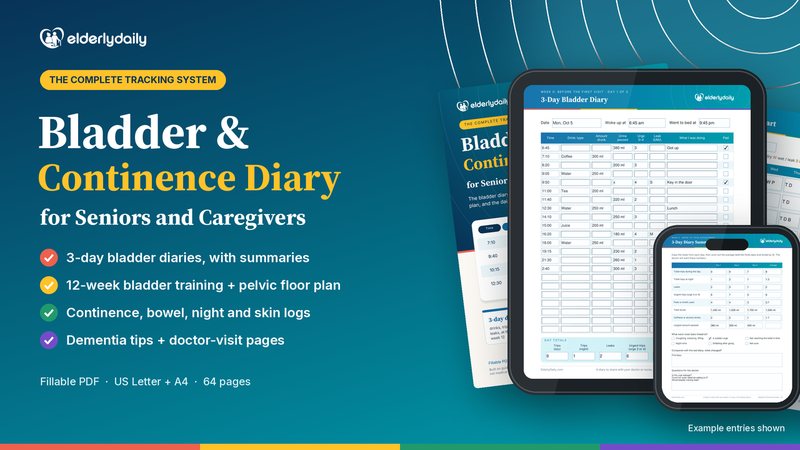
An ElderlyDaily original
Keeping track of bladder leaks?
Bladder & Continence Diary for Seniors and Caregivers
One-off purchase · Instant download · Fillable PDF · 64 pages · US Letter + A4
What a bladder diary is, and why doctors ask for one
A bladder diary is a written record, usually over three days and nights, of what you drink, when you pass urine, how urgent it felt, and when you leak. The NIH’s bladder diary says it will help you and your health care team figure out the causes of your bladder control trouble.
The pattern matters. Leaks that happen when coughing, sneezing or lifting point one way; leaks that come with a sudden, strong urge point another; many trips with small amounts, or a lot of trips at night, tell the doctor something else again. A diary shows that pattern in a way memory usually cannot.
What is inside the diary
- Page 1 — How to keep the diary: the four things to write down, the urgency scale from 0 to 4, and leak sizes.
- Pages 2 to 4 — Day 1, Day 2 and Day 3: the date, when you woke and went to bed, and a line for each drink, toilet trip or leak, with the amount, the urgency, the leak size, what you were doing, and a box to tick for a pad change. Day totals at the bottom.
- Page 5 — 3-day summary: copy each day’s totals and work out the average, then note what most leaks were linked to and your questions.
- Page 6 — When to see a doctor: the warning signs, and questions you might ask at the appointment.
How to keep a 3-day bladder diary
These steps follow the NHS three-day bladder diary and the NIH bladder diary. If your clinic gives you its own diary or asks for different details, follow theirs.
- 1
Keep it for three days and nights in a row
and, if you can, include a busy day and a quiet day, because habits can change.
- 2
Start when you get up on Day 1
and count anything during the night toward the day before, until you get up the next morning.
- 3
Write down every drink
with its type and how much. If you always use the same cup or glass, measure it once and use that amount every time.
- 4
Write down every time you pass urine
and, if your doctor or nurse asks you to, how much. If you forget to measure, still write the time and put an x.
- 5
Give each trip an urgency score
from 0 to 4, using the scale below.
- 6
Mark every leak at the time it happened
however small, with its size and what you were doing.
The urgency scale
This 0 to 4 scale is based on the one in the NHS three-day bladder diary.
| Score | What it means |
|---|---|
| 0 | No urge. You went for another reason, not because you needed to. |
| 1 | A first feeling of filling. You could have waited about an hour. |
| 2 | A first real need to go. You could have waited about 30 minutes. |
| 3 | A strong need to go. You could have waited about 15 minutes. |
| 4 | Urgent. You could not have waited even 5 minutes. |
Recording leaks
The NIH bladder diary records each leak as small, medium or large, whether you felt a strong urge to go, and what you were doing at the time. This diary uses the same idea:
- S, small: a few drops.
- M, medium: wet underwear or pad.
- L, large: soaked through, or wet clothes.
Write what you were doing in a few words: coughing, lifting, getting up from a chair, running water, putting the key in the door. Those notes are often the most useful part of the diary.
When to see a doctor
The NIDDK also advises seeing a health care professional for trouble urinating, loss of bladder control, waking at night to urinate, pelvic pain or leaking urine.
See a health care professional right away if you
Can’t pass urine or can’t empty your bladder, see blood in your urine, have signs of a bladder infection such as painful urination, or urinate eight or more times a day (NIDDK). Do not cut back on drinks to stop leaks, or change a medicine, without talking to your doctor first.
After the diary: what may come next
Your doctor or nurse will use the diary to work out the type of leakage and the next step. The NIDDK lists bladder training, where you go to the toilet on a schedule and slowly lengthen the time between trips, and pelvic floor muscle exercises among the treatments. A physical therapist trained in pelvic floor therapy can help with the exercises.
- How to talk to a doctor about incontinence
- Pelvic floor exercises for seniors
- Managing incontinence at home
- Nighttime incontinence solutions
An ElderlyDaily original
Bladder & Continence Diary for Seniors and Caregivers
One-off purchase · Instant download · Fillable PDF · 64 pages · US Letter + A4
More free printables
See all 30 free printables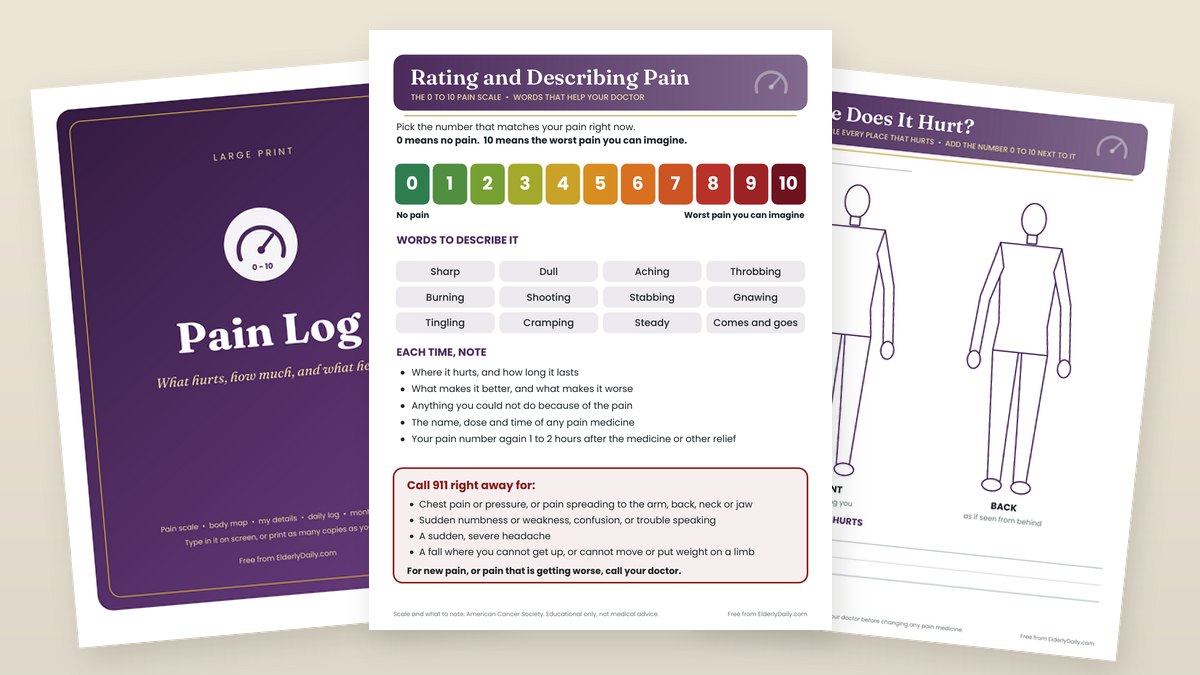 Pain LogA 0 to 10 pain scale, a body map, a daily pain diary and a monthly tracker to show your doctor.Free PDF, no sign-up
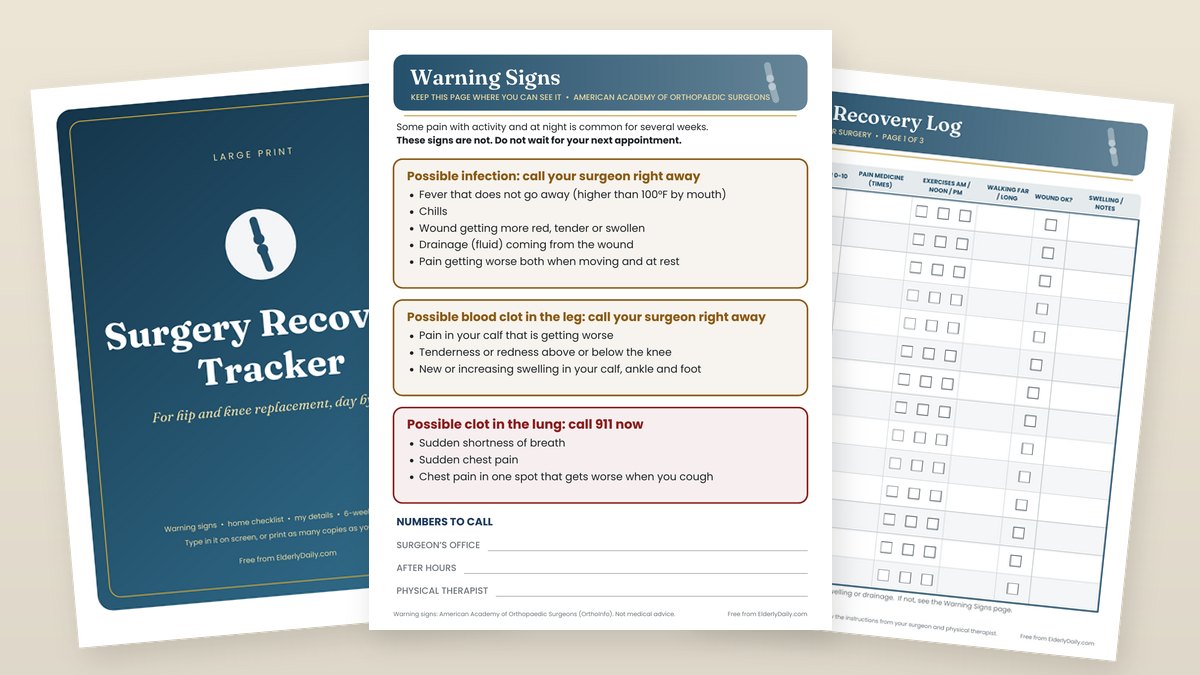 Surgery Recovery TrackerFor knee and hip replacement: warning signs, a home checklist and a 6-week daily log for pain, exercises and walking.Free PDF, no sign-up
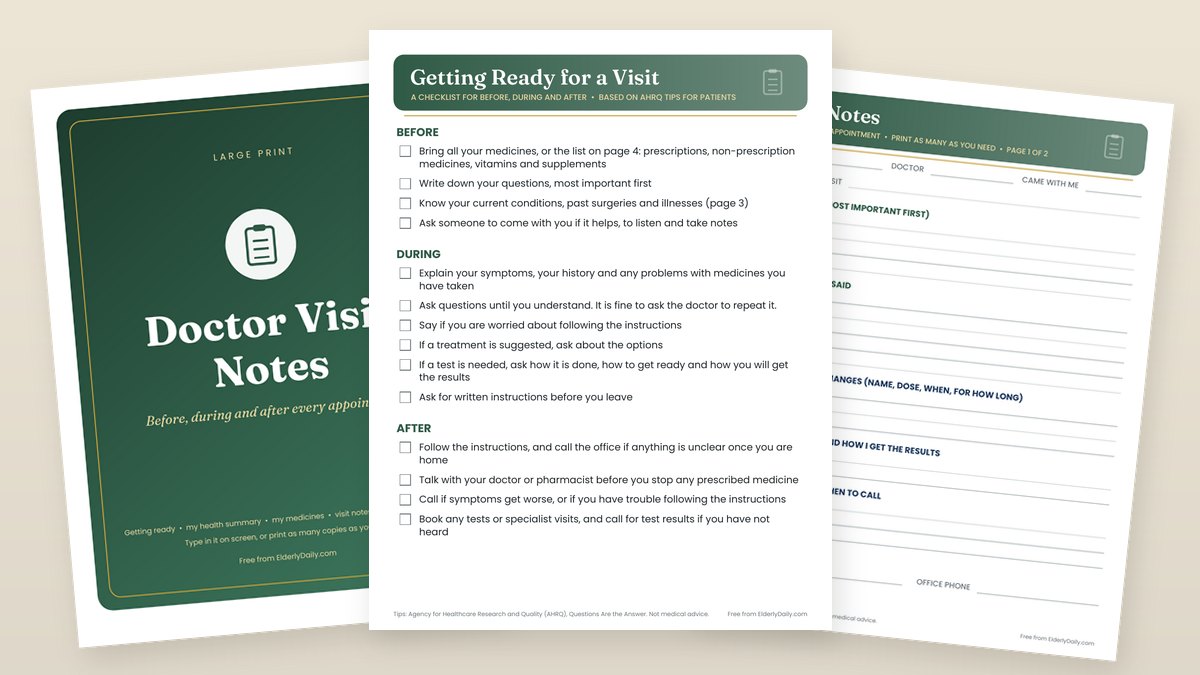 Doctor Visit NotesA before-and-after checklist, health summary, medicine list, visit notes pages and an appointment log.Free PDF, no sign-up
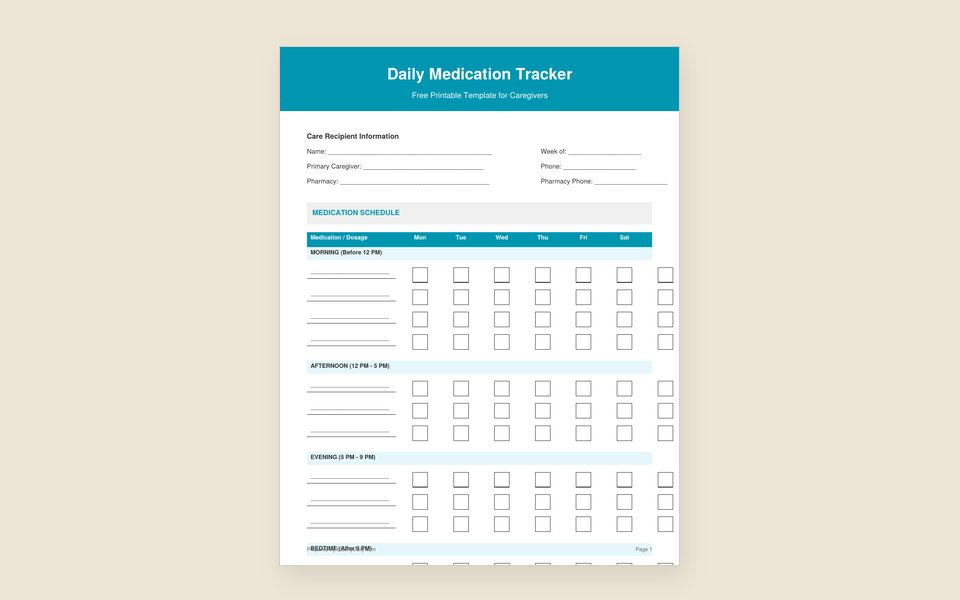 Daily Medication ChartMorning, afternoon and evening checkboxes that help prevent missed or double doses.Free PDF, no sign-up
 Emergency Binder TemplateMedications, doctors, allergies, insurance and safety plans, organized in one binder.Free PDF, no sign-up
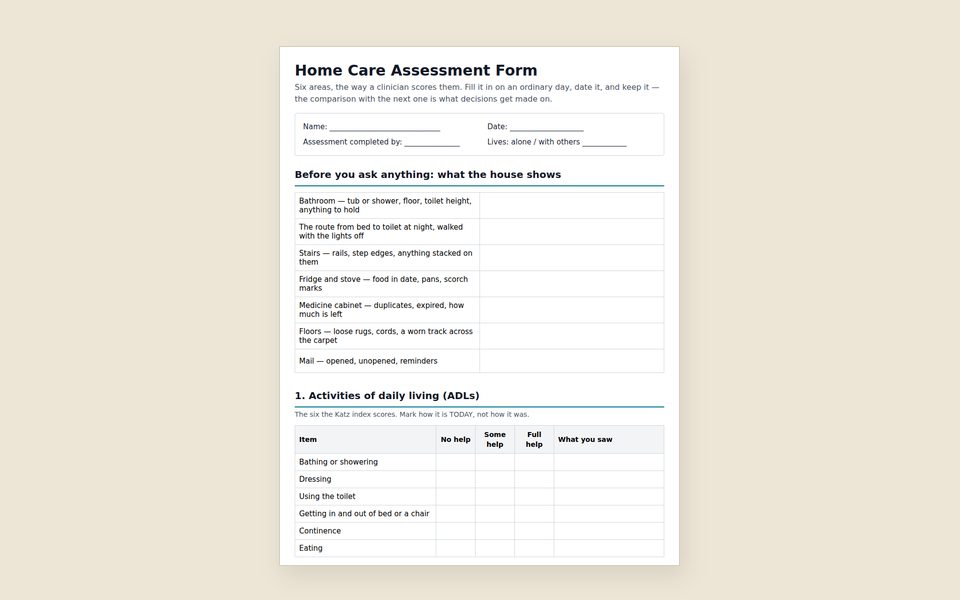 Home Care Assessment FormDaily activities, mobility, memory, medication and home safety on one dated form.Free PDF, no sign-up
Frequently asked questions
Is this bladder diary really free?
Yes. All four PDFs download directly, with no email address, sign-up or payment. Print or fill in as many copies as you like for personal use.
How many days should I keep a bladder diary?
Three days and nights in a row is common, and it is what this diary is laid out for. If your doctor or nurse asks for a different number of days, keep it for as long as they ask.
Do I have to measure my urine?
Only if your doctor or nurse asks you to. If they do, a measuring jug or a collection container that sits in the toilet works; ask your clinic or pharmacy. If you forget to measure, write the time and an x.
Can I fill in the bladder diary on my computer?
Yes. Open the PDF in Chrome, Edge or Adobe Acrobat Reader, click any box and type. Then download or save the file so your entries are kept. You can also print it blank and write by hand.
Can I keep the diary for my mother or father?
Yes. Many family caregivers keep it for a parent. Note what you see and what your parent tells you, and bring the summary page to the appointment.
Should I drink less while keeping the diary?
No. Drink as you normally do, so the diary shows your usual pattern. Do not cut back on drinks to stop leaks unless your doctor has told you to.
