


Tub Bench vs Shower Chair: Which One Does Your Bathroom Need?

Specifications taken from Drive Medical published product data and distributor spec sheets; coverage information from CMS National Coverage Determination 280.1. An occupational therapist can confirm the right choice for a specific bathroom in a single visit.
In this guide
- The short answer, at a glance
- Shower chair vs shower bench: mostly a naming problem
- Shower stool vs shower chair: the third option
- Which one fits your situation
- Drive Medical Tub Transfer Bench (12011KD-1)
- Drive Medical Shower Chair with Back & Arms (RTL12505)
- What none of these products does
- Will Medicare pay for a shower chair or transfer bench?
- The bottom line
- FAQs
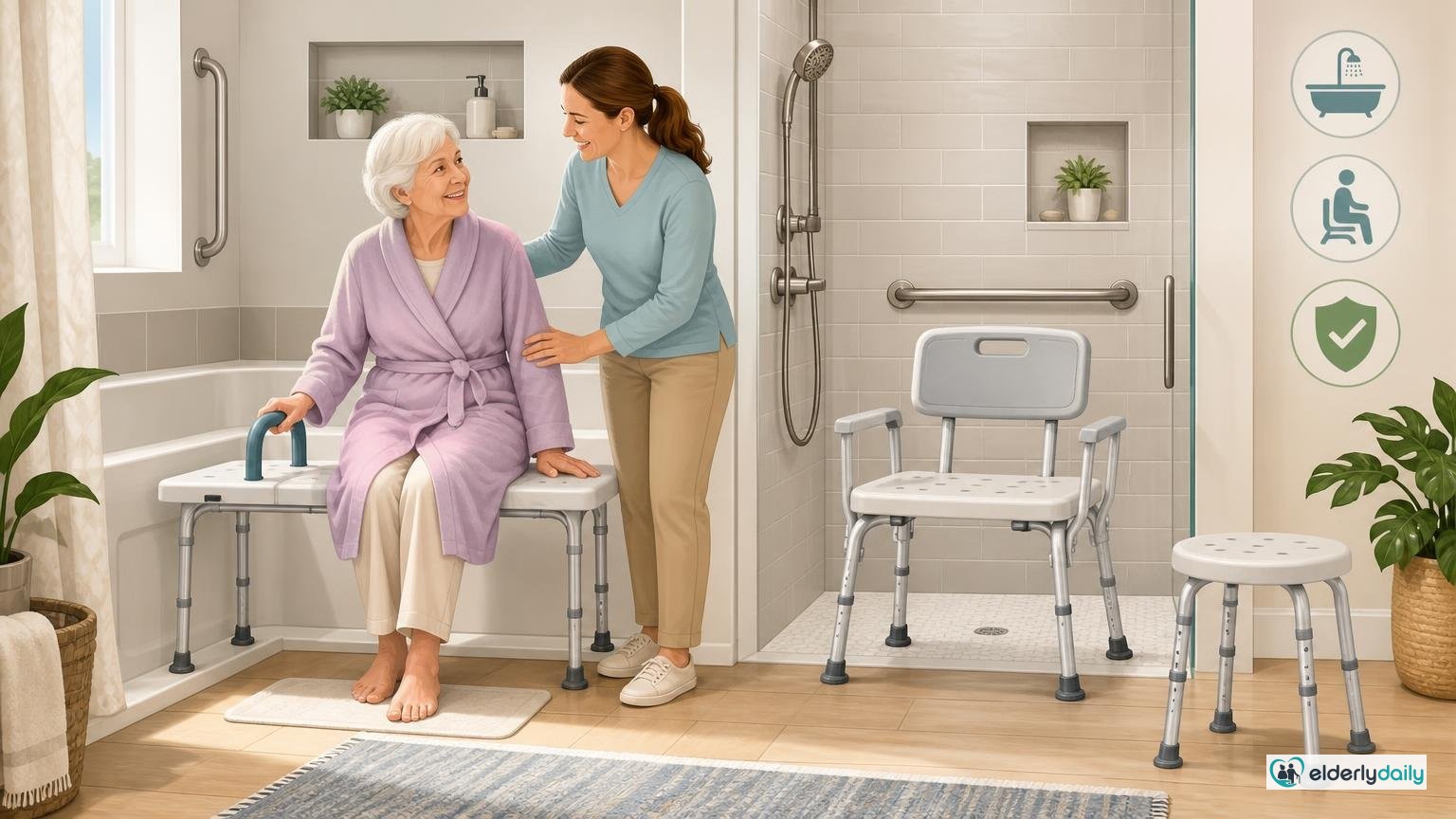
Almost everyone comparing these is solving one of two problems: the person cannot stand once they are in the shower, or they cannot get over the tub wall at all. Those need different equipment, and the wrong choice can make a bathroom less safe rather than more.
Key takeaways
- Choose a tub transfer bench if getting over the tub wall is the hard part — it spans the wall so the person sits down outside and slides across.
- Choose a shower chair if stepping in is fine but standing is not — it fits a walk-in shower or a small stall a bench cannot.
- Both hold 350 lb, so capacity is not the deciding factor — the transfer bench wins on seat size and on removing the step-over; the chair wins on fitting a small bathroom.
- A shower stool is the third option — no back, no arms. Only right for someone with reliable balance and trunk control.
- Neither replaces grab bars, and Medicare pays for none of them — see bathroom fall prevention and grab bar placement.
Quick answer
Is a tub bench or a shower chair better for an elderly person?
It depends on which part of the shower is dangerous. Use a tub transfer bench when stepping over the tub wall is the risk — it removes the step-over entirely and gives a wider seat to shuffle across. Use a shower chair when the person gets in safely but cannot stand for the length of a shower, or when the bathroom is too small for a bench. Neither substitutes for a grab bar. Browse options in our best shower chairs review.
The short answer, at a glance
A shower chair helps someone stay in the shower safely. A tub transfer bench helps them get into it. If you buy the chair when the tub wall was the problem, you have solved nothing — the most dangerous moment still happens unaided.
Both products below are Drive Medical, so what you are reading is the design difference rather than a difference in build quality.
| Tub Transfer Bench (12011KD-1) | Shower Chair (RTL12505) | |
|---|---|---|
| Spans the tub wall | Yes | No |
| Weight capacity | 350 lb | 350 lb |
| Seat width | 26 in | 21.75 in |
| Seat depth | 18.5-19.5 in | 16.5 in |
| Seat height | 17.5-22.5 in, half-inch steps | 16-20.5 in, half-inch steps |
| Footprint | 32 in W x 23 in D | 17 in W x 15.5 in D |
| Frame material | Aluminium | Moulded plastic |
| Feet | Extra-large locking suction cups | Suction-style tips |
| Removable parts | Reversible backrest | Back, legs and arms all remove |
| Product weight | About 10 lb | About 10 lb |
| Fits a walk-in shower | Only with a threshold to span | Yes |
| Curtain seals normally | No | Yes |

Sponsored Pick
12-Inch Suction Shower Grab Bar (Silver)
Tight tub or shower spaces that need a short, unobtrusive grab point
Check PriceShower chair vs shower bench: mostly a naming problem
If you have been comparing a shower chair against a shower bench and finding the specs suspiciously similar, here is why — they are often the same product.
The chair compared here is a good example. Drive Medical sells it as the "Premium Series Shower Chair with Back and Arms", model RTL12505. On Amazon the same product is listed as a "Bathroom Bench with Back & Arms". One SKU, two categories, depending on who is writing the listing.
As a rough working rule: a shower chair usually has a back and arms; a shower bench or bath bench is usually wider and often backless; a shower stool has neither back nor arms; and a tub transfer bench is the one with a genuinely different job, because it is longer than the tub is wide. Only that last distinction reliably changes which product keeps someone safe. The rest is largely marketing language.
Shower stool vs shower chair: the third option
A shower stool is the stripped-back version — a seat and legs, no back, no arms. Usually the cheapest and smallest of the three.
A stool is enough when the person has good trunk control and balance, gets in and out unaided, and simply cannot stand for the length of a shower. It fits a corner and lifts out easily.
A stool is the wrong choice when the person leans back when tired, needs to push down on something to stand, has had a fall, or has any cognitive change. Someone who forgets there is no backrest and leans anyway is at real risk of going over backwards.
The practical test: ask them to sit on a dining chair and stand up without using the arms. If they cannot, they will need armrests in a wet room too.
Which one fits your situation
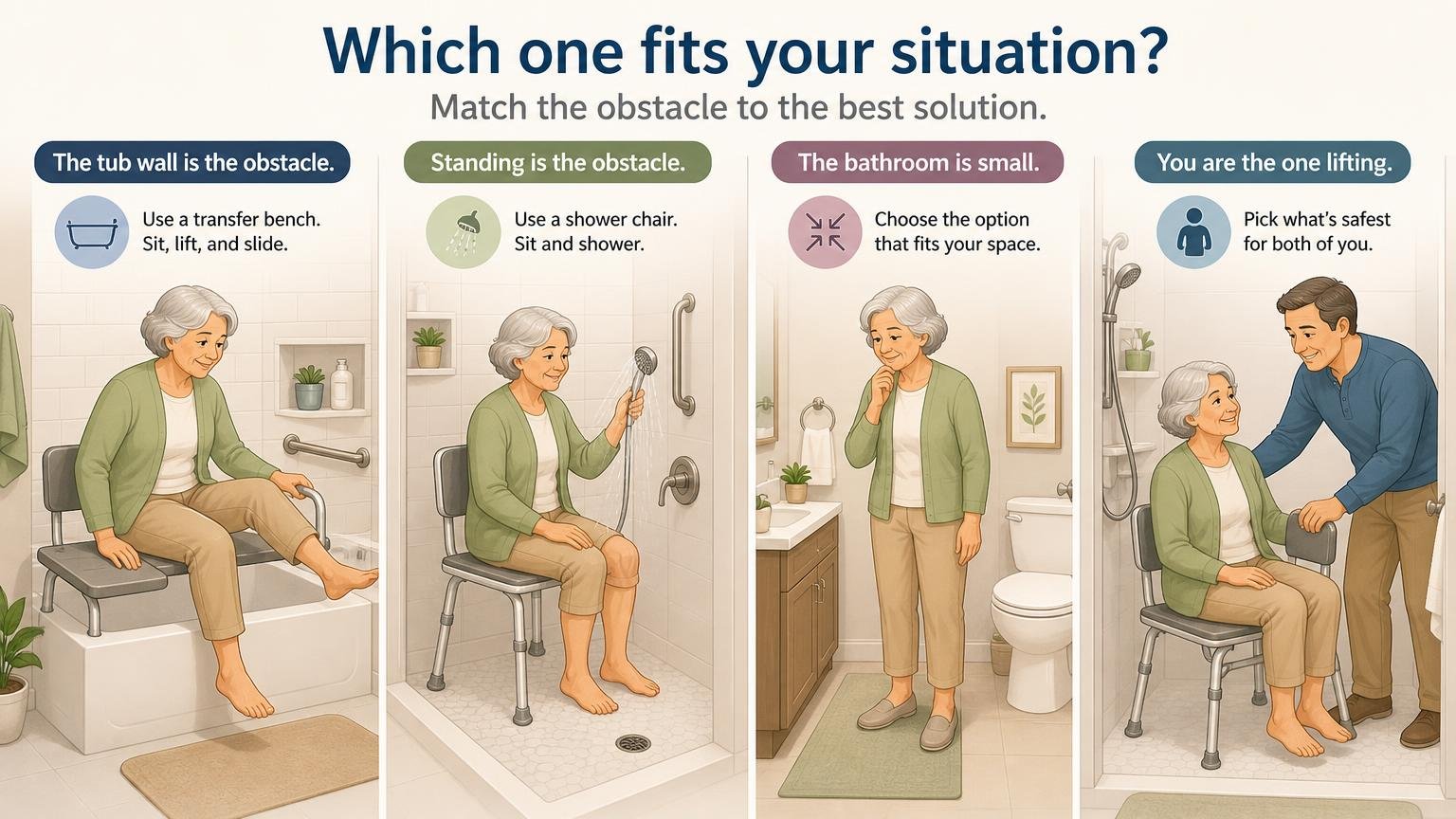
The tub wall is the obstacle. Your mother's bathroom has a standard 15 to 16 inch tub wall. She walks with a cane, but lifting a leg over means standing on one foot on wet enamel with nothing solid to hold. Choose the transfer bench — she sits on the outboard half, lifts her legs over one at a time while seated, and slides across.
Standing is the obstacle. Your father has a walk-in shower with no lip and no trouble getting in, but cannot stand for the ten minutes a shower takes and has started bracing against the tiled wall. Choose the shower chair — it fits a small stall, and its 21.75-inch seat is generous enough to sit on comfortably for the whole shower.
The bathroom is small. A transfer bench needs roughly 32 inches of width plus clear floor outside the tub. Where a toilet or vanity sits tight against the tub, the bench either will not fit or will not leave room to sit down on it. Measure first — this is the most common reason a transfer bench gets returned.
You are the one lifting. A transfer bench also takes load off the caregiver. Guiding someone who is already seated and sliding is far less physical than steadying them over a tub wall, and caregiver back injury is one of the commonest reasons home bathing stops working. If you are doing the lifting, that counts as a reason to choose the bench.
Recovering from a hip or knee replacement. Surgeons often restrict how far the hip may bend and how much weight the leg may take for weeks afterwards, and lifting a leg over a tub wall does both. A transfer bench is standard equipment during that recovery, and the same applies to anyone transferring from a wheelchair. Ask the discharge team what the specific restrictions are before buying.
Two people share the bathroom. The shower chair's back, legs and arms all come off tool-free and the whole thing weighs about 10 lb, so it lifts out between uses. A transfer bench, once positioned, is meant to stay put.
Drive Medical Tub Transfer Bench (12011KD-1)
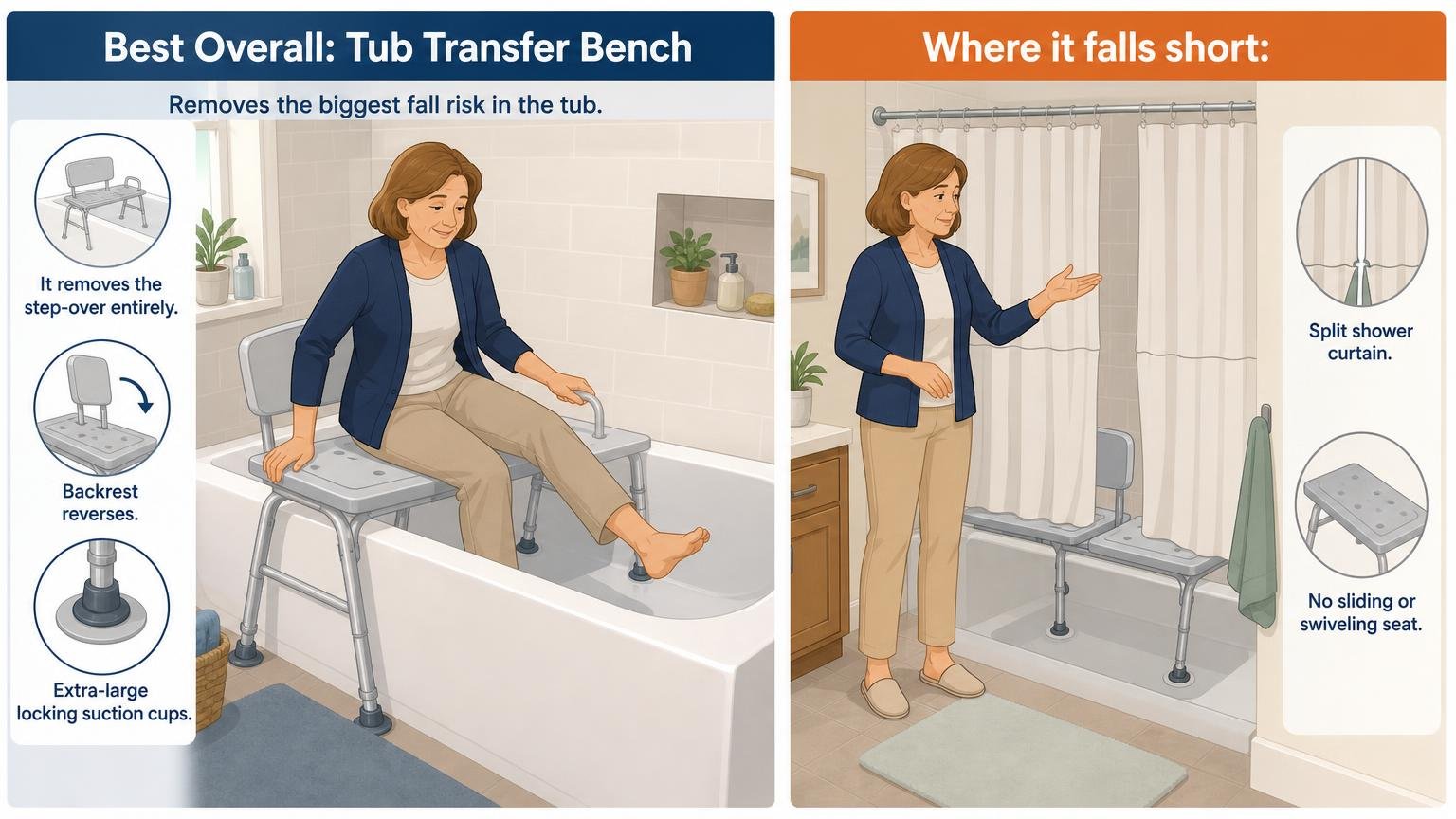
A bench longer than a standard tub is wide, on an A-frame structure — two legs inside the tub, two outside. It is the Best Overall pick in our transfer bench roundup, where four alternatives with sliding and swivelling seats are compared.
It removes the step-over entirely. The person sits, then lifts each leg over the wall while fully supported. This is the single biggest fall risk in a tub bathroom and the one thing a shower chair cannot address.
Extra-large locking suction cups hold the legs against the tub floor, and the backrest reverses so the bench works for a left or right-handed approach depending on which side of the tub is accessible.
Dual-column legs adjust in half-inch increments — necessary, because the tub floor sits lower than the bathroom floor and the inside and outside legs must be set differently for the seat to sit level. Pinch-free levers on the adjustment pins matter for arthritic hands.
Where it falls short: the seat is fixed, so the person shuffles across rather than sliding — harder with weak arms or a painful hip. It is also large, needs floor space outside the tub, and a shower curtain will not seal around it, so you will want a split shower curtain — sold specifically for transfer benches, with an overlapping slit the frame passes through — or a splash guard plus a hand-held shower head aimed down. Budget for one at the same time; a standard curtain will not seal around the frame.
Drive Medical Shower Chair with Back & Arms (RTL12505)
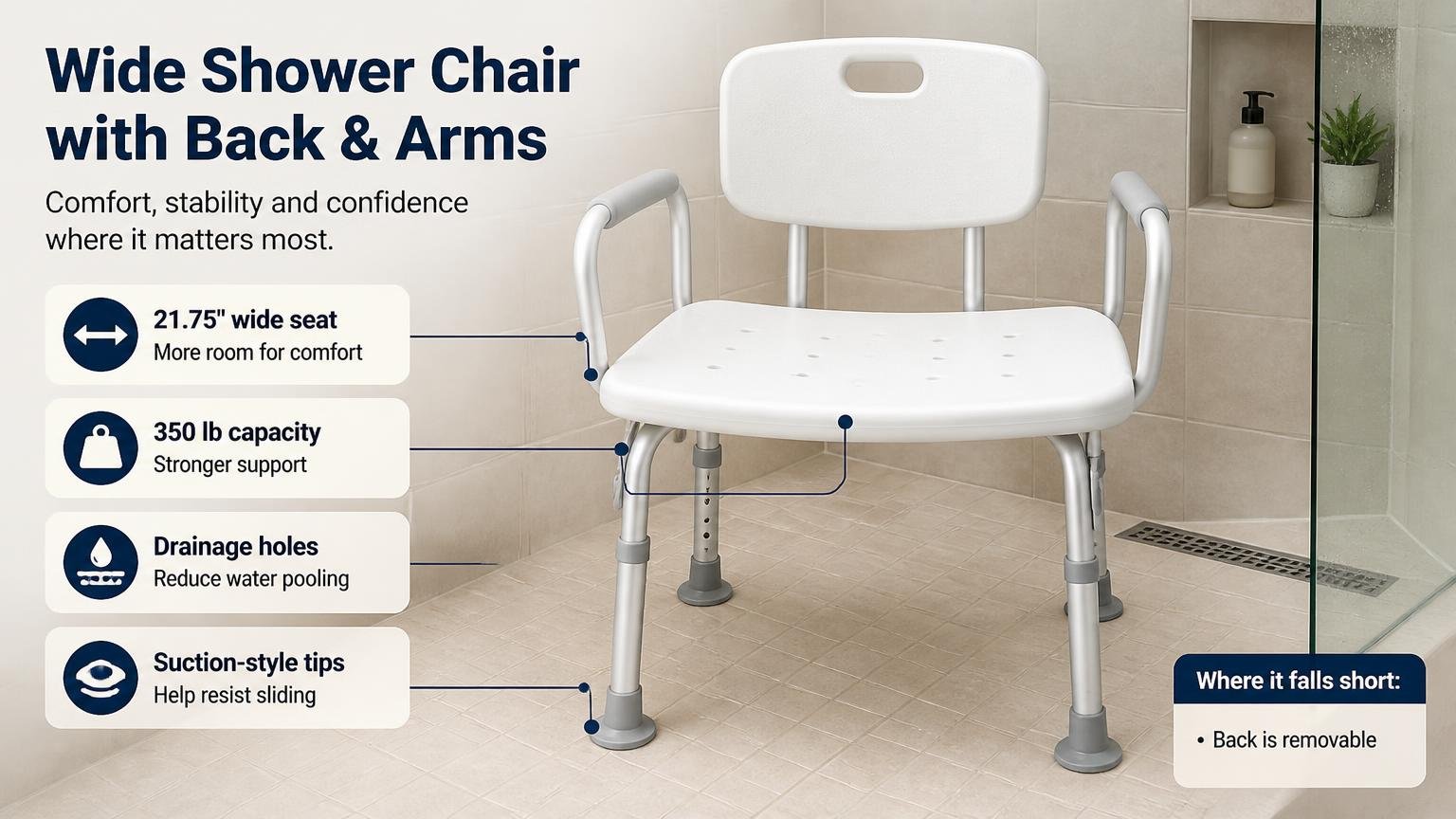
A four-leg moulded-plastic shower chair with a removable back and arms, sold on Amazon as the Bathroom Bench with Back & Arms.
The seat is unusually wide for a shower chair at 21.75 inches, with a 350 lb capacity — more room and more margin than most chairs in this price range, and a real advantage for a broader user.
Suction-style tips on the legs help resist sliding on wet tile, and drainage holes stop water pooling under the user.
The back, legs and arms all remove tool-free, so a wheelchair user can transfer sideways onto the seat without lifting over an arm, and the whole chair packs down for storage or travel. There is also a height indicator on the legs, which makes it much easier to set both sides to the same height.
Seat height adjusts 16 to 20.5 inches in half-inch steps. Set it so the feet rest flat with knees near 90 degrees — a seat that is too low is much harder to rise from.
Where it falls short: the plastic seat is not padded, it is bulkier than a compact stool, and it does nothing to help anyone get into a tub.
What none of these products does
None substitutes for grab bars. A seat helps someone stay down safely; a grab bar helps them get up and stay upright. Most bathrooms with a shower chair still need at least one properly anchored vertical or angled bar, fixed into studs or with correct hollow-wall fixings — never a suction-mounted bar as primary support. See grab bar placement.
None prevents a fall on the way in or out. The floor outside the tub is wet after every use.
And some people do not need a seat at all. If someone is steady on their feet and only wants a little more confidence, a properly anchored grab bar, a non-slip mat and a hand-held shower head may be enough — and they take up no floor space. A seat that is not needed is one more object to manoeuvre around in a small wet room. Buy for the difficulty that actually exists.
Check the setup before every use, and the feet every month. Set the legs so the seat sits level and all four feet are flat — on a transfer bench the inside and outside legs sit at different heights by design. Confirm every push-button has clicked fully through its hole; a pin that is only half engaged can hold weight until it suddenly does not. Then inspect the rubber tips monthly for wear, splitting, looseness or mould, and replace them once the tread is gone. Worn tips are the commonest reason a stable seat starts sliding, and replacements cost very little.
None works if it is set up wrong. Height, position, and the choice between them are exactly what an occupational therapist assesses on a home visit. If a fall has already happened, or a hospital discharge is coming, ask for an OT assessment before buying — it is often arranged through the discharge plan and it beats guessing.
Will Medicare pay for a shower chair or transfer bench?
No — and this is settled national policy, not a plan-by-plan judgement call.
Medicare's Durable Medical Equipment Reference List (National Coverage Determination 280.1, version 4, effective 9 June 2025) sets the coverage status of specific equipment categories. Its entry for Bathtub Seats — the category covering shower chairs, bath benches and transfer benches — instructs contractors to deny the claim as a comfort or convenience item and hygienic equipment, not primarily medical in nature, under section 1861(n) of the Social Security Act.
The reasoning is consistent across the list: Medicare's definition of durable medical equipment requires that an item be primarily and customarily used to serve a medical purpose, and generally not useful to a person in the absence of illness or injury. A seat in a bathroom fails that second test, because anyone might use one.
What works instead: FSA and HSA funds, which both products are commonly eligible for and which is the route most families use — a letter of medical necessity from a doctor strengthens the claim if your administrator asks. Some Medicare Advantage plans carry a supplemental over-the-counter or home-safety benefit; check yours specifically. Medicaid rules vary by state, and some home-and-community-based waivers do cover bath safety equipment. Many Area Agencies on Aging run home-modification or equipment-loan programmes.
Note that a transfer bench carries HCPCS billing code E0247. A code existing is not the same as Medicare paying — E0247 exists so the item can be billed to payers that do cover it.
| Equipment | Medicare status |
|---|---|
| Bathtub seats (shower chairs, benches) | Deny - comfort/convenience, hygienic |
| Bathtub lifts | Deny - convenience item |
| Grab bars | Deny - self-help device |
| Raised toilet seats | Deny - convenience, hygienic |
| Commodes | Covered if confined to bed or room |
| Canes, walkers, wheelchairs | Covered if mobility criteria are met |
The bottom line
If the tub wall is the problem, buy the tub transfer bench. The 12011KD-1 is the only one of these that addresses getting into the tub, and it does it with a wider seat and a backrest. If you want alternatives — sliding seats, swivel seats, a safety belt — see our transfer bench roundup. That is the fall risk worth spending on.
If standing is the problem, buy the shower chair. The RTL12505 is far smaller, fits a stall a bench cannot, carries 350 lb on a generous 21.75-inch seat, and strips down tool-free for storage.
If you are unsure which problem you have, watch one shower from the doorway. The moment where they hesitate, reach for a wall, or take longer than expected is the moment the equipment has to solve. Buy for that moment.
Whichever you choose, price in a grab bar at the same time — and budget for it out of pocket, because Medicare will not cover that either. None of these seats does a grab bar's job, and the two together are worth considerably more than either alone.
Frequently asked questions
Do I need a special shower curtain for a tub transfer bench?
Usually yes. Because the frame crosses the curtain line, a standard curtain leaves a gap and water runs onto the bathroom floor. A split shower curtain made for transfer benches has an overlapping slit that the frame passes through. A splash guard, or a hand-held shower head aimed downward, are the alternatives.
How do I clean and maintain a shower chair or transfer bench?
Wipe the frame and seat with mild soap and water, and rinse the drainage holes so they do not clog. Once a month, check the rubber tips for wear, splitting, looseness or mould, and check that every adjustment button still clicks fully home. Replace worn tips rather than the whole chair — they are inexpensive, and they are what stops the seat sliding.
Can you use a tub transfer bench in a walk-in shower?
Only if there is a threshold for it to span and clear floor outside. In a fully level walk-in there is nothing to transfer over, and a shower chair fits better.
Do I need to bolt any of these down?
No. All are freestanding and none should be drilled or modified. If a seat feels unstable, the cause is height adjustment, an uneven floor, or the wrong product — not a missing fixing.
Will a shower curtain still work with a transfer bench?
Not well; the bench crosses the curtain line. A splash guard, a magnetic-edge curtain, or a hand-held shower head are the usual fixes.
Is a shower stool safe for an elderly parent?
Only if they have reliable balance and trunk control and can stand without pushing off armrests. Anyone who leans back, tires quickly, or has cognitive changes should have a back and arms.
What weight capacity do I actually need?
Take the person\'s weight and leave real margin — people drop onto and push off a seat rather than lowering gently. Within about 50 lb of the rating, size up.
