
Printable Surgery Recovery Tracker for Hip and Knee Replacement (PDF)

Educational only, not medical advice. Warning signs and home preparation follow the American Academy of Orthopaedic Surgeons. Always follow the instructions from your own surgeon and physical therapist.
The first six weeks after a knee or hip replacement are full of instructions, exercises and appointments. This free printable tracker keeps them in one place: the warning signs to watch for, a checklist to get the home ready, your surgeon and therapist details, and a daily log for pain, exercises, walking and the wound. Type into it on screen, or print it.
Key takeaways
- Free printable recovery tracker for knee and hip replacement, 7 pages, with no sign-up.
- A warning signs page (infection, blood clot, clot in the lung) with space for your surgeon’s numbers.
- A get-the-home-ready checklist and a My Details page for appointments and the exercises your physical therapist gives you.
- A 6-week daily log: pain, pain medicine, exercises morning, noon and evening, walking and a wound check.
- Fill it in on screen, with tick boxes you can click, or print it. US Letter and A4, color and black and white.
Quick answer
Where can I get a free printable recovery tracker for knee or hip replacement?
Download it free here: the printable surgery recovery tracker (PDF) has the warning signs to watch for, a home checklist, a page for your surgeon, therapist and exercises, and a 42-day daily log for pain, exercises, walking and the wound, all in large print. You can type and tick on screen or print it. There are black-and-white and A4 editions too. No email or sign-up is needed.
Download the free recovery tracker
All four files have the same seven pages. Pick the paper size you use: US Letter in the US and Canada, A4 almost everywhere else.
- Surgery Recovery Tracker, color, US Letter (PDF, 7 pages)
- Surgery Recovery Tracker, black and white, US Letter (PDF, 7 pages)
- Surgery Recovery Tracker, color, A4 (PDF, 7 pages)
- Surgery Recovery Tracker, black and white, A4 (PDF, 7 pages)
Print it before surgery, fill in the home checklist and your details, and keep the warning signs page on the fridge.
Filling it in on screen
Open the PDF in Chrome, Edge or Adobe Acrobat Reader. Click any box to type, or click a tick box to check it. When you are done, download or save the file so your entries are kept, or print it.
Bonus: Health Tracker Pack
An ElderlyDaily original
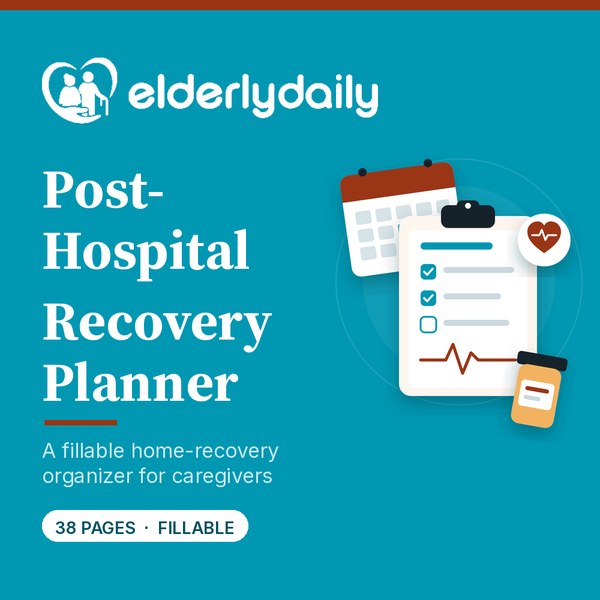
Bringing someone home from the hospital?
Post-Hospital Recovery Planner
- Discharge snapshot: care team, who to call and when, insurance and documents
- Medication reconciliation, a master list, a daily record and refills
- Daily recovery log, vitals log, and a symptom and pain log
One-off purchase. Instant download.
Fillable PDF · 38 pages · US Letter + A4

Sponsored Pick
Tracki Mini GPS Tracker
Early-to-mid dementia, where the person will carry something but refuses to wear a device
Check PriceWhat is inside the tracker
- Page 1 — Cover.
- Page 2 — Warning signs: possible infection, possible blood clot in the leg, and possible clot in the lung, with the numbers to call.
- Page 3 — Get the home ready: a tick list for the bathroom, stairs and floors, sitting and reaching, and getting around.
- Page 4 — My details: surgery, surgeon, after-hours number, physical therapist, blood thinner, follow-up appointments and your exercises.
- Pages 5 to 7 — Daily recovery log: days 1 to 42, with pain, pain medicine, exercises, walking, a wound check and notes.
Warning signs after knee or hip replacement
The American Academy of Orthopaedic Surgeons lists these signs to report straight away. Some pain with activity and at night is common for several weeks; these are different.
Possible infection — call your surgeon right away: a fever that does not go away (higher than 100°F by mouth), chills, a wound that is getting more red, tender or swollen, drainage from the wound, or pain that is getting worse both when moving and at rest.
Possible blood clot in the leg — call your surgeon right away: calf pain that is getting worse, tenderness or redness above or below the knee, or new or increasing swelling in the calf, ankle and foot.
Possible clot in the lung: call 911
Sudden shortness of breath, sudden chest pain, or chest pain in one spot that gets worse when you cough can mean a blood clot has traveled to the lung. Call 911 straight away.
Getting the home ready before surgery
The AAOS warns that a fall in the first few weeks after surgery can damage the new joint and may mean more surgery. The home checklist in the tracker covers the changes it recommends, and a few that make the first weeks easier:
- Safety bars or a secure handrail in the shower or bath, and secure handrails on the stairs
- A stable chair with arms and a firm back, and a footstool to raise the leg
- A raised toilet seat with arms if your toilet is low
- Loose rugs and cords taken up
- A bed on the main floor if stairs will be hard at first
Our post-surgery home equipment checklist goes through the equipment in more detail.
Using the daily recovery log
- Pain 0 to 10 — the same number every day makes it easy to see whether you are improving.
- Pain medicine — write the times you take it, so nothing is doubled or missed.
- Exercises — tick morning, noon and evening. Write the exercises your physical therapist gives you on the My Details page and do only those.
- Walking — how far or how long. The AAOS describes a graduated walking program, starting indoors.
- Wound OK? — tick it when the wound is dry with no new redness, swelling or drainage. If not, check the warning signs page.
Bring the tracker to every follow-up appointment. It answers most of the questions your surgeon and therapist will ask.
More free printables
See all 24 free printables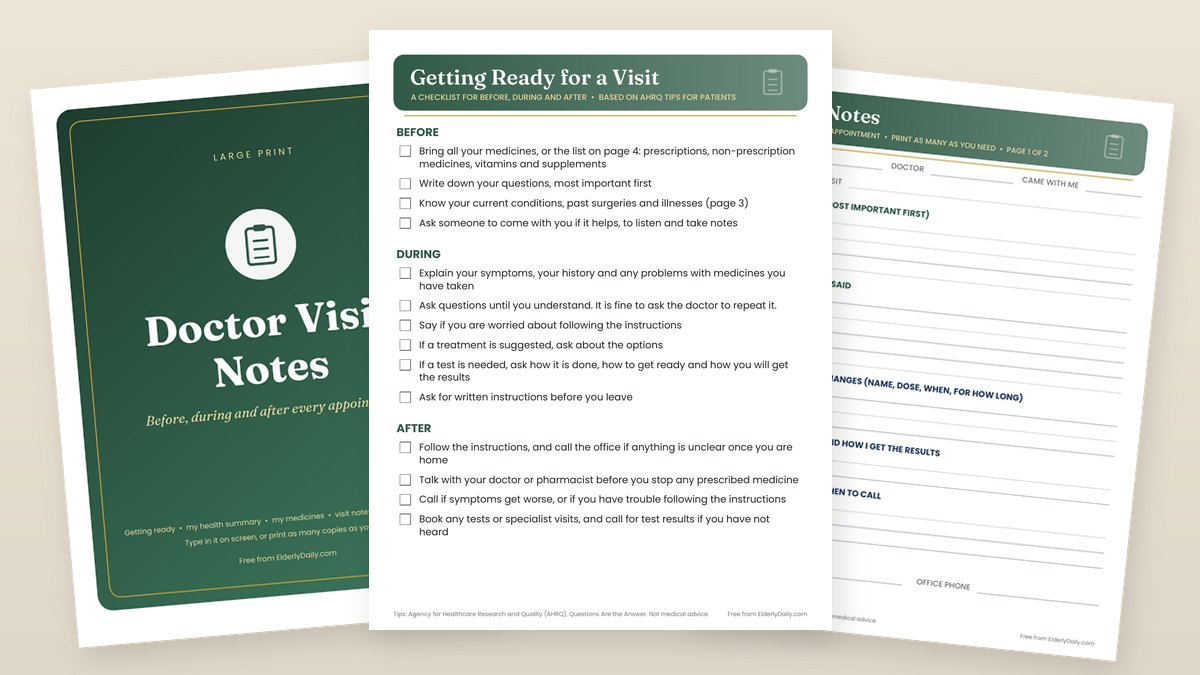 Doctor Visit NotesA before-and-after checklist, health summary, medicine list, visit notes pages and an appointment log.Free PDF, no sign-up
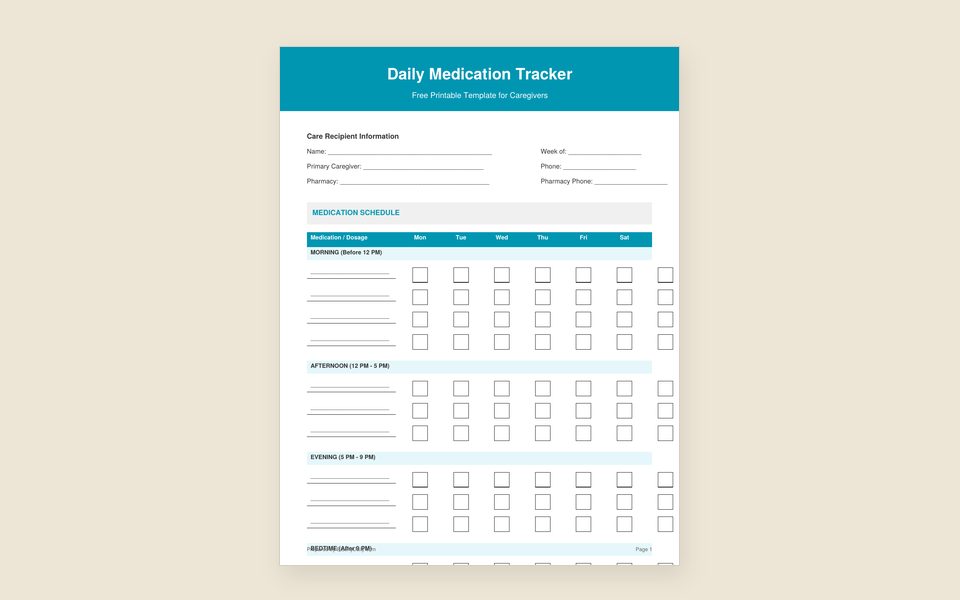 Daily Medication ChartMorning, afternoon and evening checkboxes that help prevent missed or double doses.Free PDF, no sign-up
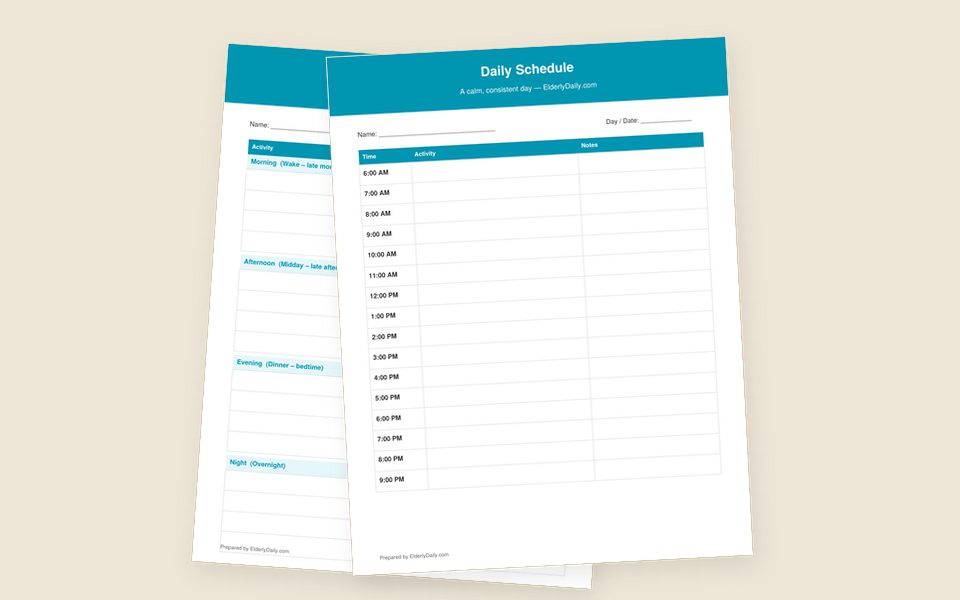 Daily Schedule TemplateBlank hourly and time-block layouts, plus a sample daily routine to copy.Free PDF, no sign-up
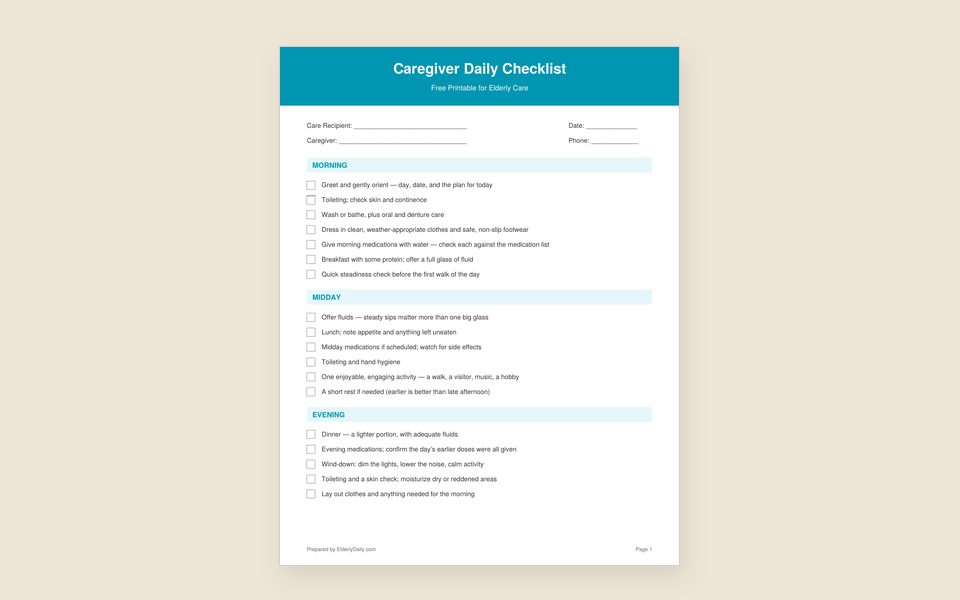 Caregiver Daily ChecklistMedication, meals, hygiene, mobility and safety tasks, laid out by time of day.Free PDF, no sign-up
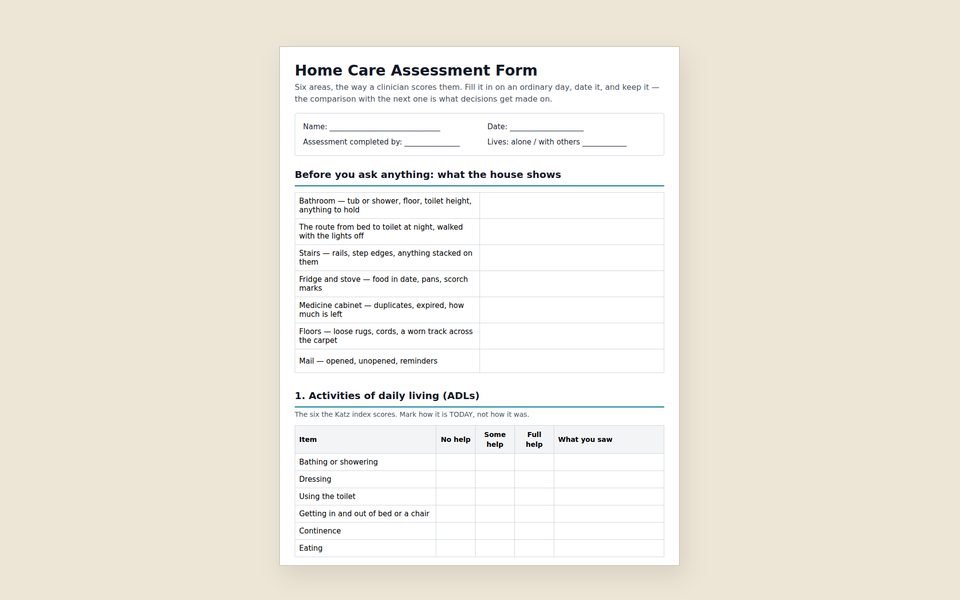 Home Care Assessment FormDaily activities, mobility, memory, medication and home safety on one dated form.Free PDF, no sign-up
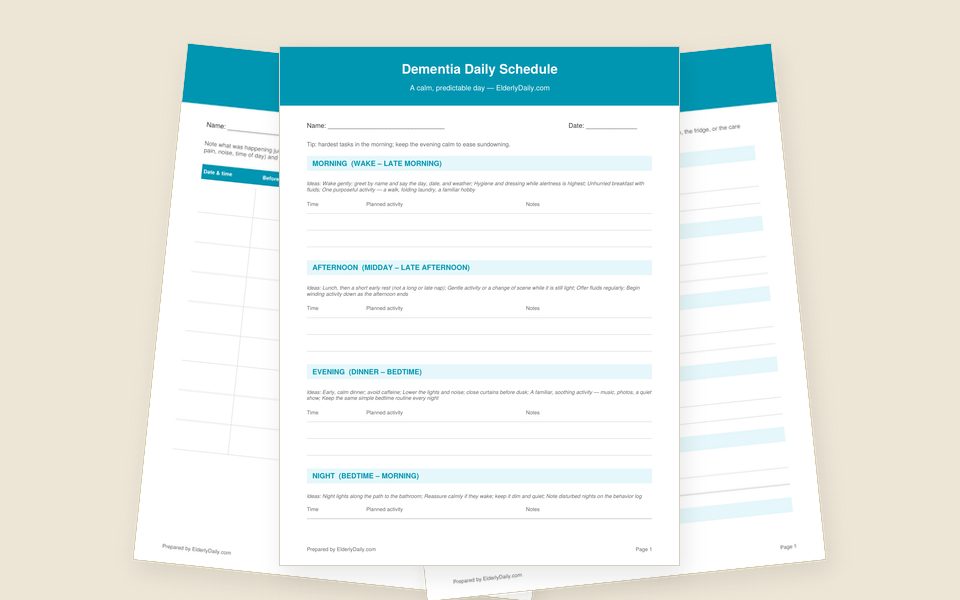 Dementia Care ToolkitA daily schedule, a sundowning and behavior log, and an All About Me profile.Free PDF, no sign-up
Frequently asked questions
Is this recovery tracker really free?
Yes. All four PDFs download directly, with no email address, sign-up or payment. Print or fill in as many copies as you like for personal use.
Does it work for both hip and knee replacement?
Yes. The warning signs, home checklist and daily log apply to both. Write which joint and which side on the My Details page, and add the exercises and precautions your own surgeon and therapist give you.
What are the warning signs after a knee replacement?
The American Academy of Orthopaedic Surgeons lists signs of infection (a fever that does not go away, chills, a wound that is more red, tender or swollen, drainage, or pain that is getting worse) and signs of a blood clot (worsening calf pain, tenderness or redness around the knee, or new swelling in the calf, ankle and foot). Call your surgeon right away. Sudden shortness of breath or chest pain needs 911.
Does the tracker tell me which exercises to do?
No. Exercises after joint replacement depend on your surgery and your progress, so the tracker gives you space to write down the ones your physical therapist prescribes and tick them off each day.
Can a family caregiver use it?
Yes. Many families keep the tracker for the first six weeks and bring it to appointments. The warning signs page is the most important one to keep where everyone can see it.
