
Can Medicaid Pay a Family Caregiver? How to Get Paid to Care for a Parent (2026)

Checked against the federal statute (42 U.S.C. § 1396p) and state Medicaid agency guidance, October 2026. Not legal advice.
Yes, through at least one program in every state that answered KFF’s survey. Here is how families actually get paid, who can be hired, and what to do if your parent pays you from their own money.
Key takeaways
- Every state that answered KFF’s 2024 survey pays family caregivers through at least one Medicaid home care program
- The usual route is self-directed care: your parent qualifies for a Medicaid waiver and hires you, and a financial management service runs payroll
- Adult children and other relatives can be paid through waivers in every responding state. Spouses can be paid through waivers in 40 states
- Structured family caregiving, in 10 states, pays a family caregiver part of a daily rate through an agency
- If your parent pays you from their own money, use a written caregiver agreement made before the care starts, at a fair rate, with a log of hours, or Medicaid may treat the pay as a gift
- Medicaid waiver pay can be tax-free if your parent lives with you
Quick answer
Can Medicaid pay a family member to be a caregiver?
Yes. Every state that responded to KFF’s 2024 survey pays family caregivers through at least one Medicaid home care program. The most common route is self-directed care: your parent qualifies for a Medicaid home care waiver and hires you as their worker, and a financial management service pays you. Adult children and other relatives can be paid through waivers in every responding state, and spouses in 40. Your parent must qualify for Medicaid and need a nursing-home level of care.
Three ways a family caregiver gets paid
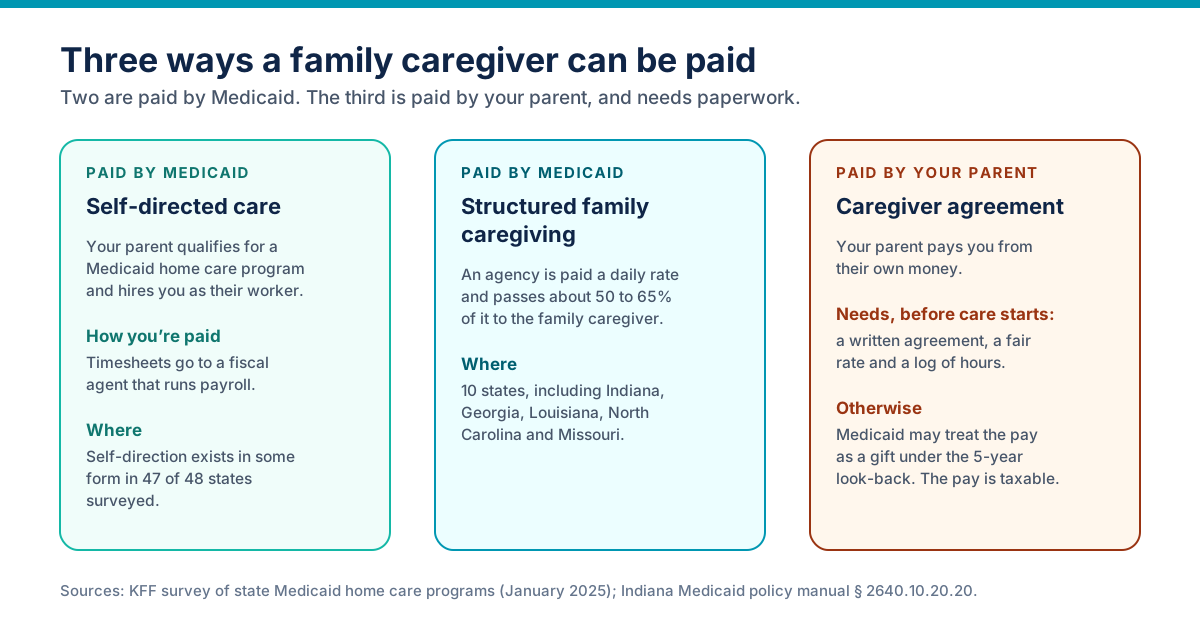
There are two ways for Medicaid to pay you, and one way for your parent to pay you themselves. Which fits depends on whether your parent qualifies for Medicaid long-term care, and on the state (KFF).
An ElderlyDaily original
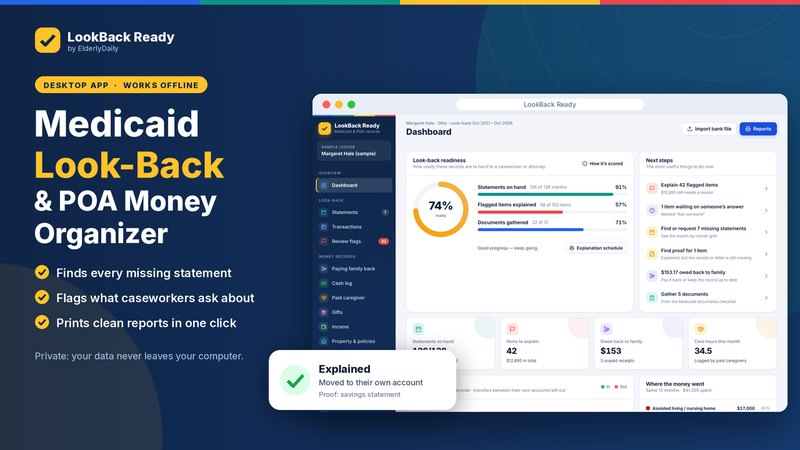
Getting a parent’s records ready for the look-back?
LookBack Ready: Medicaid Look-Back & POA Money Organizer
One-off purchase · Instant download · Desktop app · Windows & Mac · works offline

Sponsored Pick
CallToU Wireless Caregiver Pager (2 Buttons, 2 Receivers, 500+ ft)
Households where the caregiver moves between rooms or floors and wants call buttons in more than one spot
Check PriceSelf-directed care: your parent hires you
In self-directed programs, the person getting care, or their representative, recruits, hires and supervises their own workers, and in some programs also manages a budget (Medicaid.gov). In KFF’s survey, 47 of 48 states allow it in some form, and 38 let the person set the caregiver’s pay rate.
A financial management service, often called a fiscal agent, handles the payroll side: timesheets, paying you, and tax paperwork.
Your parent has to qualify first: a care-needs assessment, the financial rules and, in some states, a waiting list. See what is a Medicaid waiver. You will usually have to enroll as the worker too, which can include a background check and training, depending on the state.
Who can be paid
KFF’s survey of state Medicaid programs shows who can be paid. States can add their own limits, such as a cap on the hours a relative can be paid for, so ask the program for its rules before you plan around the income.
| Caregiver | Can Medicaid pay them? |
|---|---|
| An adult son or daughter, another relative, or a friend | Yes, through waivers in every state that answered. 22 states also pay them through regular Medicaid personal care |
| A spouse (a “legally responsible” relative) | Through waivers in 40 states, but through regular Medicaid in only 6 |
| A relative who lives with your parent | Yes, and Medicaid waiver pay can then be tax-free. See Medicaid waiver payments |
Structured family caregiving
Ten states use a model called structured family caregiving: Connecticut, Georgia, Indiana, Louisiana, Maryland, Missouri, New Mexico, North Carolina, North Dakota and South Dakota. An agency is paid a daily rate for care given by a family caregiver and passes on about 50 to 65% of it, which KFF found came to around $40 to $50 a day (KFF).
If your parent pays you: the caregiver agreement
If your parent doesn’t qualify for Medicaid, they can pay you from their own money. The risk comes later: if they apply for long-term care Medicaid within five years, the state will look at those payments, and pay to family without proper paperwork can be treated as a gift under the look-back.
Indiana’s rules show what states look for (Indiana FSSA):
- a written agreement, signed by both sides and notarized when it is made, listing the services, the pay rate and who gives the care
- pay at a fair market rate for the services, how often they are given and for how long
- no back pay: lump sums for care already given don’t count as payment for services, and lump sums for future care can cause a penalty
- a detailed log of the care given. Being on call doesn’t count
Other states set their own rules, so check yours before you start, and have an elder law attorney draft the agreement.
Pay from your parent is taxable income to you. If you count as their household employee and they pay you $3,000 or more in 2026, they generally owe Social Security and Medicare taxes on it (IRS Publication 926).
An ElderlyDaily original
LookBack Ready: Medicaid Look-Back & POA Money Organizer
One-off purchase · Instant download · Desktop app · Windows & Mac · works offline
Other help for family caregivers
Even where pay isn’t possible, Medicaid home care programs often support family caregivers in other ways: in KFF’s survey, 47 states offered respite care so caregivers can take a break, 33 offered caregiver training, and 23 offered counseling or support groups (KFF). For looking after yourself along the way, see preventing caregiver burnout.
Frequently asked questions
How much does Medicaid pay family caregivers?
It depends on the state and the program. In self-directed programs the state sets a rate or a budget, and 38 states let the person set the caregiver’s pay within it. In structured family caregiving, KFF found caregivers received around $40 to $50 a day.
Can a spouse get paid by Medicaid to be a caregiver?
In many states, yes. Spouses are legally responsible relatives, and 40 states pay them through waiver programs, though only 6 do through regular Medicaid. States can add limits, such as on hours.
Can I get paid to care for my mom if she doesn’t live with me?
Yes, in many programs. But the tax-free treatment of Medicaid waiver pay only applies when she lives in your home.
Can I get paid for care I have already given?
Usually not. Medicaid programs pay for authorized care after you are approved as the worker. For private pay, Indiana, for example, doesn’t treat lump sums for past care as payment for services, so they can count as a gift under the look-back.
Does being paid as a caregiver affect my parent’s Medicaid?
Pay from a Medicaid program doesn’t come from your parent’s savings, so it isn’t a transfer. Pay from your parent’s own money can be treated as one unless there is a proper written agreement at a fair rate.
Do I need my parent to be on Medicaid to get paid?
For Medicaid to pay you, yes: your parent has to qualify for a Medicaid home care program. Otherwise the pay has to come from your parent, under a caregiver agreement.
Sources
- KFF (January 2025). How do Medicaid home care programs support family caregivers?
- Medicaid.gov. Expanding self-direction in home and community-based services — employer and budget authority
- Indiana Family and Social Services Administration. IHCPPM 2640.10.20.20 — personal care contracts and similar agreements
- IRS. Publication 926 (2026), Household Employer’s Tax Guide
- IRS. Certain Medicaid waiver payments may be excludable from income (Notice 2014-7 questions and answers)
- U.S. Code (Cornell LII). 42 U.S.C. § 1396p — transfers of assets: the look-back date, the penalty period and exempt transfers
