
Medicaid Look-Back Period: How the 5-Year Rule Works (2026)

Checked against the federal statute (42 U.S.C. § 1396p) and state Medicaid agency guidance, October 2026. Not legal advice.
In this guide
- What the look-back period is, in plain terms
- When the 5-year clock starts
- What counts as a transfer
- What doesn’t count: exempt transfers and normal spending
- How the penalty is calculated
- Is the look-back the same in every state?
- How to get ready for the look-back
- What’s changing in 2027 and 2028
- When to talk to an elder law attorney
- FAQs
Before Medicaid pays for a nursing home, the state checks five years of a parent’s money for gifts and below-value sales. Here is exactly what that means under the federal law and state rules, and how to get the records ready.
Key takeaways
- Medicaid looks back 60 months (5 years) from the long-term care application for money or property that was given away or sold for less than it was worth
- It applies to Medicaid for nursing home care and for home and community-based care through a Medicaid waiver, not to regular Medicaid for doctor and hospital bills
- A transfer inside the window can cause a penalty period: months when Medicaid won’t pay for care, found by dividing the amount given away by your state’s average monthly nursing home cost
- Some transfers are exempt, such as gifts to a spouse or a disabled child, and spending on the person’s own needs is not a transfer at all
- California is the exception for nursing home care: Medi-Cal looks back 30 months, and transfers made in 2024 and 2025 are not reviewed
- The best protection is paperwork: statements for every account, and a short explanation with proof for every large withdrawal
Quick answer
What is the Medicaid look-back period?
The Medicaid look-back period is the 60 months (5 years) before someone applies for Medicaid to pay for long-term care. During that window, the state reviews whether any money or property was given away or sold for less than fair market value. If it was, Medicaid imposes a penalty period: a number of months during which it won’t pay for nursing home care, calculated by dividing the amount transferred by the state’s average monthly private-pay nursing home cost. California is the main exception, with a 30-month look-back for Medi-Cal.
What the look-back period is, in plain terms
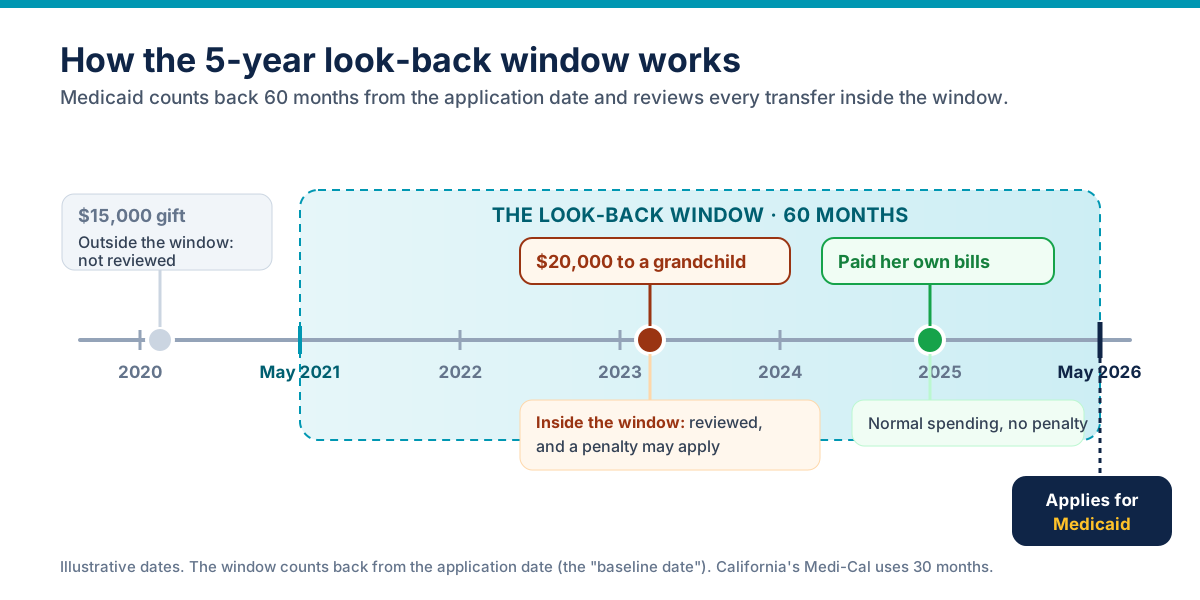
Medicaid is the main payer for long-term nursing home care in the US, but it is means-tested: to qualify, a person’s countable savings have to be low. The look-back rule exists so that someone can’t simply hand their savings to family the week before applying. Federal law tells every state to review transfers made before the application and to delay coverage when assets were given away for less than they were worth (42 U.S.C. § 1396p(c)).
For any transfer made on or after February 8, 2006, the window is 60 months, which is why it is usually called the 5-year look-back. Before the Deficit Reduction Act of 2005 it was 36 months for most transfers, and 60 months only for trusts. There is no 7-year look-back, whatever you may have read: here’s where that idea comes from.
- It applies when Medicaid pays for nursing home care, an equivalent level of care in another institution, or home and community-based services provided through a Medicaid waiver
- States may also apply it to certain home health and personal care services
- It does not affect regular Medicaid coverage for doctor visits, hospital stays or prescriptions. A penalty stops Medicaid paying for long-term care, not for other medical care
An ElderlyDaily original
Getting a parent’s records ready for the look-back?
LookBack Ready: Medicaid Look-Back & POA Money Organizer
One-off purchase · Instant download · Desktop app · Windows & Mac · works offline
When the 5-year clock starts
The look-back counts backward from what the law calls the baseline date. For someone in a nursing home, that is the first date they are both living in the nursing home and have applied for Medicaid. For someone applying for care at home, it is the date of the application.
So if a parent moves into a nursing home in May 2026 and applies that month, the look-back reaches back to May 2021. Anything given away before then is outside the window. Anything after it can be reviewed.
The window moves with the application date, so a gift made four and a half years before applying is still inside it. Questions about timing (whether to apply now, or how a planned gift would be treated) are exactly where an elder law attorney earns their fee.
What counts as a transfer
A transfer is anything given away, or sold for less than fair market value (what it would fetch on the open market). The examples caseworkers most often ask about:
- Cash or checks given to children, grandchildren or friends, including regular “help” with their bills
- Selling a house, a car or other property to family for less than it’s worth
- Putting a child’s name on the deed to the house
- Payments to a family member for help or care, unless there’s a written agreement and records showing it was fair pay for real work. Many states treat unwritten arrangements as gifts
- Turning down an inheritance or not collecting money the person is owed. Federal law counts income or assets someone is entitled to but doesn’t receive because of their own action
Large withdrawals with nothing to show where the money went can also be treated as transfers when they can’t be explained. That is why records matter as much as the rules.
What doesn’t count: exempt transfers and normal spending
Federal law lists transfers that never cause a penalty (42 U.S.C. § 1396p(c)(2)):
- Anything transferred to a spouse, or to someone else for the spouse’s sole benefit
- Transfers to a blind or disabled child of any age, or to a trust solely for that child
- Transfers to a trust solely for a disabled person under 65
- The home, when it goes to a child under 21; a sibling who already owns part of it and lived there for at least a year before the parent went into care; or a son or daughter who lived there for at least two years before and gave care that kept the parent out of a nursing home
- Transfers the state accepts were made for a reason other than qualifying for Medicaid, or where everything was given back
Spending money on the person themselves is not a transfer at all: their bills, rent, medical and care costs, a prepaid funeral that meets the state’s rules, or things bought for their own use at a fair price. That is normal spending, and good records make it obvious to a caseworker. For what each exemption takes to prove, see Medicaid look-back exemptions.
How the penalty is calculated
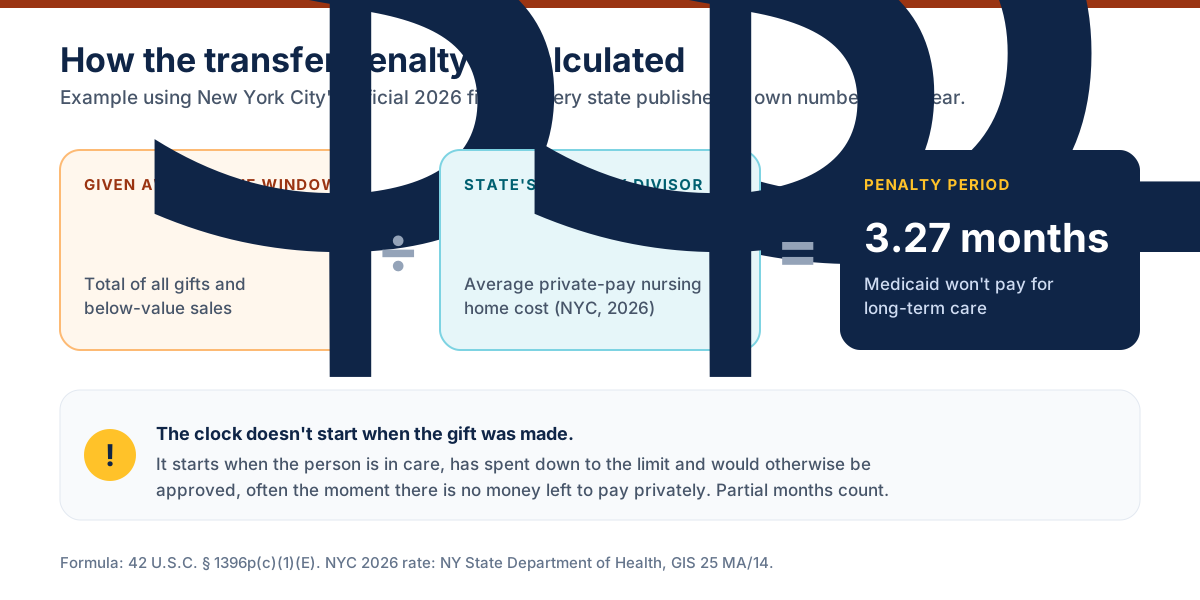
If the state finds a transfer it doesn’t accept, it adds up the value of everything given away in the window and divides it by the state’s average monthly cost of private-pay nursing home care (often called the penalty divisor). The result is the number of months Medicaid won’t pay for long-term care.
A real example: New York publishes its divisor by region each year. For New York City in 2026 it is $15,282 a month (NY Department of Health, GIS 25 MA/14). A $50,000 gift inside the look-back would mean $50,000 ÷ $15,282 = 3.27 months without Medicaid paying for care. Partial months count; the law says they can’t be rounded down.
The timing is what catches families out. The penalty doesn’t start when the gift was made. It starts only when the person is in care, has spent down to the asset limit and would otherwise be approved, which is often the moment there is no money left to pay the nursing home privately.
Every state must have a way to waive the penalty for undue hardship, for example when it would leave the person without medical care, food or shelter. Each state sets its own procedure.
Use your own state’s number
Divisors differ by state, and in some states by region, and they change every year. Use the figure your state publishes for the year of the application.
Is the look-back the same in every state?
For nursing home care, states use the federal 60 months, with one well-known exception and one change that is still pending. For the details, and each state’s penalty divisor, see the Medicaid look-back period by state.
| State | Look-back | What to know |
|---|---|---|
| California (Medi-Cal) | 30 months | The asset limit returned on January 1, 2026 ($130,000 for one person). Transfers made from January 2024 through December 2025 are not reviewed, and there is no penalty for community-based Medi-Cal. |
| New York | 60 months for nursing homes | A 30-month look-back for home care (community Medicaid) became law in 2020, but it had still not started as of early 2026. |
| Other states | 60 months | The penalty divisor, the paperwork asked for and the hardship process vary by state. |
How to get ready for the look-back
Most of the work is gathering and explaining records. Families who start early find the application far less stressful.
- 1
List every account
Every bank, credit union, brokerage and retirement account the person owned in the last five years, including ones that have since been closed. Closed accounts are the most common gap.
- 2
Collect five years of statements
Download what you can from online banking and request the rest. Banks have to keep most records for at least five years under federal rules, though they may charge for copies. See how far back Medicaid looks at bank statements.
- 3
Flag what a caseworker will ask about
Large withdrawals, cash, checks, transfers to other people and payments to family. Some local offices ask you to document the source of every deposit and withdrawal over a set amount; one New York county uses $2,000.
- 4
Explain each one, with proof
For each flagged item, note what it was for and where the proof is: a receipt, an invoice, or the statement for the account it went to.
- 5
Keep records from today
If you manage a parent’s money under a power of attorney, log repayments, cash spending and any pay for care as you go. A written caregiver agreement should be in place before a family member is paid.
An ElderlyDaily original
LookBack Ready: Medicaid Look-Back & POA Money Organizer
One-off purchase · Instant download · Desktop app · Windows & Mac · works offline
What’s changing in 2027 and 2028
The 2025 federal budget law (the One Big Beautiful Bill Act) did not change the look-back period, but two related rules are changing (National Health Law Program):
- Shorter retroactive coverage from 2027. Medicaid can currently pay bills from up to three months before the application. From January 1, 2027 that drops to two months for older and disabled applicants (and one month for the adult expansion group), so applying promptly matters more
- A fixed home equity cap from 2028. From January 1, 2028, someone seeking long-term care Medicaid can’t have more than $1,000,000 of equity in a non-farm home, and that figure will no longer rise with inflation. It doesn’t apply when a spouse, a child under 21 or a blind or disabled child lives in the home. See what happens to the home
When to talk to an elder law attorney
Organizing records is something families can do themselves. Deciding how to transfer or protect assets is not. Talk to an elder law attorney if any of these apply:
- Money or property was given away in the last five years
- A house is involved, or a parent wants to give it to a child
- There is a trust, an annuity or a life estate
- One spouse needs care and the other is staying at home
- You’ve received a penalty notice or a denial
The National Academy of Elder Law Attorneys has a directory of members. The Eldercare Locator (1-800-677-1116) can connect you with your local Area Agency on Aging and other services in your area.
Not legal advice
This guide explains how the rules work so you know what to expect and what to gather. It can’t tell you what your state will decide about a specific transfer. For that, ask your state Medicaid office or an elder law attorney.
Frequently asked questions
What is the 7-year look-back period for Medicaid?
There isn’t one. Federal law sets the Medicaid look-back at 60 months (5 years), and California uses 30 months. The “7 years” figure usually comes from other rules, such as the UK’s seven-year rule on gifts and inheritance tax, or general advice about how long to keep financial records.
Does the look-back apply to home care?
For home and community-based services provided through a Medicaid waiver, yes: federal law covers them alongside nursing home care. States may also apply it to some other home care services. In New York, a 30-month look-back for community Medicaid became law in 2020 but had not taken effect as of early 2026.
Does Medicaid look back at income?
The look-back is about assets given away. Medicaid judges income on what the person receives now. But income that was deposited and then given away is a transfer like any other, so it can still come up in the review.
Can Medicaid see my parent’s bank accounts?
Yes. Federal law requires every state to run an asset verification program, and aged, blind and disabled applicants must authorize the state to get their financial records. Expect the state to check accounts directly, as well as reading the statements you send.
Is the IRS annual gift tax exclusion safe for Medicaid?
No. The IRS annual gift exclusion is a tax rule. It has nothing to do with Medicaid, and a gift within that limit can still cause a Medicaid penalty if it falls inside the look-back window.
When does the penalty period start?
Not when the gift was made. For transfers made since February 2006, it starts on the later of the month of the transfer or the date the person is in care, has applied and would otherwise be eligible for Medicaid. In practice that is usually after the savings have been spent.
What happens if we leave a transfer off the application?
Don’t. The application includes a signed statement that the information is complete and true, and states check accounts directly. Leaving a transfer out can lead to a denial or a demand to repay benefits. Disclose it and explain it: many transfers turn out to be exempt or easy to justify with proof.
Sources
- U.S. Code (Cornell LII). 42 U.S.C. § 1396p — transfers of assets: the look-back date, the penalty period and exempt transfers
- CMS. State Medicaid Director Letter #06-018 — Deficit Reduction Act of 2005 transfer-of-assets provisions
- U.S. Code (Cornell LII). 42 U.S.C. § 1396w — the asset verification program every state runs for aged, blind and disabled applicants
- California Department of Health Care Services. ACWDL 25-18 — transfers of assets for long-term care Medi-Cal (30-month look-back, from January 2026)
- New York State Department of Health. 30-Month Lookback for Community Based Long Term Care Services
- NY Health Access (New York Legal Assistance Group). Status of the 30-month lookback for community Medicaid in New York
- New York State Department of Health. GIS 25 MA/14 — Medicaid regional rates for calculating transfer penalty periods for 2026
- National Health Law Program (2026). New fixed home equity caps and retroactive coverage limitations will limit access to long-term care
- Erie County (NY) Department of Social Services. Medicaid long-term care eligibility — documents required, including 60 months of financial records
