
5 Best Rollators for Seniors
 By Kutubuddin, Founder & Senior Care Researcher Updated October 2026
In this guide
 Best OverallDrive Medical Nitro Sprint Rollator
 Best for shorter usersDrive Medical Nitro Sprint Rollator (Petite Height)
 Best Lightweight / NarrowVive Ultra Lightweight Rollator
 Best Heavy-Duty / BariatricMedline Large Extra-Wide Aluminum Bariatric Rollator
 Best All-Terrain / OutdoorHelavo All-Terrain Rollator
- What to look for
- Frequently asked questions
A rollator walker is a four-wheel walker with a built-in seat and hand brakes — the right choice when someone can walk but tires quickly.
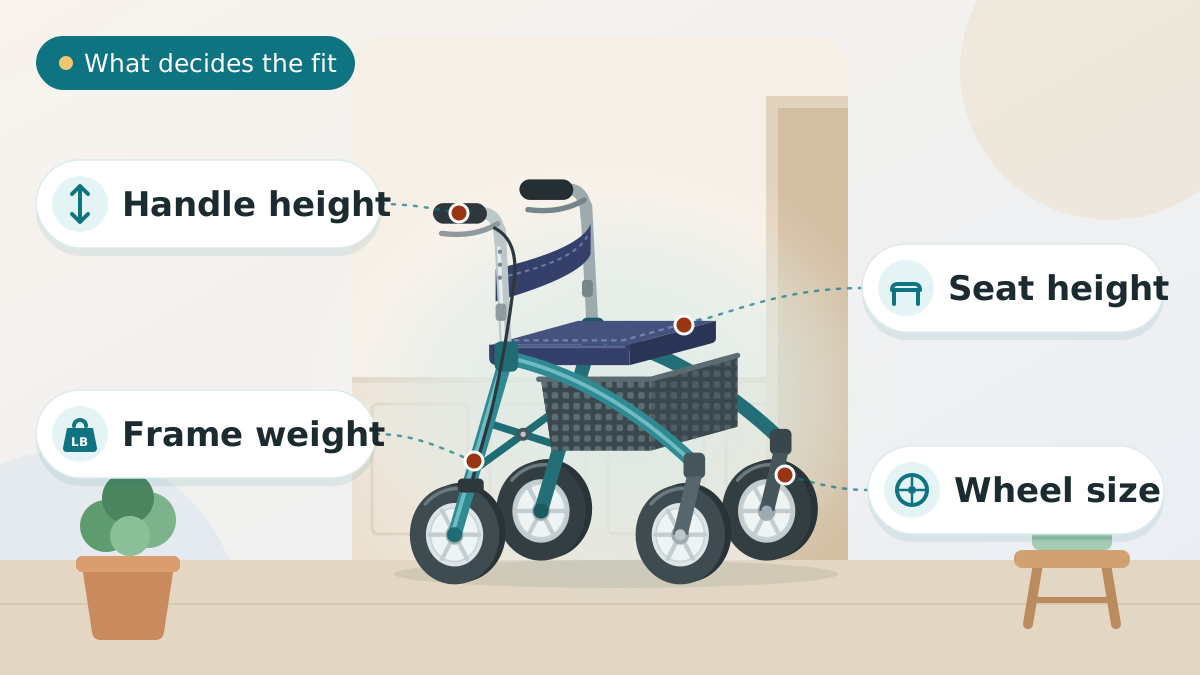
What decides the fit: handle height, frame weight if it has to go in a car, wheel size for indoors or out, and seat height.
One safety point first — a rollator is not a walker. It must not take someone's full weight, and the seat is for resting with the brakes locked. If falls are already a worry, our fall risk assessment takes two minutes.
We may earn a commission when you buy through links on this page. Read our affiliate disclosure.
Our Top Pick
Drive Medical Nitro Sprint Rollator
The consensus winner across lab tests and senior roundups.
- 10-inch front wheels roll over thresholds, cracks, and uneven ground
- Upright Euro-style frame keeps users taller
- About 17.5 lbs — manageable to lift into a car
- Folds for transport
- Among the highest customer ratings in the category
Top 5 Picks — Find Your Situation
- Drive Medical Nitro Sprint RollatorBest Overall
Best forEveryday use indoors and out — the best all-rounder
- Rolls smoothly over thresholds, cracks, and uneven ground
- Upright frame eases shoulder and neck strain
- Light enough to lift into a car
Watch out: Standard weight capacity — choose the Nitro Sprint for a higher 350 lb limit
- Drive Medical Nitro Sprint Rollator (Petite Height)Best for shorter users
Best forShorter users who want the Nitro Sprint but need it to adjust lower
- Adjusts lower than the standard Nitro Sprint without changing anything else
- Same braking and wheel setup as our top pick
- Comfortable seat and backrest for real rests, not perching
Watch out: Amazon shows an extended dispatch time — not a next-day buy
- Vive Ultra Lightweight RollatorBest Lightweight / Narrow
Best forApartments, narrow doorways, and frequent car trips
- Narrow frame fits tight spaces and doorways
- Folds compactly and lifts easily into a car
- Ideal for seniors who travel or shop often
Watch out: Lightweight aluminum suits smooth indoor and paved use more than rough outdoor terrain
- Medline Large Extra-Wide Aluminum Bariatric RollatorBest Heavy-Duty / Bariatric
Best forUsers above standard weight limits who want rock-solid stability
- 400 lb capacity — safe well above standard limits
- Rock-solid stability
- Extra-wide padded seat for comfortable rests
Watch out: The heaviest type to lift — plan for that if it rides in a car often
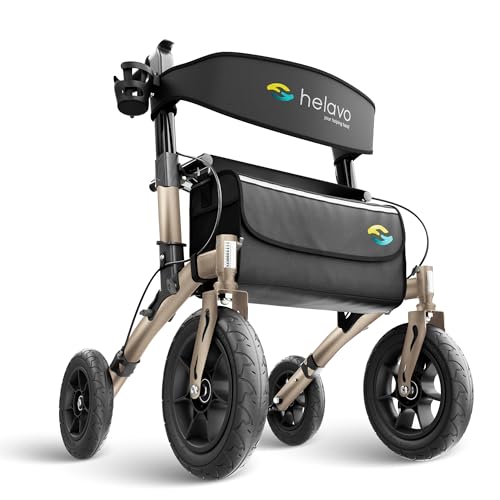
- Helavo All-Terrain RollatorBest All-Terrain / Outdoor
Best forSeniors who walk on grass, gravel, or rough sidewalks
- Pneumatic tires smooth out shock on any surface
- Handles grass, gravel, and rough sidewalks with less jolting
- Rolls over uneven ground where 6-inch wheels would catch
Watch out: Bulkier when folded — needs more trunk space
Drive Medical Nitro Sprint Rollator
Everyday use indoors and out — the best all-rounder
The Nitro is the consensus best all-rounder, and the standout feature for seniors is its 10-inch front wheels: they roll over thresholds, pavement cracks, and uneven ground without the juddering or catching that makes smaller wheels feel unsafe. That smoothness is what keeps someone confident moving between indoors and out.
Its upright, Euro-style frame keeps the user taller, which eases the shoulder and neck strain a hunched posture over a low rollator creates over time. And at about 17.5 pounds it's genuinely manageable to fold and lift into a car — the practical detail that decides whether a rollator actually gets used.
What we love
- Rolls smoothly over thresholds, cracks, and uneven ground
- Upright frame eases shoulder and neck strain
- Light enough to lift into a car
- One of the highest-rated rollators available
Things to consider
- Standard weight capacity — choose the Nitro Sprint for a higher 350 lb limit
Right for you if
- ✓You move between indoors and outdoors on mixed surfaces
- ✓Posture and shoulder or neck comfort matter to you
- ✓You need to lift it into a car without a struggle
Maybe skip it if
- !You need a higher weight capacity than the standard model
- !You want the absolute lightest or narrowest frame for tiny spaces
- !You only ever walk on smooth indoor floors and want minimal cost
What owners consistently report
Common praise
- +The big front wheels handle thresholds and cracks smoothly
- +The upright frame is easier on the back, neck, and shoulders
- +It's light enough to fold and lift into a car
Common gripes
- –Standard weight capacity — heavier users should size up to the Sprint
- –Larger wheels make it less compact than a narrow indoor rollator
- –The seat is for resting only, with the brakes locked
Getting started
- →Set the handle height to your wrist crease with arms relaxed
- →Practice locking both brakes before sitting on the seat
- →Use the brakes to slow down — don't let it get ahead of you on slopes
How it compares to our runner-up
Our runner-up, the ELENKER KLD-9218-10, solves a narrower problem: it adjusts down to 4'7" where the Nitro starts at 5'2", and its 14-inch square seat is much deeper for anyone who genuinely rests on it rather than perching. The Nitro is the narrower frame at 23 inches against 26, and slightly lighter to lift. Choose the Nitro for the best all-round balance of stability, weight and maneuverability; choose the ELENKER when the user is shorter than the Nitro comfortably fits, or when seat comfort matters more than three inches of doorway clearance.
How we picked
We compared 5 options. These rollators were ranked on stability and frame strength, wheel size for indoor or outdoor terrain, brake feel and locking, seat comfort, and fold for transport. We drew on manufacturer specs, verified owner reviews, and mobility guidance, not thorough research. Wheel size and weight capacity should match where it's used and the user's build — confirm both, and have a therapist set the handle height correctly.
Reviewed by Kutubuddin — who researches senior-care products and the real-world needs of caregivers and older adults.
Our picks, reviewed
Drive Medical Nitro Sprint Rollator
The consensus winner across lab tests and senior roundups. Its 10-inch front wheels roll over thresholds, pavement cracks, and uneven ground without juddering, the upright Euro-style frame keeps users taller to ease shoulder and neck strain, and at about 17.5 lbs it's manageable to lift into a car — all behind one of the highest customer ratings in the category.
The best all-rounder for everyday use indoors and out. If you need a higher weight limit, the Nitro Sprint is the upgraded 350 lb version of the same design.
What we like
- Rolls smoothly over thresholds, cracks, and uneven ground
- Upright frame eases shoulder and neck strain
- Light enough to lift into a car
- One of the highest-rated rollators available
Keep in mind
- Standard weight capacity — choose the Nitro Sprint for a higher 350 lb limit
Key features
- 10-inch front wheels roll over thresholds, cracks, and uneven ground
- Upright Euro-style frame keeps users taller
- About 17.5 lbs — manageable to lift into a car
- Folds for transport
- Among the highest customer ratings in the category
Drive Medical Nitro Sprint Rollator (Petite Height)
Most rollators stop adjusting somewhere around five foot two, which quietly rules out a lot of shorter users. Drive's answer is a separate petite build of the same Nitro Sprint that leads this page — identical frame, brakes and wheels, set lower. You get the 10-inch front casters that handle thresholds and pavement cracks, the three-mode braking system, the large padded seat with the contoured backstrap, and a storage bag that mounts in three positions. If the Nitro Sprint is the right rollator but the handles will not come down far enough, this is the same rollator that does.
Worth knowing before you order: Amazon currently shows an extended dispatch time on this one, so it is not a next-day buy.
What we like
- Adjusts lower than the standard Nitro Sprint without changing anything else
- Same braking and wheel setup as our top pick
- Comfortable seat and backrest for real rests, not perching
Keep in mind
- Amazon shows an extended dispatch time — not a next-day buy
- Costs more than a basic rollator
- No use to anyone of average height — buy the standard version instead
Key features
- Petite / hemi height build of the same Nitro Sprint frame
- 10-inch front casters for thresholds and uneven pavement
- Three braking modes — free, slowdown and park
- Large padded seat with a contoured backstrap and viewing window
- Storage bag mounts at three points on the frame
Vive Ultra Lightweight Rollator
The pick for apartments, narrow doorways, and frequent car trips. It's a foldable, narrow 4-wheel aluminum frame built for tight spaces, light enough to fold compactly and lift into a trunk without a struggle — ideal for seniors who travel or shop often. If shaving every pound matters more than price, the byACRE Carbon Ultralight (around 10.6 lbs) is the premium step-up worth considering.
What we like
- Narrow frame fits tight spaces and doorways
- Folds compactly and lifts easily into a car
- Ideal for seniors who travel or shop often
Keep in mind
- Lightweight aluminum suits smooth indoor and paved use more than rough outdoor terrain
Key features
- Narrow 4-wheel aluminum frame built for tight spaces
- Folds compactly
- Light enough to lift into a trunk without a struggle
- Fits standard doorways and small rooms
Medline Large Extra-Wide Aluminum Bariatric Rollator
The right — and often only — safe choice above standard weight limits. A reinforced aluminum frame rated to 400 lb, with adjustable handles, a padded seat and backrest, and 8-inch wheels, and it still folds for storage. If rock-solid stability is the top priority, the extra-wide padded seat and high capacity deliver it. Just know it's the heaviest type to lift, so plan for that if it rides in a car often.
What we like
- 400 lb capacity — safe well above standard limits
- Rock-solid stability
- Extra-wide padded seat for comfortable rests
- Folds despite the heavy-duty build
Keep in mind
- The heaviest type to lift — plan for that if it rides in a car often
Key features
- Reinforced aluminum frame rated to 400 lb
- Adjustable handles
- Extra-wide padded seat and backrest
- 8-inch wheels
- Still folds for storage
Helavo All-Terrain Rollator
For seniors who walk on grass, gravel, or rough sidewalks, not just smooth indoor floors. Its 12-inch pneumatic tires absorb shock for a smoother ride on any surface, and the larger wheels roll over uneven ground where standard 6-inch wheels would catch and jolt. The honest trade-off: big-wheel outdoor rollators are bulkier when folded and need more trunk space.
What we like
- Pneumatic tires smooth out shock on any surface
- Handles grass, gravel, and rough sidewalks with less jolting
- Rolls over uneven ground where 6-inch wheels would catch
Keep in mind
- Bulkier when folded — needs more trunk space
Key features
- 12-inch pneumatic tires absorb shock for a smoother ride
- Large wheels roll over uneven ground that catches small wheels
- Built for outdoor terrain
- Folds for transport
What to look for
Wheel size: indoor, outdoor, or both
Wheel size is the first thing to match to where the rollator will be used. Small wheels (around 6 inches) are nimble and turn easily in tight indoor spaces like hallways and bathrooms. Larger wheels (8 inches or more), and especially air-filled tires, roll far more smoothly over cracks, thresholds, grass, and uneven pavement.
If most walking happens indoors, smaller wheels keep things maneuverable. If the person wants to get outside and cover real ground, prioritize bigger wheels even at the cost of a little indoor agility.
Weight and folding for transport
A rollator only helps if it can come along, so weight and fold matter. Lightweight aluminum models (roughly 11 to 15 pounds) are far easier to lift into a car trunk than heavier steel frames. Check how it folds — many fold side-to-side and stand on their own, while others cross-fold flat — and confirm the folded size fits your vehicle.
For anyone who drives to appointments or shops, an easy one-hand fold and a manageable lifting weight are worth more than almost any other feature.
Seat height, width, and weight capacity
Because a rollator doubles as a resting seat, the seat dimensions matter. Measure the distance from the floor to the back of the knee — the seat height should be close to that so the person can sit and stand without strain. A wider, padded seat is more comfortable for longer rests.
Standard rollators support around 300 pounds; bariatric models are built for 400 to 500 pounds with wider frames and seats. As with any mobility aid, choose a capacity with comfortable margin above the user's weight.
Brakes and safety
Brakes are central to rollator safety. Loop hand brakes squeeze like bicycle brakes to slow down and push down to lock the wheels in place for sitting or standing. Before buying, make sure the person has the hand strength and coordination to operate the brakes reliably — squeezing to slow and pressing to park.
Always lock both brakes before sitting on the seat or standing up from it. If grip strength is limited enough that braking is uncertain, a rollator may not be the safe choice, and a standard walker should be considered instead.
Storage, baskets, and useful extras
Part of a rollator's appeal is carrying things so the hands stay free. Most include an under-seat basket or zippered bag for groceries, a phone, or a water bottle. A padded backrest adds comfort when resting, and accessories like a cane holder or a clip-on tray can make the rollator more useful. Just be mindful that loading heavy items low and centered keeps the rollator stable rather than top-heavy.
Tips to Choose Rollators
Short on time? Here are the key points to weigh before choosing, each covered in detail above:
- Wheel size: indoor, outdoor, or both
- Weight and folding for transport
- Seat height, width, and weight capacity
- Brakes and safety
- Storage, baskets, and useful extras
Comparing options? See our guides to Best Canes for Seniors, Best Walkers for Seniors, and Best Wheelchairs for Elderly.
Rollator vs. standard walker: which is safer for you?
The key safety distinction is weight-bearing. A standard walker can be leaned on heavily because its legs (or two front wheels and two rear legs) anchor in place. A rollator rolls freely on four wheels, so leaning your full weight on it can send it rolling away — which is why it is meant for people who can walk steadily but need endurance, not heavy support.
Put simply: if someone needs to lean hard for balance or has significant unsteadiness, a standard walker is safer. If they walk confidently but tire and want to go farther, a rollator is the better, more freeing tool. A therapist can confirm which matches the person's gait and strength.
Using a rollator safely
A rollator is safe and freeing when used as intended:
- Always lock both brakes before sitting down on or standing up from the seat
- Do not let someone push you while you sit on the seat unless the model is specifically rated as a transport chair
- Approach thresholds and curbs squarely and slowly, tipping the front wheels up gently if needed
- Keep an upright posture and let the rollator stay just ahead of you rather than reaching far forward
- Engage the brakes on any slope before pausing
Does Medicare cover rollators?
Rollators are durable medical equipment, so Original Medicare (Part B) may cover part of the cost when a doctor prescribes one as medically necessary and the supplier is Medicare-enrolled. You typically pay a share after the deductible, and Medicare generally covers one mobility device within a given period — so a rollator and a separate walker in the same window may not both be covered.
Because rules and documentation requirements vary, confirm coverage with your supplier and plan before purchasing. This is general information and not a guarantee of coverage.
Indoor vs. outdoor rollators
Matching the rollator to its environment makes daily life smoother. Indoors, narrower frames and smaller wheels turn easily and fit through standard doorways and tight bathrooms. Outdoors, wider stances and larger or pneumatic wheels handle sidewalks, driveways, and uneven ground with less jolting. If the person needs both, a mid-size three-wheel or all-terrain model can be a reasonable compromise, trading a little of each for everyday versatility.
Frequently asked questions
A rollator has wheels on all four legs and includes hand brakes, while a standard walker has no wheels or wheels only on the front legs. Rollators allow continuous walking without lifting, include a built-in seat for resting, and are easier to maneuver. Walkers provide more stability but require lifting with each step. Rollators are better for seniors who can walk but need continuous support, while walkers are better for those who need maximum stability and can lift the walker.
Yes, rollators are safe when properly fitted and used correctly. They provide excellent stability with four wheels, hand brakes for control, and a seat for rest breaks. The key is choosing the right size, ensuring brakes work properly, and teaching proper technique. Rollators reduce fall risk by providing continuous support during walking. However, seniors must have adequate hand strength to operate the brakes safely.
Stand upright with arms at your sides. The rollator handles should reach the crease of your wrist. When holding the handles, your elbows should bend at about 15–20 degrees. Most rollators adjust from 31" to 38" in height. Proper fit prevents back strain and ensures effective support. Also check seat height — feet should touch the ground when sitting.
Yes, all rollators have hand brakes on both handles. Squeeze the brakes to slow down or stop while walking. Push the brakes down to lock the wheels when sitting on the seat. Always test brakes before each use and replace brake cables if they feel loose or unresponsive. Proper brake function is critical for safety.
Yes, rollator seats are designed for resting during walks. Always lock both brakes before sitting down. Most rollator seats support 250-300 lbs. Check the weight capacity to ensure it matches the user's weight. The seat should be high enough that feet touch the ground when sitting. Never sit on the seat while the rollator is moving.
Rollators run from basic folding models up to premium lightweight and bariatric builds, and price tracks weight capacity, wheel size, seat comfort, and build quality. Medicare Part B may cover rollators when prescribed by a doctor as medically necessary durable medical equipment.
Standard rollators support 250-300 lbs. Bariatric rollators support up to 500 lbs. Always choose a rollator rated for at least 50 lbs more than the user's actual weight for a safety margin. Never exceed the manufacturer's stated weight limit — doing so can cause frame failure and serious injury.
Yes, rollators with larger wheels (8"-10") work well outdoors on sidewalks, parks, and paved paths. All-terrain rollators with 10" wheels handle grass, gravel, and uneven surfaces best. Smaller 6" wheels are better for indoor use only. Consider where your loved one will use the rollator most when choosing wheel size.
Most rollators fold by pulling up on the seat or pressing a release lever. The exact mechanism varies by model. Practice folding and unfolding several times before your loved one uses it independently. Folded rollators fit in car trunks and closets. Some models fold with one hand, while others require two hands.
Medicare Part B may cover rollators when prescribed by a doctor as medically necessary durable medical equipment (DME). You'll typically pay 20% of the Medicare-approved amount after meeting your Part B deductible. The rollator must be purchased from a Medicare-approved supplier. Contact Medicare or your supplier to verify coverage before purchasing.
The frame is rarely the problem — aluminium frames outlast the need for them. What wears out is everything attached to it. The hand brakes go first: cables stretch and the loop brakes lose their bite, though most are adjustable with a screwdriver and a cable tensioner, and replacement cables are inexpensive. Padded seats are next, as vinyl can split with sun and daily use. Wheels are third, especially small hard casters used outdoors on rough ground. If you want the fewest problems, look for adjustable brake cables, a seat you can replace, and larger wheels (8 inches or more) if it will be used outside.
The final verdict
A rollator is the right call for a senior who can still walk but needs to conserve energy and rest along the way — and the best one fits the life they actually lead. Size the wheels to where they walk, keep the folded weight light enough to lift, confirm the brakes suit their grip, and set the seat to a comfortable sit-and-stand height. Get those four things right and a rollator becomes a ticket to longer walks, errands, and outings rather than a reason to stay home. If standing tall is the real problem rather than distance, we compare six models side by side in Best Upright Walkers for Seniors.
Our overall winner is the Drive Medical Nitro Sprint Rollator — our best overall for most seniors. You can check the current price on Amazon to see today’s deal.
