
Medicaid Estate Recovery: How It Works, What’s Exempt and How to Avoid It

Checked against the federal statute (42 U.S.C. § 1396p) and state Medicaid agency guidance, October 2026. Not legal advice.
After someone who had Medicaid long-term care dies, the state can ask their estate to pay it back. Here is who that applies to, what it can reach, who is protected, and the legitimate ways families reduce or avoid it.
Key takeaways
- Every state must seek repayment from the estates of people who got Medicaid at 55 or older, for nursing home care, home and community-based services, and related hospital and drug costs
- Recovery can’t happen while a spouse is alive, or if there is a child under 21 or a blind or disabled child of any age
- Every state can claim the probate estate. Some also reach jointly owned property, life estates and living trusts
- Every state must have an undue hardship waiver. CMS suggests cases such as a family farm or business the heirs depend on, or a home of modest value
- Recovery comes only from what the person left. If there’s nothing in the estate, nothing is owed
- Giving assets away to avoid recovery runs into the 5-year look-back, so any planning has to start early, with a lawyer
Quick answer
What is Medicaid estate recovery?
Medicaid estate recovery is how a state gets back, from a person’s estate after they die, what Medicaid spent on their care. Federal law requires every state to recover the cost of nursing home care, home and community-based services, and related hospital and drug costs for anyone who received them at 55 or older. Recovery is barred while a spouse is alive or if there is a surviving child under 21 or a blind or disabled child, and states must waive it when it would cause undue hardship.
How estate recovery works
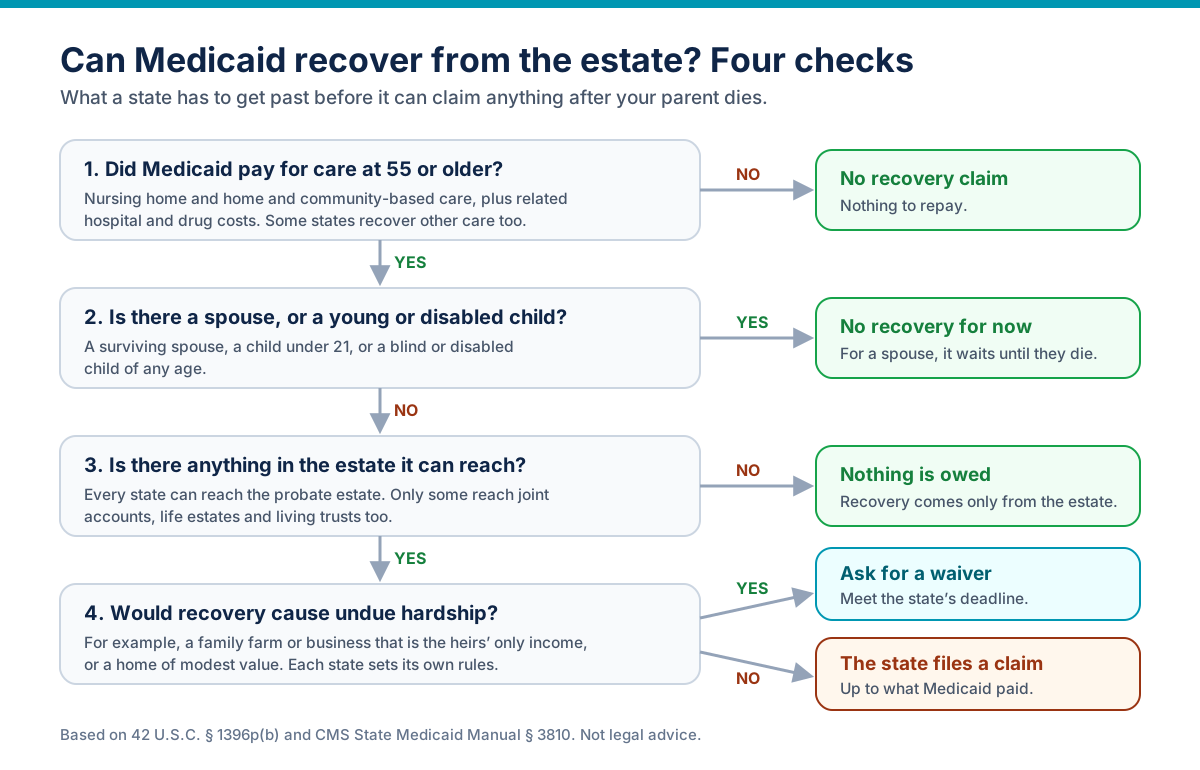
Federal law requires every state to seek repayment from the estate of anyone who received Medicaid at 55 or older, for (42 U.S.C. § 1396p(b)):
- nursing home care
- home and community-based services, such as care at home or in assisted living paid through a Medicaid waiver
- related hospital and prescription drug services
States can choose to recover for any other Medicaid services given after 55 as well, but never for help with Medicare premiums and cost-sharing through a Medicare Savings Program (Medicaid.gov). For someone permanently in a nursing home whose home has a lien on it, the state can also recover when the home is sold, at any age.
The claim is for what Medicaid actually paid. In California, for example, that includes managed care premiums paid on the person’s behalf (DHCS). For what happens to the home while your parent is alive, see can Medicaid take your house?
An ElderlyDaily original
Getting a parent’s records ready for the look-back?
LookBack Ready: Medicaid Look-Back & POA Money Organizer
One-off purchase · Instant download · Desktop app · Windows & Mac · works offline
When the state can’t recover
Federal law bars recovery, or delays it, in these cases (42 U.S.C. § 1396p(b)(2)):
- While a spouse is alive. Recovery has to wait until after the surviving spouse has died
- If there is a surviving child under 21
- If there is a surviving child of any age who is blind or disabled
- For a home with a lien: while a brother or sister who lived there for a year before your parent went into care, or a son or daughter who lived there for two years and gave care that kept your parent at home, still lives there
Two kinds of help are also protected: Medicare Savings Program help with Medicare costs is never recovered, and assets protected under a qualifying long-term care partnership insurance policy are exempt from recovery too.
What counts as the estate
Every state can recover from the probate estate: everything that passes under the will or the state’s inheritance rules. States can choose an expanded definition that also reaches property your parent had an interest in when they died, to the extent of that interest, including property that passed to someone else through joint ownership, a life estate or a living trust (42 U.S.C. § 1396p(b)(4)).
| Property | Probate-only states | Expanded-estate states |
|---|---|---|
| A home or account in your parent’s name alone | Can be claimed | Can be claimed |
| A home or account held jointly, passing to the other owner | Usually out of reach (passes outside probate) | Can be claimed, up to your parent’s interest |
| A life estate in the home | Usually out of reach (ends at death) | Can be claimed, up to your parent’s interest |
| Property in a living (revocable) trust | Usually out of reach (passes outside probate) | Can be claimed, up to your parent’s interest |
California
For deaths since January 1, 2017, Medi-Cal recovers only from assets that go through probate, and only for nursing home care, home and community-based services, and related hospital and drug costs (DHCS). Ask your own state’s estate recovery unit which definition it uses.
Hardship waivers
Every state must have a way to waive recovery when it would cause undue hardship (42 U.S.C. § 1396p(b)(3)). CMS guidance suggests states consider cases like these (State Medicaid Manual § 3810):
- the estate is the only income-producing asset of heirs with limited income, such as a family farm or family business
- the estate includes a home of modest value, which CMS suggests defining as 50% or less of the average home price in the county
- other compelling circumstances
A state can waive part of a claim, waive it only while the hardship lasts, or let heirs pay over time with reasonable interest instead of selling a home. It can refuse a waiver where assets were illegally transferred to avoid recovery. Apply in writing, with proof, before the deadline in the state’s letter. In California that is 60 days from the date of the claim letter (DHCS).
Legal ways families reduce or avoid recovery
- Use the exemptions. If a spouse survives, or there is a child under 21 or a blind or disabled child, tell the estate recovery unit and send proof
- Ask for a hardship waiver if the home is modest or the estate supports the family
- Check what is actually in the estate. In probate-only states, property that passes outside probate may be out of reach. In expanded-estate states it often isn’t
- Plan years ahead, with a lawyer. Giving assets away or moving them into an irrevocable trust is a transfer under the 5-year look-back, so it has to happen well before care is needed, and the rules differ by state
- Long-term care partnership insurance. Where a state has a partnership program, assets protected by a qualifying policy are protected from recovery
- Don’t hide or move assets to dodge a claim. A state can refuse a hardship waiver when assets were illegally divested to avoid recovery, and leaving property off an application can lead to repayment demands
Good records help either way. If a parent gave money away in the five years before applying, the state will ask about it; see how far back Medicaid looks at bank statements.
Get advice before changing a deed
Estate recovery planning is state-specific and easy to get wrong. Talk to an elder law attorney (the NAELA directory lists members) before changing a deed or setting up a trust.
An ElderlyDaily original
LookBack Ready: Medicaid Look-Back & POA Money Organizer
One-off purchase · Instant download · Desktop app · Windows & Mac · works offline
What to expect after a parent dies
For the rest of the to-do list, see what to do when a parent dies.
- 1
Watch for the state’s notice
CMS guidance says the notice should go to the executor or the family and give the amount, the reason, how to request a hearing and how to apply for a hardship waiver.
- 2
Check the amount
Ask for an itemized list of what Medicaid paid, and check the dates against when your parent turned 55 and which services the state recovers for.
- 3
Claim exemptions and waivers in time
Send proof of any exemption (a spouse, a child under 21, a blind or disabled child) and apply for a hardship waiver before the deadline in the letter.
- 4
Ask about payment options
If the family wants to keep the home, ask whether the state allows a payment schedule instead of a sale.
Frequently asked questions
What assets are exempt from Medicaid estate recovery?
Federal law protects the whole estate while a spouse is alive or if there is a child under 21 or a blind or disabled child. Medicare Savings Program help is never recovered, and assets protected by a long-term care partnership policy are exempt. Beyond that it depends on the state: probate-only states don’t reach property that passes outside probate, and every state must have a hardship waiver.
Does estate recovery apply to everyone on Medicaid?
No. The required recovery covers long-term care (nursing home care, home and community-based services, and related hospital and drug costs) received at 55 or older, plus care for people permanently in a nursing home whose home has a lien. States can choose to recover for other services received at 55 or older.
Do children have to pay back a parent’s Medicaid?
No. Recovery comes only from the parent’s estate, so children aren’t billed personally. But the claim can reduce or use up what they inherit, and in states with an expanded definition of estate it can reach property that passed to them outside probate.
Is there a time limit on Medicaid estate recovery?
There is no single federal deadline. Each state sets its own process and time limits, and recovery waits until after a surviving spouse has died, which can be many years later.
Does Medicare do estate recovery?
No. Estate recovery is a Medicaid rule. Medicare is federal health insurance and doesn’t claim against estates.
Can the state take the house if a child is living in it?
Only a child under 21 or a blind or disabled child stops recovery outright. Where the state put a lien on the home, recovery also waits while a son or daughter who lived there for two years before the parent went into care, and gave care that kept them at home, still lives there. Otherwise, ask about a hardship waiver.
Sources
- U.S. Code (Cornell LII). 42 U.S.C. § 1396p — transfers of assets: the look-back date, the penalty period and exempt transfers
- Medicaid.gov. Estate recovery — who states must recover from, liens, and hardship waivers
- CMS. State Medicaid Manual § 3810 (Transmittal 75) — estate recovery, undue hardship and notices
- California Department of Health Care Services. Medi-Cal Estate Recovery Program
