
Medicare vs Medicaid: What’s the Difference? (2026)

Checked against Medicare.gov, Medicaid.gov and CMS 2026 figures, October 2026. Not legal advice.
They sound alike and are often mixed up, but they work very differently. Here is the difference in one table, what each pays for, and what happens when a parent has both.
Key takeaways
- Medicare is federal health insurance for people 65 or older and some younger people with disabilities, whatever their income
- Medicaid is run by each state under federal rules and funded jointly with the federal government, for people with limited income and savings
- Medicare doesn’t pay for long-term custodial care, such as an ongoing nursing home stay. For people who qualify, Medicaid does
- Medicare covers up to 100 days in a skilled nursing facility after a qualifying hospital stay, with a copay of $217 a day from day 21 in 2026
- You can have both. Medicare pays first, and Medicaid pays last and covers extras such as nursing home and personal care
- If a parent’s income is too high for full Medicaid, a Medicare Savings Program may still pay their Part B premium ($202.90 a month in 2026)
Quick answer
What is the difference between Medicare and Medicaid?
Medicare is federal health insurance for people 65 or older and some younger people with disabilities, regardless of income. Medicaid is run by each state, under federal rules and with joint federal and state funding, for people with limited income and savings. The biggest practical difference for older adults is long-term care: Medicare doesn’t pay for ongoing custodial care in a nursing home or at home, while Medicaid does for people who qualify. Many people have both, and then Medicare pays first.
Medicare vs Medicaid at a glance
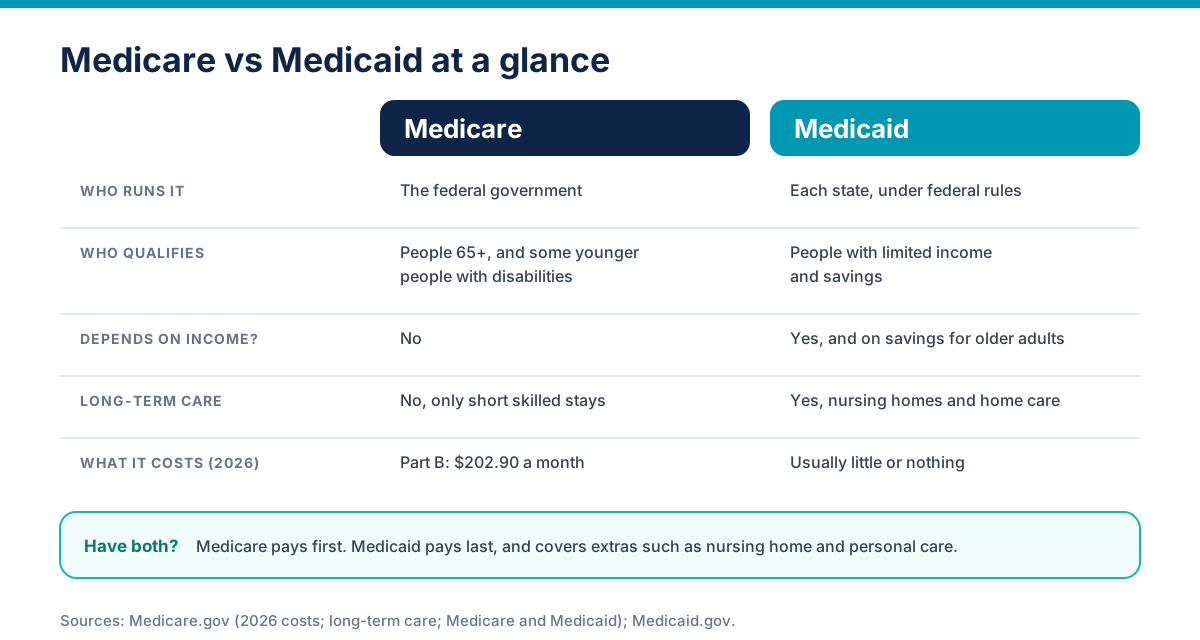
The short version: Medicare is based on age or disability, Medicaid on income and savings. Everything else follows from that.
| Question | Medicare | Medicaid |
|---|---|---|
| Who runs it | The federal government | Each state, under federal rules, funded jointly with the federal government |
| Who qualifies | People 65 or older, and some younger people with a disability, End-Stage Renal Disease or ALS | People with limited income and savings. For older adults, rules vary by state |
| Does income matter? | No, though higher earners pay more for Part B | Yes, and for older adults savings matter too |
| Hospital and doctor care | Yes (Parts A and B, or a Medicare Advantage plan) | Yes. For people with both, Medicare pays first |
| Prescription drugs | Through a Part D or Medicare Advantage drug plan | For people with both, drugs are covered through a Medicare drug plan |
| Long-term care in a nursing home or at home | No, apart from short skilled nursing stays | Yes, for people who qualify |
| What it costs | Premiums, deductibles and copays. Part B is $202.90 a month in 2026 | Usually little or nothing, but nursing home residents pay most of their income toward their care |
An ElderlyDaily original
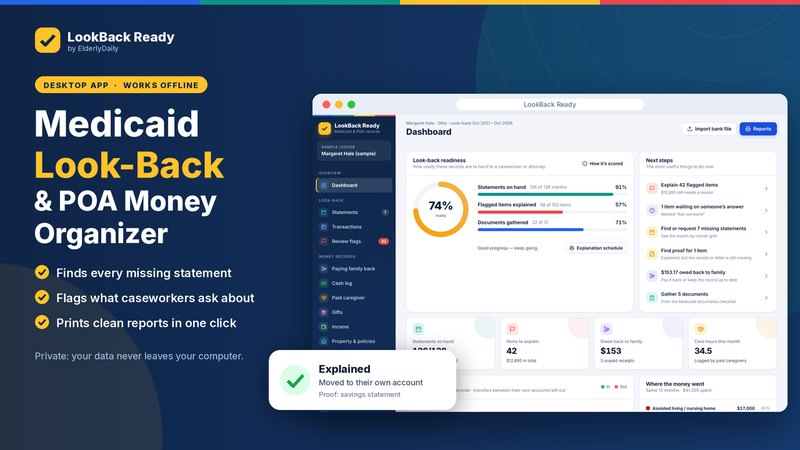
Getting a parent’s records ready for the look-back?
LookBack Ready: Medicaid Look-Back & POA Money Organizer
One-off purchase · Instant download · Desktop app · Windows & Mac · works offline
Medicare: health insurance for people 65 and older
Medicare is health insurance for people 65 or older, and for some younger people with a disability, End-Stage Renal Disease or ALS (Medicare.gov). It doesn’t depend on income or savings. It comes in parts:
- Part A (hospital): premium-free for most people. In 2026 the deductible is $1,736 for each hospital benefit period
- Part B (doctors and outpatient care): $202.90 a month in 2026 for most people, with a $283 deductible (Medicare.gov)
- Part C (Medicare Advantage): private plans that combine A and B, and usually drug coverage
- Part D: prescription drug plans
Medicaid: help based on income and savings
Medicaid covers eligible low-income adults, children, pregnant women, older adults and people with disabilities. It is administered by states, according to federal requirements, and funded jointly by the states and the federal government (Medicaid.gov).
For older adults, that usually means an asset limit (often $2,000 for one person) and income rules that differ by state. See long-term care Medicaid eligibility for the 2026 figures.
Medicaid pays for what Medicare doesn’t: nursing home care, and in most states care at home through a Medicaid waiver.
The big difference: long-term care
Medicare doesn’t provide long-term care or custodial care unless medical care is needed, and neither does Medigap (Medicare.gov). Help with bathing, dressing and eating, day after day, in a nursing home or at home, isn’t something Medicare pays for.
What Medicare does cover is a short skilled nursing stay after a qualifying hospital stay: up to 100 days, with nothing to pay for the first 20 and $217 a day for days 21 to 100 in 2026 (Medicare.gov). See our guide to skilled nursing facilities.
After that, families pay privately until the savings run low, and then Medicaid usually becomes the payer. Before it pays, the state reviews five years of finances: the Medicaid look-back.
Start the paperwork early
If a parent is likely to stay in a nursing home, start gathering five years of bank statements during the Medicare-covered stay. See how far back Medicaid looks at bank statements.
Having both Medicare and Medicaid
People with both are called dual eligible. Medicare pays first for Medicare-covered services, and Medicaid pays last, after Medicare and any other insurance (Medicare.gov).
- Medicaid covers benefits Medicare normally doesn’t, like nursing home care and personal care
- Prescriptions are covered through a Medicare drug plan, which your parent is enrolled in automatically
- Your parent still chooses Original Medicare or a Medicare Advantage plan, and with Medicaid can change their coverage once a calendar month (Medicare.gov)
There is also partial help. If a parent’s income is too high for full Medicaid, a Medicare Savings Program can pay Medicare premiums, and sometimes deductibles and copays. See QMB, SLMB and QI.
An ElderlyDaily original
LookBack Ready: Medicaid Look-Back & POA Money Organizer
One-off purchase · Instant download · Desktop app · Windows & Mac · works offline
Frequently asked questions
Are Medicare and Medicaid the same thing?
No. Medicare is federal health insurance based on age or disability. Medicaid is a state-run program based on income and savings. Many older adults have both.
Can you have Medicare and Medicaid at the same time?
Yes. People with both are called dual eligible. Medicare pays first, and Medicaid pays last and covers extras like nursing home care and personal care.
Which is better, Medicare or Medicaid?
They aren’t alternatives. Medicare is the main health insurance for people 65 and older. Medicaid helps people with limited income and savings, and pays for long-term care that Medicare doesn’t.
Does Medicare pay for nursing homes?
Only short skilled nursing stays after a qualifying hospital stay, up to 100 days, with a $217 daily copay from day 21 in 2026. Long-term custodial care isn’t covered by Medicare.
Do you have to be poor to get Medicaid for a nursing home?
There are income and asset limits, but they work differently for long-term care. Most states allow income up to $2,982 a month in 2026 for nursing home Medicaid, and a spouse at home can keep part of the couple’s savings.
Is Medicaid only for people over 65?
No. Medicaid covers eligible low-income adults, children, pregnant women, older adults and people with disabilities.
Sources
- Medicare.gov. Get started with Medicare — who can get Medicare
- Medicare.gov. Medicare costs — 2026 Part A and Part B premiums and deductibles
- Medicaid.gov. Medicaid — who it covers, and how it is run and funded
- Medicare.gov. Long-term care — what Medicare doesn’t cover
- Medicare.gov. Skilled Nursing Facility (SNF) Care Coverage
- Medicare.gov. Medicaid — having both Medicare and Medicaid
- Medicare.gov. Special enrollment periods — moving, living in an institution, and having Medicaid
