
Medicaid Look-Back Period by State (2026)

Checked against the federal statute (42 U.S.C. § 1396p) and state Medicaid agency guidance, October 2026. Not legal advice.
One federal rule covers almost the whole country. Here is where the states differ, the divisor each one uses to work out a penalty, and how to check your own state.
Key takeaways
- For nursing home Medicaid the look-back is 60 months in 49 states and Washington DC, as federal law requires for transfers made since February 8, 2006
- California looks back 30 months for Medi-Cal long-term care, and does not review transfers made in 2024 and 2025
- New York uses 60 months for nursing homes. Its 30-month look-back for home care was passed in 2020 but had not started as of early 2026
- What really differs is the penalty divisor. The same $50,000 gift means about 6.5 months of penalty in Indiana but about 3.5 months in California
- Some states publish the divisor as a daily rate (New Jersey, Massachusetts, Texas), so their penalties are counted in days
Quick answer
Is the Medicaid look-back period the same in every state?
Almost. For nursing home Medicaid, federal law sets a 60-month (5-year) look-back, and that is the rule in 49 states and Washington DC. California is the exception: Medi-Cal looks back 30 months, and transfers made in 2024 and 2025 are not reviewed. New York uses 60 months for nursing home care; a separate 30-month look-back for home care had not started as of early 2026. What really varies by state is the penalty divisor, which decides how long a penalty lasts.
The look-back in every state, at a glance
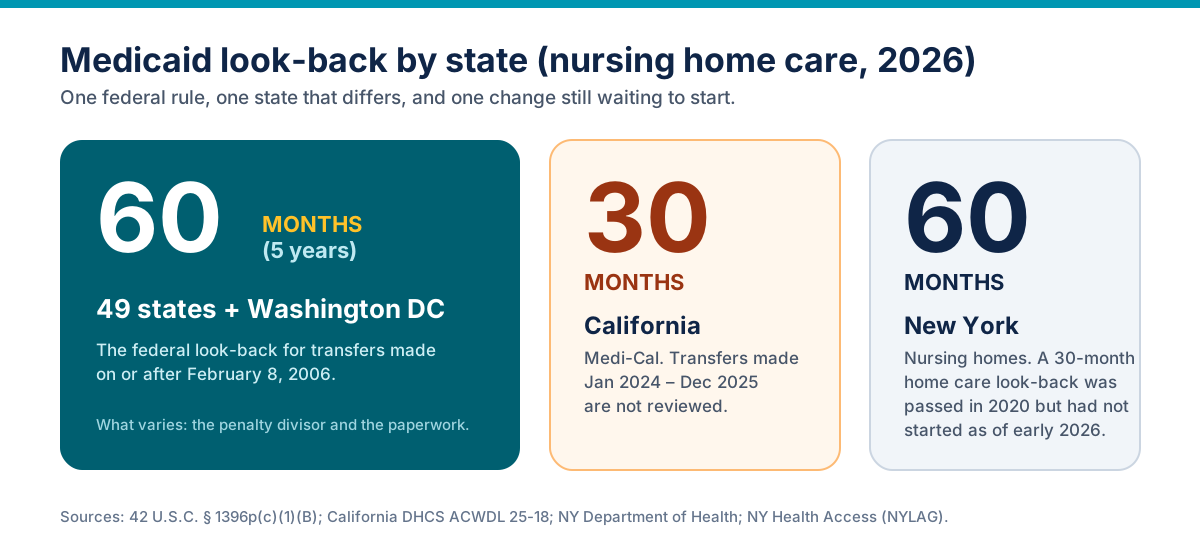
Federal law sets the look-back date at 60 months before the application for any transfer made on or after February 8, 2006 (42 U.S.C. § 1396p(c)(1)(B)). States apply it to nursing home Medicaid and to home and community-based services provided through a Medicaid waiver. For how the rule works, see our main guide to the Medicaid look-back period.
| Look-back | States |
|---|---|
| 60 months (5 years) | Alabama, Alaska, Arizona, Arkansas, Colorado, Connecticut, Delaware, District of Columbia, Florida, Georgia, Hawaii, Idaho, Illinois, Indiana, Iowa, Kansas, Kentucky, Louisiana, Maine, Maryland, Massachusetts, Michigan, Minnesota, Mississippi, Missouri, Montana, Nebraska, Nevada, New Hampshire, New Jersey, New Mexico, North Carolina, North Dakota, Ohio, Oklahoma, Oregon, Pennsylvania, Rhode Island, South Carolina, South Dakota, Tennessee, Texas, Utah, Vermont, Virginia, Washington, West Virginia, Wisconsin, Wyoming |
| 60 months for nursing homes | New York. A 30-month look-back for home care is law but had not started as of early 2026 |
| 30 months | California (Medi-Cal long-term care). Transfers made from January 2024 through December 2025 are not reviewed |
An ElderlyDaily original
Getting a parent’s records ready for the look-back?
LookBack Ready: Medicaid Look-Back & POA Money Organizer
One-off purchase · Instant download · Desktop app · Windows & Mac · works offline
Penalty divisors: why the same gift costs more in some states
When a state finds a transfer it doesn’t accept, it divides the amount by its penalty divisor, the average monthly (or daily) cost of private-pay nursing home care in that state. The result is how long Medicaid won’t pay for long-term care. A lower divisor means a longer penalty. These are the latest official figures we could verify from each state’s own publications:
| State | Penalty divisor | Applies from | Published by |
|---|---|---|---|
| California | $14,440 a month | Applications from January 1, 2026 | DHCS, ACWDL 26-03 |
| Delaware | $13,378.33 a month ($439.84 a day) | Applications from January 1, 2026 | Delaware Health and Social Services |
| Indiana | $7,651 a month | Applications from July 1, 2025 | Indiana FSSA, IHCPPM 3006.00.00 |
| Massachusetts | $450 a day | Applications received from November 1, 2025 | MassHealth, Eligibility Operations Memo 25-16 |
| New Jersey | $402.74 a day | April 1, 2025 | NJ Division of Medical Assistance and Health Services |
| New York | $13,765 to $15,675 a month by region (New York City $15,282) | 2026 | NY Department of Health, GIS 25 MA/14 |
| Ohio | $7,787 a month | September 1, 2024 (latest we found) | Ohio Department of Medicaid, MEPL 181 |
| Texas | $242.13 a day | September 1, 2023 (latest in the handbook) | Texas HHSC, MEPD Handbook |
What the difference means
A $50,000 gift inside the look-back works out to about 6.5 months of penalty in Indiana ($50,000 ÷ $7,651), but about 3.5 months in California ($50,000 ÷ $14,440). If your state isn’t listed, ask its Medicaid office for the current figure and whether it is monthly or daily.
New York: 60 months, regional divisors, and a home care rule on hold
New York applies the federal 60-month look-back to nursing home Medicaid and publishes a separate penalty divisor for each of its seven regions every year (GIS 25 MA/14).
| Region | 2026 divisor |
|---|---|
| New York City | $15,282 |
| Long Island | $15,193 |
| Northern Metropolitan | $15,024 |
| Western | $13,765 |
| Northeastern | $14,783 |
| Rochester | $15,675 |
| Central | $14,146 |
Home care (community Medicaid)
In 2020 New York passed a 30-month look-back for community-based long-term care, such as home care and adult day health care. As of early 2026 it had not started and had no start date (NY Health Access). The state has said that once it begins, transfers made on or after October 1, 2020 can be reviewed (NY Department of Health).
California: 30 months, and a gap for 2024 and 2025
Medi-Cal’s asset limit was removed in 2024 and came back on January 1, 2026, at $130,000 for one person plus $65,000 for each additional household member. The transfer rules for long-term care came back with it (DHCS ACWDL 25-18):
- The look-back is 30 months, counted back from the month before the Medi-Cal application (or before admission to long-term care, for current members)
- Transfers made from January 2024 through December 2025 are not reviewed, and counties may not ask you to verify them
- The penalty (Medi-Cal calls it a period of ineligibility) does not apply to people enrolled in community-based Medi-Cal programs
- The 2026 divisor is $14,440 a month (ACWDL 26-03). Medi-Cal doesn’t impose partial months, and a period of ineligibility can’t run more than 30 months from the date of the transfer
How to check your own state
Four questions to ask your state or county Medicaid office before you apply:
- 1
Which office handles long-term care Medicaid?
It is often the county social services office rather than the state. Your local Area Agency on Aging can point you to it; find yours through the Eldercare Locator (1-800-677-1116).
- 2
What is on the document checklist?
How many months of statements, for which accounts, and what proof they want for large withdrawals. See how far back Medicaid looks at bank statements.
- 3
What is the current penalty divisor?
Ask whether it is monthly or daily, and which date decides which year’s figure applies (usually the application date).
- 4
How do they handle exemptions and hardship?
What proof they accept for an exempt transfer, and how to ask for an undue hardship waiver. See Medicaid look-back exemptions.
An ElderlyDaily original
LookBack Ready: Medicaid Look-Back & POA Money Organizer
One-off purchase · Instant download · Desktop app · Windows & Mac · works offline
Frequently asked questions
What is the Medicaid look-back period in New York?
Sixty months for nursing home Medicaid. A 30-month look-back for home care (community Medicaid) became law in 2020 but had not started as of early 2026. The 2026 penalty divisor ranges from $13,765 to $15,675 a month depending on the region; New York City’s is $15,282.
What is the Medicaid look-back period in California?
Thirty months for Medi-Cal long-term care, counted back from the month before the application. Transfers made from January 2024 through December 2025 are not reviewed. The 2026 divisor is $14,440 a month.
What is the Medicaid look-back period in Ohio?
Sixty months, the federal rule. The latest official divisor we found is $7,787 a month, effective September 1, 2024; ask the Ohio Department of Medicaid or your county office whether it has been updated.
What is the Medicaid look-back period in New Jersey?
Sixty months. New Jersey publishes its divisor as a daily rate: $402.74 a day from April 1, 2025.
What is the Medicaid look-back period in Florida?
Sixty months, the federal rule. Ask the Florida Department of Children and Families for the current penalty divisor before you apply.
What happens if my parent moved states during the look-back?
The state where your parent applies does the review, using its own rules and divisor, and it looks at every transfer inside the window, including ones made while your parent lived somewhere else.
Sources
- U.S. Code (Cornell LII). 42 U.S.C. § 1396p — transfers of assets: the look-back date, the penalty period and exempt transfers
- California Department of Health Care Services. ACWDL 25-18 — transfers of assets for long-term care Medi-Cal (30-month look-back, from January 2026)
- California Department of Health Care Services. ACWDL 26-03 — 2026 statewide average private pay rate for nursing facility services ($14,440)
- New York State Department of Health. GIS 25 MA/14 — Medicaid regional rates for calculating transfer penalty periods for 2026
- New York State Department of Health. 30-Month Lookback for Community Based Long Term Care Services
- NY Health Access (New York Legal Assistance Group). Status of the 30-month lookback for community Medicaid in New York
- Delaware Health and Social Services. Nursing home private pay rate used for transfer-of-assets penalties, from January 1, 2026
- Indiana Family and Social Services Administration. IHCPPM 3006.00.00 — facility rate used to calculate the penalty period
- MassHealth. Eligibility Operations Memo 25-16 — average daily cost of nursing facility services for calculating a period of ineligibility
- New Jersey Division of Medical Assistance and Health Services. Medicaid Communication 25-04 — penalty divisor effective April 1, 2025
- Ohio Department of Medicaid. MEPL 181 — average private pay rate for nursing facilities, effective September 1, 2024
- Texas Health and Human Services. MEPD Handbook I-5000 — calculation of the transfer penalty period (daily rate)
