
Printable Pain Log: Free Pain Diary and Tracker (PDF)

Educational only, not medical advice. The pain scale and what to record follow the American Cancer Society. Ask your doctor before starting, changing or stopping any pain medicine.
When pain comes and goes, it is hard to remember the details at an appointment. This free printable pain log makes it quick to write down how bad the pain is, where it is, what it feels like and what helped, so your doctor sees the real pattern. Type into it on screen, or print as many copies as you need.
Key takeaways
- Free printable pain log and pain diary in large print, 7 pages, with no sign-up.
- A 0 to 10 pain scale, a list of words that describe pain, and a body map to mark where it hurts.
- A daily pain log (pain number, where, what it feels like, what you took and the pain number 1 to 2 hours later) and a monthly tracker with one row per day.
- Fill it in on screen: click any box in the PDF and type, then save or print. Or print it blank and use a pen.
- Comes in US Letter and A4, in color and black and white.
Quick answer
Where can I get a free printable pain log?
Download it free here: the printable pain log (PDF) has a 0 to 10 pain scale, words to describe pain, a body map, a page for your doctor and pain medicines, a daily pain diary and a monthly pain tracker, all in large print. You can type into the boxes on screen or print it. There are black-and-white and A4 editions too. No email or sign-up is needed.
Download the free pain log
All four files have the same seven pages. Pick the paper size you use: US Letter in the US and Canada, A4 almost everywhere else.
- Pain Log, color, US Letter (PDF, 7 pages)
- Pain Log, black and white, US Letter (PDF, 7 pages)
- Pain Log, color, A4 (PDF, 7 pages)
- Pain Log, black and white, A4 (PDF, 7 pages)
Print the daily log pages as often as you need them, and one monthly tracker each month.
Filling it in on screen
Open the PDF in Chrome, Edge or Adobe Acrobat Reader, click any box and type. When you are done, download or save the file so your notes are kept, or print it. On a phone, Adobe Acrobat Reader works best.

Bonus: Health Tracker Pack
An ElderlyDaily original
Bringing someone home from the hospital?
Post-Hospital Recovery Planner
- Discharge snapshot: care team, who to call and when, insurance and documents
- Medication reconciliation, a master list, a daily record and refills
- Daily recovery log, vitals log, and a symptom and pain log
One-off purchase. Instant download.
Fillable PDF · 38 pages · US Letter + A4
What is inside the pain log
- Page 1 — Cover.
- Page 2 — Rating and describing pain: the 0 to 10 scale, words that describe pain, what to note each time, and when to call 911.
- Page 3 — Body map: front and back outlines to shade where it hurts.
- Page 4 — My details: your doctor and pharmacy, what helps, what makes it worse, your pain medicines and questions for your next appointment.
- Pages 5 and 6 — Daily pain log: one line each time you have pain or take something for it.
- Page 7 — Monthly pain tracker: one row per day for worst pain, usual pain, sleep and medicine, so the pattern is easy to see.
How to rate your pain from 0 to 10
Most doctors and nurses ask for pain as a number. As the American Cancer Society puts it, a 0 means no pain and a 10 means the worst pain you can imagine. Pick the number that matches your pain right now, not the worst it has ever been, and use the same scale every time so the numbers can be compared.
Words help too. Write down the ones that fit, such as sharp, dull, throbbing, gnawing, burning, shooting or steady, along with where the pain is and how long it lasts.
What to write in a pain diary
The American Cancer Society suggests keeping a record of these, and the daily log has a column for each:
- 1
Your pain number
from 0 to 10, at different times of the day.
- 2
Where it hurts and what it feels like
in your own words.
- 3
What makes it better or worse
such as rest, movement, heat or the time of day.
- 4
What you could not do because of the pain
like walking to the mailbox or sleeping through the night.
- 5
The name, dose and time of any pain medicine
and any side effects you noticed.
- 6
Your pain number again 1 to 2 hours later
so you and your doctor can see what actually helped.
When pain needs help right away
A pain log is for everyday pain. Some pain should never wait for an appointment.
Call 911 right away for
Chest pain or pressure, or pain spreading to the arm, back, neck or jaw; sudden numbness or weakness, confusion or trouble speaking; a sudden, severe headache; or a fall where the person cannot get up or cannot move a limb. For new pain, or pain that keeps getting worse, call your doctor.
Making your pain log useful to your doctor
- Bring the monthly tracker to every appointment. One page shows a month of pain at a glance.
- Write down medicine exactly, including over-the-counter pain relievers, and the most the label allows in a day.
- Do not wait for pain to get bad before telling your doctor it is not controlled.
- Never take more than the label or your doctor allows, and ask before changing or stopping any pain medicine.
More free printables
See all 24 free printables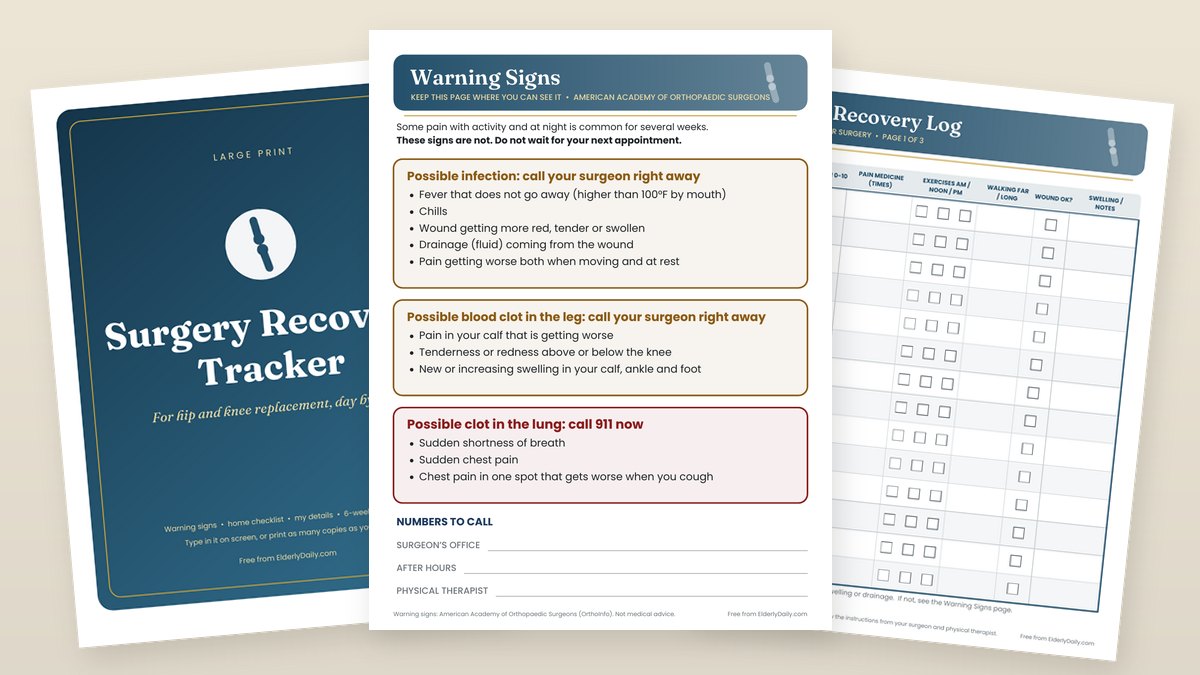 Surgery Recovery TrackerFor knee and hip replacement: warning signs, a home checklist and a 6-week daily log for pain, exercises and walking.Free PDF, no sign-up
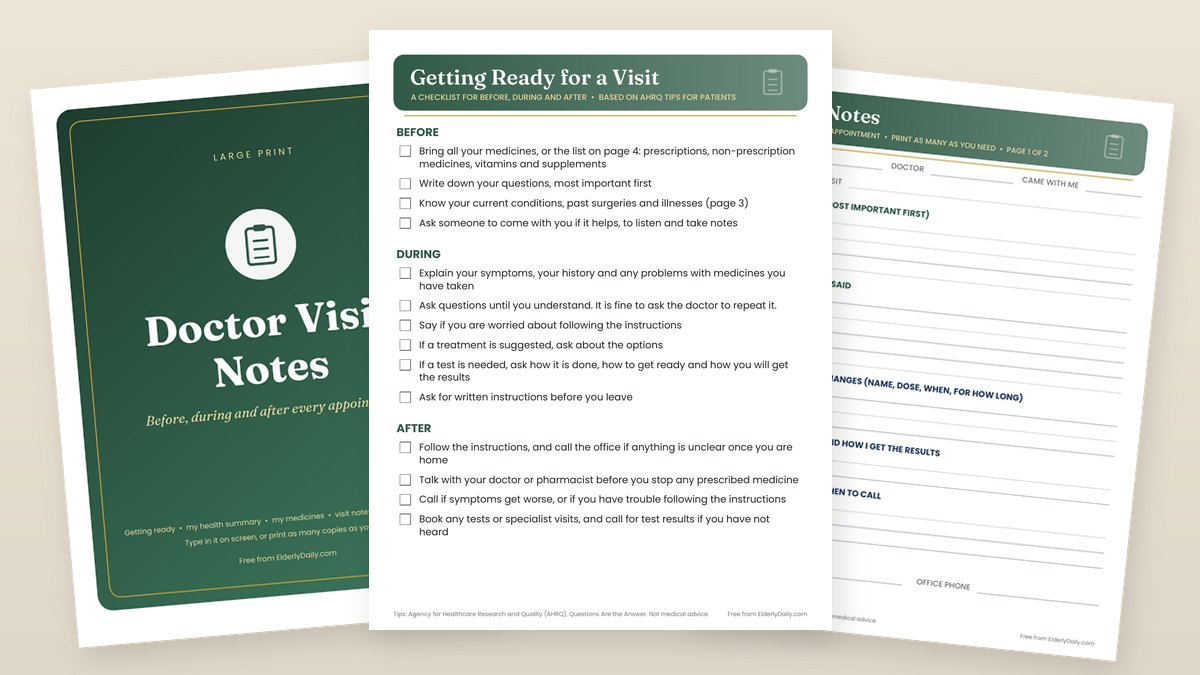 Doctor Visit NotesA before-and-after checklist, health summary, medicine list, visit notes pages and an appointment log.Free PDF, no sign-up
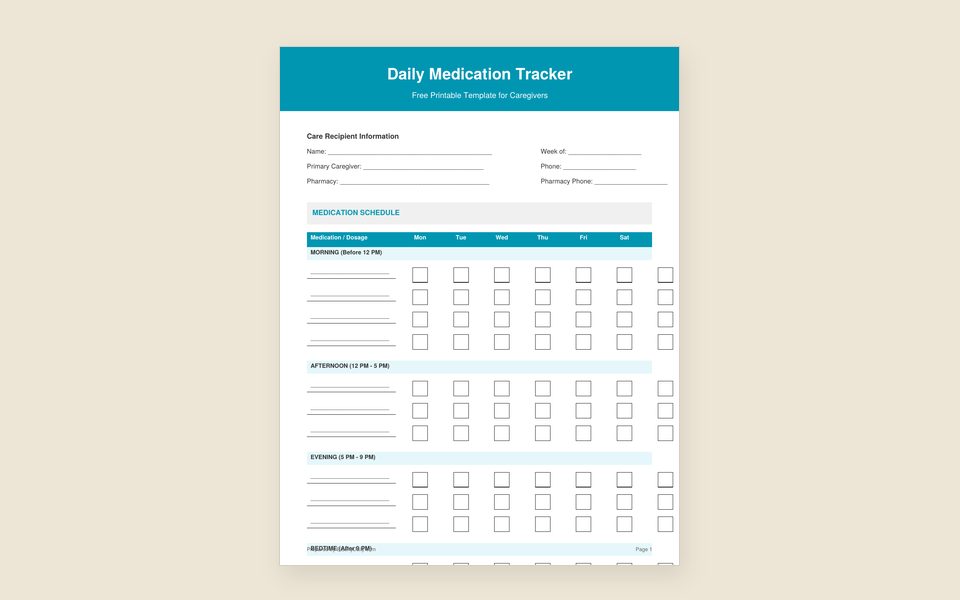 Daily Medication ChartMorning, afternoon and evening checkboxes that help prevent missed or double doses.Free PDF, no sign-up
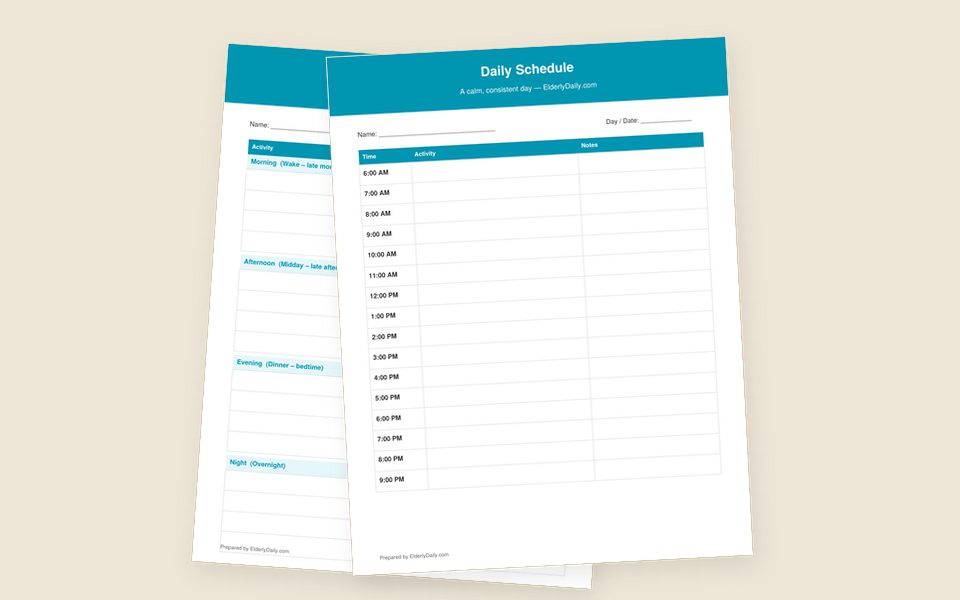 Daily Schedule TemplateBlank hourly and time-block layouts, plus a sample daily routine to copy.Free PDF, no sign-up
 Emergency Binder TemplateMedications, doctors, allergies, insurance and safety plans, organized in one binder.Free PDF, no sign-up
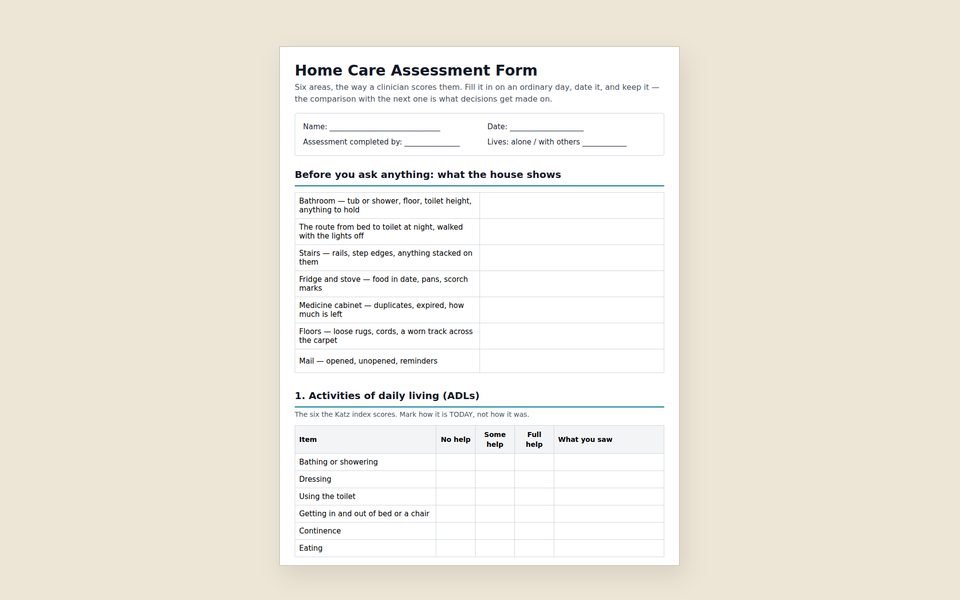 Home Care Assessment FormDaily activities, mobility, memory, medication and home safety on one dated form.Free PDF, no sign-up
Frequently asked questions
Is this pain log really free?
Yes. All four PDFs download directly, with no email address, sign-up or payment. Print or fill in as many copies as you like for personal use.
How do I rate pain on a 0 to 10 scale?
A 0 means no pain and a 10 means the worst pain you can imagine. Pick the number that matches your pain right now and use the same scale every time, so you and your doctor can compare the numbers.
What should I write in a pain diary?
Your pain number, where it hurts, what it feels like, what makes it better or worse, anything you could not do because of it, the name, dose and time of any pain medicine, and your pain number again 1 to 2 hours later.
Can I fill in the pain log on my computer?
Yes. Open the PDF in Chrome, Edge or Adobe Acrobat Reader, click any box and type. Then download or save the file so your notes are kept. You can also print it blank and write by hand.
Can a caregiver fill it in for someone else?
Yes. Ask the person for their pain number and words in their own terms, and write down what you see too, such as limping, not eating or trouble sleeping. Bring the log to their appointments.
