
What Is a Medicaid Waiver? Home Care Waivers Explained (2026)

Checked against the federal statute (42 U.S.C. § 1396p) and state Medicaid agency guidance, October 2026. Not legal advice.
A Medicaid waiver is how most states pay for long-term care at home instead of in a nursing home. Here is what it covers, who qualifies, why there are waiting lists, and how to apply for a parent.
Key takeaways
- A Medicaid waiver (formally a 1915(c) home and community-based services waiver) lets a state pay for long-term care at home or in the community for people who would otherwise need a nursing home
- 46 states and Washington DC run at least one. Arizona, New Jersey, Rhode Island and Vermont don’t use this type of waiver
- Your parent must need a nursing-home level of care and meet the state’s income and asset rules, including the 5-year look-back
- Waivers cover help such as personal care, homemaker services, adult day care, respite and home changes, but not room and board
- States can cap how many people a waiver serves, and 40 states had waiting lists in 2024, so apply early
- Every state that answered KFF’s 2024 survey pays family caregivers through at least one Medicaid home care program
Quick answer
What is a Medicaid waiver?
A Medicaid waiver is a state program, approved by the federal government, that uses Medicaid to pay for long-term care at home or in the community instead of in a nursing home. The most common kind, the 1915(c) home and community-based services waiver, serves people who need a nursing-home level of care, and covers help such as personal care, homemaker services, adult day care and respite. States can limit how many people each waiver serves, so many have waiting lists.
What a Medicaid waiver is
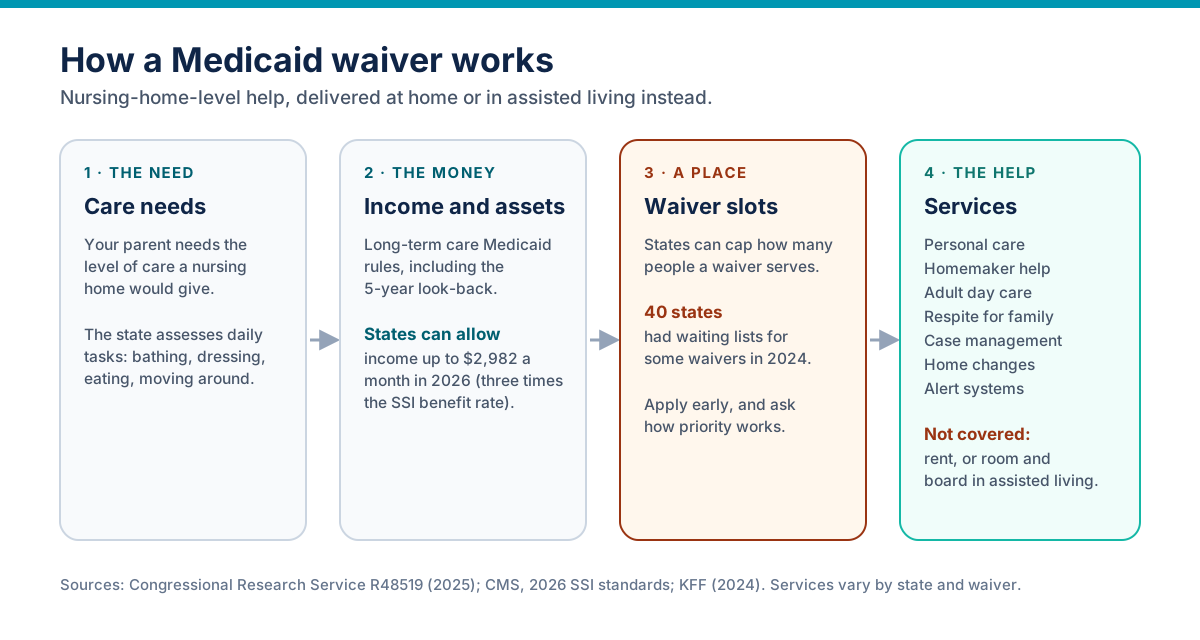
Medicaid normally has to follow the same rules for everyone in a state. A waiver lets the federal government set some of those rules aside, so a state can offer home and community-based services to a chosen group of people, such as older adults who would otherwise need a nursing home (Congressional Research Service).
Each waiver serves a target group (for example, older adults and adults with physical disabilities, or people with intellectual and developmental disabilities), and the state has to show that it costs no more on average than institutional care would have. In 2022 nearly 1.8 million people received services through these waivers, and 46 states and Washington DC run at least one.
States give their waivers their own names, so the one your parent needs may not have “waiver” in the title. Your local Area Agency on Aging can tell you which ones exist where your parent lives.
An ElderlyDaily original
Getting a parent’s records ready for the look-back?
LookBack Ready: Medicaid Look-Back & POA Money Organizer
One-off purchase · Instant download · Desktop app · Windows & Mac · works offline
What a waiver covers
Each waiver has its own list of services. The ones the Congressional Research Service lists as common (CRS):
- case management, to plan and arrange the care
- homemaker and home health aide services
- personal care: help with bathing, dressing, eating and getting around
- adult day health care
- respite care, to give family caregivers a break
- with federal approval, extras such as home modifications, skilled nursing, transportation, special equipment, personal emergency response systems, adult foster care and assisted living services
Waivers can’t pay for room and board. In assisted living, a waiver can pay for care services but not the rent and meals, which your parent still pays, often from their own income. See our guide to assisted living costs and coverage.
Who qualifies
- Care needs. Your parent must need the level of care a nursing home (or another institution) would provide. States decide this with an assessment, often of daily activities such as bathing, dressing and eating
- Income. States can set the income limit for waiver services as high as three times the SSI benefit rate: $2,982 a month in 2026 (CMS). Generally only your parent’s own income counts, not a spouse’s
- Assets and the look-back. Long-term care asset rules apply, and the 5-year look-back covers waiver services just as it covers nursing homes (42 U.S.C. § 1396p(c)). See the Medicaid look-back period
- Estate recovery. States must seek repayment for waiver services received at 55 or older from the estate. See Medicaid estate recovery
Waiting lists
Unlike most of Medicaid, a waiver can cap the number of people it serves. In 2024, 40 states reported waiting lists, with more than 710,000 people waiting, about a quarter of them older adults or people with physical disabilities (KFF). Waits vary by state and by waiver, and are longest for people with intellectual and developmental disabilities (CRS).
Some states also offer home care through other Medicaid options, under Sections 1915(i) and 1915(k), which generally can’t cap enrollment. Ask whether your state has one. Under a 2024 CMS rule, states must start reporting on their waiting lists every year by July 2027.
Apply even if there is a list
A place on the list is worth having early. Ask how the state decides priority, how often it reviews the list, and what help is available while your parent waits.
How to apply for a Medicaid waiver
The order is roughly the same everywhere, though the names of the offices differ:
- 1
Find the right office
Your local Area Agency on Aging or Aging and Disability Resource Center can tell you which waivers exist and where to apply. Find yours through the Eldercare Locator (1-800-677-1116).
- 2
Ask for a care needs assessment
A nurse or social worker assesses your parent’s daily needs to decide whether they meet the nursing-home level of care.
- 3
Complete the Medicaid application
The financial part uses long-term care rules, so gather five years of statements for every account. See how far back Medicaid looks at bank statements.
- 4
Get on the waiting list if there is one
Ask how priority is decided and how you will be contacted when a place opens.
- 5
Choose the care, or self-direct it
Once enrolled, your parent gets a care plan. Almost every state lets people manage their own care and hire their own workers, including family. See how Medicaid can pay a family caregiver.
An ElderlyDaily original
LookBack Ready: Medicaid Look-Back & POA Money Organizer
One-off purchase · Instant download · Desktop app · Windows & Mac · works offline
Frequently asked questions
Is a Medicaid waiver the same as Medicaid?
It is part of Medicaid: a program with its own rules, usually for long-term care at home or in the community. People on a waiver generally also have regular Medicaid coverage.
Does a Medicaid waiver pay for assisted living?
Some waivers pay for care services in assisted living, but never for room and board. Your parent still pays the rent and meals.
Does a Medicaid waiver pay family caregivers?
Often, yes. Every state that answered KFF’s 2024 survey pays family caregivers through at least one Medicaid home care program, most often through a waiver where the person can hire their own workers.
How long is the waiting list for a Medicaid waiver?
It depends on the state and the waiver. In 2024, 40 states had waiting lists for some waivers, and waits were longest for people with intellectual and developmental disabilities. Ask your state how long the list is for the waiver your parent needs.
Does the 5-year look-back apply to a Medicaid waiver?
Yes. Federal law applies the look-back to home and community-based services provided through a waiver, just as it does to nursing home care.
What is a Medicaid waiver payment?
It is money paid to a caregiver, often a family member, for care given through a Medicaid waiver program. Under IRS Notice 2014-7, these payments can be tax-free when the person being cared for lives in the caregiver’s home.
Sources
- Congressional Research Service (2025). R48519 — Medicaid Section 1915(c) home and community-based services waivers
- CMS. Informational Bulletin, December 9, 2025 — 2026 SSI, spousal impoverishment and home equity standards ($752,000 to $1,130,000)
- KFF (October 2024). A look at waiting lists for Medicaid home and community-based services from 2016 to 2024
- KFF (January 2025). How do Medicaid home care programs support family caregivers?
- U.S. Code (Cornell LII). 42 U.S.C. § 1396p — transfers of assets: the look-back date, the penalty period and exempt transfers
