
Can Medicaid Take Your House? What Happens to a Parent’s Home (2026)

Checked against the federal statute (42 U.S.C. § 1396p) and state Medicaid agency guidance, October 2026. Not legal advice.
Not while your parent is alive, and sometimes after they die. Here is what happens to the home at each stage, who is protected, and what to know before anyone signs a deed.
Key takeaways
- Medicaid can’t take a home while your parent is alive. The home usually doesn’t count toward the asset limit while they live in it
- Long-term care Medicaid has a home equity limit: $752,000 to $1,130,000 in 2026, depending on the state. It doesn’t apply if a spouse, a child under 21 or a blind or disabled child lives in the home
- If your parent moves to a nursing home, the home can stay exempt if they intend to return, or if a spouse or dependent relative lives there
- A state may put a lien on the home of someone permanently in a nursing home, but only after notice and a hearing, and not while certain family members live there
- After death, every state must try to recover the cost of long-term care from the estate, which often means the house, unless a spouse, a child under 21 or a blind or disabled child survives
- Giving the house away to protect it is a transfer that the 5-year look-back can penalize, unless it goes to an exempt person
Quick answer
Can Medicaid take your house?
Not while your parent is alive. The home usually doesn’t count for Medicaid eligibility while they live in it, or while they are in a nursing home and intend to return. Two things can affect it later: a state may place a lien on the home of someone permanently in a nursing home, and after death every state must try to recover the cost of long-term care from the estate, which often includes the house. Recovery can’t happen while a spouse is alive or if there is a child under 21 or a blind or disabled child, and every state must offer a hardship waiver.
The short answer: no while alive, sometimes after death
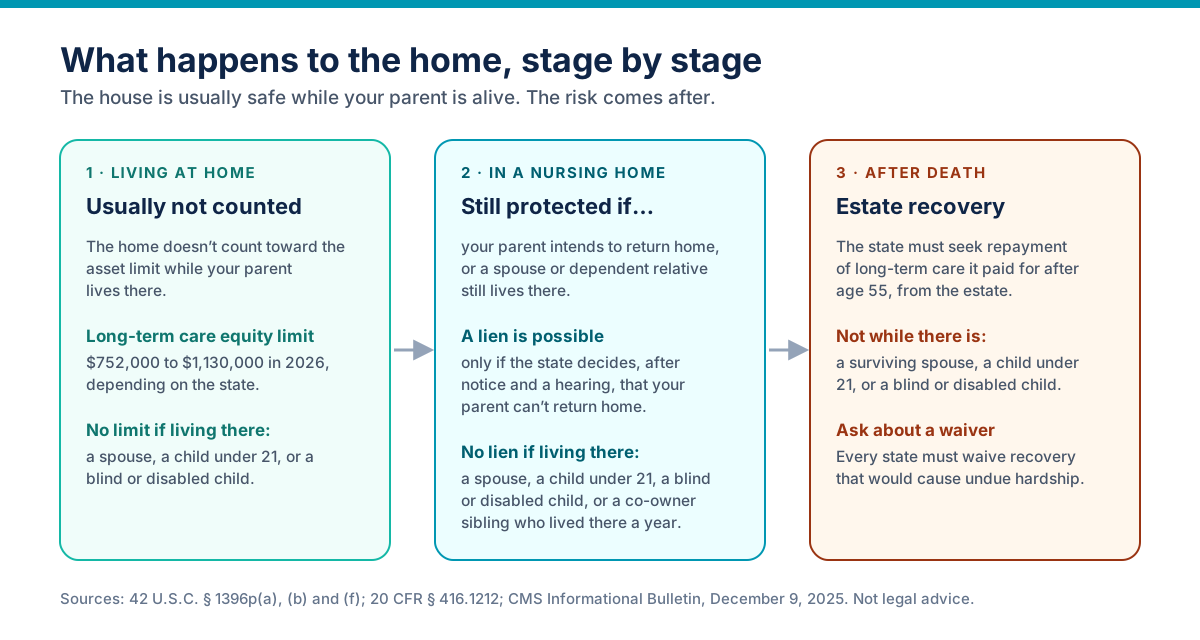
Medicaid doesn’t seize homes. What it can do depends on where your parent is: living at home, living in a nursing home, or after they have died. Federal law sets the limits for each stage (42 U.S.C. § 1396p), and each state fills in the details.
An ElderlyDaily original
Getting a parent’s records ready for the look-back?
LookBack Ready: Medicaid Look-Back & POA Money Organizer
One-off purchase · Instant download · Desktop app · Windows & Mac · works offline
While your parent lives at home
Medicaid for older and disabled people generally follows the SSI rules, and under them the home a person lives in doesn’t count toward the asset limit, whatever it is worth (20 CFR § 416.1212).
Long-term care is the exception. To get Medicaid for nursing home care or long-term care at home, your parent’s equity in the home (its value minus any mortgage) has to be under the state’s limit. For 2026 states use a limit between $752,000 and $1,130,000 (CMS). The limit doesn’t apply if a spouse, a child under 21 or a blind or disabled child lives in the home, and federal law allows a reverse mortgage or home equity loan to bring the equity down (42 U.S.C. § 1396p(f)).
From January 1, 2028 the top limit becomes a flat $1,000,000 for homes that aren’t on agricultural land, so states using the higher figure will have to lower it (Justice in Aging).
If your parent moves into a nursing home
Moving into care doesn’t automatically make the house countable. Under the SSI rules the home stays exempt if your parent intends to return to it, and it stays their home, whatever they intend, while a spouse or dependent relative still lives there (20 CFR § 416.1212). Ask your state how it judges intent to return.
States may also place a lien on the home of someone in a nursing home, but only if the state decides, after notice and a hearing, that they can’t reasonably be expected to return home (42 U.S.C. § 1396p(a)). No lien is allowed while any of these people lawfully live in the home:
- a spouse
- a child under 21, or a blind or disabled child of any age
- a brother or sister who owns part of the home and lived there for at least a year before your parent went into care
A lien doesn’t mean the state takes the house. It secures the state’s claim for when the home is sold or after your parent dies, and it must be removed if your parent is discharged and returns home.
After your parent dies: estate recovery
This is when homes are actually lost. Federal law requires every state to seek repayment from the estate of anyone who received Medicaid at 55 or older, for nursing home care, home and community-based services, and related hospital and prescription drug costs. States can choose to recover for other Medicaid services too, except help with Medicare costs through a Medicare Savings Program (Medicaid.gov).
Recovery can’t happen while a spouse is alive, or if there is a surviving child under 21 or a blind or disabled child of any age. Where there is a lien, it also waits while a co-owner sibling or a caregiver son or daughter who has lived there since before your parent went into care still lives in the home.
What the state can reach depends on how it defines the estate. Every state can claim from the probate estate. States may also reach property that passes outside probate, such as a home held in joint tenancy, a life estate or a living trust (42 U.S.C. § 1396p(b)(4)). California, for example, recovers only from assets that go through probate for deaths since January 1, 2017 (DHCS). The full process is in our guide to Medicaid estate recovery.
Can you give the house to your children first?
Giving the home away, or adding a child to the deed, is a transfer. If it happens within the 60 months before a long-term care application, it can cause a penalty period. See our guide to the Medicaid look-back period.
There are exceptions. The home can go without penalty to a spouse, a child under 21, a blind or disabled child, a brother or sister who co-owns it and lived there for a year before your parent went into care, or a son or daughter who lived there for two years and gave care that kept your parent at home. See Medicaid look-back exemptions.
Deeds, life estates, trusts and transfer-on-death deeds each interact differently with the look-back, the equity limit and estate recovery, and the answer depends on the state. Make this decision with an elder law attorney before anything is signed.
Selling the house
If the house is sold while your parent is applying for or receiving Medicaid, the money from the sale generally counts as an asset, and selling to family for less than it is worth is a transfer. Talk to the caseworker or an attorney before listing it.
What families can do now
Most of this is paperwork you can start today:
- 1
Find out your state’s rules
Ask the state Medicaid office for its home equity limit, how it treats a home when someone moves into care, whether it uses liens, and how it defines the estate for recovery.
- 2
Keep the home’s paperwork together
The deed, mortgage statements, property tax bills and homeowner’s insurance. You’ll need them for the application and for any exemption.
- 3
Document who lives there
If a spouse, a young or disabled child, a co-owner sibling or a caregiver child lives in the home, keep proof: mail, ID and tax returns, and for a caregiver child, a doctor’s statement about the care.
- 4
Get advice before changing ownership
An elder law attorney can tell you whether a transfer, a trust or another option fits your state’s rules. The NAELA directory lists members.
An ElderlyDaily original
LookBack Ready: Medicaid Look-Back & POA Money Organizer
One-off purchase · Instant download · Desktop app · Windows & Mac · works offline
Frequently asked questions
Can Medicaid take your house if your spouse still lives there?
No. A spouse living in the home protects it: it doesn’t count toward eligibility, the home equity limit and liens don’t apply, and estate recovery can’t happen while the spouse is alive.
Will Medicaid take my house if I go into a nursing home?
Not while you are alive. The home can stay exempt if you intend to return or a spouse or dependent relative lives there. The risks are a lien in some states, and estate recovery after death.
Does Medicaid put a lien on your house?
Only in some cases. A state may place a lien on the home of someone permanently in a nursing home, after notice and a hearing, but not while a spouse, a child under 21, a blind or disabled child, or a co-owner sibling who lived there for a year lives in the home. The lien must be removed if your parent returns home.
How long after death can Medicaid take your house?
There is no single federal deadline. Each state sets its own process and time limits for claims, and recovery waits until a surviving spouse has died, which can be years later. Ask the state’s estate recovery unit.
Can my parent sell the house while on Medicaid?
Yes, but the money from the sale generally counts as an asset and can affect eligibility, and selling for less than the home is worth is a transfer that the look-back can penalize. Talk to the caseworker first.
Is the house protected if it is in a trust?
It depends on the trust and the state. A revocable trust doesn’t protect it. Moving the home into an irrevocable trust is usually a transfer subject to the 5-year look-back, and some states can recover from trust property after death. This is a question for an elder law attorney.
Sources
- U.S. Code (Cornell LII). 42 U.S.C. § 1396p — transfers of assets: the look-back date, the penalty period and exempt transfers
- Code of Federal Regulations (Cornell LII). 20 CFR § 416.1212 — the home exclusion, and when a home stays exempt after someone moves into care
- CMS. Informational Bulletin, December 9, 2025 — 2026 SSI, spousal impoverishment and home equity standards ($752,000 to $1,130,000)
- Justice in Aging. H.R. 1 imposes a new $1,000,000 limit on home equity for Medicaid long-term care, effective 2028
- Medicaid.gov. Estate recovery — who states must recover from, liens, and hardship waivers
- California Department of Health Care Services. Medi-Cal Estate Recovery Program
