
How to Talk to a Doctor About Incontinence

Practical guidance for productive medical visits, not medical advice. The aim is to help you get the evaluation and treatment your family member deserves.
Incontinence is under-reported and under-treated, often because it never gets raised clearly. A little preparation turns an awkward appointment into a productive one — and frequently into a real solution.
Key takeaways
- Incontinence is treatable and worth raising — most people never bring it up, so it goes undiagnosed. Do not accept "it is just age."
- Preparation is everything: bring a bladder diary, a full medication list, and a clear description of the pattern.
- Use specific, matter-of-fact language — how often, how much, day or night, with urgency or without warning — so the doctor can narrow the cause.
- Ask directly for a urine test (to rule out infection) and about treatable causes and specialist referral if needed.
- For sudden changes, frame it as a new, abrupt symptom — that urgency changes the workup. See elderly suddenly incontinent.
Quick answer
How do I bring up incontinence with my parent’s doctor?
Prepare first: keep a bladder diary for a few days (times, leaks, amounts, day vs night), bring a complete medication list, and write down the pattern and when it started. At the visit, state it plainly — "she has been leaking urine several times a day for a month" — ask for a urine test to check for infection, and ask what treatable causes to investigate and whether a specialist referral would help. Do not accept "it is just aging."

Why it so often goes unspoken — and why to change that
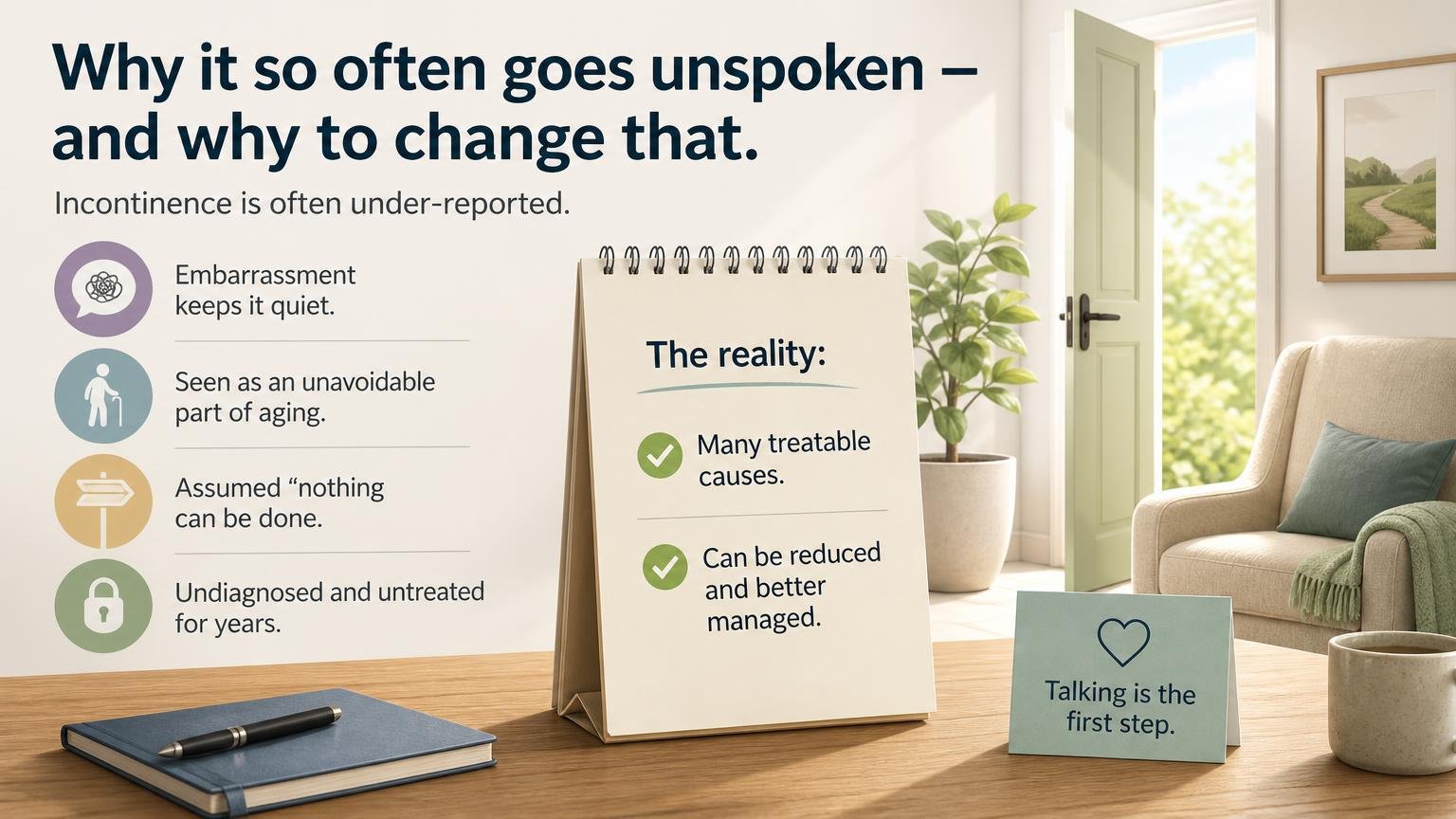
Incontinence is one of the most under-reported conditions in older adults. Embarrassment, the belief that it is an unavoidable part of aging, and the assumption that "nothing can be done" keep it out of the exam room — so it goes undiagnosed and untreated for years, quietly shrinking a person’s confidence and independence.
The reality is the opposite: incontinence has many treatable causes, and even when it cannot be cured, it can often be reduced and better managed. The single biggest barrier is simply naming it clearly to a doctor. This guide is about doing that well.
Prepare before the appointment
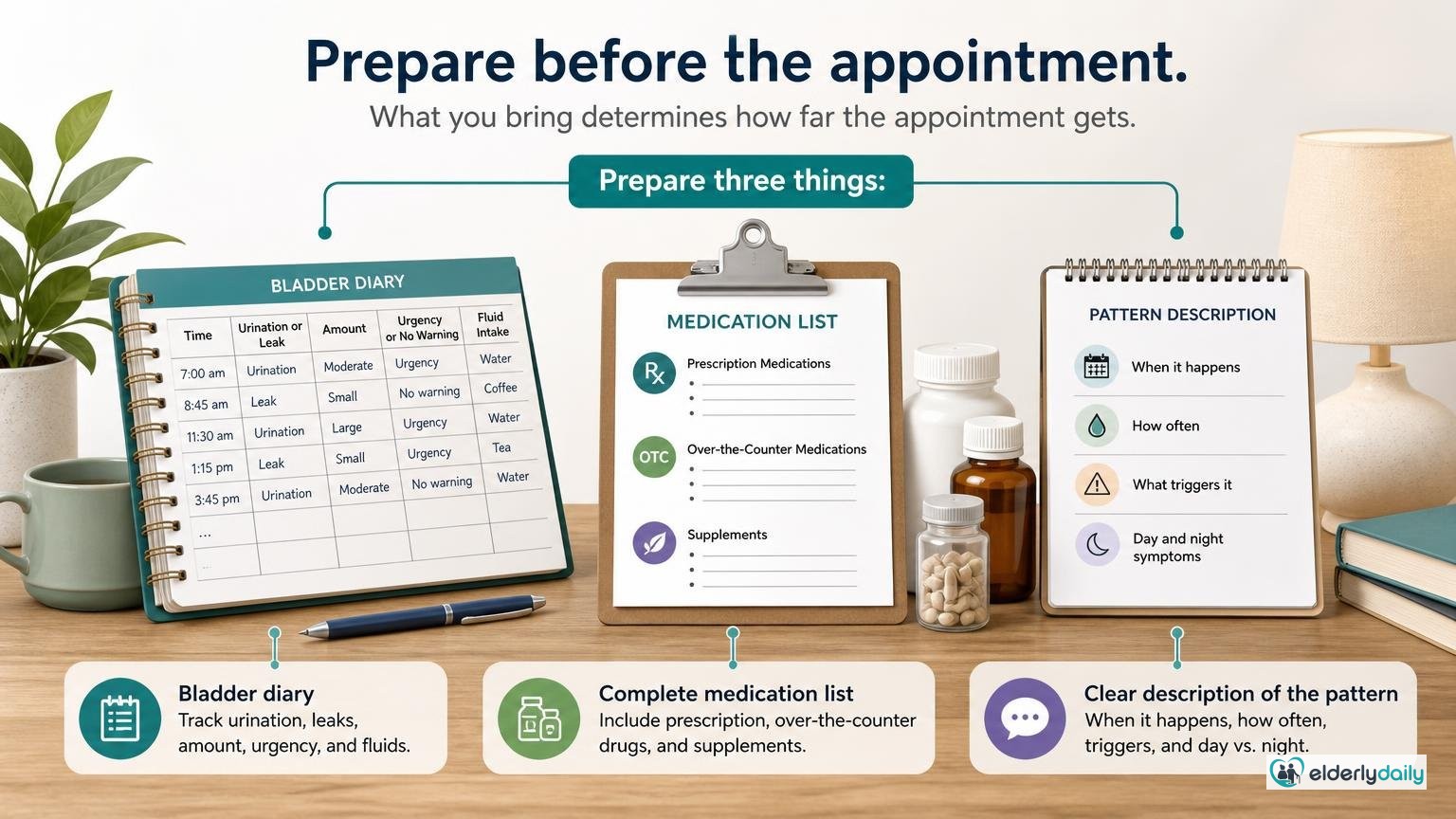
What you bring determines how far the appointment gets. Prepare three things:
- 1
A bladder diary (a few days)
Note the times of urination and of leaks, roughly how much (a few drops, a soaked pad), whether there was urgency or no warning, and fluid intake. Patterns — leaks on standing or coughing, urgency, night waking — point to different causes and are gold to a doctor.
- 2
A complete medication list
Include prescriptions, over-the-counter drugs, and supplements. Several medications affect the bladder, and this is one of the first things a good doctor will review. Keeping medications organized helps day to day too — see medication management.
- 3
A clear description of the pattern
Write down when it started (gradual or sudden), how often and how much, day vs night, and any other new symptoms (confusion, pain, fever, constipation). Sudden changes especially change the workup — see elderly suddenly incontinent.
The words to use in the room
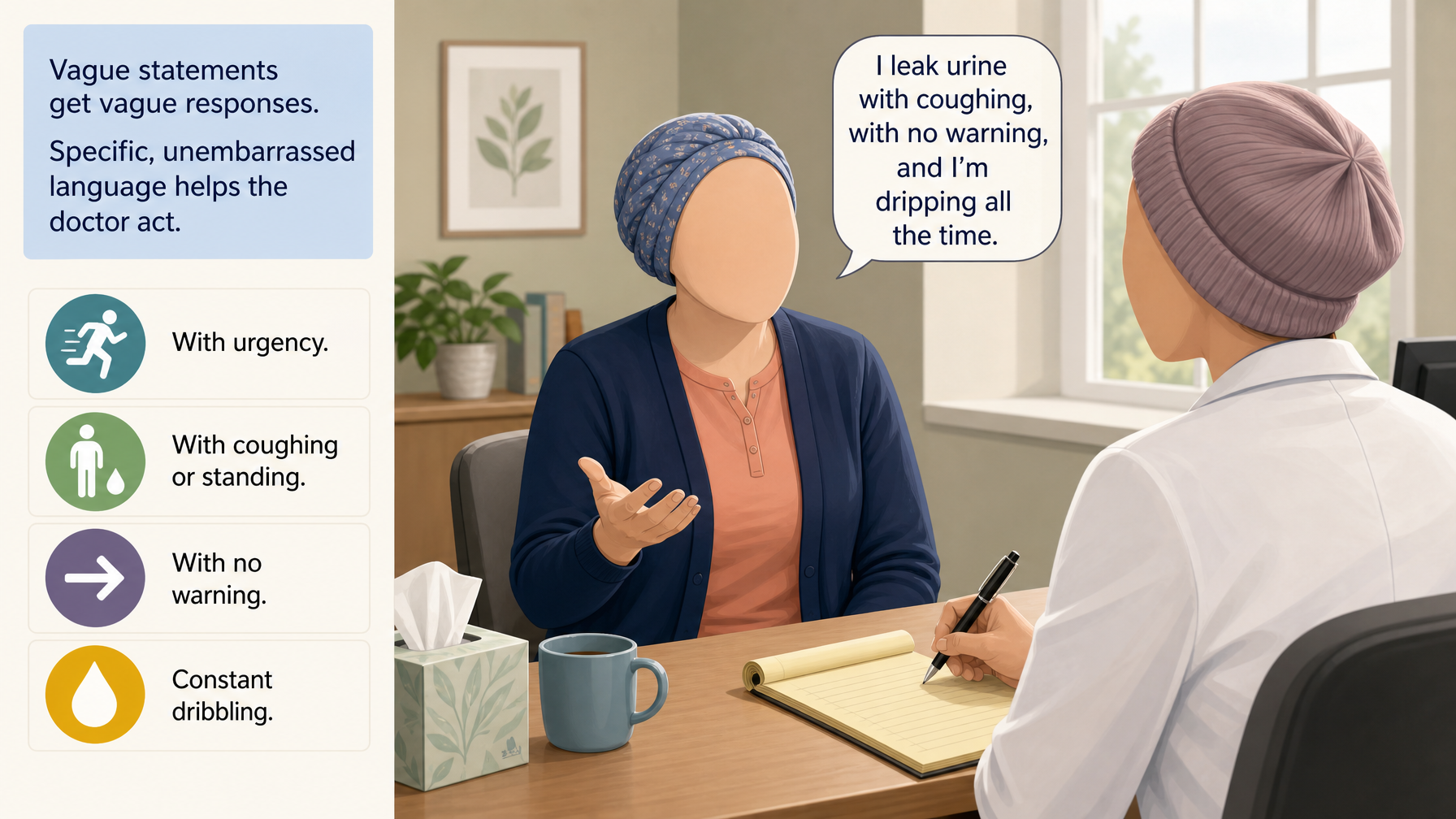
Vague statements get vague responses. Specific, unembarrassed language helps the doctor act:
- Open plainly: "I want to talk about a bladder-control problem" or "Mom has been having urinary accidents." Naming it directly signals you want it taken seriously.
- Describe the type without jargon: leaks with urgency ("has to go and can’t hold it"), leaks with coughing or standing (stress), leaks with no warning, or constant dribbling — each suggests a different cause.
- Quantify: "several times a day," "soaks through overnight," "a few drops with coughing." The diary makes this easy.
- State the impact: "she has stopped going out because of it" — the effect on life underlines that this needs addressing, not dismissing.
Good to know
If the appointment is for the senior and they are embarrassed, agree beforehand that you will raise it, or write it at the top of the visit’s concern list so it is not left to the last rushed minute.
Questions to ask the doctor

Come with questions so the visit produces a plan, not just sympathy:
- "Could this be a urinary tract infection? Can we do a urine test today?" — infection is a common, easily missed cause, especially with any confusion. See UTI signs in seniors.
- "Could any of the medications be contributing?"
- "Could constipation be involved?" — a frequent, fixable factor; see bowel incontinence in elderly.
- "What type of incontinence does this look like, and what are the treatment options — exercises, medication, or procedures?"
- "Would pelvic-floor exercises help?" — see pelvic floor exercises for seniors.
- "Should we see a specialist (urologist, urogynecologist, or continence nurse)?"
If the doctor brushes it off
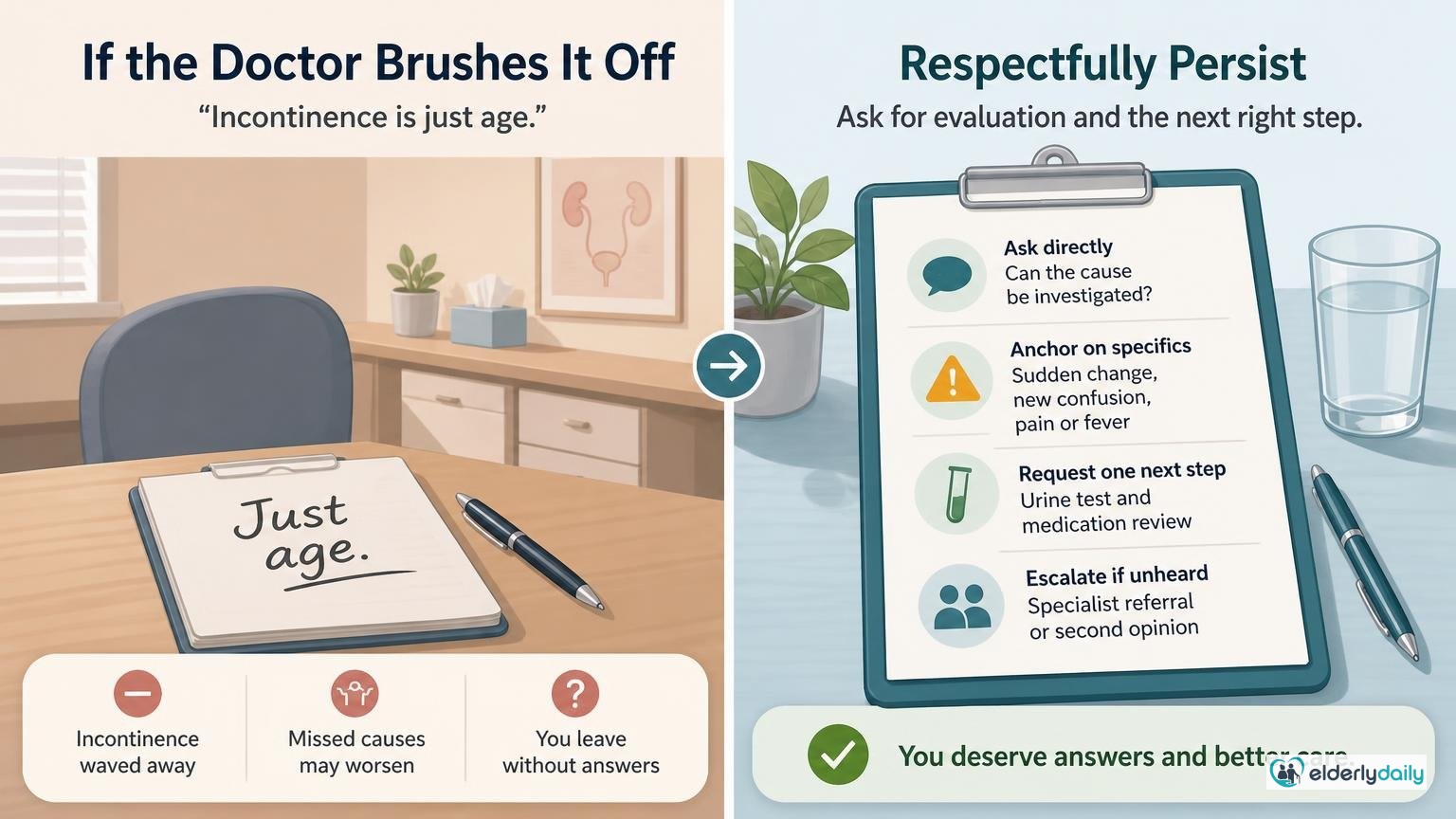
Occasionally incontinence is waved away as "just age." You can respectfully persist:
- Ask directly: "I understand it is more common with age, but I have read it is often treatable — can we look into the cause?"
- Anchor on the specifics: a sudden change, or new confusion, or pain/fever, clearly warrants a workup — restate those.
- Request the concrete next step: "Can we at least start with a urine test and a medication review?"
- If you still feel unheard, it is reasonable to ask for a referral to a continence specialist or to seek a second opinion. Advocacy is part of caregiving — the same persistence helps across talking to doctors as a caregiver.
Safety first
Do not let red-flag symptoms be dismissed. Inability to urinate, new leg weakness or numbness with loss of control, or high fever with back pain need urgent evaluation regardless — see incontinence warning signs.
After the appointment

Leave with clarity and follow through:
- Confirm you understand the suspected cause, the plan, and what to watch for.
- If tests were ordered, note when results come and how you will hear them.
- Start any recommended steps — exercises, fluid timing, a medication trial — and keep the diary going to see whether things improve.
- While treatment takes effect, manage day to day with dignity — see managing incontinence at home and, for nights, nighttime incontinence solutions.
- Book follow-up if there is no improvement, and revisit if things worsen — see signs incontinence is getting worse.
Frequently asked questions
Is incontinence actually treatable, or is it just part of aging?
It is treatable. Incontinence is more common with age but is a medical symptom with identifiable causes — infection, medications, constipation, pelvic-floor weakness, prostate issues, and more. Many cases can be cured or substantially reduced, and almost all can be better managed. It should never be dismissed as unavoidable.
What should I bring to the doctor about incontinence?
Three things: a bladder diary kept over a few days (times, leaks, amounts, urgency, day vs night, fluid intake), a complete list of medications and supplements, and a written description of the pattern and when it started. These let the doctor narrow the cause quickly.
What is a bladder diary?
A simple log, kept for a few days, of when the person urinates and leaks, roughly how much, whether there was urgency or no warning, and how much they drink. The patterns it reveals — such as leaks with coughing, urgency, or night waking — point to different types and causes of incontinence and greatly help diagnosis.
What questions should I ask the doctor about incontinence?
Ask whether it could be a UTI and request a urine test, whether medications or constipation could be contributing, what type of incontinence it appears to be and the treatment options, whether pelvic-floor exercises would help, and whether a specialist referral is warranted.
What if the doctor says it is just old age?
Persist respectfully. Note that incontinence is often treatable and ask to investigate the cause, restate any red flags (a sudden change, confusion, pain or fever), and request a concrete first step such as a urine test and medication review. If still unheard, ask for a continence-specialist referral or seek a second opinion.
How do I bring it up if my parent is embarrassed?
Agree beforehand that you will raise it, or write it at the top of the appointment’s concern list so it is not left to the final rushed minute. Use matter-of-fact language, and frame it around getting help and keeping independence rather than as a failing.
Sources
- National Institute on Aging (NIH). Urinary Incontinence in Older Adults
- Clinical Infectious Diseases (Norman, 2000). Fever in the Elderly
- American Association of Neurological Surgeons. Cauda Equina Syndrome
