
4 Best Bed Rails for Elderly
 By Kutubuddin, Founder & Senior Care Researcher Updated October 2026
In this guide

A bed rail can give leverage to sit up and a reassuring handhold. But safety has to come first: regulators have documented serious injuries and deaths from entrapment between rail and mattress, especially for people with confusion or dementia.
We may earn a commission when you buy through links on this page. Read our affiliate disclosure.
Top 4 Picks — Find Your Situation
#1 · Best Overall
Stander EZ Adjust Bed RailBest for: Most alert seniors who need leverage to sit up and get in and out of bed
#2 · Best Swing-Down Rail
Stander Wonder Pivot Bed RailBest for: Households where a caregiver needs to reach the bed, or the rail is only wanted at night
#3 · Best Adjustable
Able Life Bedside Extend-A-RailBest for: Seniors with higher beds who need a customizable assist rail
#4 · Best for Living Alone
Vaunn Medical Adjustable Bed RailBest for: Independent seniors who want a stable rail that does not rely on mattress weight
From January 2003 through September 2021 the CPSC recorded 300 deaths involving adult portable bed rails, 92 percent from entrapment. Since 2021 the CPSC has issued 38 recalls and 14 safety warnings, with 19 recalls in 2026 alone. Two picks here — the Stander EZ Adjust and the Vaunn — passed independent Consumer Reports testing published 23 July 2026, which almost nothing in this category has done. For most seniors, the right choice is a half-length assist rail used as a mobility aid, not a full-length side rail used to keep someone in bed. Our overall pick is the Stander EZ Adjust. Because the people most at risk of a bed fall often can't call for help, many families also add a monitoring system so a night-time fall is detected automatically.
A closer look at our top pick: the Stander EZ Adjust
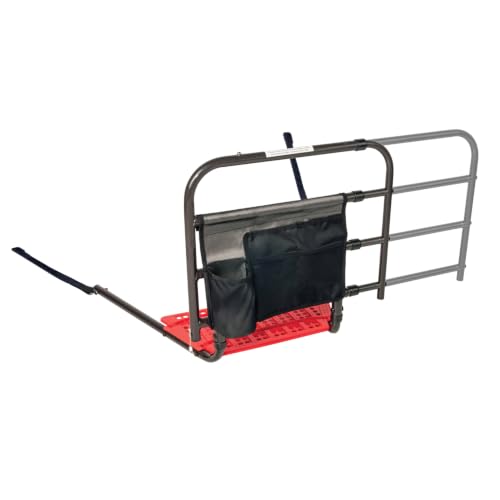
Stander EZ Adjust Bed Rail
Most alert seniors who need leverage to sit up and get in and out of bed
The Stander EZ Adjust is our overall pick because it adapts to the user instead of forcing a one-size approach. Its length adjusts, so the same rail can serve as a compact assist bar or extend for more support as needs change, and it folds down so getting in and out of bed is easier rather than harder. A supporting leg and a frame strap keep it anchored, and the organizer pouch is a genuinely useful touch for keeping a phone and glasses in reach.
It earns the spot by being a flexible assist rail rather than a restraint-style barrier — which is the safer category for most seniors. That said, no rail is safe if it's poorly fitted: anchor it properly, confirm there's no dangerous gap against the mattress, and re-check it over time.
What we love
- Flexible length suits different needs
- Folding design aids transfers
- Stable when properly anchored
- Handy storage pouch
Things to consider
- Requires correct anchoring to avoid shifting
- Must check mattress fit for gaps
- Heavier than a simple assist handle
Right for you if
- ✓You're an alert senior who needs leverage to sit up and transfer
- ✓You want a rail whose length adapts to changing needs
- ✓You'd benefit from a fold-down design for getting in and out
- ✓You can fit and anchor it correctly to the mattress and frame
Maybe skip it if
- !The user has dementia, confusion, or restlessness — see safer alternatives and consult a professional
- !You want a simple handhold only — see our [bed assist handles guide](/reviews/best-bed-assist-handles)
- !Your mattress is very soft or thick and can't be fitted without gaps
What owners consistently report
Common praise
- +Owners value the adjustable length and fold-down support
- +It's praised for steadiness when properly anchored
- +The organizer pouch is a frequently mentioned plus
Common gripes
- –It must be anchored correctly or it can shift
- –Mattress fit needs checking to avoid gaps
- –It's bulkier and heavier than a basic assist handle
Getting started
- →Secure the frame strap and seat the supporting leg before use
- →Confirm there's no gap large enough to trap a head or limb
- →Re-check the fit and tightness periodically
How it compares
The Stander Wonder Pivot is the better choice where someone else needs regular access to the bed — it swings down out of the way and back up again, which the EZ Adjust does not do as readily. Both makers state ASTM F3186-17 compliance, though only the EZ Adjust has a published independent test result behind it. Choose the EZ Adjust for everyday adjustable support, the Wonder Pivot when a caregiver is in and out of the bedside and a fixed rail keeps getting in the way.
How we picked
We compared widely available bed rails and assist handles on what matters for safety: stable anchoring and mattress fit, ease of getting in and out, adjustability, weight capacity, and — most importantly — entrapment-risk design. We favored half-length assist rails and looked for products that meet the current federal safety standard (ASTM F3186-17 / CPSC 16 CFR Part 1270). Every product here is checked against the CPSC recall database and against published independent test results before it is listed, and re-checked when we update the page; anything under an active recall is removed rather than caveated. Our picks draw on manufacturer specs, CPSC recall notices, FDA and CPSC safety guidance, Consumer Reports test results published 23 July 2026, expert reviews, and owner feedback — not our own hands-on lab testing. Where a senior has cognitive impairment, no product replaces a doctor's or occupational therapist's assessment.
Reviewed by Kutubuddin — who researches senior-care products and the real-world needs of caregivers and older adults.
Other picks, reviewed
Stander Wonder Pivot Bed Rail

The rail to buy when someone else has to get to the bed. It pivots down through 180 degrees and rests against the side, so making the bed, helping with a transfer or reaching someone in the night does not mean unbolting anything — then swings back up and latches. Stander states that it complies with ASTM F3186-17, the standard that sets limits on the openings that cause entrapment, though no published independent test result is available for this model. Length adjusts through three positions, 26, 32 and 38.5 inches, so it works as a short assist rail or a longer guard depending on what you set it to. Worth knowing before you order: Amazon currently shows an extended dispatch time on this one, so it is not a next-day buy.
What we like
- Stander states ASTM F3186-17 compliance — the standard that limits the openings causing entrapment
- Pivots down 180° and rests at the bedside, so bed-making and transfers do not mean removing it
- Three length settings, so it works as an assist rail or a longer guard
- Doubles as a handhold for sitting and standing, not just a barrier
- Fits platform, box-spring and slat beds with the included safety strap
Keep in mind
- **Not intended for adjustable beds or hospital beds** — the maker excludes both
- Fits mattresses 8–12 in thick only; measure before ordering
- 300 lb limit is lower than some floor-standing rails
- The pivot needs clear floor space beside the bed to swing into
- Type
- Swing-down guard rail
- Certification
- ASTM F3186-17
- Length
- 26 / 32 / 38.5 in, adjustable
- Capacity
- 300 lb
- Mattress depth
- 8–12 in
Able Life Bedside Extend-A-Rail
A height-adjustable assist rail that fits a wide range of bed heights, which matters because the right height makes sitting and rising much easier. It anchors under the mattress with a frame strap and includes a storage pouch. The adjustability helps you get a snug fit and reduce gaps.
What we like
- Adjustable height fits many beds
- Helps achieve a snug, low-gap fit
- Frame strap for added stability
- Convenient storage pouch
Keep in mind
- Single rail, not full-side coverage
- Confirm fit on very thick mattresses
- Re-check height after bed changes
- Type
- Adjustable-height assist rail
- Height
- Adjusts to the bed
- Anchoring
- Under-mattress bar + strap
- Extras
- Storage pouch
- Capacity
- Verify on listing
Vaunn Medical Adjustable Bed Rail

The pick for someone managing on their own, because it does not depend on mattress weight to stay put. The base slides under the mattress but the load is carried by two floor-standing legs, with horizontal stabiliser bars and a slip-resistant foam-padded handle, in powder-coated steel rated to 300 pounds. Height and width both adjust, so it fits twin through king on either side of the bed, and it assembles without tools.
Check two measurements before ordering, because they rule this rail out more often than anything else. It needs at least 13 inches of clearance from the floor to the bed frame for the legs, so it will not work on a low or platform bed. And it fits mattresses 7 to 11 inches thick — note that this is a different window from the Stander EZ Adjust above, which needs 10 to 14 inches. If your mattress is 12 inches, look at the Stander EZ Adjust; if it is 8 inches, this one fits. Vaunn also states it will not work on most Sleep Number beds or on mattresses velcroed to their foundation.
What we like
- Floor legs carry the load, so stability does not depend on mattress weight — the safer design on a twin or a light mattress
- 300 lb capacity in powder-coated steel, with horizontal stabiliser bars
- Height and width both adjust; fits twin through king, either side
- Slip-resistant foam-padded handle rather than bare tube
- Tool-free assembly
Keep in mind
- Needs 13 in or more from floor to bed frame — rules out low and platform beds
- Mattresses 7–11 in only; a 12 in mattress is outside the range
- Vaunn excludes most Sleep Number beds and velcroed mattresses
- Not for confused or restless users
- Single-side support only
- Type
- Floor-standing adjustable rail
- Capacity
- 300 lb
- Mattress depth
- 7–11 in
- Floor clearance
- Needs 13 in+ under the frame
- Anchoring
- Under-mattress base + floor legs
- Independent test
- Passed CR breakage + entrapment, Jul 2026
What to look for
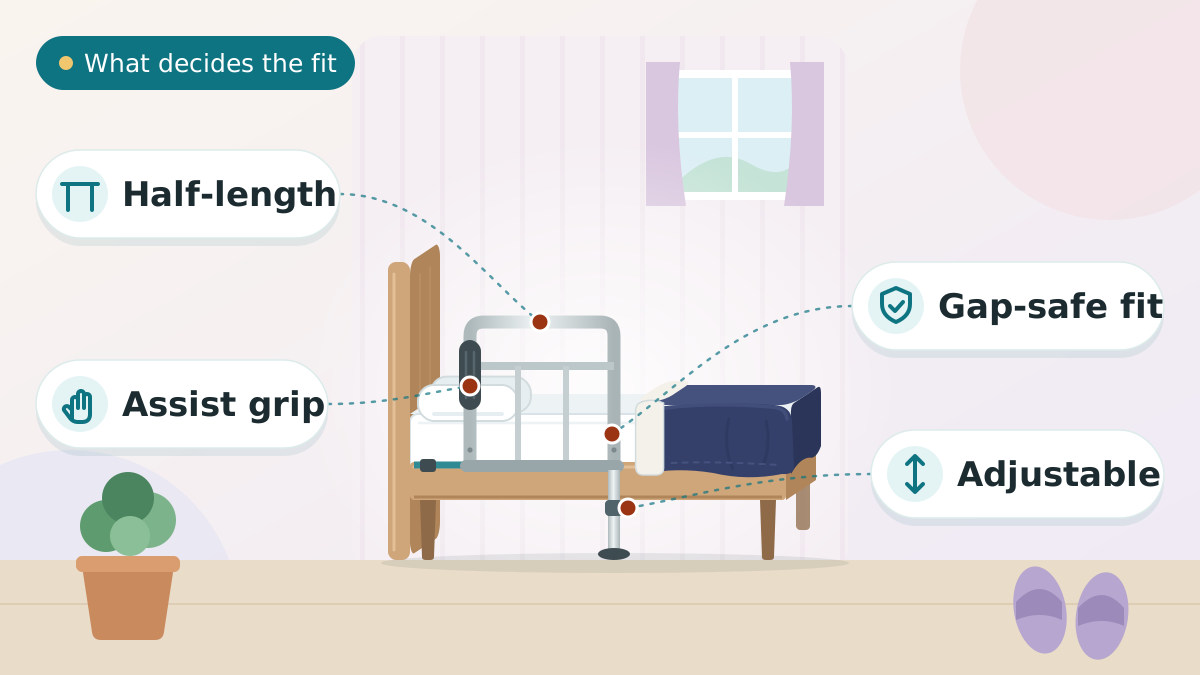
Assist rail vs full side rail — start here
This is the most important decision, and it's about purpose, not just product.
An assist rail or handle helps a person sit up, balance, and get in and out of bed — it's a mobility aid, and for an alert senior it's generally the safer choice. A full-length side rail is meant to stop someone rolling out, which is closer to a restraint and carries a higher entrapment risk. For most older adults at home, a half-length assist rail is the appropriate option.
Entrapment risk: the most important safety factor
Regulators have documented serious harm from bed rails. From January 2003 through September 2021 the CPSC received reports of 300 deaths involving adult portable bed rails; 92 percent were caused by the head or neck becoming entrapped, and 7 percent by falls involving the rail. Enforcement has stepped up sharply since the federal standard became mandatory in August 2023: the CPSC has announced 38 recalls and 14 safety warnings since 2021, covering more than two million rails, and 19 recalls in 2026 alone. The risk is a head, neck, or chest becoming caught between the rail and the mattress.
- Choose a rail that meets the federal safety standard (ASTM F3186-17 / CPSC 16 CFR Part 1270).
- Fit it tightly to the mattress so there's no gap large enough to trap a head or limb.
- Be extra cautious with soft, memory-foam, or air mattresses, which compress and create gaps.
- Inspect the rail monthly for shifting, loosening, or new gaps.
Secure anchoring and mattress fit
A rail that shifts is dangerous, so anchoring and fit are non-negotiable.
Look for an under-mattress bar plus a strap that secures to the bed frame, and confirm the rail suits your mattress thickness and type — heavier mattresses anchor better, while very soft ones need careful checking. Some rails need a compatible bed frame to attach safely.
Height, length, and adjustability
The rail should match the mattress height so the grip sits where it's useful for pushing up.
Adjustable-height and adjustable-length models fit more beds and help you achieve a snug, low-gap fit. Foldable rails make it easier to get in and out and to transfer, and they tuck out of the way when not needed.
Weight capacity and useful extras
Confirm the weight capacity on the listing and choose one with a comfortable margin for the user.
Helpful extras include padded or contoured grips for arthritic hands, an organizer pouch for a phone and glasses, and a fold-down design that doubles as a transfer aid.
Read more:How to Help an Elderly Person Stand Up SafelyNighttime Falls in SeniorsPost-Hospital Recovery at Home
Check your rail against the recall list first
If a bed rail is already on the bed, checking it is more urgent than choosing a new one. More than two million adult portable bed rails have been recalled in the US since 2021, and recalled models keep reappearing on resale sites months afterwards. The fact that a rail is still for sale proves nothing.
Find the model number — printed on the metal tubing, on the fabric pouch, or next to the letters REF on the label, depending on the brand — and search it at CPSC.gov/Recalls. Recent recalls in this category include:
- Drive DeVilbiss bed assist handles and rails, December 2021 — models RTL15063-ADJ, 15064, RTL15062, RTL15073. About 496,100 units, two entrapment deaths.
- Carex / Compass Health Bed Support Rail model P566 and Easy Up 2-in-1 model P569, 2022 — three entrapment deaths involving the P566.
- Medline Bed Assist Bar, May 2024 — models MDS6800BA and MDS6800BAH. About 1.5 million units, two entrapment deaths.
- Medical King Bed Assist Rail, November 2024 — models 7007, 7057, 7037. One death.
- KingPavonini adult portable bed rails, November 2025 — six models, for violating the mandatory standard and missing the required hazard warning labels.
- Plus a steady run of importer-brand recalls through 2025 and 2026 — Vive Health, MNIENT, Hepo, Nimood, Hopelight and others — and a CPSC warning on CanFord rails in January 2026.
We removed a product from this guide in July 2026 for exactly this reason. The KingPavonini rail we previously listed as our heavy-duty pick came from a brand whose bed rail line was recalled in November 2025, and Consumer Reports separately tested a KingPavonini rail and it failed the breakage test. We do not caveat recalled products here; we take them off the page.
What independent testing actually shows
Almost no adult bed rail has ever been independently verified, which is why so much of the marketing leans on the word ASTM. The record is worth knowing before you trust a listing.
Starting in 2018 the CPSC tested 35 adult portable bed rail models chosen to represent the market. 94 percent failed the entrapment requirements and 80 percent failed the retention-system requirements — not one met the voluntary standard then in place. Seventeen more were tested three years later, and again none passed. That is what led to the mandatory standard in August 2023.
Consumer Reports published its own testing of ten adult models on 23 July 2026, and four of the ten failed on breakage or entrapment. Of the rails on this page, the Stander EZ Adjust and the Vaunn Medical Adjustable Bed Rail both passed. The KingPavonini rail failed breakage, which is why it is no longer listed here.
The practical lesson: treat a maker's own "ASTM tested" badge as marketing until you see a published independent result or a specific claim of compliance with 16 CFR Part 1270. ASTM does not approve or certify anything, and several recalled rails carried the phrase.
Tips to Choose Bed Rails
Short on time? Here are the key points to weigh before choosing, each covered in detail above:
- Assist rail vs full side rail — start here
- Entrapment risk: the most important safety factor
- Secure anchoring and mattress fit
- Height, length, and adjustability
- Weight capacity and useful extras
Comparing options? See our guides to Best Canes for Seniors, Best Walkers for Seniors, and Best Rollators for Seniors.
Who should not use a bed rail (and safer alternatives)
Bed rails are not appropriate for everyone, and for some people they raise the risk of serious injury. Standard rails are not recommended for seniors with moderate-to-severe dementia, Alzheimer's, confusion, restlessness, or uncontrolled movements. A disoriented person may try to climb over the rail — and fall from a greater height — or become wedged against it. In these cases, always consult the person's doctor or an occupational therapist first.
Often a different approach is safer. For high-risk users, consider lowering the bed, placing bedside fall mats to cushion a fall, using a bed alarm to alert a caregiver, and adding motion-activated lighting. A bed rail also only helps at the bed — it does nothing for falls elsewhere in the home.
Installing and checking a bed rail safely
Safe use comes down to fit and follow-up:
- Install exactly per the instructions, using the under-mattress bar and frame strap.
- Make sure there's no gap larger than recommended between the rail and the mattress.
- Press and tug to confirm the rail doesn't shift before relying on it.
- Re-check the fit regularly, since rails can loosen or move over time.
- Stop using it if the person tries to climb over it or could get caught, and reassess with a professional.
Bed rails for adjustable beds
An adjustable bed changes the problem completely, and most rails sold for a flat bed are unsafe on one. As the head or foot section raises, the mattress bends while a rigid rail does not — which opens a gap that was not there when the bed was flat, exactly the kind of moving gap that causes entrapment. Rails that anchor by sliding a bar under the mattress are the worst offenders, because the base they rely on is the part that moves.
If the bed articulates, you need a rail that either mounts to the bed frame and travels with the moving section, or is sold and tested specifically for adjustable bases. Many adjustable bed makers sell a matching rail, and that is usually the safest answer because it has been tested against that frame.
Check the rail with the bed in every position it will actually be used in — flat, head raised, and both raised — not just flat. The same applies to a hospital-style bed at home: those take manufacturer half-rails that bolt to the frame, and mixing a consumer bed rail with a hospital bed is a combination the FDA has specifically warned about.
Rail, grab rail, assist handle or bed cane — what the names mean
The same words get used for very different products, and buying the wrong category is the most common mistake here.
- Bed rail or safety rail — a long barrier, usually 20 to 40 inches, meant to stop someone rolling out of bed during sleep. It is a guard.
- Grab rail, assist handle, assist bar or bed cane — a short vertical handle, often under 20 inches, giving leverage to sit up and stand. It is a handhold, not a barrier; someone can roll straight past it.
- Half rail — between the two: long enough to give a sense of edge, short enough to leave the foot of the bed clear.
The distinction matters because the two solve opposite problems. If the worry is rolling out while asleep, a handle will not help. If the worry is the effort of getting up at 3am, a full-length guard rail is more barrier than anyone needs and adds climb-over risk. Be clear which problem you are solving before you shop — our bed assist handles roundup covers the handle category in full.
Bed rail pads, and why they are a safety item
Bed rail pads are sold as comfort accessories. They are better understood as gap-filling safety kit.
Entrapment happens in the spaces around a rail — between the bars, between the rail and the mattress, and at the ends where the rail stops. A well-fitted rail keeps those spaces small enough that a head or limb cannot pass through. A pad wrapped around the rail reduces those openings further, and softens the rail so a knock at night is a bump rather than a bruise.
They are worth having if the rail has open bars rather than a solid panel, if the person moves a lot in their sleep, or if bruising has already happened. What a pad cannot do is make an unsafe rail safe — if there is a gap large enough to worry you, the answer is a better-fitting rail, not padding over the problem. Padding compresses, and a compressed pad is a gap again.
Check that the pad fits the rail you own; they are not universal, and a loose pad that slides is worse than none.
Should you build a bed rail yourself?
There is steady search interest in making one, usually from timber or PVC pipe, and the honest answer is no.
Certified rails are tested against defined dimensional limits — ASTM F3186 for adult portable bed rails, and the FDA entrapment zone guidance for hospital beds — because the sizes of the openings are the whole safety question. Those numbers are not intuitive. A gap that looks obviously too small to be a problem can still admit a head, and a gap that seems harmless when the mattress is firm changes when someone rolls against it.
A home-made rail has no tested gap dimensions, no load rating, and no anchoring designed for the bed it is on. It is also being built for the person most likely to be harmed by getting it wrong.
If cost is the reason, look at a short assist handle instead — they are considerably cheaper, and for most people the real need is leverage to get up rather than a barrier. If a barrier is genuinely needed, ask about equipment loan schemes through social services, a hospice or a local charity, and an occupational therapist can assess and fit one properly. Our bed rail safety and entrapment guide covers what a proper fit involves.
Frequently asked questions
They can be safe for an alert senior who needs leverage to sit up and transfer, provided the rail complies with the federal standard (16 CFR Part 1270, which incorporates ASTM F3186-17), is fitted tightly to the mattress with no dangerous gaps, and is checked regularly. They are not safe for everyone: regulators have documented entrapment injuries and deaths, and standard rails are not recommended for people with confusion, dementia, or uncontrolled movements without a professional's guidance.
Only partially, and not for everyone. An assist rail helps someone reposition and get in and out safely, but it isn't a guaranteed barrier. For a disoriented person it can backfire — they may climb over it and fall from a greater height, or become wedged against it. If preventing falls from bed is the goal for a high-risk user, a lower bed plus bedside fall mats is often safer than a rail.
Sometimes, but only if the rail is certified for that use and installed per the maker's instructions. Adjustable and specialty mattresses change shape and can open up gaps between the rail and mattress, which raises entrapment risk. Confirm compatibility with both the bed and the mattress before buying, and re-check the fit whenever the bed position changes.
It varies widely by model, so check the weight capacity on the specific product listing rather than assuming. Choose a rail rated comfortably above the user's weight, and remember that capacity is only one factor — secure anchoring and a proper mattress fit matter just as much for safe support.
Most install without professional help, using an under-mattress bar and a strap that secures to the bed frame. The important part is doing it correctly: follow the instructions exactly, eliminate any large gap against the mattress, and test that the rail doesn't shift. If the user has complex needs or cognitive impairment, have an occupational therapist advise on whether a rail is appropriate at all.
A bed assist handle is a compact grip that slides under the mattress to help someone push up and steady a transfer — a pure mobility aid with minimal barrier. A bed rail is longer and offers more support, but a full-length one acts more like a barrier and carries higher entrapment risk. For many seniors who just need leverage, an assist handle is the simpler and safer choice.
Yes, and this is the central safety concern. Entrapment happens when a head, neck, or chest is caught between the rail and the mattress, and of the 300 deaths the CPSC recorded from adult portable bed rails between 2003 and 2021, 92 percent were caused this way. The risk rises with soft or specialty mattresses and with confused users. Reduce it by choosing a certified rail, fitting it with no large gaps, and inspecting it regularly.
Generally not. Traditional Medicare typically doesn't cover portable bed rails, and a bill that would expand coverage for items like detachable bed rails had not passed as of 2026. Some bed rails may be FSA or HSA eligible, and a doctor's letter of medical necessity can help — check your specific plan before buying.
A bed rail anchors to the bed and helps with sitting up and getting in and out at the bedside. A floor-to-ceiling transfer pole provides a vertical grip the person can use to pull up to standing and pivot, which suits those who need help rising and turning, not just bedside support. Some people benefit from both; an occupational therapist can advise which fits the person's mobility.
Use extra caution. Memory foam and other soft mattresses compress and shift, which can open gaps between the rail and mattress and increase entrapment risk. If you do use a rail with memory foam, choose a certified model, ensure a snug fit with no large gap, and check it frequently. Where a safe fit can't be achieved, consider a bedside fall mat and a lower bed instead.
Bed size matters less than mattress thickness and how the rail anchors. Most portable rails fit any bed width because they sit at the side rather than spanning it, and the specification to check is the mattress depth range — typically something like 8 to 12 inches, or 13 to 20 inches for the frame-clamp type. What does change with bed size is stability: on a twin, a rail that anchors by sliding a bar under the mattress has less mattress weight holding it down, so a model with floor-standing legs is the safer choice. On a queen or king the mattress weight alone is usually enough. Measure the mattress depth and the bed frame height before ordering, and check the rail's stated range rather than assuming.
Yes, and for some people they are safer. Lowering the bed reduces the distance of any fall and often removes the need for a barrier at all. A bedside fall mat cushions the landing. A bed alarm alerts a caregiver when someone gets up. A floor-to-ceiling transfer pole gives leverage without creating any gap to become trapped in, and suits someone who mainly needs help standing. For a person with dementia or significant confusion, these alternatives are generally preferred over a rail, because a rail can be climbed over — turning a fall from mattress height into a fall from rail height. Our bed rail safety and entrapment guide covers who should not use a rail in more detail.
A half rail runs roughly the upper half of the bed, covering the area where someone lies and turns while leaving the lower half clear for getting in and out. For many people that is the right compromise: it gives an edge to feel and something to hold when sitting up, without walling the bed in or forcing a climb over to get out. It is usually not enough if the concern is someone rolling right out during deep sleep or a seizure, where a full-length rail or a different approach entirely is needed. Half rails also leave an obvious open end, so check what is beside it — a bedside table with a hard corner in that position is worth moving.
A folding rail from a reputable maker that complies with the federal standard (16 CFR Part 1270) can be as safe as a fixed one when it is properly latched. The safety question is the latch, not the fold. Check that it locks positively rather than relying on friction, that the person using it cannot release it accidentally by leaning on it, and that you can hear or feel it engage. Fold-down rails suit situations where a caregiver needs quick access to the bed, or where the rail is only wanted at night. Get into the habit of confirming the latch every time it goes back up — a rail left unlatched looks exactly like one that is latched.
Generally no, and this is one of the clearer safety lines. Hospital beds have their own manufacturer rails designed and tested for that specific frame, and the FDA has warned about the risks of mixing components from different makers. An adult portable rail intended for a domestic bed is not tested against a bed that raises, lowers and articulates, and the gaps it creates change as the bed moves. If a hospital bed at home needs rails, they should come from the bed's manufacturer or supplier, and be fitted by whoever provides the bed. The exception is a few rails specifically sold as hospital-bed compatible — and there, compatible means the maker states it, not that it looks like it will fit.
Most of the models on this page are available from Amazon and general retailers, and medical supply shops stock the sturdier floor-standing types. Before ordering online, check three things the listing photo will not tell you: the mattress depth range, whether the rail has floor legs or relies on the mattress to hold it, and whether it carries ASTM F3186 certification. If a new mattress is also on the list, decide the rail first — mattress depth is what rules a rail in or out, and it is much easier to pick a mattress that fits the rail than the other way round. Our mattress guide for seniors sorts the options by depth for exactly this reason. If the person has complex needs, or the bed is adjustable or hospital-style, buying through a medical supplier or having an occupational therapist assess is worth the extra step — fitting is the part that goes wrong, and it is the part a website cannot check for you.
Yes. Compliance is mandatory, not optional. A federal safety standard for adult portable bed rails — 16 CFR Part 1270, which incorporates ASTM F3186 — took effect in August 2023, and it sets limits on the openings a rail can have, because opening size is the mechanism behind entrapment injuries. Selling a non-compliant rail is a violation, and most of the recent recalls are exactly that. One caution while shopping: a listing that says "ASTM Approved" or "ASTM tested" is not proof of anything. ASTM does not approve or certify products, so the phrase carries no weight on its own — several recalled rails carried it. What is worth looking for is a specific claim of compliance with the CPSC standard, and better still, third-party lab testing or a published independent test result. Never buy a used bed rail: it may predate the standard entirely, or be subject to a recall you will not hear about.
The final verdict
For most alert seniors, the Stander EZ Adjust is the best bed rail — adjustable, foldable, stable when properly fitted, and one of the few that has passed independent breakage and entrapment testing. The Vaunn passed the same tests and is the pick for an independent senior who wants something simpler. Choose the Stander Wonder Pivot when a caregiver needs to swing the rail out of the way, or the Able Life for adjustable height — noting that neither of those two has a published independent test result, only the maker's own compliance claim. If all the person needs is a handhold to push up from rather than a barrier, a bed assist handle is the lower-risk answer. Above all, treat this as a safety decision: pick an assist rail over a restraint-style side rail, fit it to the mattress with no dangerous gaps, and do not use a bed rail for someone with confusion or dementia without medical advice — for high-risk users, fall mats, a bed alarm, and a lower bed are often safer.
Our overall winner is the Stander EZ Adjust Bed Rail. You can visit the official site.
Our Top 4 Picks at a Glance
Ready to choose? Here are the top 4 again.
Best Overall
Stander EZ Adjust Bed Rail
Best Swing-Down Rail
Stander Wonder Pivot Bed Rail
Best Adjustable
Able Life Bedside Extend-A-Rail
Best for Living Alone
Vaunn Medical Adjustable Bed Rail
Affiliate links — we may earn a commission.
