
5 Best Adaptive Eating Utensils for Seniors
 By Kutubuddin, Founder & Senior Care Researcher Updated October 2026
In this guide
 Best overallHeavy Weighted Utensil Set (7 oz)
 Best angled design42-Degree Angled Weighted Utensil Set
 Best foam handleBUNMO Foam-Handle Weighted Utensils
 Best bendable / adjustable9-Piece Bendable Adaptive Utensil Set
 Best swivel design360-Degree Swivel Fork and Spoon
- What to look for
- Frequently asked questions
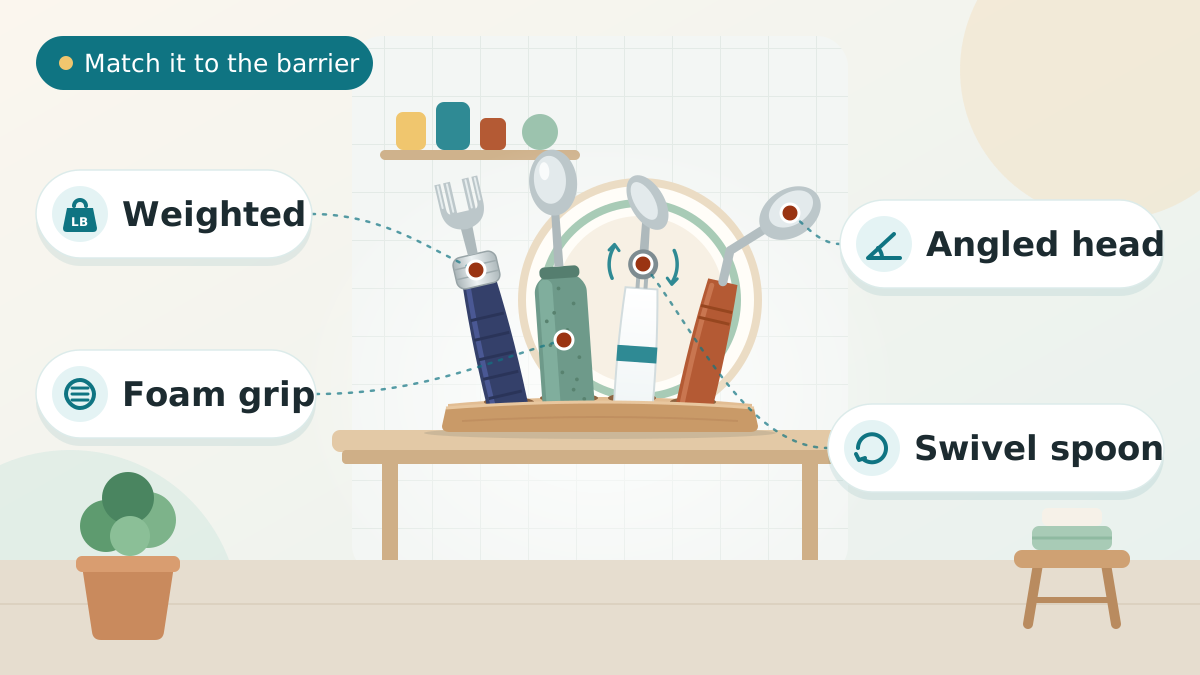
The right adaptive utensil matches the tool to the problem. Tremors or arthritis usually call for a heavy weighted set — the added mass steadies a shaky hand through inertia. Limited wrist motion needs an angled utensil that brings food to the mouth without twisting the wrist; a weak grip does best with a thick foam handle; changing conditions suit a bendable set you can reshape by hand. For advanced dementia or cerebral palsy, a swivel utensil that stays level on its own cuts spills.
Pair the right utensil with adaptive plates and cups and mealtimes get easier still. Below, our picks by need.
We may earn a commission when you buy through links on this page. Read our affiliate disclosure.
Our Top Pick
Heavy Weighted Utensil Set (7 oz)
For most seniors with tremors or arthritis, this heavy weighted set is the best place to start.
- About 7 oz per piece to dampen tremors through inertia
- Full stainless-steel set: knife, fork, and two spoons
- Substantial handles that arthritic hands can feel and hold
- Balanced weight for steadier food delivery
- Dishwasher friendly for daily use
- Designed for tremors, Parkinson's, and arthritis
Top 5 Picks — Find Your Situation
- Heavy Weighted Utensil Set (7 oz)Best overall
Best forSeniors with hand tremors, Parkinson's, or arthritis who need steadier control at every meal
- Heavier than most sets, so it steadies stronger tremors
- Complete set covers the whole meal
- Solid handles suit arthritic grip
Watch out: The weight can tire a very weak or frail hand
- 42-Degree Angled Weighted Utensil SetBest angled design
Best forLimited wrist or forearm mobility, where twisting to reach the mouth is the problem
- Angle removes painful wrist twisting
- Light weight also steadies a mild tremor
- Built-up grips suit a hand that cannot close tightly
Watch out: Handed design: confirm right or left before buying
- BUNMO Foam-Handle Weighted UtensilsBest foam handle
Best forWeak grip or arthritis, where a big soft handle matters more than heavy weight
- Very easy to hold with almost no squeezing
- Comfortable for long meals
- Light enough for a frail or tired hand
Watch out: Not heavy enough for a strong tremor
- 9-Piece Bendable Adaptive Utensil SetBest bendable / adjustable
Best forMultiple or changing conditions, where an adjustable angle and built-up grip both matter
- Adjusts to almost any hand or wrist
- Adapts over time as needs change
- Built-up non-slip grip suits weak hands
Watch out: Bend gradually and check for metal fatigue over time
- 360-Degree Swivel Fork and SpoonBest swivel design
Best forAlzheimer's, dementia, cerebral palsy, or strong tremor, where keeping the utensil level is the challenge
- Self-levelling head keeps food on the spoon
- Well suited to advanced neurological conditions
- Easy-grip handle
Watch out: The swivel feels unusual at first and takes adjustment
Heavy Weighted Utensil Set (7 oz)
Seniors with hand tremors, Parkinson's, or arthritis who need steadier control at every meal
The heavy weighted set earns the top spot because it solves the most common mealtime problem, an unsteady hand, in the simplest, most reliable way. There is no mechanism to learn and nothing to charge: about 7 ounces of stainless steel per piece dampens a tremor through plain physics, and the same solid weight gives an arthritic hand something substantial to hold. As a full knife, fork, and spoon set, it covers the whole meal rather than a single task.
It is deliberately heavier than most weighted utensils, which is what makes it effective on moderate to stronger tremors where lighter sets fall short. That same strength is its one limit, so it is worth being honest about who it does not suit.
What we love
- Heavier than most sets, so it steadies stronger tremors
- Complete set covers the whole meal
- Solid handles suit arthritic grip
- Simple, durable stainless steel
Things to consider
- The weight can tire a very weak or frail hand
- Heavier than needed for mild tremor alone
Right for you if
- ✓Moderate to stronger hand tremors or Parkinson's
- ✓Arthritis, where a solid handle is easier to feel and hold
- ✓Anyone who wants one durable set for the whole meal
Maybe skip it if
- !A very weak or frail hand that the weight would tire (choose the foam-handle set)
- !Limited wrist motion, where an angled set helps more
- !Advanced dementia or cerebral palsy, better served by a swivel utensil
What owners consistently report
Common praise
- +Owners with tremors report noticeably steadier eating and fewer spills
- +The substantial weight is the feature people credit most
- +Reviewers value having a complete matching set
Common gripes
- –A few find the weight tiring if the hand is very weak
- –Heavier than someone with only a mild tremor needs
- –Hand-dry to keep the stainless steel spotless
Getting started
- →Start with the spoon, usually the easiest piece to control
- →Rest the forearm on the table to add stability
- →If the weight tires the hand, switch to a lighter foam-handle set
How it compares to our runner-up
If the weight proves tiring for a frail hand, the foam-handle set gives the same easy grip with far less mass. And where the real problem is keeping the utensil level rather than steadying a shake, the swivel fork and spoon self-levels in a way no fixed utensil can.
How we picked
We compared 5 options. We compared adaptive utensils on how well they steady a tremor (weight and balance), grip comfort for arthritic or weak hands, the head shape and angle for getting food to the mouth without twisting the wrist, and how easy they are to clean for daily use. Picks draw on manufacturer specifications, verified owner reviews, and occupational-therapy guidance rather than hands-on lab testing. Match the handle size and weight to the user's grip and strength, and ask an occupational therapist or doctor if severe tremor, swallowing difficulty, or advanced dementia is involved.
Reviewed by Kutubuddin — who researches senior-care products and the real-world needs of caregivers and older adults.
Our picks, reviewed
Heavy Weighted Utensil Set (7 oz)
For most seniors with tremors or arthritis, this heavy weighted set is the best place to start. Each piece weighs about 7 ounces, and that added mass is the point: the weight dampens hand shaking through inertia, so a wobbling hand delivers food far more steadily than it would with an ordinary light fork. It is a full stainless-steel set, knife, fork, and two spoons (and other sets add extra spoons and knives), so it covers a whole meal, and the weight also gives arthritic hands something substantial to hold rather than a thin handle that is hard to feel. Heavier than most weighted utensils, it suits moderate to stronger tremors; for a very weak hand, the weight itself can tire the arm, in which case a lighter foam-handle set is the better match.
What we like
- Heavier than most sets, so it steadies stronger tremors
- Complete set covers the whole meal
- Solid handles suit arthritic grip
- Simple, durable stainless steel
Keep in mind
- The weight can tire a very weak or frail hand
- Heavier than needed for mild tremor alone
Key features
- About 7 oz per piece to dampen tremors through inertia
- Full stainless-steel set: knife, fork, and two spoons
- Substantial handles that arthritic hands can feel and hold
- Balanced weight for steadier food delivery
- Dishwasher friendly for daily use
- Designed for tremors, Parkinson's, and arthritis
42-Degree Angled Weighted Utensil Set
When the barrier is a wrist that will not twist, the angle of the utensil matters more than anything else. These pieces are bent to about 42 degrees, so the head reaches the mouth while the wrist stays in a neutral, comfortable position, with no painful rotation to scoop and lift. They are also lightly weighted at around 2.5 ounces, enough to calm a mild tremor without tiring the arm, and the handles are built up with non-slip silicone for a hand that cannot close tightly. This is a four-piece set built for a specific hand, so check the handedness of the version you are ordering. For a senior with limited wrist mobility from arthritis, stroke, or Parkinson's, the angled head is what makes self-feeding possible again.
What we like
- Angle removes painful wrist twisting
- Light weight also steadies a mild tremor
- Built-up grips suit a hand that cannot close tightly
- Purpose-built for limited range of motion
Keep in mind
- Handed design: confirm right or left before buying
- Lighter weight helps less with a strong tremor
Key features
- About 42-degree angled head for a neutral wrist position
- Lightly weighted (around 2.5 oz) to calm mild tremor
- Four-piece adaptive set
- Built-up handles with non-slip silicone grips
- Handed design — confirm right or left before ordering
- For limited wrist mobility from arthritis, stroke, or Parkinson's
BUNMO Foam-Handle Weighted Utensils
A thick, soft foam handle is the easiest thing in the world to hold, and that is exactly what this set gets right. The built-up foam grips give a weak or arthritic hand plenty to wrap around with very little squeezing force, while the stainless-steel heads still feel like proper cutlery. It is lighter than the heavy weighted set, so it does not tire a frail arm, yet the modest weight and wide grip together steady a mild tremor and let many seniors eat independently again. For a weak hand grip, handicapped users, or an elderly person who finds thin metal handles hard to manage, this is the comfortable, low-effort choice.
What we like
- Very easy to hold with almost no squeezing
- Comfortable for long meals
- Light enough for a frail or tired hand
- Good value everyday set
Keep in mind
- Not heavy enough for a strong tremor
- Foam can compress over months of daily use
Key features
- Thick, soft foam handles need very little grip force
- Stainless-steel heads for real cutlery feel
- Lightweight, so it does not tire a frail arm
- Wide grip helps arthritis and weak hands
- Helps many users eat independently
- For elderly, weak grip, and handicapped users
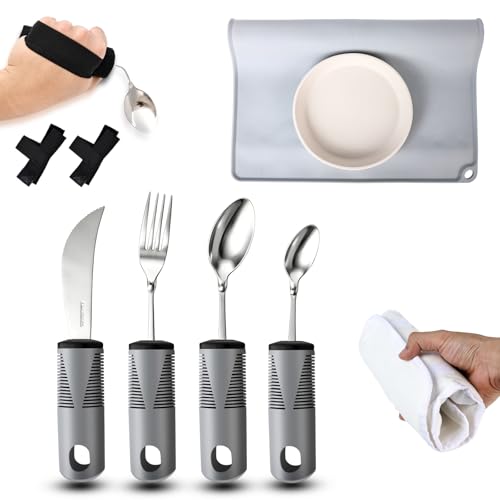
9-Piece Bendable Adaptive Utensil Set
When needs are mixed or changing, one adjustable set beats buying several. These utensils bend, so you can shape the head to whatever angle a hand and wrist need, and reshape it later as things change after a stroke or as arthritis progresses. They pair that with built-up, non-slip grips for a weak or painful hand, a light weight that helps stabilise without tiring, and BPA-free materials. At nine pieces it is the most comprehensive set here, covering different foods and both hands. For a household managing more than one condition, or a recovery where the right angle keeps shifting, the bendable set is the most flexible answer.
What we like
- Adjusts to almost any hand or wrist
- Adapts over time as needs change
- Built-up non-slip grip suits weak hands
- Comprehensive multi-piece set
Keep in mind
- Bend gradually and check for metal fatigue over time
- Not a substitute for heavy weight on a strong tremor
Key features
- Bendable heads shape to any wrist or hand angle
- Reshape as needs change after stroke or with arthritis
- Built-up, non-slip grips for a weak or painful hand
- Light weight to stabilise without tiring
- Nine pieces cover different foods and both hands
- BPA-free materials
360-Degree Swivel Fork and Spoon
A swivel utensil does something none of the others can: the head rotates freely, so it stays level on its own even when the hand tilts. That self-levelling action is a real help for the tremor, rigidity, and unpredictable movements of Alzheimer's, dementia, Parkinson's, and cerebral palsy, where keeping a loaded spoon flat is the hardest part. The easy-grip stainless-steel handles are simple to hold, and because the food stays put on the way to the mouth, spills and frustration drop. For advanced conditions where control is limited and dignity at the table matters, the swivel design is the one to try.
What we like
- Self-levelling head keeps food on the spoon
- Well suited to advanced neurological conditions
- Easy-grip handle
- Cuts spills and mealtime stress
Keep in mind
- The swivel feels unusual at first and takes adjustment
- Fork and spoon only, not a full cutlery set
Key features
- 360-degree swivel head stays level on its own
- Counters tilting from tremor and rigidity
- Easy-grip stainless-steel handles
- Reduces spills on the way to the mouth
- For Alzheimer's, dementia, Parkinson's, and palsy
- Simple to hold and use
What to look for
Match the utensil to the barrier
There is no single best adaptive utensil, only the best one for a particular hand. Start by naming the barrier:
- Tremor or Parkinson's: added weight steadies the hand through inertia, and the stronger the tremor, the heavier the utensil should be.
- Weak or arthritic grip: a thick, built-up foam handle needs far less squeezing force than thin metal.
- Limited wrist motion: an angled head reaches the mouth without twisting a stiff or painful wrist.
- Mixed or changing needs: a bendable set adjusts to the hand and reshapes as things change.
- Advanced dementia or cerebral palsy: a swivel head that self-levels keeps food on the utensil.
If more than one applies, a weighted set with built-up handles covers the two most common problems at once. For related mealtime help, adaptive plates, bowls, and cups work alongside any of these.
Weight versus built-up handles
These are the two features people confuse most, and they solve different problems. Added weight, roughly 4 to 8 ounces, fights tremor because the mass resists shaking. A built-up handle, simply a thicker grip, fights weak or arthritic grip by reducing how hard the hand has to close. A senior with a strong tremor needs weight; a senior with painful arthritis but steady hands needs girth; and many do best with both. Weight has a limit, though: on a very frail arm a heavy utensil tires the hand and backfires, so match the weight to the strength, not just the tremor. If arthritis is flaring in the hands, a warm-up with a heating pad before meals can loosen stiff joints.
Head shape, angle, and handedness
The business end matters as much as the handle. A slightly angled head lets a stiff wrist reach the mouth without rotating; a swivel head stays level for unpredictable movement; a deep, rounded spoon bowl holds more without spilling than a flat one. Watch for handedness too, since some angled utensils are made specifically for the right or left hand, so confirm before ordering. And check the head is not too large for the mouth, which matters for anyone with swallowing concerns.
Keeping them usable day to day
An adaptive utensil only helps if it gets used, so practical details count. Most weighted and foam-handled sets are dishwasher friendly, though thick foam grips last longer with a gentle wash, and any utensil with a mechanism, like a swivel, is best hand-washed. Buy a set rather than a single piece so the whole meal is covered, and keep a spare in case one is lost or in the wash. For a fuller picture of setting up the home for independence, our daily living aids caregiver guide walks through the wider kit.
Tips to Choose Adaptive Utensils
A few quick pointers when choosing an adaptive utensil set:
- Name the single biggest barrier first, tremor, grip, wrist motion, or control, and buy for that.
- For tremor, match the weight to the hand: heavier for a strong tremor, lighter for a frail arm.
- For arthritis, prioritise a thick, soft handle over weight.
- Confirm handedness on any angled utensil before ordering.
- Start with one utensil to test the fit before buying a full set.
- Involve an occupational therapist if there is severe tremor, swallowing trouble, or advanced dementia.
The goal is not the fanciest utensil, it is the one the person will actually pick up and use at every meal.
When to ask an occupational therapist
Adaptive utensils solve a mechanical problem, getting food from plate to mouth, but they do not address why eating has become hard. If a senior is losing weight, coughing or choking during meals, pocketing food, or showing a sudden change in their ability to eat, that needs a professional assessment, not just a new fork. An occupational therapist can match the exact utensil to the hand and also spot swallowing or cognitive issues that need medical attention. Treat the right utensil as one part of a mealtime plan; our guide to managing chronic conditions at home covers how mealtime fits the bigger picture.
Frequently asked questions
Yes. Weighted utensils add mass that dampens hand shaking through inertia, so a wobbling hand delivers food more steadily, and many families see meaningfully fewer spills after switching. The heavier the utensil, the more it steadies a strong tremor, up to the point where the weight starts to tire the hand. For very severe tremor, battery-powered stabilising spoons exist and can help further, and an occupational therapist can advise whether one is worth it.
They solve different problems. Weighted utensils add mass, often 4 to 8 ounces, to steady a tremor through inertia. Built-up handles are simply thicker, so an arthritic or weak hand can hold them with much less squeezing force, without adding weight. Choose weighted for tremors, built-up for arthritis or weak grip, and a set that combines both if a hand has both problems.
Yes, when adjusted gently and checked over time. Bendable utensils let you shape the head for limited wrist motion, but bend them gradually rather than forcing them, and inspect them for cracks or metal fatigue every so often. Replace one if the angle will no longer hold or the metal looks stressed. With reasonable care they hold up well to everyday use.
Most weighted and foam-handled utensils are dishwasher friendly, ideally on the top rack, though thick foam grips last longer with a gentle hand wash. Anything with a moving mechanism, such as a swivel utensil, is best hand-washed to protect it. Always check the maker's instructions before the first wash.
Sometimes. Medicare Part B may cover adaptive utensils if a doctor prescribes them as medically necessary durable medical equipment for a specific condition, such as stroke recovery or Parkinson's. Coverage depends on documentation and your plan, so check with your provider and supplier. Because most sets are inexpensive, many families simply buy them out of pocket.
Watch what goes wrong at meals. Shaking points to weighted or swivel utensils; a weak or painful grip points to built-up foam handles; a stiff wrist points to angled or bendable designs; and unpredictable movement from dementia or palsy points to a swivel head. If several apply, a weighted set with built-up handles covers the two most common at once, or ask an occupational therapist for a tailored recommendation. Testing one utensil before buying a full set is a low-risk way to check the fit.
Indirectly, yes. When eating becomes frustrating because of spills, tremor, or hand pain, people often eat less or avoid harder foods. The right utensil can restore enough confidence and independence to make meals easier and more enjoyable, which supports better intake. That said, unexplained weight loss always deserves a medical review, since the cause may have nothing to do with utensils.
A swivel utensil has a head that rotates freely so it stays level on its own, which helps when a hand tilts unpredictably, common in advanced Parkinson's, dementia, or cerebral palsy. An angled utensil is fixed at a bend, often around 40 degrees, so a stiff wrist can reach the mouth without twisting. Swivel designs fight tilting and spills; angled designs fight limited wrist motion. Which one helps depends on whether the problem is keeping the utensil level or reaching the mouth comfortably.
The final verdict
For most seniors with tremors or arthritis, the heavy weighted set is the safest first choice, and you can narrow from there: an angled set for a stiff wrist, a foam-handle set for a weak grip, a bendable set for mixed needs, and a swivel utensil for advanced dementia or cerebral palsy. Match the weight to the hand's strength, not just its shake, and confirm handedness on anything angled. Whichever you choose, pair it with the right adaptive plates and cups and an unhurried, well-lit place at the table. And if eating has changed suddenly or swallowing is a worry, let an occupational therapist or doctor guide the choice.
Our overall winner is the Heavy Weighted Utensil Set (7 oz) — our best overall for most seniors. You can check the current price on Amazon to see today’s deal.
