


Hearing Aid vs Amplifier: What Is the Difference for Seniors?

Regulatory detail taken from the FDA final rule establishing over-the-counter hearing aids (87 FR 50698, effective 17 October 2022) and the FDA guidance on hearing aids and personal sound amplification products. Educational information, not medical advice.
In this guide
- The short answer, at a glance
- Four tiers, not two
- Why an amplifier disappoints someone with hearing loss
- When an amplifier is a perfectly sensible buy
- When to see a doctor before buying anything
- OTC vs prescription: which does the person actually need?
- How to tell which one you are looking at
- The bottom line
- FAQs
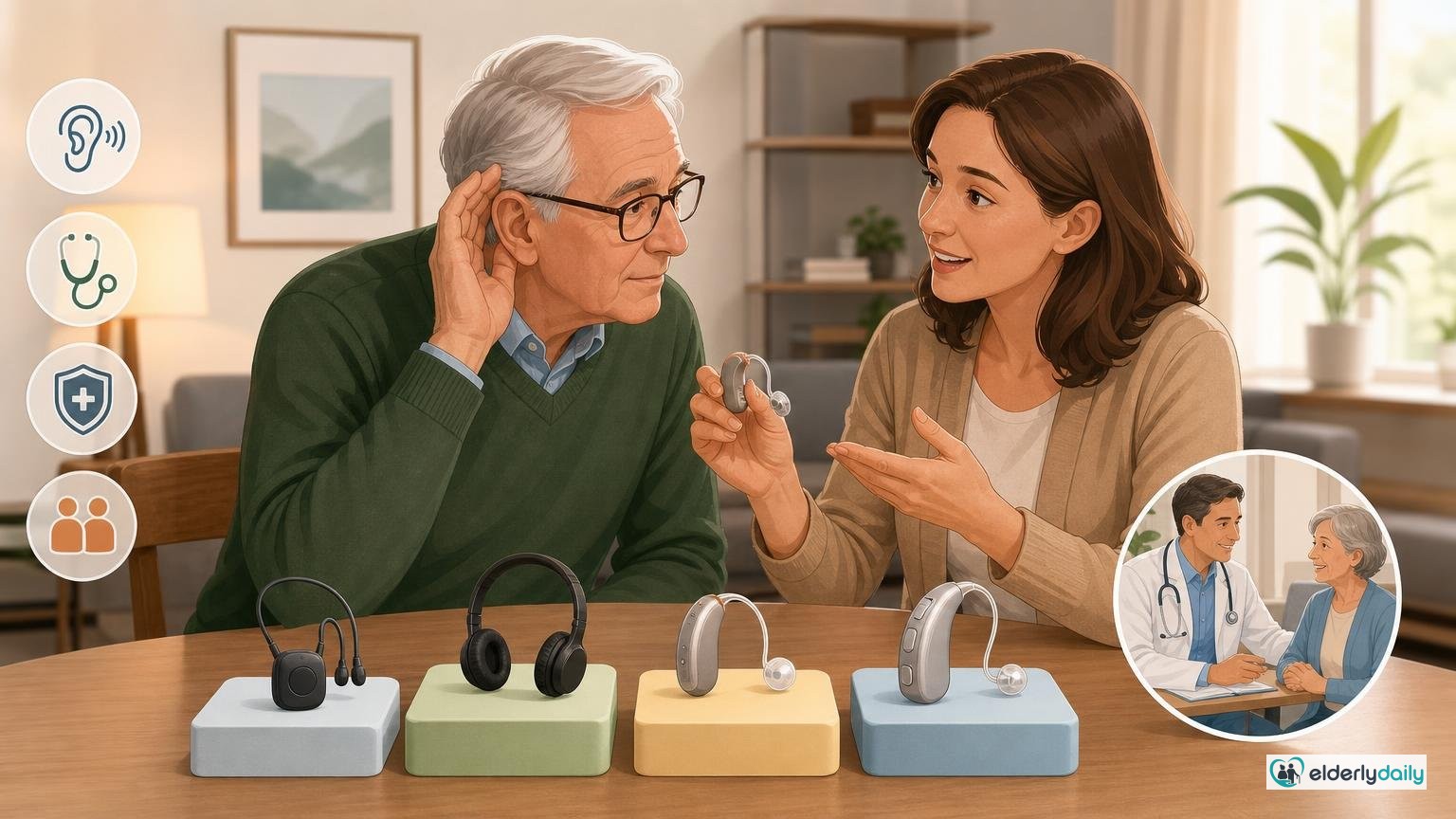
They sit side by side online at wildly different prices, and the cheap one is often called a hearing aid in the listing title. It is not one. The difference is regulatory, and it decides whether the device was ever meant to treat hearing loss at all.
Key takeaways
- A personal sound amplifier (PSAP) is not a medical device. The FDA gives it no classification and no product code, and manufacturers do not have to register it.
- Amplifiers are intended for people without hearing loss — birdwatching, hunting, hearing a distant speaker. Hearing aids are intended to compensate for hearing loss.
- There are four tiers, not two: amplifier, over-the-counter hearing aid, self-fitting OTC hearing aid, and prescription. Only the last three are hearing aids.
- Registered is not the same as cleared. Most OTC hearing aids are exempt from FDA premarket review; only self-fitting ones go through 510(k) clearance.
- Some symptoms mean see a doctor before buying anything — sudden hearing loss is treated as an emergency, and the window for treatment is short.
Quick answer
Is a hearing amplifier the same as a hearing aid?
No. A hearing aid is a medical device regulated by the FDA and intended to compensate for hearing loss. A personal sound amplifier is a consumer electronic intended for people with normal hearing who want to hear something faint — it has no FDA device classification and its maker does not have to register it. An amplifier makes everything louder, including the background. A hearing aid is shaped to the frequencies a person has actually lost. If someone has hearing loss, an over-the-counter hearing aid is the cheapest honest option — see our best hearing aids for the elderly.
The short answer, at a glance
The names are used interchangeably in listings, but these are two different classes of product with two different legal statuses and two different intended users.
The single most useful sentence: an amplifier makes everything louder; a hearing aid makes the sounds you have lost louder. In a quiet room the difference is small. In a restaurant it is the whole thing, because an amplifier raises the clatter along with the conversation.
| Sound amplifier (PSAP) | Hearing aid | |
|---|---|---|
| Medical device? | No | Yes |
| FDA classification | None — no product code | Class I or Class II |
| Maker must register with FDA | No | Yes |
| Intended for | People without hearing loss | People with hearing loss |
| What it amplifies | Everything, more or less evenly | The frequencies that were lost |
| Performance standards | None specified | Set by FDA regulation |
| Labelling rules | None specific | Required warnings and instructions |
| Typical use | Birdwatching, a distant speaker | Daily conversation |
Four tiers, not two
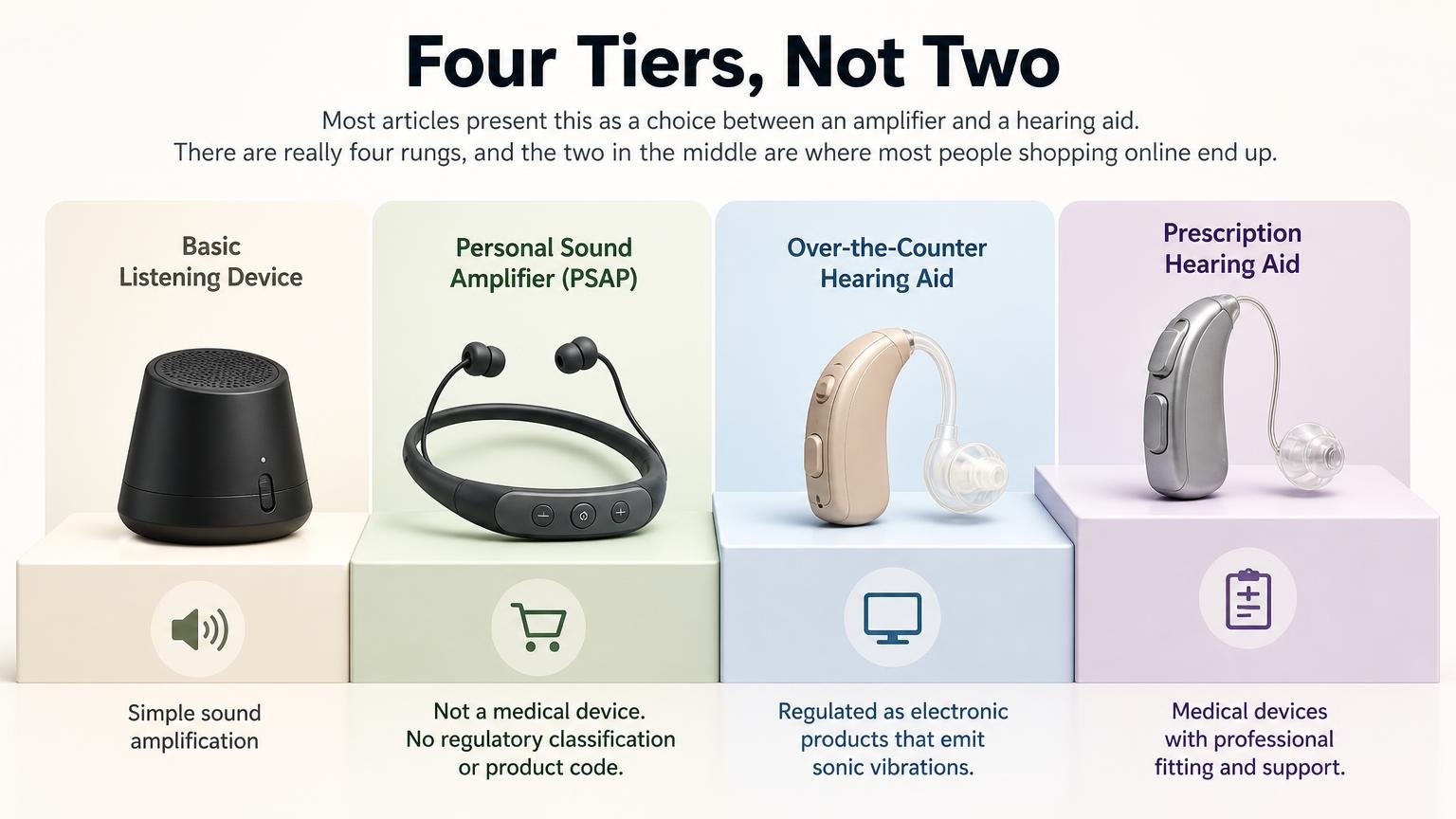
Most articles present this as a straight choice between an amplifier and a hearing aid. There are really four rungs, and the two in the middle are where almost everyone shopping online ends up.
- Personal sound amplifier (PSAP). Not a medical device. The FDA guidance is explicit that there is no regulatory classification or product code for these products, and no requirement for the manufacturer to register them. The FDA regulates them only as electronic products that emit sonic vibrations, which is the same framework that covers radiation safety in consumer electronics.
- Over-the-counter hearing aid, not self-fitting. A medical device, made legal in the United States by an FDA rule effective 17 October 2022. It must meet the requirements at 21 CFR 800.30, follow labelling rules, and be built under FDA quality-system requirements. But it is exempt from premarket review, so no clinical data was submitted before it went on sale. It typically ships with preset listening modes.
- Self-fitting over-the-counter hearing aid. Also a medical device, but this one had to go through 510(k) clearance. The manufacturer had to give the FDA data showing the self-fitting process is as safe and effective as a fitting by a professional. This is the tier where an app or a built-in hearing check tunes the device to your own hearing.
- Prescription hearing aid. Fitted by an audiologist or a hearing instrument specialist against a measured audiogram, with follow-up adjustment. The only tier for severe or profound loss, and the only one available to anyone under 18.
The line that matters most is between the first rung and the rest. Everything from the second rung up is a hearing aid, made and sold for hearing loss. The first was not.
Good to know
A useful test when reading a listing: does it say what the device is *for*? Hearing aid listings name a hearing loss range, usually "perceived mild to moderate". Amplifier listings describe situations instead — hunting, birdwatching, watching television. That phrasing is not an accident; it is what keeps the product outside medical-device regulation.
Why an amplifier disappoints someone with hearing loss
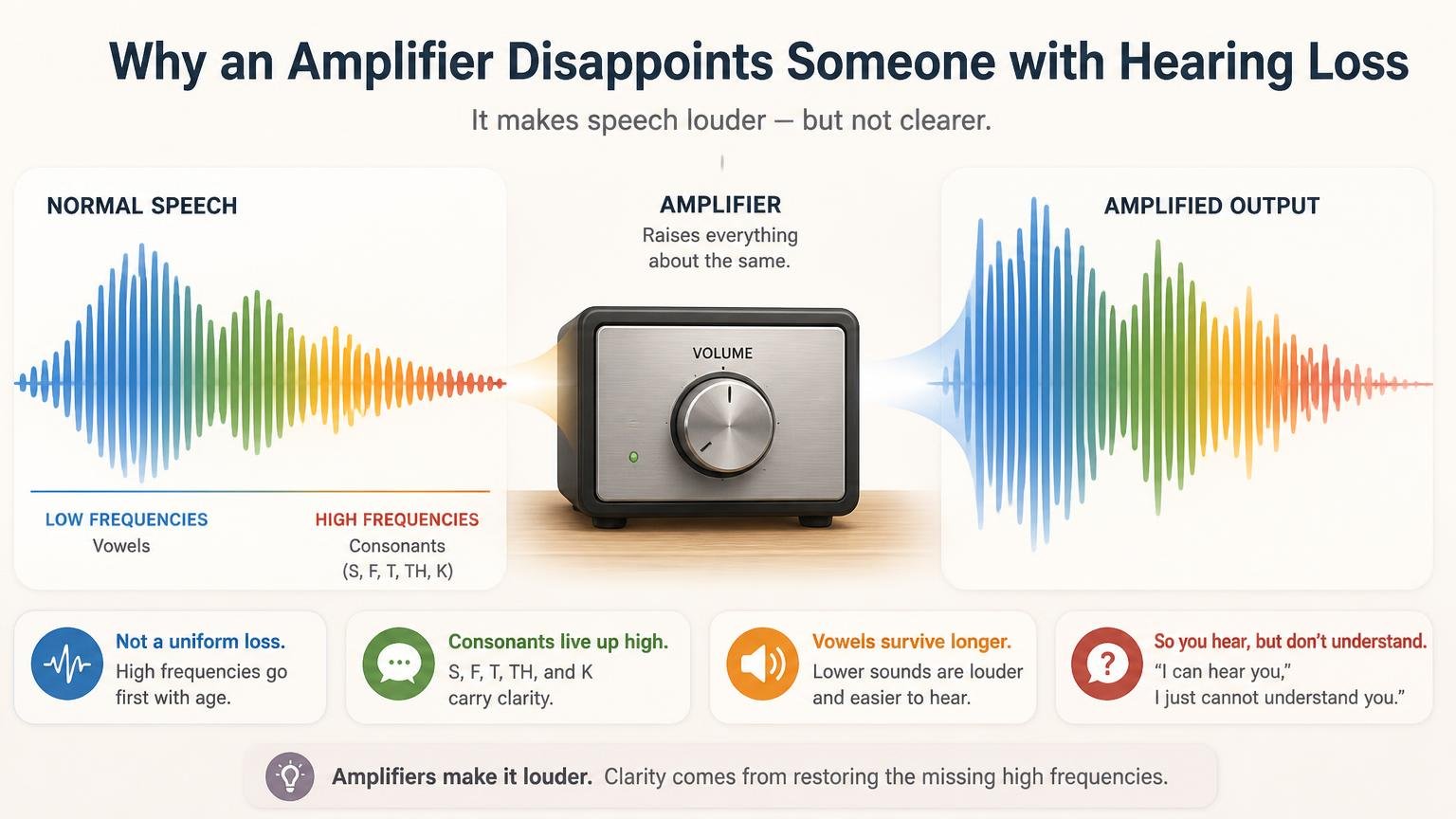
Age-related hearing loss is not a uniform drop in volume. It usually takes the high frequencies first — and those carry the consonants that separate one word from another. S, F, T, TH and K live up there. Vowels, which are lower and louder, survive much longer.
That is why the common complaint is so specific: "I can hear you, I just cannot understand you." The speech is loud enough already. The parts that distinguish words are missing.
An amplifier raises everything by roughly the same amount. It makes the vowels louder, which the person could already hear, and it makes the background louder too. A hearing aid applies more gain where hearing has dropped and less where it has not, which is the entire point of a hearing test.
This is measurable rather than theoretical. Independent bench testing of budget devices routinely shows good scores for feedback control and music streaming alongside poor scores for speech in noise — good at the easy problems, weak at the one people buy the device for. Our hearing aid review gives the lab figures per model.
When an amplifier is a perfectly sensible buy
None of this makes amplifiers a scam. They do a real job well, and it is worth saying so plainly.
- Hearing is normal and the sound is genuinely faint. A lecture from the back of a hall, birdsong, a stage whisper in a theatre.
- A single specific situation, not daily life. Someone who hears fine except when watching television at low volume late at night.
- Testing the water before spending more. An amplifier will tell you whether more volume helps at all. It will not tell you whether a hearing aid would help, because it does a different thing.
What is not fine is a listing that calls an amplifier a hearing aid, or a family buying one for a parent whose hearing has genuinely declined and concluding, when it disappoints, that hearing aids do not work.
When to see a doctor before buying anything
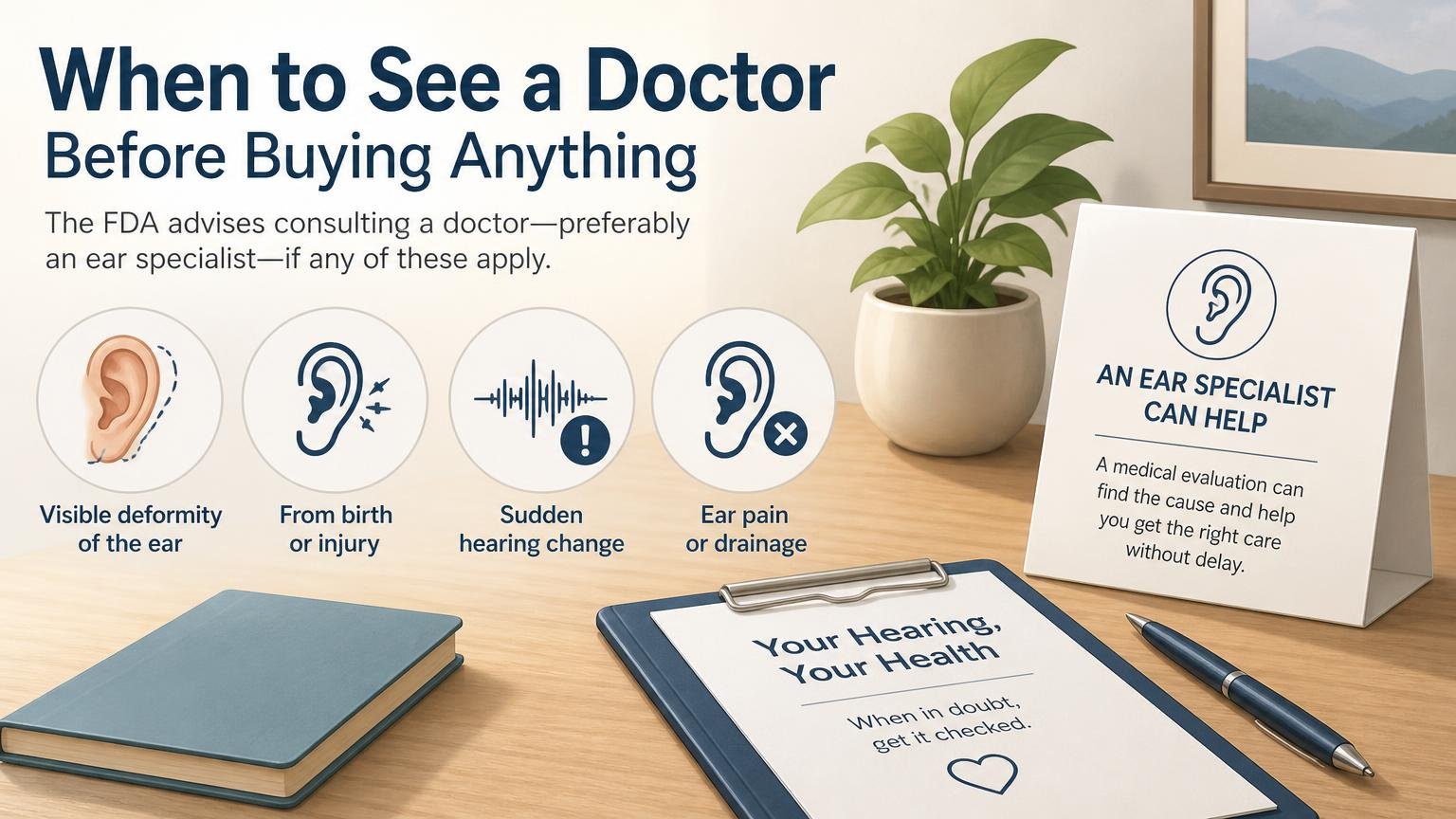
Over-the-counter hearing aids exist because a medical evaluation is not necessary for most adults with gradual, age-related hearing loss. Some presentations are different, and buying a device instead of getting them checked can cost time that matters.
The FDA advises consulting a doctor, preferably an ear specialist, if any of these apply:
- A visible deformity of the ear, from birth or from an injury.
- Fluid, pus or blood coming out of the ear.
- Hearing loss that came on suddenly, or that is getting rapidly worse.
- Dizziness, whether it comes in episodes or is constant.
- Hearing loss or ringing in one ear only, or a clear difference between the two ears.
- Pain or discomfort in the ear.
- Visible wax blockage, or something lodged in the ear canal.
One of these carries a deadline. Sudden hearing loss is treated as a medical emergency, and the treatment window is measured in days rather than weeks. Someone who loses hearing in one ear over hours and orders a device online instead of being seen may lose the chance of recovery. See sudden hearing loss in seniors for what to do and how fast.
One item on that list cannot be self-checked at all: a gap between air-conduction and bone-conduction hearing suggests a problem in the outer or middle ear rather than the inner ear, and only a hearing test will show it. That is one of the arguments for having a test even when you intend to buy over the counter afterwards.
Watch out
A drop in hearing in one ear is the single most important thing on this list. Age-related loss is normally symmetrical and gradual. One-sided or sudden loss is a different situation and needs to be seen, not amplified.
OTC vs prescription: which does the person actually need?
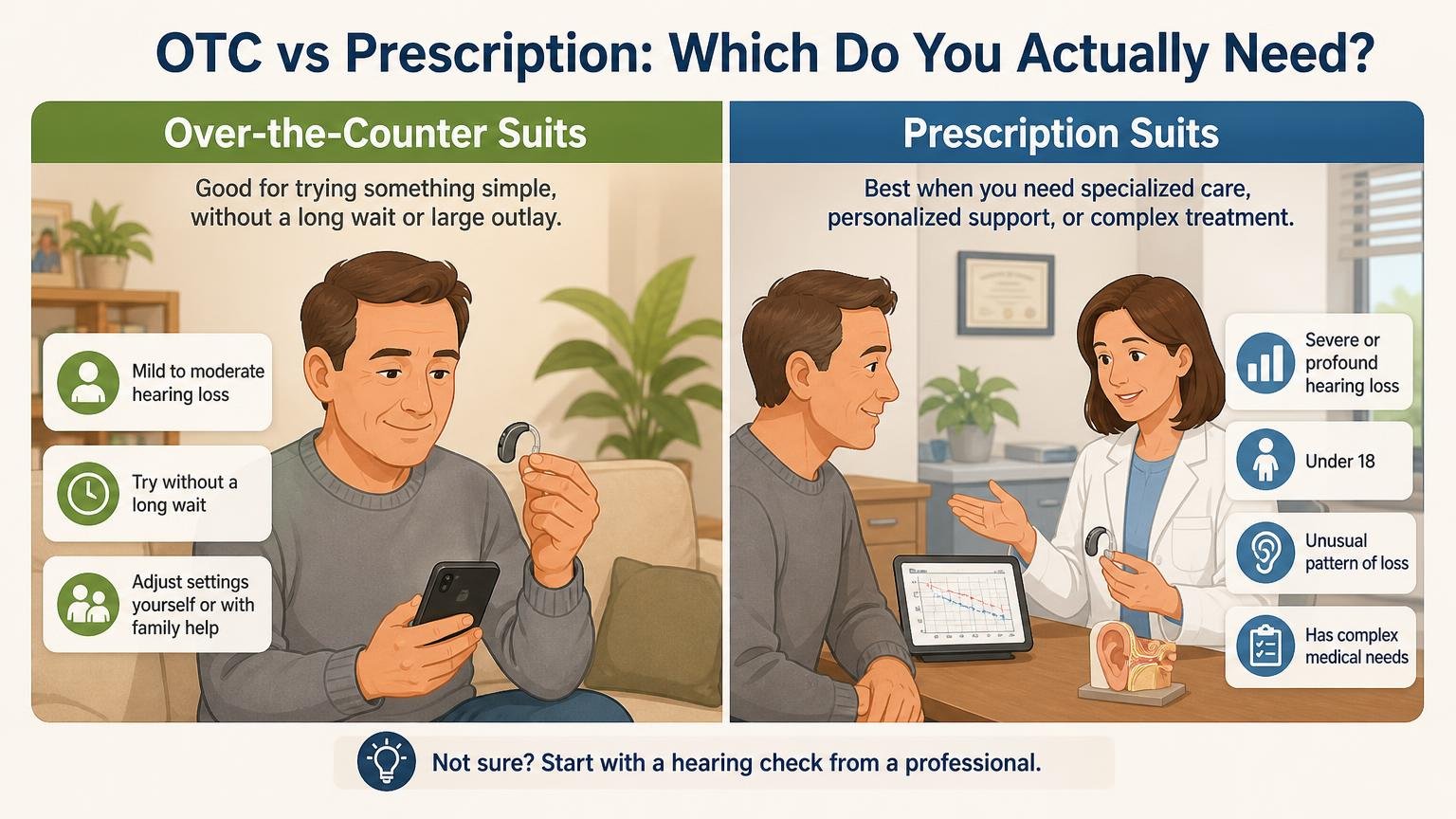
Once it is clear that a hearing aid rather than an amplifier is the right category, the next question is whether to buy one directly or go through a professional.
- Over-the-counter suits an adult with perceived mild to moderate loss, who wants to try something without a long wait or a large outlay, and who is comfortable adjusting settings themselves or with family help.
- Prescription suits anyone with severe or profound loss, anyone under 18, anyone with an unusual pattern of loss, anyone who has struggled with an OTC device already, and anyone who wants ongoing adjustment as their hearing changes.
The two are not rivals so much as different starting points. A person who buys OTC and finds it not quite right has lost far less than a person who avoided the whole subject for a decade because a professional fitting felt like too big a step. Untreated hearing loss in older adults is associated with social withdrawal, low mood and higher fall risk, and those costs accrue quietly while the decision is postponed.
A middle path is worth knowing about: have a hearing test, take the results, and then buy over the counter. The test costs far less than the aids and tells you whether you are in the mild-to-moderate range that OTC devices are designed for.
How to tell which one you are looking at
Product photography is no help — the two look identical. The listing text is where the difference shows.
- Look for the intended user. "For adults with perceived mild to moderate hearing loss" is hearing aid language, and it is required. "Enhance sounds while hunting or birdwatching" is amplifier language.
- Registered or cleared? "FDA registered" tells you the maker filed paperwork. "FDA cleared" or "510(k)" means data was reviewed. Both are legitimate; they are not equal.
- Is there a fitting step? A self-fitting device runs a hearing check or an app-based setup. Preset modes are not the same thing.
- Does the packaging carry warnings? Hearing aids must carry specified warnings and a red-flag list. Amplifiers carry no such requirement.
- Be wary of the word "aid" alone. It is not a protected term in a product title.
The bottom line
If the person has hearing loss, buy a hearing aid. Since October 2022 the over-the-counter category has made that affordable without a prescription, and the price argument for an amplifier has largely gone.
If hearing is fine and a specific sound is too faint, an amplifier is the right tool and costs a fraction as much.
If the loss came on suddenly, is in one ear, or the ear hurts or is discharging, buy nothing yet. See a doctor. Sudden hearing loss has a short treatment window and is the one situation where ordering online is actively harmful.
And if you are unsure which category a device belongs to, the listing will tell you if you read it for who the product is *for* rather than what it does. Our hearing aid review covers the OTC options we would actually recommend, with independent lab figures where they exist.
Frequently asked questions
Is a hearing amplifier the same as a hearing aid?
No. A hearing aid is an FDA-regulated medical device intended to compensate for impaired hearing. A personal sound amplifier is a consumer electronic intended for people without hearing loss who want to hear something faint, such as while birdwatching. The FDA gives amplifiers no device classification and no product code, and their manufacturers are not required to register them.
Can I use a sound amplifier instead of a hearing aid to save money?
You can, and many people do, but you are buying a different kind of product. An amplifier raises the volume of everything it picks up, including the background noise that already makes conversation hard. A hearing aid raises only the frequencies that have been lost. Since over-the-counter hearing aids became legal in the United States in October 2022, the price gap between the two is far smaller than it used to be, which removes most of the reason to settle for an amplifier.
What is the difference between OTC and prescription hearing aids?
Over-the-counter hearing aids are for adults aged 18 and over with perceived mild to moderate hearing loss, and can be bought without a hearing test or a professional fitting. Prescription hearing aids are fitted by an audiologist or hearing instrument specialist to a measured audiogram, and are the only option for severe or profound hearing loss and for anyone under 18. Both are medical devices; the difference is who decides the settings.
What does FDA-registered mean on a hearing aid box?
Registration means the manufacturer has listed itself and the product with the FDA. It is not the same as clearance. Most over-the-counter hearing aids are exempt from premarket review, so registration is all that applies. Self-fitting OTC hearing aids are different: they must go through 510(k) clearance, which means the FDA has reviewed data showing the self-fitting works as safely as a professional fitting. A listing that says only "FDA registered" is telling you less than one that says "FDA cleared".
When should I see a doctor instead of buying a hearing aid?
The FDA lists several conditions that should be checked by a doctor, preferably an ear specialist, before buying: a visible deformity of the ear from birth or injury; fluid, pus or blood coming from the ear; sudden or rapidly worsening hearing loss; dizziness; hearing loss or ringing in one ear only, or a noticeable difference between the ears; ear pain or discomfort; and visible wax blockage or something lodged in the ear canal. Sudden hearing loss in particular is treated as a medical emergency — see sudden hearing loss in seniors.
Are hearing amplifiers ever a reasonable buy?
Yes, for the job they were designed for. If hearing is normal and the goal is to pick out a faint sound — a lecture from the back of a hall, birdsong, a television at low volume late at night — an amplifier does that cheaply and nobody is being misled. The problem is only when one is sold, or bought, as a treatment for hearing loss.
