
Medicaid & Long-Term Care Guides for Families
When a parent needs nursing home care, Medicaid is how most families end up paying for it. Before it pays, the state reviews five years of the parent’s finances, and the paperwork lands on whoever manages their money.
These 16 guides explain the rules in plain English, using the federal law and each state’s own guidance: the look-back and what counts as a gift, what happens to the family home, how waivers pay for care at home, and how Medicaid fits with Medicare.
Educational guides for families, checked against federal and state sources. Not legal advice.
Medicaid Look-Back Period: How the 5-Year Rule Works
What the state reviews, what counts as a transfer, what is exempt, how the penalty is calculated, and the states that differ.
Read the guideThe 5-year look-back
What the state reviews before Medicaid pays for long-term care, which gifts and transfers count, and the records to gather.
How Far Back Does Medicaid Look? Bank Statements, Income and Assets
Which records the caseworker reads, what they stop on, and how to get statements from years ago.
Read guideMedicaid Look-Back Period by State (2026)
Sixty months almost everywhere, 30 in California, New York’s pending home care rule, and each state’s penalty divisor.
Read guideMedicaid Look-Back Exemptions: Transfers That Don’t Count
Spouses, disabled children, the caregiver child home rule, normal spending, and the hardship waiver, with the proof each one needs.
Read guideIs There a 7-Year Look-Back for Medicaid?
No. Where the seven years comes from, and what the 60-month rule means for a gift your parent made.
Read guide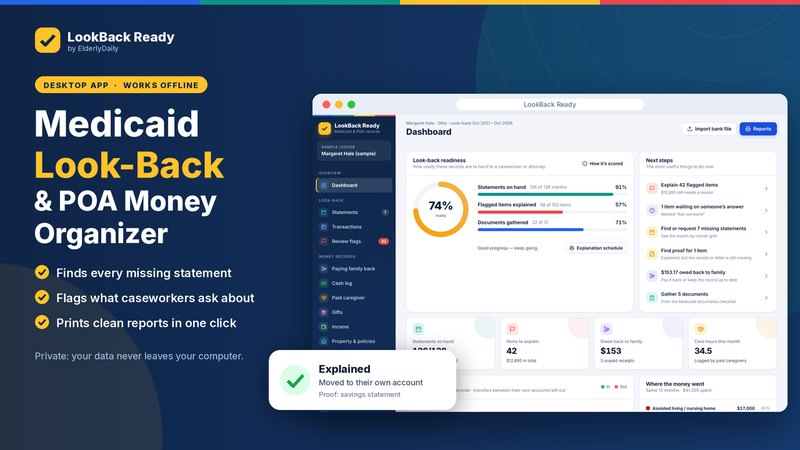
An ElderlyDaily original
Getting a parent’s records ready for the look-back?
LookBack Ready: Medicaid Look-Back & POA Money Organizer
- A month-by-month checklist of every statement, for every account, closed ones included
- Imports bank download files and flags cash, checks, transfers and payments to family
- Explain each item once, with the proof and where it’s kept
One-time purchase · Instant download · Desktop app · Windows & Mac · works offline
The family home and estate recovery
What happens to a parent’s house while they get Medicaid, and what the state can claim back after they die.
Can Medicaid Take Your House?
What happens to a parent’s home while they live there, in a nursing home, and after they die, and who is protected.
Read guideMedicaid Estate Recovery: How It Works and How to Avoid It
Who the state can recover from, what counts as the estate, what’s exempt, and how hardship waivers work.
Read guideCare at home and Medicaid waivers
How home and community care waivers work, and when Medicaid can pay a family member to be the caregiver.
What Is a Medicaid Waiver?
How home care waivers work, what they cover, who qualifies, why there are waiting lists, and how to apply.
Read guideCan Medicaid Pay a Family Caregiver?
Self-directed care, structured family caregiving, who can be paid, and the caregiver agreement if your parent pays you.
Read guideMedicaid Waiver Payments: Are They Taxable?
When caregiver pay from a Medicaid waiver is tax-free under IRS Notice 2014-7, and how to report it.
Read guideEligibility, Medicare and moving states
The asset and income tests, how Medicare and Medicaid fit together, help with Medicare costs, and what to do when a parent moves.
Long-Term Care Medicaid Eligibility and Asset Limits
The four tests, the $2,000 asset limit and what doesn’t count, the income rules, and protections for a spouse at home.
Read guideMedicare vs Medicaid: What’s the Difference?
Who each one covers, why Medicare doesn’t pay for long-term care, and what happens when a parent has both.
Read guideMedicare Savings Programs: QMB, SLMB and QI
What each program pays, the 2026 income and resource limits, and how to apply through your state.
Read guideHow to Transfer Medicaid to Another State
Why Medicaid doesn’t move with you, the steps in the right order, and what changes for a parent in long-term care.
Read guidePowers of attorney and legal planning
The documents that let a family act for a parent, and the powers Medicaid planning depends on.
Durable Power of Attorney: What It Is and How to Set One Up
How it differs from a regular POA, the powers that must be written in, what it can’t do, and why Medicaid planning depends on it.
Read guideHow to Set Up a Trust for a Parent
Revocable vs. irrevocable, the steps, what it costs, and which trusts protect savings from nursing home costs.
Read guideChoosing and paying for care
Related guides from elsewhere on ElderlyDaily.
- Skilled Nursing Facilities: What Medicare Actually CoversWhere Medicare stops and Medicaid or private pay takes over.
- Assisted Living: Costs and CoverageWhat it includes, what it costs, and where a Medicaid waiver can help.
- Memory Care: What It Is and What It CostsHow memory care differs, and how families pay for it.
- In-Home Care: What It Covers and CostsHelp at home, and what Medicare and Medicaid will and won’t pay.
- Senior Care Cost CalculatorA state-by-state estimate of what each kind of care costs.
Not legal advice: these guides explain how Medicaid’s rules work so you know what to expect and what to gather. Rules differ by state and change over time. For a decision about a specific transfer, ask your state Medicaid office or an elder law attorney.
