
Printable Fall Risk Checklist: Free CDC Stay Independent Checklist (PDF)

Educational only, not medical advice. The checklist is the CDC’s Stay Independent fall risk self-assessment. A doctor or physical therapist should assess anyone who has fallen or feels unsteady.
More than one out of four older people falls each year, but less than half tell their doctor. This free checklist uses the CDC’s 12 questions to show whether it is time to talk to the doctor about falls, and adds a log for every fall and near miss and a page on what to do if you fall. Type into it on screen, or print it.
Key takeaways
- Free printable fall risk checklist in large print, 4 pages, with no sign-up.
- The CDC Stay Independent checklist: 12 statements worth 1 or 2 points. 4 points or more means you may be at risk for falling: discuss it with your doctor.
- Adds a Fall & Near-Miss Log for the doctor and an If You Fall page to keep by the phone.
- Fill it in on screen: click any box in the PDF and type, then save or print. Or print it blank and use a pen.
- Comes in US Letter and A4, in color and black and white.
Quick answer
Where can I get a free printable fall risk checklist?
Download it free here: the printable fall risk checklist (PDF) has the CDC’s 12-question Stay Independent checklist with points and three columns to take it again later, a fall and near-miss log, and what to do if you fall, all in large print. You can type into the boxes on screen or print it. There are black-and-white and A4 editions too. No email or sign-up is needed.
Download the free fall risk checklist
All four files have the same four pages. Pick the paper size you use: US Letter in the US and Canada, A4 almost everywhere else.
- Fall Risk Checklist, color, US Letter (PDF, 4 pages)
- Fall Risk Checklist, black and white, US Letter (PDF, 4 pages)
- Fall Risk Checklist, color, A4 (PDF, 4 pages)
- Fall Risk Checklist, black and white, A4 (PDF, 4 pages)
Filling it in on screen
Open the PDF in Chrome, Edge or Adobe Acrobat Reader, click any box and type or tick. When you are done, download or save the file so your entries are kept, or print it. On a phone, Adobe Acrobat Reader works best.
An ElderlyDaily original
Worried about a parent falling?
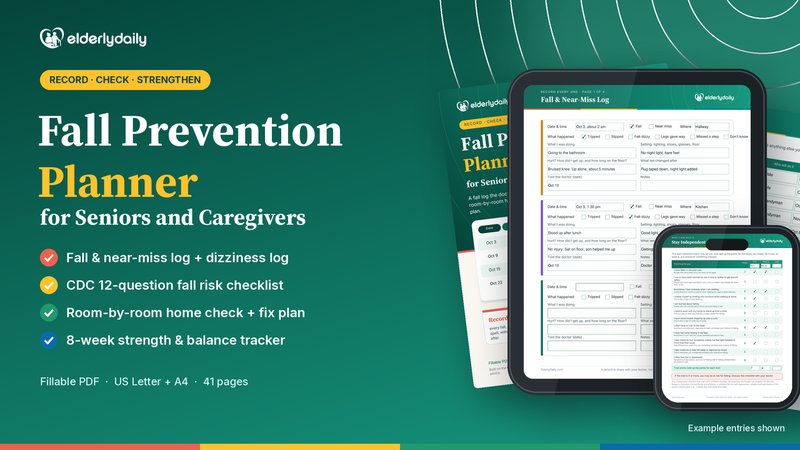
Fall Prevention Planner for Seniors and Caregivers
One-off purchase · Instant download · Fillable PDF · 41 pages · US Letter + A4

Sponsored Pick
REHAND Ergonomic All-Terrain Folding Cane
Seniors with arthritis or joint pain who want a cushioned, ergonomic grip with all-terrain stability
Check PriceWhat is inside
- Page 1 — How to use it: the three steps, and the CDC’s four ways to lower the chance of a fall.
- Page 2 — Stay Independent checklist: the CDC’s 12 statements with their points, why each one matters, and three tick columns (today, next time, later) with a total for each.
- Page 3 — Fall & Near-Miss Log: three records with the date, where, what happened (tripped, slipped, felt dizzy, legs gave way), any injury, how you got up, and what you changed after.
- Page 4 — If You Fall: how to get up safely, what to do if you can’t, and when to call 911.
The 12 questions and their points
The Stay Independent checklist is part of the CDC’s STEADI materials for older adults. The CDC brochure describes it as a validated fall risk self-assessment tool, developed by the Greater Los Angeles VA Geriatric Research Education Clinical Center and affiliates. Tick each statement that is true for you, and add up the points.
| Statement | Points | Why it matters |
|---|---|---|
| I have fallen in the past year. | 2 | People who have fallen once are likely to fall again. |
| I use or have been advised to use a cane or walker to get around safely. | 2 | People who have been advised to use a cane or walker may already be more likely to fall. |
| Sometimes I feel unsteady when I am walking. | 1 | Unsteadiness or needing support while walking are signs of poor balance. |
| I steady myself by holding onto furniture when walking at home. | 1 | This is also a sign of poor balance. |
| I am worried about falling. | 1 | People who are worried about falling are more likely to fall. |
| I need to push with my hands to stand up from a chair. | 1 | This is a sign of weak leg muscles, a major reason for falling. |
| I have some trouble stepping up onto a curb. | 1 | This is also a sign of weak leg muscles. |
| I often have to rush to the toilet. | 1 | Rushing to the bathroom, especially at night, increases your chance of falling. |
| I have lost some feeling in my feet. | 1 | Numbness in your feet can cause stumbles and lead to falls. |
| I take medicine that sometimes makes me feel light-headed or more tired than usual. | 1 | Side effects from medicines can sometimes increase your chance of falling. |
| I take medicine to help me sleep or improve my mood. | 1 | These medicines can sometimes increase your chance of falling. |
| I often feel sad or depressed. | 1 | Symptoms of depression, such as not feeling well or feeling slowed down, are linked to falls. |
What the score means
If the total is 4 points or more, you may be at risk for falling. Discuss the checklist with your doctor (CDC). A lower score does not rule out a fall: tell your doctor about any fall, worry about falling, or feeling unsteady.
After the checklist: talking to the doctor
Bring the checklist and the fall log to the appointment. The CDC’s advice for older adults comes down to four steps, listed in its STEADI patient materials: speak up about falls and worries with your health care provider, including a review of your medicines; keep moving with exercises for strength and balance; have your eyes checked every year; and make your home safer.
Why keep a fall and near-miss log
According to the CDC, falling once doubles your chances of falling again, and less than half of older people who fall tell their doctor. A short written record helps: where it happened, what you were doing, whether you tripped, slipped, felt dizzy or your legs gave way, and what you changed afterwards. Near misses count too, because they often show the same pattern before a real fall.
If you fall: what to do
These steps follow the NHS advice on falls, with 911 for the US.
- 1
Take your time
Stay still for a moment, check for pain or injury, and do not get up too quickly.
- 2
Roll onto your side
then push up onto your hands and knees.
- 3
Crawl to something sturdy
such as a heavy chair, and hold on to it.
- 4
Stand up slowly
holding on to the sturdy furniture, then turn and sit down. Rest before you do anything else.
If you can’t get up, or may be hurt
Use your phone or personal alarm if you can reach it, or call out and bang on the wall or floor. Keep warm with anything nearby, and change position about every 30 minutes. Call 911 if someone has fallen and may have hurt their head, back, neck or hip, or can’t get up. Tell the doctor about every fall, even if nobody was hurt.
Want more than the checklist?
The free checklist is a starting point. Our Fall Prevention Planner builds the CDC’s advice into an 8-week plan: a 12-record fall log, a dizziness log, the CDC room-by-room home safety check with a fix plan, a medicine review, eyes, feet and shoes, the CDC chair-rise exercise with an 8-week strength and balance tracker, and doctor-visit pages.
An ElderlyDaily original
Fall Prevention Planner for Seniors and Caregivers
One-off purchase · Instant download · Fillable PDF · 41 pages · US Letter + A4
More free printables
See all 31 free printables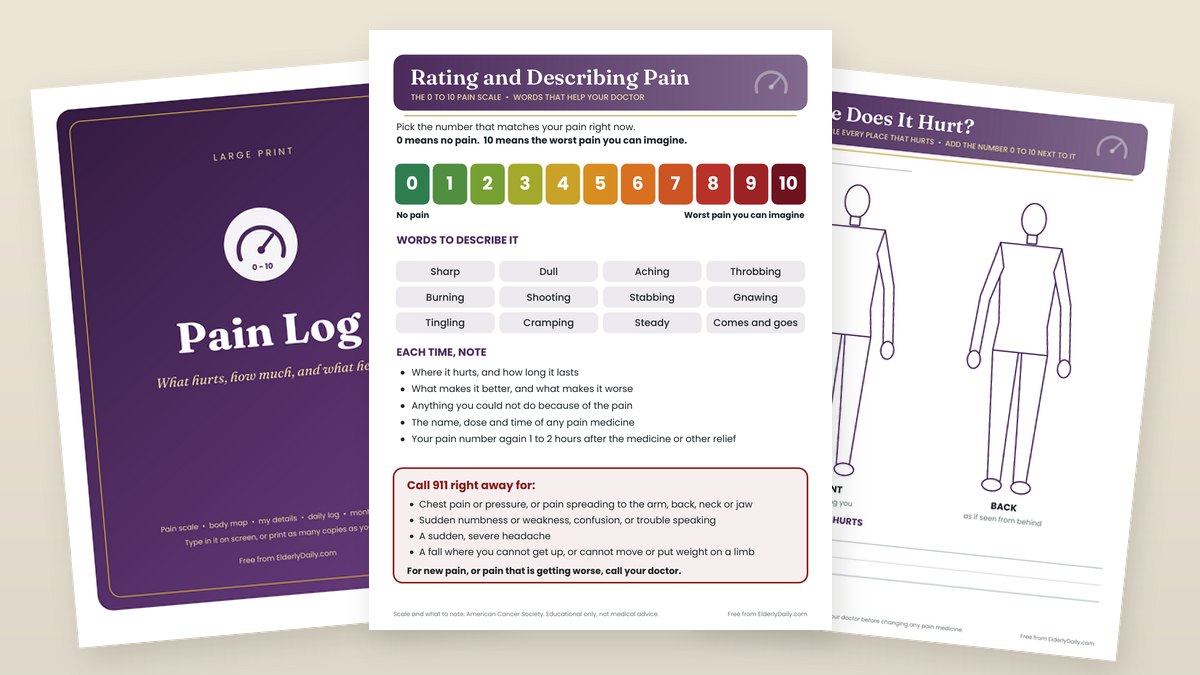 Pain LogA 0 to 10 pain scale, a body map, a daily pain diary and a monthly tracker to show your doctor.Free PDF, no sign-up
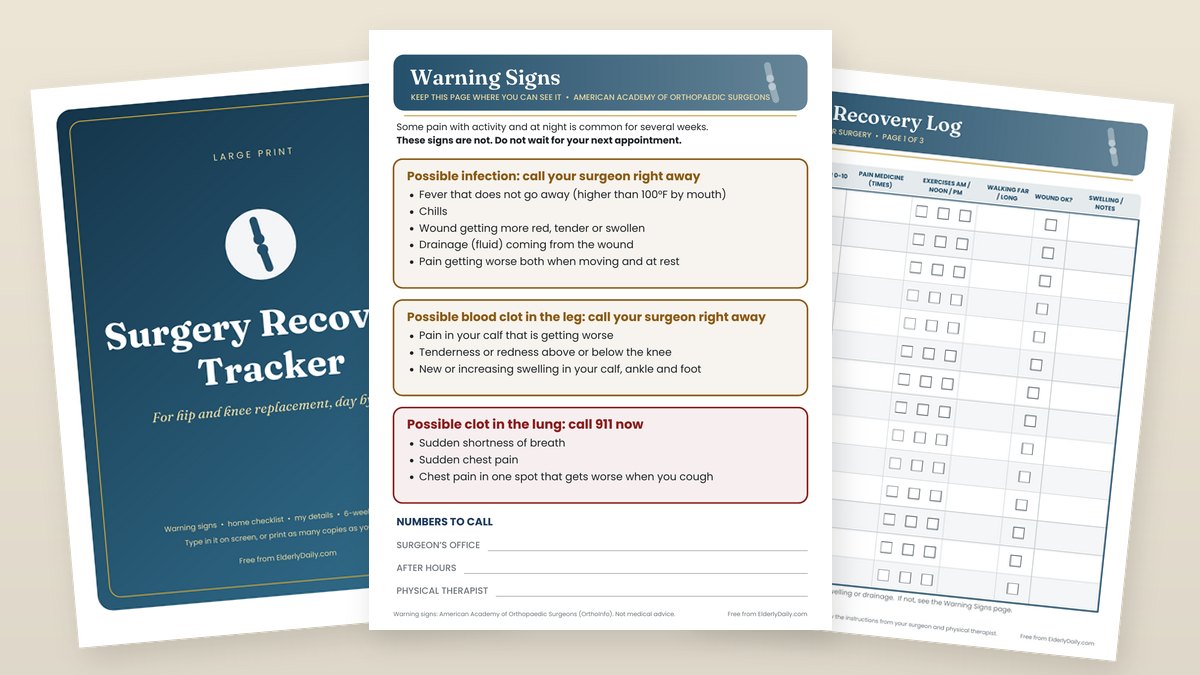 Surgery Recovery TrackerFor knee and hip replacement: warning signs, a home checklist and a 6-week daily log for pain, exercises and walking.Free PDF, no sign-up
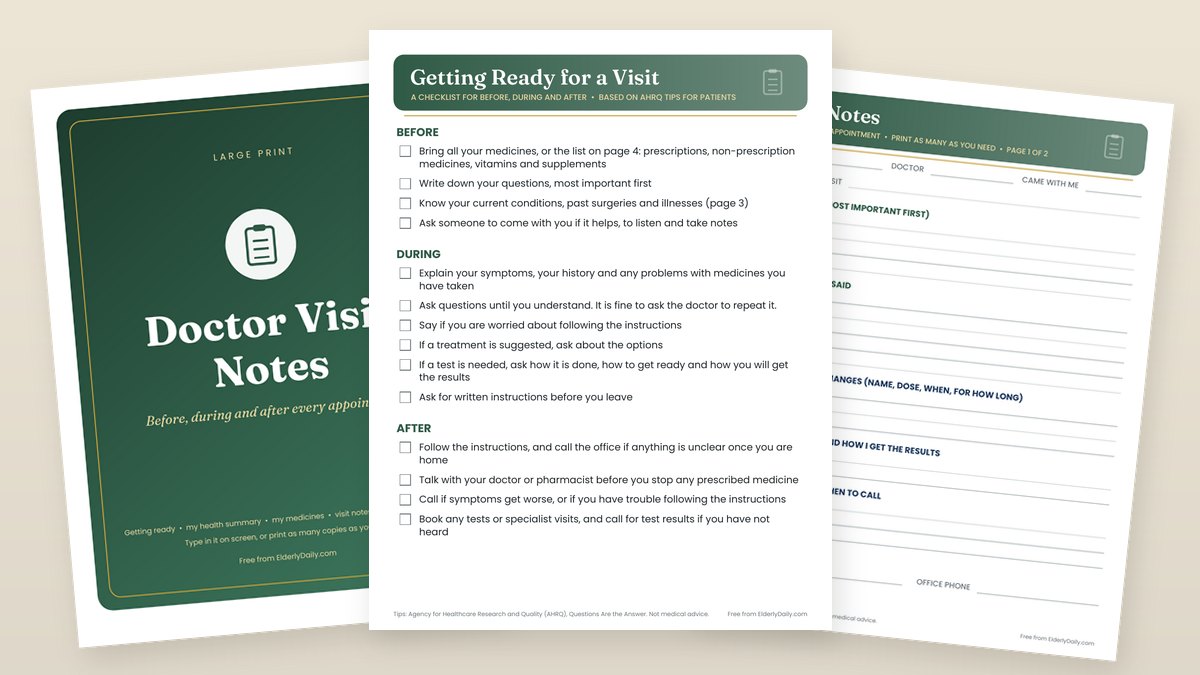 Doctor Visit NotesA before-and-after checklist, health summary, medicine list, visit notes pages and an appointment log.Free PDF, no sign-up
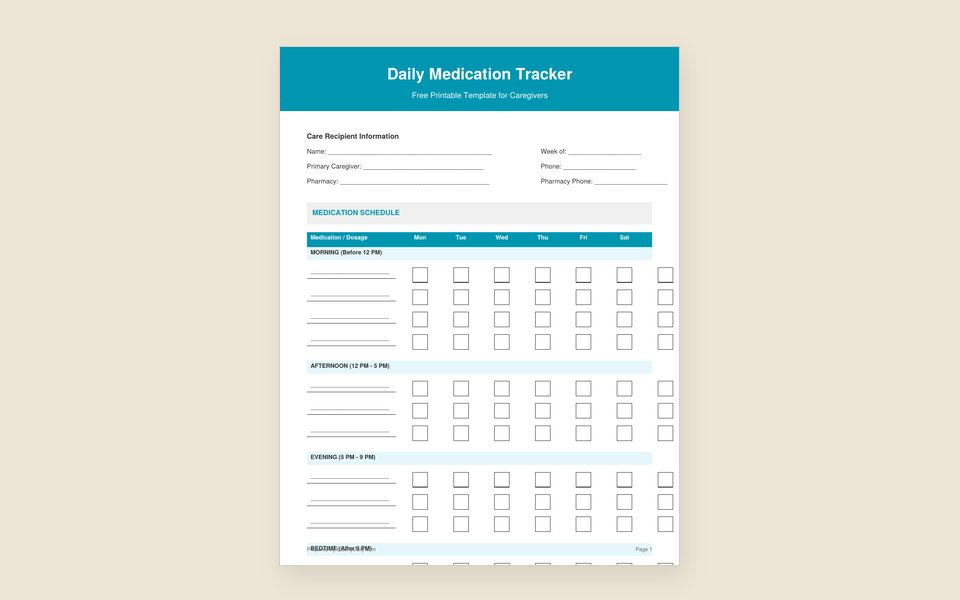 Daily Medication ChartMorning, afternoon and evening checkboxes that help prevent missed or double doses.Free PDF, no sign-up
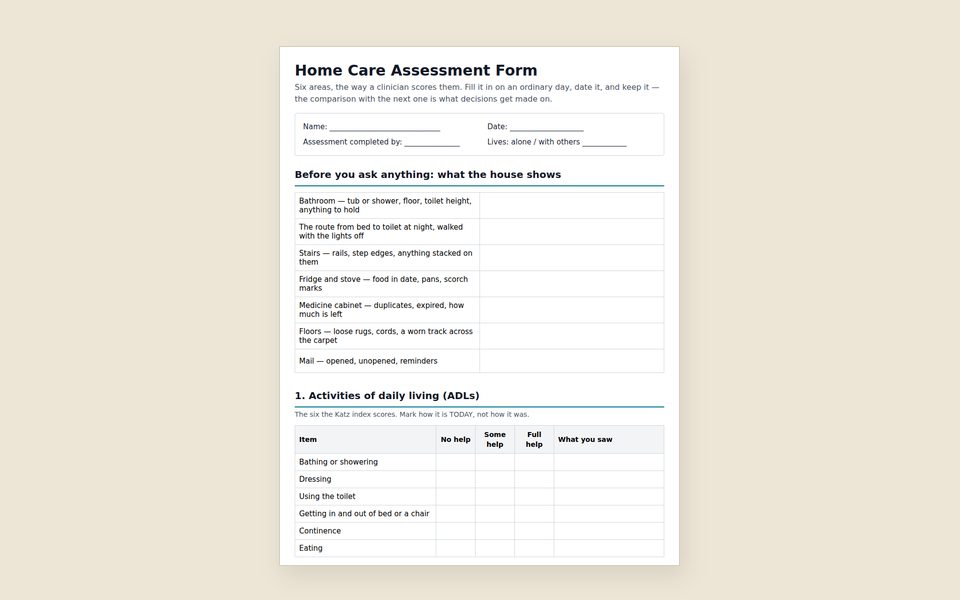 Home Care Assessment FormDaily activities, mobility, memory, medication and home safety on one dated form.Free PDF, no sign-up
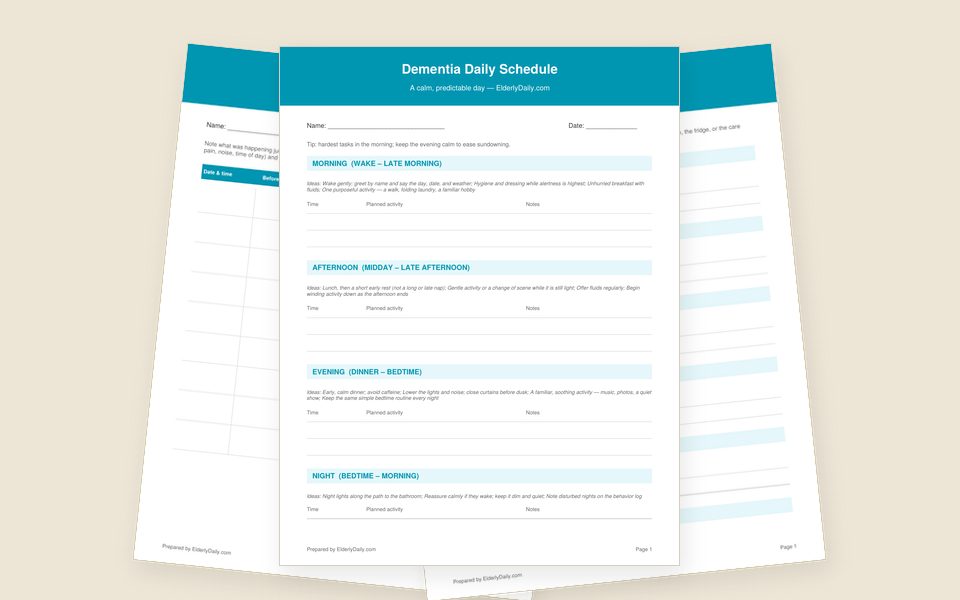 Dementia Care ToolkitA daily schedule, a sundowning and behavior log, and an All About Me profile.Free PDF, no sign-up
Frequently asked questions
Is this fall risk checklist really free?
Yes. All four PDFs download directly, with no email address, sign-up or payment. Print or fill in as many copies as you like for personal use.
What score on the fall risk checklist is high?
On the CDC Stay Independent checklist, a total of 4 points or more means you may be at risk for falling, and the CDC advises discussing the checklist with your doctor. Two statements, a fall in the past year and using or being advised to use a cane or walker, count 2 points each; the rest count 1.
Is this the same as the CDC Stay Independent brochure?
The 12 statements, the points and the scoring are the CDC’s. We set them out in large print as a fillable PDF, with columns to take it again later, and added a fall log and an If You Fall page.
Can I fill in the checklist on my computer?
Yes. Open the PDF in Chrome, Edge or Adobe Acrobat Reader, click any box and tick or type. Then download or save the file so your entries are kept. You can also print it blank and use a pen.
Can I fill it in for my mother or father?
Yes. Go through the statements together, in your parent’s words, and bring the checklist and the fall log to their next appointment.
My parent scored under 4. Do we still need to tell the doctor?
Tell the doctor about any fall, even without an injury, and about feeling unsteady or worried about falling. The checklist is a guide, not a diagnosis.
