
Qigong vs Tai Chi vs Yoga for Seniors: Which Is Best for You?

Educational guidance, not medical advice. Check with your doctor before starting a new exercise, especially after a fall, with dizziness, a heart condition, joint replacement or recent surgery.
All three are gentle, and all three can be done sitting down. But they move differently, they ask different things of your balance, and the research behind them is not the same. Here is how to choose, or how to combine them.
Key takeaways
- Tai chi is a set sequence of slow, flowing moves that step and shift your weight. It has the strongest evidence of the three for preventing falls.
- Qigong is the wider family tai chi belongs to: short moves repeated many times, often standing in place and timed to the breath. It is usually the easiest to learn.
- Yoga uses held poses and stretches. It has shown small improvements in balance and better mobility in people over 60, but less evidence on falls.
- Seated versions exist for all three, so poor balance or limited mobility need not rule any of them out.
- The best choice is the one you will keep doing; many people mix them across the week.
Quick answer
Which is better for seniors: qigong, tai chi or yoga?
For balance and fall prevention, tai chi has the strongest evidence: a Cochrane review found it may reduce the rate of falls in older adults by about 19% (Cochrane, 2019). Qigong is usually the easiest to learn, because its moves are short and repeated, often standing in place. Yoga suits people who want flexibility and strength from held poses. All three have seated versions. Choose the one you enjoy enough to do most days.
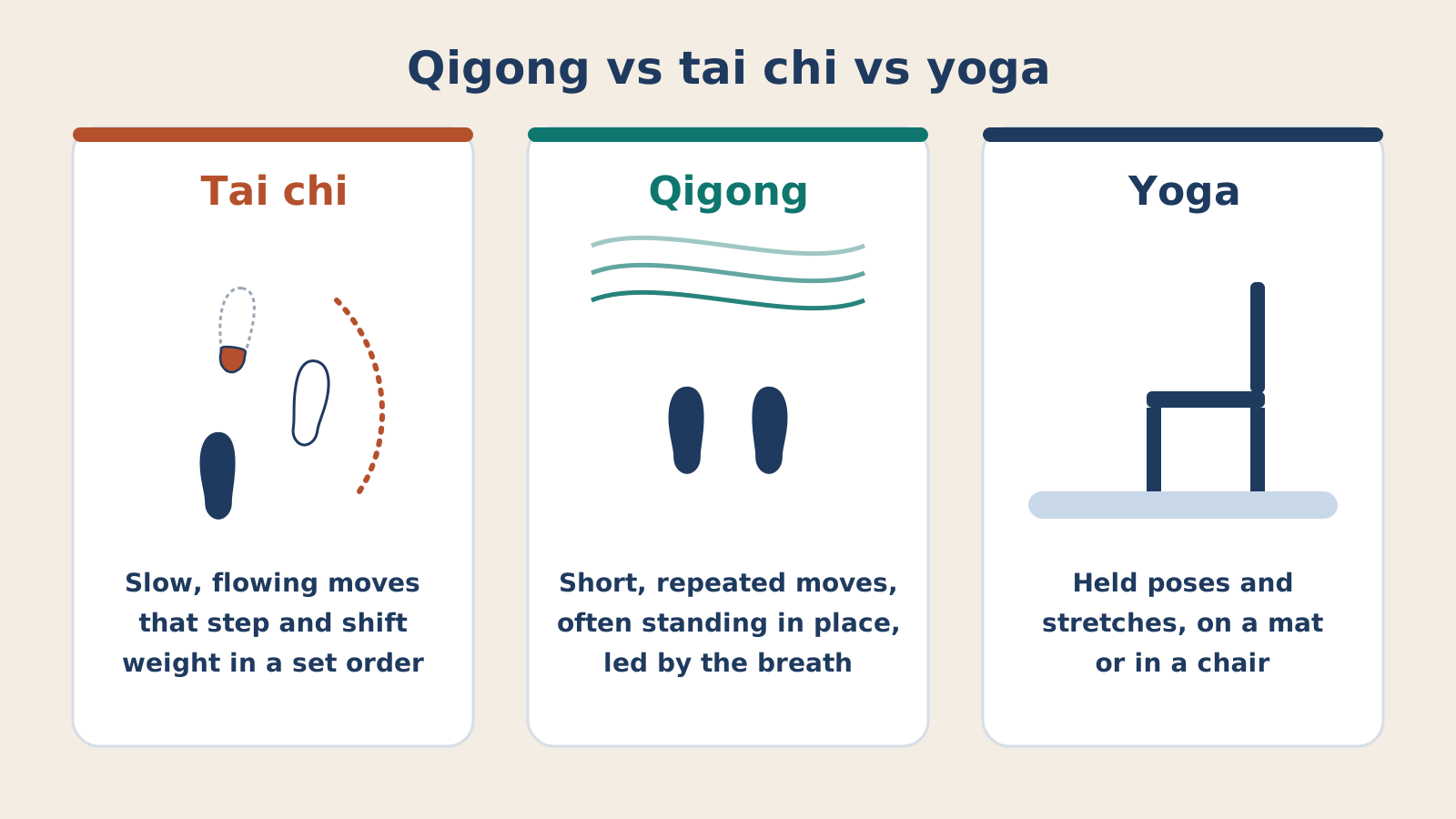
Qigong vs tai chi vs yoga at a glance
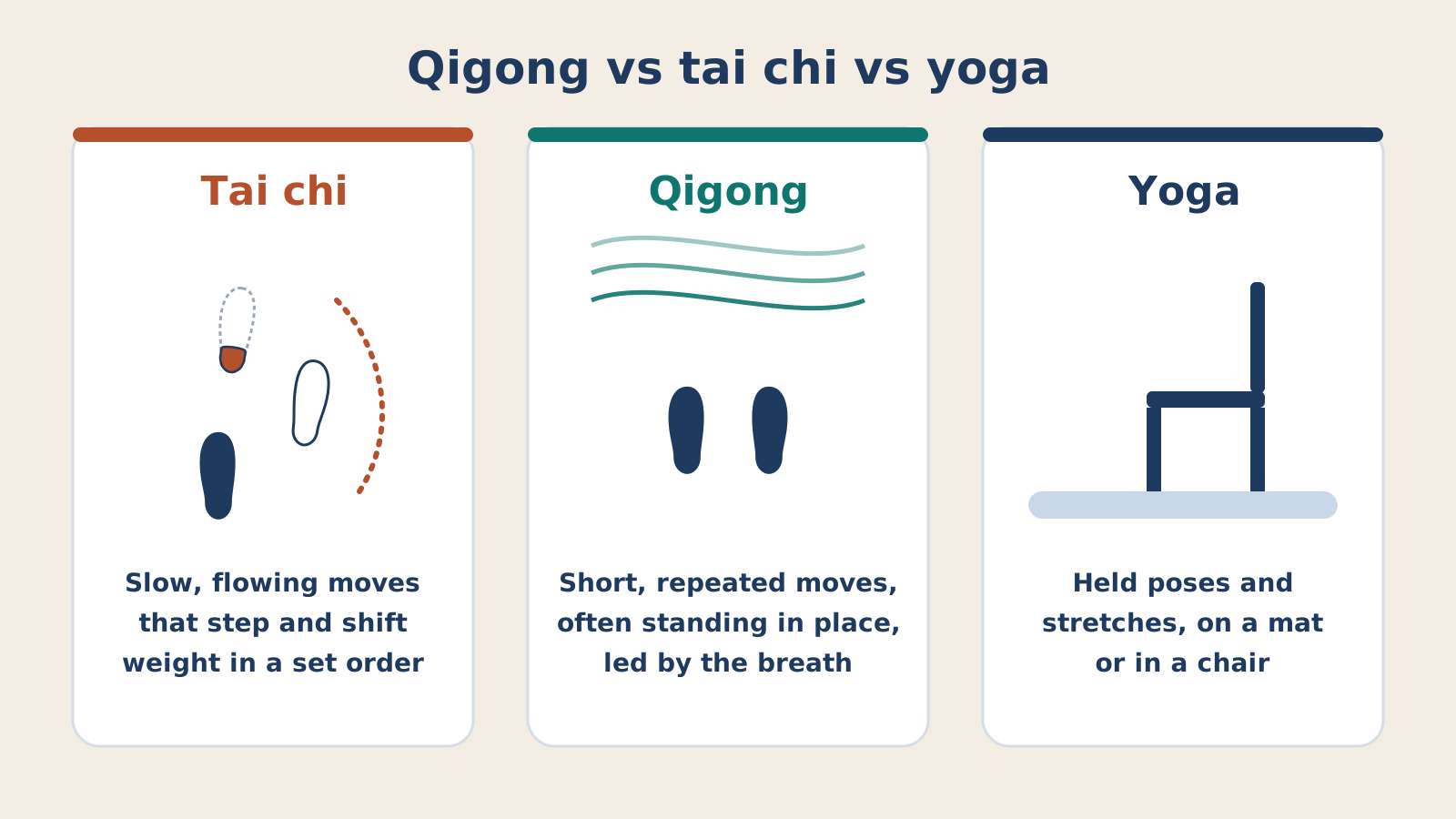
A quick side-by-side for older adults:
| Tai chi | Qigong | Yoga | |
|---|---|---|---|
| How it moves | A set sequence of slow, linked moves that step forward, back and sideways | Short moves repeated several times, often standing in place | Poses held for several breaths, with stretches between |
| Balance challenge | High: constant weight shifts from foot to foot | Low to moderate: mostly two feet on the floor | Varies: standing poses can be demanding; seated and floor poses less so |
| Easy to learn? | Takes weeks to learn a full sequence | Usually the quickest to pick up | Easy to start with simple poses |
| Evidence on falls | Strongest of the three (Cochrane review) | Promising balance results; falls not well studied | Small balance gains; falls not well studied |
| Seated version | Chair tai chi | Many qigong sets can be done seated | Chair yoga |
Large-print edition included
An ElderlyDaily original
Want every movement drawn out, a full page each?
Chair Tai Chi — Illustrated Edition
- All eight movements, a full page each, drawn frame by frame
- A three-minute warm-up, plus five common mistakes and how to fix them
- A four-week plan with a practice tracker
One-off purchase. Instant download.
PDF · 24 pages · US Letter + A4
Qigong vs tai chi: what is the difference?
They are closely related. A US Veterans Affairs handout puts it simply: "Tai chi is one form of qi gong", but the two are practised differently. Qigong postures are often done standing in place or even standing still, and qigong includes many short sets that do not involve stepping at all (VA Whole Health).
Tai chi began as a martial art. Its forms link dozens of moves into a long sequence that travels across the floor, so you are always shifting weight from one foot to the other. Qigong sets, such as the well-known Baduanjin ("eight pieces of brocade"), are short and repeated, which makes them quicker to learn and easier to do in a small space.
For health purposes, the difference matters less than people think. As integrative medicine specialist Dr. Michelle Loy of NewYork-Presbyterian/Weill Cornell put it, "there’s really not too much difference" (NewYork-Presbyterian). Both are slow, both are breath-led, and both can be adapted for walking, standing or sitting.
Tai chi vs yoga: what is the difference?
Tai chi keeps you moving: one slow move flows into the next, and your weight is always travelling. Yoga is built around poses you move into and hold for a few breaths. That makes yoga better for stretching and building strength in particular positions, and tai chi better for practising the moving balance you need when walking and turning.
Yoga also includes floor work, which some older adults find hard to get down to and up from. Chair yoga removes that problem. Tai chi is almost always done standing or seated, never on the floor.
What the research says for older adults
- Tai chi: a Cochrane review of exercise to prevent falls in older people living at home found tai chi may reduce the rate of falls by about 19% (low-certainty evidence). Balance and functional exercise overall reduced falls by about 24% (high certainty) (Cochrane, 2019).
- Qigong: a 2022 review of 17 trials with 1,267 older adults found the Baduanjin qigong set improved balance tests, including the Berg Balance Scale and the Timed Up and Go, compared with control groups. The authors called for more high-quality studies, and falls themselves were not the main outcome (Guo et al., Frontiers in Medicine, 2022).
- Yoga: a review of trials in people aged 60 and over found yoga produced small improvements in balance and medium improvements in physical mobility. The authors noted that more research is needed to show whether this prevents falls (Youkhana et al., Age and Ageing, 2016).
In short: all three help balance to some degree. If preventing falls is your main reason, tai chi has the most direct evidence, alongside general balance exercises.
Which one suits you?
- Worried about falling or already unsteady: start with seated qigong or chair tai chi, then add standing tai chi beside a counter, such as tai chi walking.
- Stiff joints or arthritis: gentle tai chi and chair yoga both work well; avoid deep knee bends and any pose that hurts. See our chair yoga for balance routine.
- Limited mobility or using a wheelchair: all three have seated versions; chair yoga and seated qigong are the easiest to start.
- Mainly want to relax and breathe: qigong, with its slow, repeated, breath-led moves, is often the gentlest place to start.
- Want flexibility and strength: yoga, especially chair yoga, gives more stretching and holding work.
- Want something social: tai chi and qigong classes are common at senior and community centres; many yoga studios run gentle or chair yoga classes. Our guide to finding tai chi classes for seniors shows where to look.
Can you do more than one?
Yes, and many people do. A simple week might be tai chi walking or a tai chi class on three days for balance, chair yoga on two days for flexibility and strength, and a few minutes of qigong breathing on the days in between.
US guidelines for adults 65 and over recommend balance activities as well as aerobic and muscle-strengthening activity each week, so whichever you choose, try to add some walking and strength work too.
An ElderlyDaily original
Chair Tai Chi — Illustrated Edition
Large-print edition included
- Instant download
- PDF · 24 pages · US Letter + A4
Staying safe with any of the three
- Practise beside a sturdy counter, rail or chair back when standing.
- Move only within a comfortable range. Mild muscle aches are common at first; sharp pain is a reason to stop.
- Avoid deep bends and twisting if you have had a hip or knee replacement unless your surgeon or physical therapist says otherwise.
- Breathe slowly and never hold your breath.
Check with your doctor first
Talk to your doctor before starting if you have had a fall, feel dizzy, have a heart condition or uncontrolled blood pressure, osteoporosis, or have had recent surgery. Stop and sit down if you feel pain, dizziness, chest discomfort or unsteadiness.
Frequently asked questions
What is the difference between qigong and tai chi?
Tai chi is one form of qigong. Tai chi links many slow moves into a long sequence that steps and shifts weight; qigong usually repeats short moves, often standing in place, timed to the breath. Qigong is quicker to learn; tai chi asks more of your balance.
Is qigong or tai chi better for seniors?
For fall prevention, tai chi has the stronger evidence. For an easy, gentle start, qigong is often simpler. Many people begin with qigong or chair tai chi and add standing tai chi later.
Is tai chi better than yoga for balance?
Tai chi has more direct evidence for preventing falls, because it trains moving balance and weight shifts. Yoga has shown small improvements in balance and better mobility in people over 60. Both are good choices; tai chi is the stronger pick if falls are your main worry.
Which is easiest for beginners over 60?
Qigong is usually the easiest to pick up, because its moves are short and repeated. Chair yoga is also easy to start. Tai chi takes longer to learn as a full sequence, but simple drills such as tai chi walking are easy to begin.
Can I do tai chi, qigong or yoga sitting down?
Yes. All three have seated versions. Try our free chair tai chi routine or printable chair yoga.
How often should seniors practise?
Short sessions on most days work better than one long session a week. Ten to twenty minutes, three to five days a week, is a good start; build up slowly.
Is tai chi a religion?
Tai chi grew out of Chinese martial arts and philosophy, but classes for older adults teach it as exercise: movement, balance and breathing. No religious practice is required.
Tai chi vs Pilates: which is better for seniors?
Pilates focuses on core strength and controlled movements, often on a mat or machine; tai chi focuses on slow, standing balance and weight shifts. Tai chi has been studied more for preventing falls; for core strength, Pilates may suit you better.
Sources
- National Institute on Aging (NIH). Four Types of Exercise Can Improve Your Health and Physical Ability
- Cochrane. Exercise for preventing falls in older people living in the community (2019)
- CDC. Facts About Falls — Older Adult Fall Prevention
