
Tai Chi Classes for Seniors: How to Find Free and Low-Cost Classes Near You

Educational guidance, not medical advice. Check with your doctor before starting a new exercise class, especially after a fall or with dizziness, a heart condition or recent surgery.
A good tai chi class is one of the best things an older adult can do for balance, and many are free or low-cost. Here is where to look, which programs have proven results, what Medicare does and does not pay for, and what to ask before you sign up.
Key takeaways
- Start with your local Area Agency on Aging. Call the free Eldercare Locator at 1-800-677-1116 or search at eldercare.acl.gov; many agencies run or list free and low-cost tai chi classes.
- Look for a proven program. Tai Ji Quan: Moving for Better Balance and Tai Chi for Arthritis and Fall Prevention are designed for older adults and taught by trained instructors.
- Original Medicare does not pay for fitness classes, but some Medicare Advantage plans include a fitness program, such as SilverSneakers, at no extra cost.
- Community centers, YMCAs, senior centers, parks departments and hospitals often run classes; ask for a beginners or seated class.
- Cannot get to a class? Start at home with our free tai chi walking guide or chair tai chi routine.
Quick answer
How do I find tai chi classes for seniors near me?
Call the Eldercare Locator at 1-800-677-1116 (or search eldercare.acl.gov) to reach your local Area Agency on Aging, which can point you to free or low-cost classes. Also ask your senior center, YMCA, parks department or hospital. If you have a Medicare Advantage plan, check whether it includes a fitness program with tai chi. For classes built for fall prevention, look for Tai Ji Quan: Moving for Better Balance or Tai Chi for Arthritis and Fall Prevention.
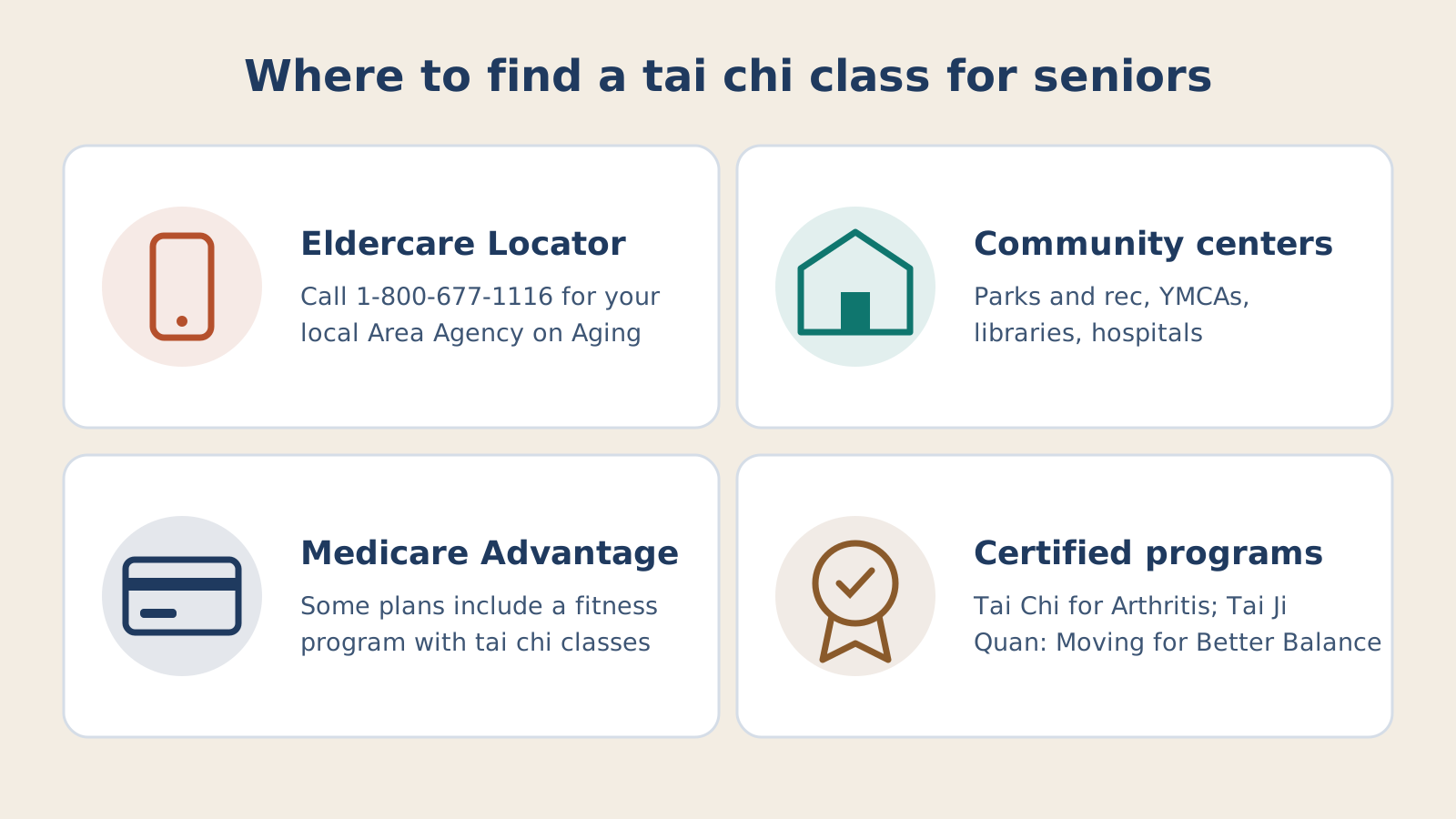
Where to find tai chi classes for seniors
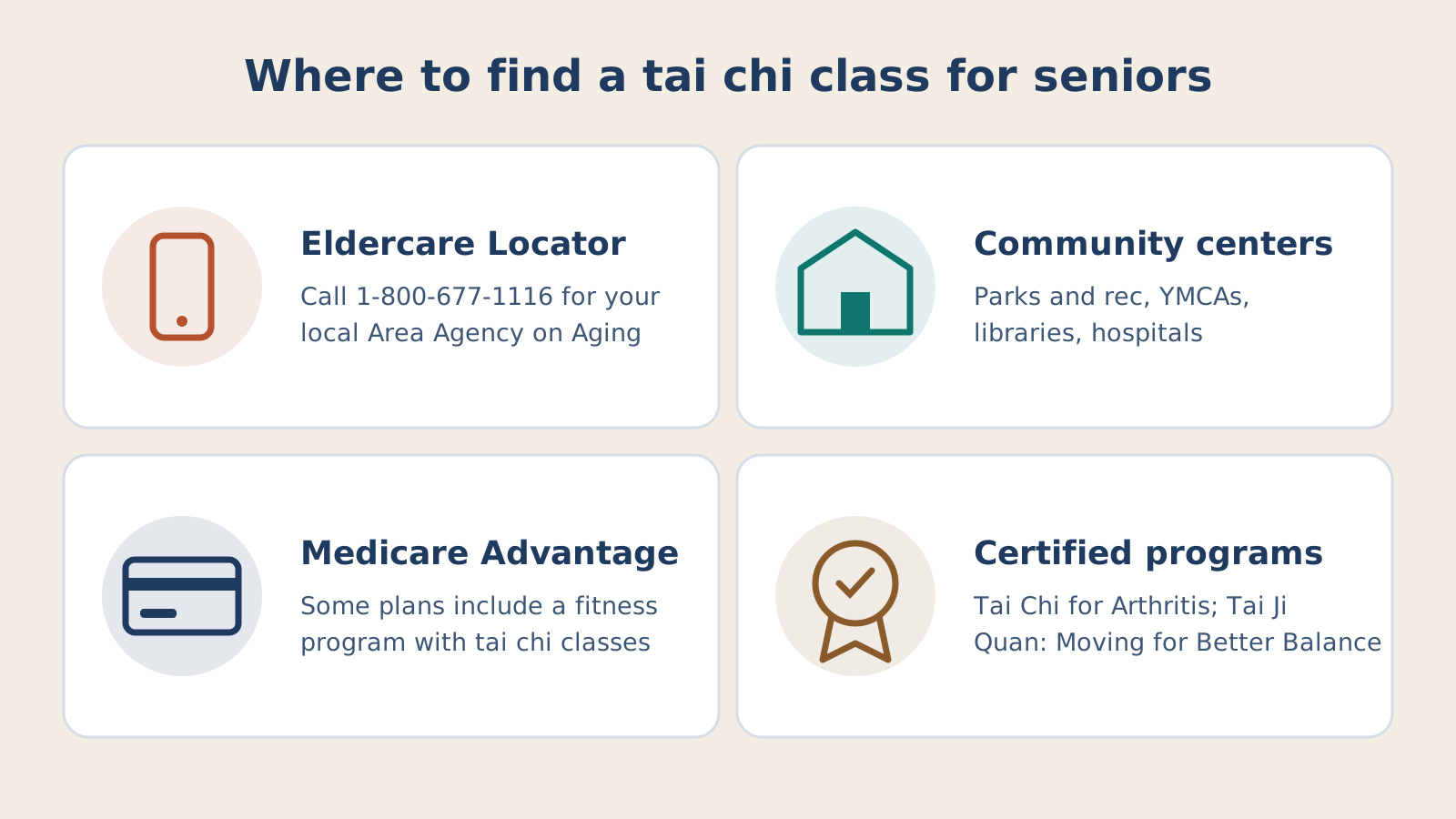
- Your Area Agency on Aging. These local agencies run or fund health programs for older adults, including evidence-based fall-prevention classes. Find yours through the Eldercare Locator, a free service of the US Administration for Community Living: call or text 1-800-677-1116, or search by location at eldercare.acl.gov.
- Senior centers and community centers. Many run weekly tai chi or qigong classes, often free or for a small fee or donation.
- YMCAs, parks and recreation departments, and libraries. Ask about beginners, "gentle" or seated classes.
- Hospitals and health systems. Some run community wellness or falls-prevention classes, sometimes with a physical therapist involved.
- Your Medicare Advantage plan. Check whether it includes a fitness benefit; more on this below.
- Certified instructor directories. The Tai Chi for Health Institute lists classes and certified instructors at its Find a Tai Chi Class page.

Large-print edition included
An ElderlyDaily original
Want every movement drawn out, a full page each?
Chair Tai Chi — Illustrated Edition
- All eight movements, a full page each, drawn frame by frame
- A three-minute warm-up, plus five common mistakes and how to fix them
- A four-week plan with a practice tracker
One-off purchase. Instant download.
PDF · 24 pages · US Letter + A4
Tai chi programs proven to help older adults
Any gentle tai chi class can help, but two programs were designed specifically for older adults and are widely offered through aging and health agencies.
| Program | What it is | Format | How to find it |
|---|---|---|---|
| Tai Ji Quan: Moving for Better Balance | A fall-prevention program derived from simplified 24-form tai chi, for older adults at risk of falling and people with movement problems such as Parkinson’s disease (NCOA) | Group classes, two 1-hour sessions a week for 24 weeks; in person or online | Ask your Area Agency on Aging, or see tjqmbb.org |
| Tai Chi for Arthritis and Fall Prevention | A program created in 1997 by Dr Paul Lam, a family physician and tai chi teacher, for people with arthritis, to improve balance and general health (Tai Chi for Health Institute) | Classes with certified instructors; also online lessons and DVDs | Find a Tai Chi Class |
Do tai chi classes really reduce falls?
Yes, with good evidence for the right kind of class. In a trial of 670 adults with an average age of about 78 who had fallen in the past year or had trouble getting around, a tai chi (tai ji quan) program tailored for balance, taught twice a week for 24 weeks, reduced falls by 58% compared with stretching, and by 31% compared with a general exercise program (Li et al., JAMA Internal Medicine, 2018).
Across many studies, a Cochrane review found tai chi may reduce the rate of falls in older adults living at home by about 19% (low-certainty evidence), and balance and functional exercise by about 24% (Cochrane, 2019). The lesson: regular, ongoing classes matter more than any single session.
Does Medicare pay for tai chi classes?
Original Medicare does not. Medicare’s own guidance says "Original Medicare doesn’t cover gym memberships or fitness programs" (Medicare.gov).
Some Medicare Advantage plans do, as an extra benefit. SilverSneakers, for example, is available at no cost to adults 65 and over through select Medicare plans, and its online classes include a tai chi session; in-person classes vary by location. You can check SilverSneakers eligibility online or call the number on your plan card.
Classes run through Area Agencies on Aging are often free or low-cost whatever your insurance.
What to ask before you join a class
- Is it for beginners and older adults? A class for martial-arts students moves very differently from a gentle class for seniors.
- What training does the instructor have? Look for certification in a recognized program, such as Tai Ji Quan: Moving for Better Balance or Tai Chi for Arthritis.
- Can I sit down or hold a chair? A good teacher offers seated or supported versions.
- How big is the class? Smaller groups mean more help with your form.
- How long does it run, and what does it cost? The proven programs run for several months, twice a week.
- Can I try one class first? Most will let you watch or try before committing.
What to wear and bring
- Comfortable, loose clothing you can step and bend in; you do not need a special uniform.
- Flat, thin-soled shoes with good grip. Avoid backless slippers and thick, chunky soles that make it hard to feel the floor. Our guide to the best shoes to prevent falls covers what to look for.
- Water, your glasses and any walking aid you normally use.
- Tell the instructor about any joint replacement, dizziness or recent fall before the class starts.
If you cannot get to a class
- Learn the basic step at home with our free tai chi walking guide and printable.
- Follow a timed routine in a small room: our 10-minute tai chi indoor walking routine.
- Start seated with the free chair tai chi routine.
- Thinking of an app instead? Read our tai chi walking app reviews before you subscribe. Prefer a disc or a book? See the best tai chi DVDs and books for seniors. Want a full plan on paper? Our 28-day tai chi walking plan teaches 21 moves at home.
- Not sure tai chi is for you? Compare it with qigong and yoga in qigong vs tai chi vs yoga for seniors.
An ElderlyDaily original
Chair Tai Chi — Illustrated Edition
Large-print edition included
- Instant download
- PDF · 24 pages · US Letter + A4
Frequently asked questions
Are there free tai chi classes for seniors?
Often, yes. Area Agencies on Aging, senior centers and some libraries run free or donation-based classes. Call the Eldercare Locator at 1-800-677-1116 to find your local agency, and ask about evidence-based fall-prevention programs.
Does Medicare cover tai chi classes?
Original Medicare does not cover fitness programs. Some Medicare Advantage plans include a fitness benefit, such as SilverSneakers, that can include tai chi. Check with your plan.
What is the best tai chi program for seniors?
For fall prevention, look for Tai Ji Quan: Moving for Better Balance, a program designed for fall prevention and offered through many aging agencies, or Tai Chi for Arthritis and Fall Prevention, created by Dr Paul Lam. Any gentle class with a trained instructor is a good start.
Who is Dr Paul Lam?
A family physician and tai chi teacher who, with his team, created the Tai Chi for Arthritis program in 1997. His Tai Chi for Health Institute trains instructors and lists classes on its website.
How long does it take to learn tai chi?
You can follow a beginners class from the first session, but learning a full sequence takes weeks to months. Tai Ji Quan: Moving for Better Balance, for example, runs twice a week for 24 weeks.
Is tai chi good for beginners over 60?
Yes. Classes for older adults move slowly, use simple movements and allow you to hold a chair or sit down. Tell the instructor about any health conditions first.
What should I wear to a tai chi class?
Loose, comfortable clothes and flat, thin-soled shoes with good grip. You do not need a uniform or special equipment.
Can I do tai chi classes online?
Yes. Some programs, including Tai Ji Quan: Moving for Better Balance, can be delivered online, and some Medicare Advantage fitness programs include online tai chi. Make sure you have a sturdy chair or counter beside you when practising at home.
Sources
- National Institute on Aging (NIH). Four Types of Exercise Can Improve Your Health and Physical Ability
- Cochrane. Exercise for preventing falls in older people living in the community (2019)
- CDC. Facts About Falls — Older Adult Fall Prevention
