
Tai Chi Walking for Seniors: Step-by-Step Guide & Free Printable PDF

Educational guidance, not medical advice. Check with your doctor before starting a new exercise, especially after a fall, with dizziness, a heart condition, uncontrolled blood pressure or recent surgery.
In this guide
- Download the free tai chi walking PDF
- What tai chi walking is
- Does tai chi walking really work, and is it legit?
- Before you start: set up a safe path
- Part 1: three moves on the spot
- Part 2: the tai chi walk, step by step
- Breathing and pace
- A four-week tai chi walking plan
- If standing is not safe yet: chair tai chi
- FAQs
Tai chi walking is slow, deliberate stepping taken from tai chi: heel first, roll down, then shift your weight. Here is how to do it safely at home, beside a counter, with a free four-page printable and an honest look at what it can and cannot do.
Key takeaways
- Tai chi walking is a slow stepping drill from tai chi. Each step lands heel first, rolls down to the whole foot, and only then does your weight move onto it.
- Free printable, no sign-up and no app: four pages with three moves on the spot, the tai chi walk drawn step by step, and a four-week plan with a tick chart. US Letter and A4.
- Practise beside a kitchen counter or rail, on a cleared path, until you feel steady.
- What it can do: regular tai chi is linked to fewer falls in older adults. What it will not do: a slow stepping drill burns few calories, so it is not a weight-loss plan.
- If standing is not safe for you yet, our free chair tai chi routine gives the same slow, breath-led movement sitting down.
Quick answer
What is tai chi walking, and how do you do it?
Tai chi walking is a slow stepping practice taken from tai chi. Stand beside a counter or rail, shift your weight onto one foot, step the other foot forward and touch the heel down, roll down onto the whole foot, then slowly move your weight forward onto it before the next step. Breathe slowly and never hold your breath. Start with three simple moves on the spot, then a few steps of the walk, three days a week. The free printable PDF has the whole routine and a four-week plan; no email or app needed.

Download the free tai chi walking PDF
Four large-print pages: what tai chi walking is and how to set up safely, three moves on the spot, the tai chi walk drawn as footprints step by step, and a four-week plan with a tick chart. Open it in your browser or a PDF reader and print.
No email, sign-up or payment. Print as many copies as you like for yourself, a parent or a group.

Large-print edition included
An ElderlyDaily original
Want every movement drawn out, a full page each?
Chair Tai Chi — Illustrated Edition
- All eight movements, a full page each, drawn frame by frame
- A three-minute warm-up, plus five common mistakes and how to fix them
- A four-week plan with a practice tracker
One-off purchase. Instant download.
PDF · 24 pages · US Letter + A4

What tai chi walking is
Tai chi walking is a stepping drill. Tai chi instructor Jeffrey Yang Sr., who teaches at Cleveland Clinic, describes it as the stepping built from the first two movements of the 32-movement Yang style (Bottom Line). Instead of the quick, automatic stride of everyday walking, every step is broken into parts: weight onto one foot, the other heel down, roll the foot flat, then move your weight onto it.
Going that slowly is the point. Each step asks the standing leg to hold you for a moment and asks you to move your weight on purpose. That weight shift, from one foot to the other, is the movement most falls happen in.
You will also see "tai chi walking" sold as an app or a weight-loss program, often with heavy advertising. The practice itself is free and needs no app. The routine on this page and in the printable is all you need to start.
Does tai chi walking really work, and is it legit?
For balance and falls, tai chi has real evidence behind it. A Cochrane review of exercise for preventing falls in older people living at home found that tai chi may reduce the rate of falls by about 19%, though the evidence was rated low certainty. Balance and functional exercises, which include practising weight shifts and stepping, reduced the rate of falls by about 24%, with high-certainty evidence (Cochrane, 2019).
Be clear about the limit: those studies looked at tai chi and balance programmes, not at the tai chi walking drill on its own. Tai chi walking is a reasonable, gentle way to practise the same skills, not a proven treatment in itself.
For weight loss, expect very little. A slow stepping drill burns few calories. Yang told Bottom Line that tai chi walking "won’t give you a six-pack", and any program promising dramatic weight loss from it alone is overselling it. We look at the calorie numbers and the research in tai chi walking for weight loss.
Is it a scam? The exercise is not. Be cautious of paid apps and subscriptions that promise fast results. You do not need one: the full routine is free on this page.
Before you start: set up a safe path
- Clear a straight path about 6 feet (2 metres) long. Move rugs, cords and clutter.
- Practise beside a kitchen counter, a hallway rail or a sturdy chair back you can hold. Use it every time until you feel steady.
- Wear flat shoes with good grip, or go barefoot on a non-slip floor. Not socks on a smooth floor.
- Rest one hand on your belly with the other over it, as many tai chi classes teach, or keep one hand on your support.
Check with your doctor first
Talk to your doctor before starting if you have had a fall, feel dizzy, have a heart condition or uncontrolled blood pressure, or have had recent surgery. Stop and sit down if you feel pain, dizziness, chest discomfort, breathlessness or unsteadiness.
Part 1: three moves on the spot
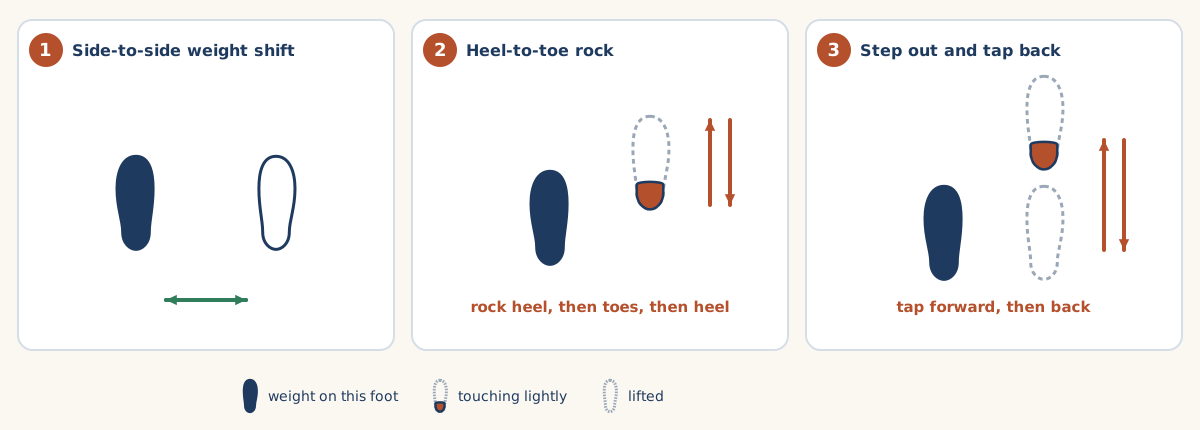
Do these standing beside your counter or chair back with one hand resting on it. They teach the weight shift the walk is built on, and they need no more room than a doormat, so they suit the smallest kitchen.
- Side-to-side weight shift. Feet hip-width apart. Slowly move your weight onto the left foot until the right foot feels light, then slowly across to the right. 8 times each way.
- Heel-to-toe rock. Weight on the left foot. Place the right heel lightly ahead of you, roll down onto the whole foot and up onto the ball of the foot, then back to the heel. Keep most of your weight on the left foot. 6 times, then swap feet.
- Step out and tap back. Weight on the left foot. Step the right foot a small way forward, touch the heel down lightly, then bring it back beside the left. 6 times, then swap feet.
If a move feels wobbly, make it smaller rather than faster, and hold your support with both hands. For a timed 10-minute version built for a small room, see our tai chi indoor walking routine.
Part 2: the tai chi walk, step by step
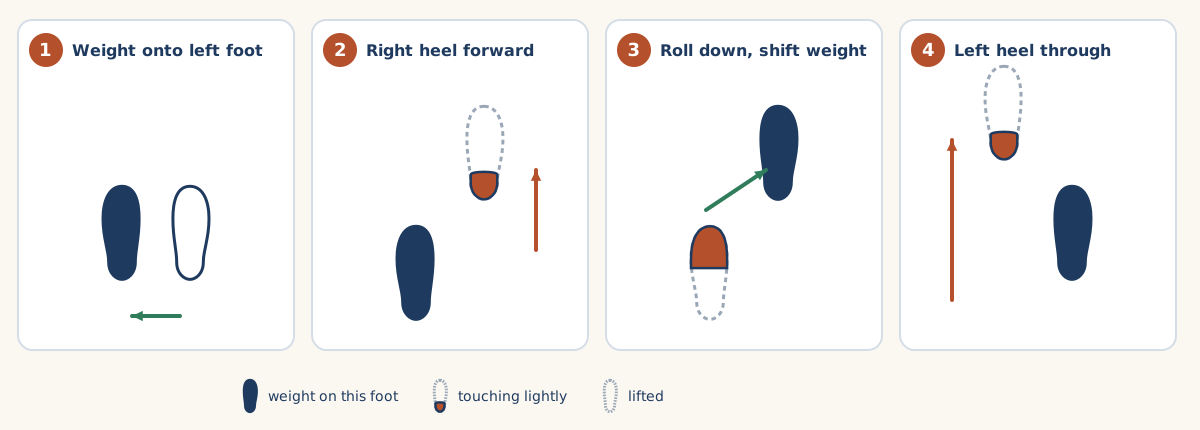
Walk slowly along your cleared path, beside the counter or rail. Every step has the same four parts.
- Weight onto one foot. Stand with your feet together. Shift your weight onto the left foot until the right foot feels light.
- Heel first. Step the right foot forward a short way and touch the heel down. Keep your weight on the back foot.
- Roll down, then shift. Lower the right foot until it is flat, then slowly move your weight forward onto it. The left heel lifts as you do.
- Step through. Bring the left foot forward and place its heel down ahead of you. Repeat with the other foot.
Start with six steps, stop, and turn round with small steps rather than twisting on one foot. Walk back the same way. Short steps are better than long ones. Some classes also practise walking backwards; leave that until you are steady, and do it beside a rail.
Breathing and pace
Move slowly: a count of about four for each part of a step is plenty. Breathe slowly and evenly, and never hold your breath; if you notice you are holding it, slow down.
Stand tall, look ahead rather than down at your feet, and keep your knees soft rather than locked.
A four-week tai chi walking plan
Build up slowly. This is the plan in the printable, which has a tick chart for each day:
- Week 1. 3 days, about 5 minutes. Part 1 only, holding your support with both hands.
- Week 2. 3 to 4 days, about 10 minutes. Part 1, then the walk for six steps and back, beside your support.
- Week 3. 4 days, 10 to 15 minutes. Part 1, then the walk the length of your path, two or three times.
- Week 4. 4 to 5 days, about 15 minutes. The full routine, with a hand near your support until you feel steady.
Rest days are part of the plan. A few minutes most days does more than one long session a week.
If standing is not safe yet: chair tai chi
If balance, dizziness or weak legs make standing practice unsafe for now, start sitting down. Our free chair tai chi routine keeps the slow, breath-led tai chi movement with no standing at all, and many people do it on the days between walking practice.
An ElderlyDaily original
Chair Tai Chi — Illustrated Edition
Large-print edition included
- Instant download
- PDF · 24 pages · US Letter + A4
More free printables
See all 29 free printables- Tai Chi Indoor Walking (10 Minutes)A timed 10-minute tai chi walking routine for a small kitchen or hallway, with a room-setup plan and a 30-day tick chart.Free PDF, no sign-up
- Short Chair Yoga RoutinesTwo short seated routines: a 10-minute flow for circulation and flexibility, and a gentle morning wake-up for stiff joints.Free PDF, no sign-up
- Morning Chair YogaTwo short seated routines: a 10-minute flow for circulation and flexibility, and a gentle morning wake-up for stiff joints.Free PDF, no sign-up
- Seated Stretches for BeginnersA gentle top-to-bottom stretching routine for flexibility and comfort, with clear safety notes.Free PDF, no sign-up
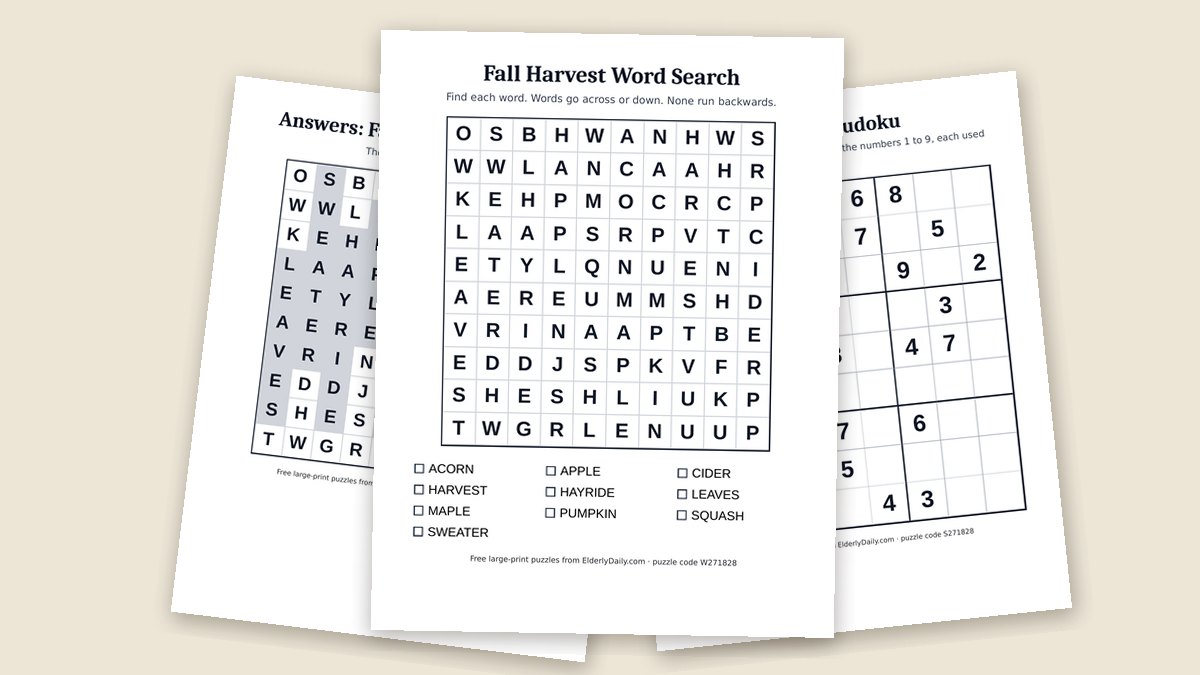 Large Print Puzzle MakerMake your own word search or Sudoku: pick a theme or type your own words, choose the size, and print it with an answer page.Free PDF, no sign-up
 Large Print Calendar 2027One month per page, extra-large dates and boxes big enough to write in. Starts November 2026 and runs to December 2027.Free PDF, no sign-up
Frequently asked questions
What is tai chi walking?
A slow stepping practice taken from tai chi. Each step lands heel first, rolls down to the whole foot, and only then does your weight move onto it. Moving that slowly makes every step a small balance exercise, practising the weight shift from one foot to the other.
Is tai chi walking legit, or a scam?
The exercise is legitimate. Tai chi is one of the better-studied gentle exercises for older adults, and a Cochrane review found it may reduce the rate of falls. What deserves caution are paid apps and programs that promise fast results or big weight loss. You do not need any of them: the full routine is free on this page.
Does tai chi walking help you lose weight?
Not much. A slow stepping drill burns few calories, and it is not a weight-loss workout. Its value is balance, steadier walking and gentle activity. If weight loss is the goal, talk to your doctor about diet and more vigorous activity that suits you. See tai chi walking for weight loss for the numbers and a realistic weekly plan.
Is tai chi walking good for seniors?
For most older adults it is a gentle, low-impact way to practise balance, done beside a counter or rail. Tai chi has been linked to fewer falls in older people. Check with your doctor first if you have had a fall, feel dizzy, or have a heart condition, and start with the moves on the spot.
Can I do tai chi walking indoors?
Yes. The three moves on the spot need no more room than a doormat, and the walk needs a clear path of about six feet, such as a hallway or the length of a kitchen counter. Clear rugs and cords, and keep something sturdy to hold. Our 10-minute tai chi indoor walking routine is built for exactly that kind of space.
How long and how often should I do it?
Start with about five minutes, three days a week, then build to about fifteen minutes on four or five days over four weeks. Regular short sessions do more than occasional long ones.
Is there a free tai chi walking PDF?
Yes. Download the free tai chi walking PDF (or the A4 version): four large-print pages with the moves on the spot, the walk drawn step by step and a four-week plan with a tick chart. No email or sign-up.
Do I need an app for tai chi walking?
No. Everything you need is on this page and in the printable. An app or video can be useful if you like following along, but there is no need to pay for a subscription to learn the basic steps.
How is tai chi walking different from ordinary walking?
Ordinary walking is quick and automatic, and your weight falls forward from one foot to the next. In tai chi walking you place the heel first, roll the foot down, and only then deliberately move your weight onto it, so each step is slower and more controlled.
What if I cannot stand for long?
Start sitting down. Our free chair tai chi routine gives the same slow, breath-led tai chi movement in a chair, and you can add the moves on the spot later, holding a counter, once you feel ready.
Sources
- National Institute on Aging (NIH). Four Types of Exercise Can Improve Your Health and Physical Ability
- Cochrane. Exercise for preventing falls in older people living in the community (2019)
- CDC. Facts About Falls — Older Adult Fall Prevention
