
Tai Chi Walking for Weight Loss: What It Can and Can’t Do

Educational guidance, not medical advice. Talk to your doctor before trying to lose weight, and about any weight loss you did not plan.
Ads promise that a few weeks of tai chi walking will melt the pounds away. It won’t, on its own. Here is what it really burns, what the research on tai chi and belly fat found, and where tai chi walking fits in a plan that can work.
Key takeaways
- On its own, tai chi walking is not a weight-loss workout. Thirty minutes of tai chi burns roughly 110 calories for a 154 lb adult over 60, about the same as a slow stroll, and the slow walking drill is likely a little less.
- Regular tai chi classes did trim waistlines a little. In a trial of 543 adults over 50, an hour of tai chi three times a week for 12 weeks reduced waist size by about 1.8 cm (under an inch) more than doing nothing, much like conventional exercise.
- Its real strengths are balance and confidence. Tai chi may reduce falls, which keeps people moving, and moving more is what supports a healthy weight.
- Be wary of "28-day" programs and apps that promise big losses from tai chi walking alone.
- A plan that can work: eating changes agreed with your doctor, building toward 150 minutes a week of moderate activity, strength work twice a week, and tai chi walking for balance.
Quick answer
Does tai chi walking help you lose weight?
Only a little, on its own. It is slow, gentle movement: 30 minutes burns roughly 110 calories for a 154 lb adult over 60, about the same as a slow stroll (Older Adult Compendium). A trial of hour-long tai chi classes three times a week found a small drop in waist size, about 1.8 cm over 12 weeks (Siu et al., 2021). Tai chi walking is best used for balance and as a gentle start, alongside eating changes and more vigorous activity if your doctor agrees.
The honest answer
Tai chi walking is a slow stepping drill: heel down, roll the foot flat, then move your weight onto it. It is excellent practice for balance, and it is gentle enough for almost anyone to start. But slow movement burns few calories, and weight loss mostly comes down to the balance between what you eat and what you burn.
Tai chi instructor Jeffrey Yang Sr. put it plainly to Bottom Line: tai chi walking "won’t give you a six-pack" (Bottom Line). That is not a reason to skip it. It is a reason to be clear about what it is for.

Large-print edition included
An ElderlyDaily original
Want every movement drawn out, a full page each?
Chair Tai Chi — Illustrated Edition
- All eight movements, a full page each, drawn frame by frame
- A three-minute warm-up, plus five common mistakes and how to fix them
- A four-week plan with a practice tracker
One-off purchase. Instant download.
PDF · 24 pages · US Letter + A4

Sponsored Pick
REHAND Ergonomic All-Terrain Folding Cane
Seniors with arthritis or joint pain who want a cushioned, ergonomic grip with all-terrain stability
Check PriceHow many calories does tai chi walking burn?
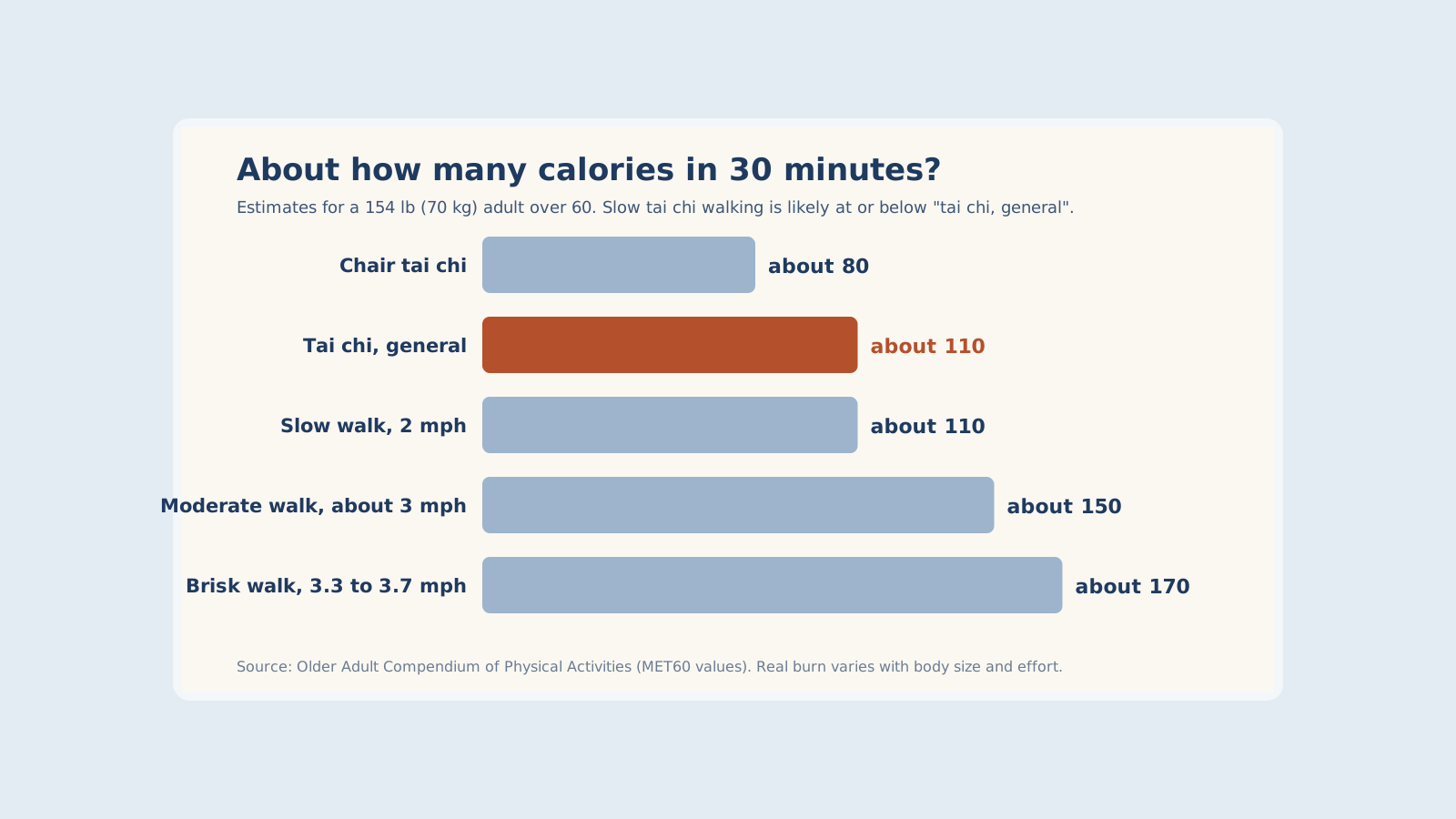
Nobody has measured the tai chi walking drill on its own, but the Older Adult Compendium of Physical Activities, which lists energy costs measured in people aged 60 and over, gives general tai chi about the same value as walking slowly at 2 mph (Older Adult Compendium). For a 154 lb (70 kg) adult, that works out to roughly:
- Chair tai chi: about 80 calories in 30 minutes.
- Tai chi, general: about 110 calories in 30 minutes, or about 35 in a 10-minute session.
- A moderate walk, about 3 mph: about 150 calories in 30 minutes.
- A brisk walk, 3.3 to 3.7 mph: about 170 calories in 30 minutes.
These are estimates: a heavier person burns more, a lighter person less, and the slow tai chi walk is likely at or below the general tai chi figure. For scale, a pound of body fat holds roughly 3,500 calories of energy, so ten-minute sessions alone would take months to make a visible difference.
What the research on tai chi and weight found
The best-known trial is from Hong Kong. Researchers randomly assigned 543 adults aged 50 and over with central obesity (a large waist) to tai chi, conventional exercise (brisk walking and strength training), or no exercise. The exercise groups did one-hour, instructor-led sessions three times a week for 12 weeks (Siu et al., Annals of Internal Medicine, 2021).
Compared with the no-exercise group, the tai chi group’s waists shrank by about 1.8 cm (under an inch), and the conventional exercise group’s by about 1.3 cm. Both exercise groups also lost some weight and kept their "good" HDL cholesterol from falling.
Two things to keep in mind. The change was real but modest. And it came from three hours a week of full tai chi classes, not ten minutes of the walking drill. If you want that kind of result, the time you put in matters more than the style.
What tai chi walking can do for you
- Better balance and fewer falls. A Cochrane review found that tai chi may reduce the rate of falls in older adults living at home by about 19% (low-certainty evidence), and balance and functional exercise by about 24% (high certainty) (Cochrane, 2019).
- A safe first step. If you have been inactive, worried about falling or out of breath on a normal walk, slow practice beside a counter is a way back into movement.
- Confidence to do more. Feeling steadier on your feet makes longer walks, stairs and outings easier, and that everyday activity adds up more than any single exercise.
- A daily habit. Ten minutes is easy to fit in. Our 10-minute tai chi indoor walking routine is built for a small kitchen or hallway.
About the "28-day tai chi walking" ads
Much of the interest in tai chi walking for weight loss comes from app and social media ads promising fast results from a short daily routine. Be cautious of any program that promises a set number of pounds from tai chi walking alone, shows dramatic before-and-after photos, or pushes a subscription before you have seen the exercises.
You do not need to pay to learn it. The basic step, a four-week plan and a free printable are in our tai chi walking for seniors guide.
A realistic weekly plan if you want to lose weight
US guidelines for adults 65 and over recommend at least 150 minutes a week of moderate activity, muscle-strengthening activities on at least 2 days, and activities to improve balance (CDC). Tai chi walking covers the balance part. A week that covers the rest might look like this:
- Most days: 10 minutes of tai chi walking for balance.
- Five days: a 30-minute walk at a pace where you can talk but not sing, built up slowly, or another activity you enjoy such as an exercise bike or swimming.
- Two days: strength exercises, such as our printable chair exercises.
- Every day: the eating changes you agree with your doctor. Our daily nutrition guide for seniors covers the basics.
If standing for long is hard, start with our free chair tai chi routine and build up from there.
Weight loss in later life: check with your doctor
Talk to your doctor before trying to lose weight, especially if you are over 65, have a heart condition, diabetes or kidney disease, or take medicines that affect blood sugar or blood pressure. Losing weight without trying, or losing muscle strength, is a reason to see your doctor rather than something to celebrate.
Frequently asked questions
Can you lose weight with tai chi walking?
A little, but not much on its own. It is slow movement that burns roughly the same as a gentle stroll. It helps most as part of a plan that also includes eating changes, more vigorous activity and strength work.
How many calories does 10 minutes of tai chi walking burn?
Roughly 35 calories for a 154 lb adult over 60, based on the energy cost of general tai chi in the Older Adult Compendium of Physical Activities. A heavier person burns a little more, a lighter person a little less.
Does tai chi reduce belly fat?
Modestly. In a trial of 543 adults over 50 with a large waist, an hour of tai chi three times a week for 12 weeks reduced waist size by about 1.8 cm more than no exercise, similar to brisk walking plus strength training.
Is the 28-day tai chi walking challenge real?
The exercise is real; the promised results often are not. Be wary of programs that promise a set amount of weight loss from tai chi walking alone. You can learn the routine for free in our tai chi walking for seniors guide.
Is tai chi walking better than normal walking for weight loss?
No. A brisk walk burns more calories than tai chi walking. Tai chi walking is better for practising balance, which is why many people do both.
How long should I do tai chi walking each day?
Ten to fifteen minutes most days is a good balance routine. For weight, the total amount of activity across the week matters more; US guidelines suggest at least 150 minutes of moderate activity a week for older adults.
Is tai chi walking good for overweight seniors?
It can be a good, low-impact place to start, done beside a counter for support, especially if knees, breathlessness or fear of falling make other exercise hard. Check with your doctor first.
Does chair tai chi help with weight loss?
Even less than standing tai chi, since sitting burns fewer calories. Its value is gentle movement and flexibility for people who cannot stand safely for long.
Sources
- National Institute on Aging (NIH). Four Types of Exercise Can Improve Your Health and Physical Ability
- Cochrane. Exercise for preventing falls in older people living in the community (2019)
- CDC. Facts About Falls — Older Adult Fall Prevention
