
Tai Chi Walking App Reviews: Are They Worth Paying For? (Plus Free Alternatives)

We have no affiliation with any app on this page and earn nothing from them. We do sell our own one-time printable plan, shown on this page; weigh that as you read. App ratings and prices change often; we checked the store listings on 23 October 2026.
You have probably seen the ads: a 28-day tai chi walking plan that promises easy results from home. We looked at the most-reviewed tai chi walking apps, what they charge and what users complain about, so you can decide whether to pay, and what you can do for free instead.
Key takeaways
- Most tai chi walking apps are subscriptions that renew automatically. On the listings we checked, monthly plans ran about $10 to $12 in the US, with yearly and occasional one-time "lifetime" options.
- The exercise is real; the app is optional. The apps package short, gentle routines, often shown by an animated figure rather than a teacher.
- Common complaints are about paywalls, not the movements: challenges that lock partway through, being charged again, and instructions that do not match the on-screen figure.
- Weight-loss promises are the biggest red flag. Slow tai chi walking burns roughly as much as a gentle stroll.
- Free options cover the basics: our step-by-step guide and printable, a 10-minute indoor routine, and local classes.
Quick answer
Are tai chi walking apps worth it?
Only if you will use a guided video most days and you choose a plan you can cancel easily. The popular apps are real and give you short, gentle routines, but most are auto-renewing subscriptions (monthly plans of about $10 to $12 on the US listings we checked on 23 October 2026), and the most common complaints are paywalls partway through a challenge and unexpected charges. If you mainly want to learn the steps, our free tai chi walking guide and printable covers the basics without a subscription.
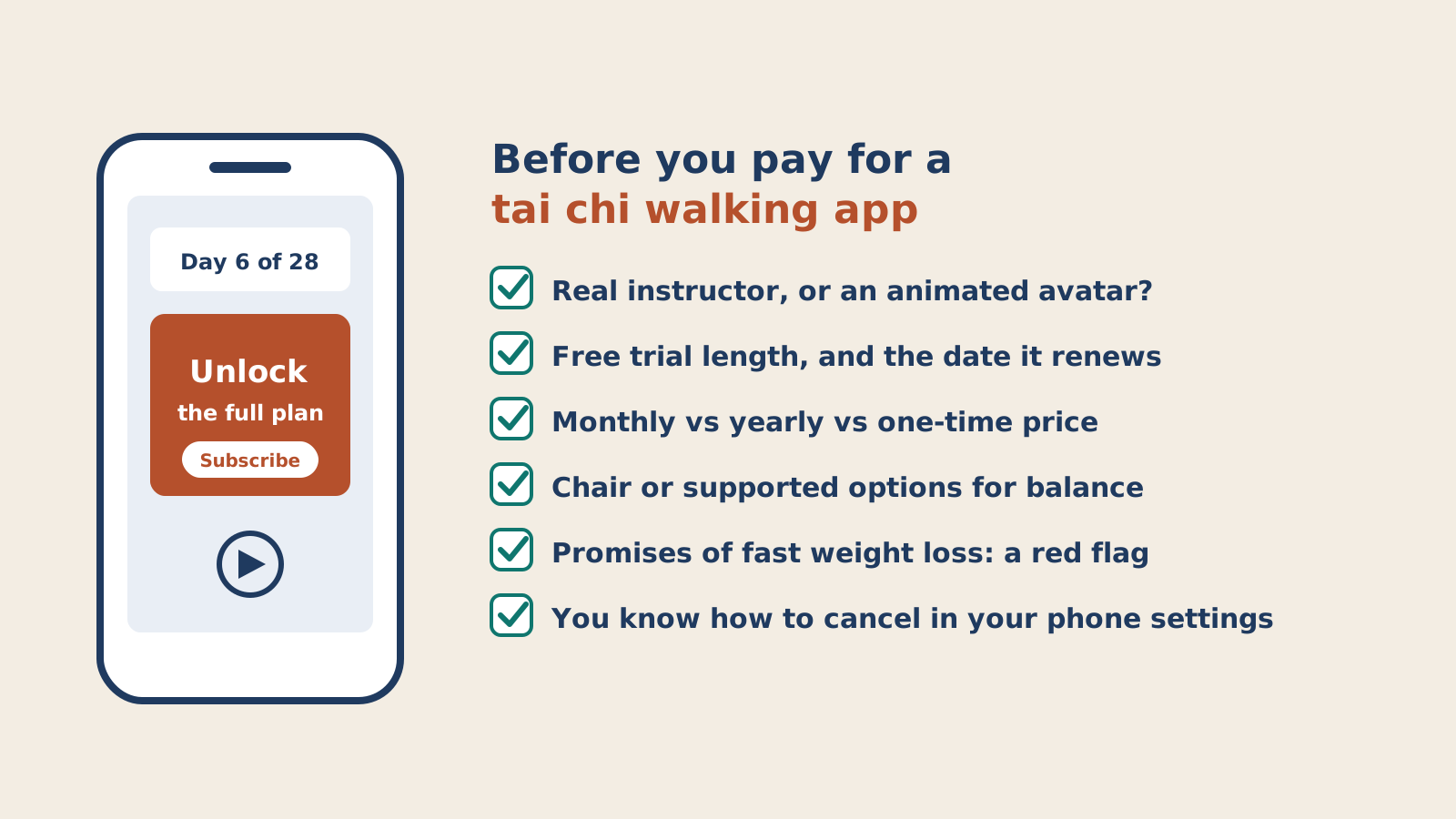
What a tai chi walking app actually gives you
Tai chi walking is a slow stepping drill taken from tai chi: heel down first, roll the foot flat, then move your weight onto it. The apps advertised under that name usually offer a series of short daily routines, often 10 to 20 minutes, mixing tai chi-style stepping and arm movements with gentle marching, side steps and stretches. Many follow a 28-day "challenge" format.
Most show the movements with an animated figure or short video loops and a countdown timer, rather than a teacher explaining each step. That can work well if you already know the basics. It is harder if you need the movement broken down slowly, or if you need to adapt it for balance problems.
None of this is a scam in itself: you do get routines you can follow. The question is whether the routines are worth a recurring charge, and whether the marketing matches what the exercise can do.

Seated version of every move
An ElderlyDaily original
Want every move drawn out, with a 28-day plan?
Tai Chi Walking for Seniors — The Indoor 28-Day Plan
- 21 illustrated moves, one per page, with numbered steps and a breathing cue
- A supported and a seated version of every move
- A gentle 4-week plan: about 10 minutes a day, building to about 20
One-off purchase. Instant download.
Fillable PDF · 35 pages · US Letter + A4

The tai chi walking apps we checked
These are the most-reviewed apps that came up for "tai chi walking" in the US App Store and Google Play. Ratings, review counts and prices are as listed when we checked on 23 October 2026; they change often, so check the listing before you buy.
| App (store) | Store rating | Listed prices | What reviewers raise |
|---|---|---|---|
| Tai Chi Walking: GentleFit (iPhone) | 4.7 from about 2,500 ratings | Free download. $11.99 a month, $79.99 a year; other annual offers listed at $44.99 and $59.99 | Few written reviews; those shown praise the short 10-minute sessions and chair options |
| Tai Chi Walking & Chair Yoga (Android) | 4.5 from about 12,900 reviews; 1M+ downloads | Prices not shown on the listing | A challenge that stops at day 6 without a subscription; workouts that feel like gym intervals; previews that move too fast |
| Tai Chi Walking App (Android) | 4.7 from about 5,000 reviews; 100K+ downloads | Prices not shown on the listing; a reviewer says a subscription is needed after two free workouts | Low impact and easy to start; instructions that do not always match the animated figure; videos cut off by the timer |
| Tai Chi Walking for Seniors (iPhone) | 4.7 from 61 ratings | Free download. $9.99 a month; yearly $24.99 to $39.99; $109.99 lifetime | Very few reviews; one reports having to pay a second time to finish the 28-day plan |
How to read those star ratings
All four apps sit at 4.5 stars or higher, yet the written reviews that complain tend to focus on money rather than the movements. When you read reviews before you subscribe, look for these specifically:
- Paywalls partway through. Reviewers of some apps say a free start ends after a few days or workouts, and the rest of the plan is locked.
- Renewal surprises. The App Store listings we checked all say the subscription renews automatically unless you cancel at least 24 hours before the period ends.
- Avatar vs instructor. An animated figure shows the shape of a move, but rarely tells you where your weight should be or how to make it easier.
- Names that over-promise. One UK listing is called "Tai Chi Walking: Weight Loss", yet its own description says to "forget calories and heart rate" and focuses on balance (App Store).
What about the weight-loss promises?
Much of the advertising sells tai chi walking as a weight-loss plan. Be sceptical. Slow tai chi burns roughly the same as a gentle stroll, about 110 calories in 30 minutes for a 154 lb adult over 60, and the walking drill is likely a little less. Regular hour-long tai chi classes have trimmed waistlines slightly in research, but not by the amounts implied in ads.
We go through the numbers in tai chi walking for weight loss: what it can and can’t do. In short: tai chi walking is good for balance and a gentle daily habit, not a shortcut to weight loss.
A checklist before you subscribe
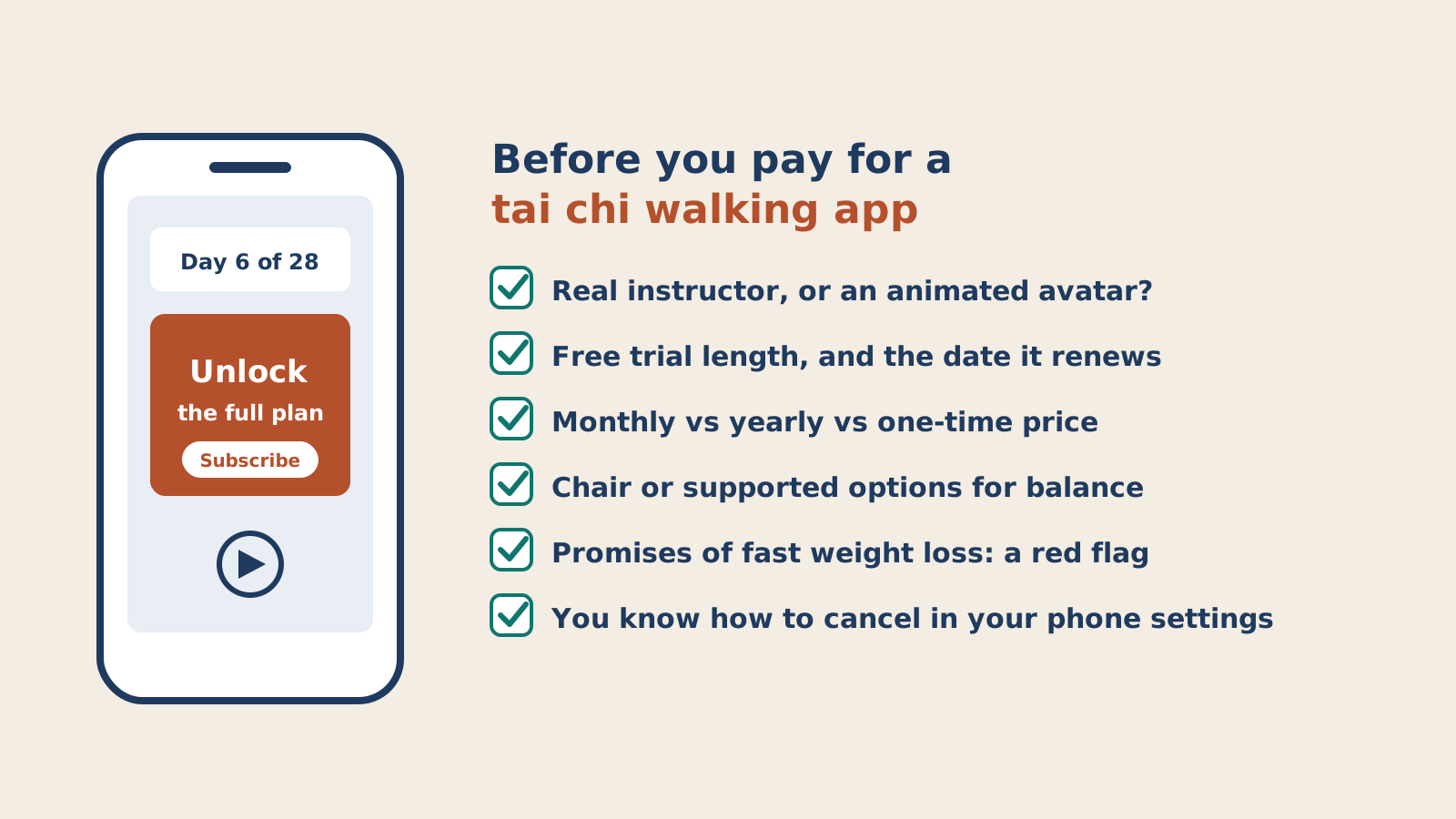
- Watch the first routine before paying. If you cannot see what a full session looks like, wait.
- Note the renewal date the day you start a free trial, and put it on your calendar.
- Compare monthly, yearly and one-time prices. A yearly plan only saves money if you will still be using it in month four.
- Look for chair or supported versions if your balance is not steady. Practise beside a kitchen counter either way.
- Skip any app that promises a set amount of weight loss.
- Check who made it. Look at the developer name and the support contact on the listing before you hand over card details.
How to cancel a tai chi walking app subscription
Deleting the app does not cancel the subscription. Cancel it in your phone’s settings:
- 1
iPhone or iPad
Open Settings, tap your name, tap Subscriptions, choose the app, then tap Cancel Subscription (scroll down if you do not see it). If there is no cancel button, it is already cancelled (Apple).
- 2
Android phone
Open the Google Play Store app, tap your profile picture, then Payments & subscriptions, then Subscriptions. Choose the app and tap Cancel subscription.
- 3
Asking for a refund
For iPhone purchases, go to reportaproblem.apple.com, choose "Request a refund", pick the subscription and submit (Apple). For Google Play, Google suggests contacting the app’s developer first, as that is often quickest (Google Play Help).
- 4
Helping a parent
If you are checking a parent’s phone for unexpected charges, look at the same Subscriptions screen together. It lists every active subscription and its renewal date.
Free alternatives to a tai chi walking app
- Our step-by-step guide and printable. Tai chi walking for seniors breaks the heel-first step into four parts, with three moves on the spot, a four-week plan and a free 4-page PDF. No email or sign-up.
- A timed 10-minute routine. Our tai chi indoor walking routine is built for a small kitchen or hallway, with its own printable and 30-day chart.
- A seated version. If standing is hard, the free chair tai chi routine keeps the slow, breath-led movement sitting down.
- Free videos. Plenty of qualified tai chi teachers post free beginner videos online. Prefer a teacher who names their training and shows the moves slowly from the front and the side.
- Local classes. Senior centres, community centres and YMCAs often run low-cost tai chi, and some Medicare Advantage plans include fitness programs with tai chi classes. See how to find tai chi classes for seniors.
An ElderlyDaily original
Tai Chi Walking for Seniors — The Indoor 28-Day Plan
Seated version of every move
- Instant download
- Fillable PDF · 35 pages · US Letter + A4
Our verdict
A tai chi walking app can be a useful nudge if you like following a screen and will open it most days. Choose one you can try before paying, set a reminder before the renewal date, and ignore any weight-loss promise.
If you mainly want to learn the movement and build a habit, you do not need a subscription. Start with the free guide and printable, practise beside a counter, and add a class or a video later if you enjoy it. A one-off tai chi DVD is another option with no subscription, as is our own 28-day tai chi walking plan, a one-time printable.
Frequently asked questions
Is tai chi walking legit?
The exercise is. Tai chi walking is a slow stepping drill from tai chi, and tai chi is one of the better-studied gentle exercises for balance in older adults. What deserves caution is the marketing: some apps and ads promise fast weight loss that a slow stepping drill cannot deliver.
How much does a tai chi walking app cost?
On the US listings we checked on 23 October 2026, monthly plans ran about $10 to $12, yearly plans about $25 to $80, and one app offered a one-time lifetime option. Most are free to download, then charge for the full program. Prices change often, so check the listing.
Is there a free tai chi walking app?
Most apps are free to download but lock the full program behind a subscription. For a fully free option, use our tai chi walking guide and free printable, or free beginner videos from qualified teachers.
Do tai chi walking apps help you lose weight?
Not much on their own. Slow tai chi burns about the same as a gentle stroll. See tai chi walking for weight loss for the numbers and a realistic plan.
How do I cancel a tai chi walking subscription?
On iPhone: Settings, your name, Subscriptions, choose the app, Cancel Subscription. On Android: Google Play Store, your profile picture, Payments & subscriptions, Subscriptions, choose the app, Cancel subscription. Deleting the app does not cancel it.
What is the best tai chi walking app for seniors?
We do not recommend one over another: the apps change prices and content often, and none has been tested in research. If you try one, choose an app with chair or supported options, a real preview before you pay, and an easy way to cancel. Practise beside a counter either way.
Is a tai chi walking app safe for seniors?
The movements are gentle, but an app cannot see you. Practise beside a sturdy counter or rail, clear rugs and cords, and check with your doctor first if you have had a fall, feel dizzy, or have a heart condition.
What is the difference between an app and a tai chi class?
A class has a teacher who can watch you and adjust the moves for your balance, and many are low-cost at senior or community centres; see how to find tai chi classes for seniors. An app is cheaper per session and always available, but only shows you the movements.
Sources
- National Institute on Aging (NIH). Four Types of Exercise Can Improve Your Health and Physical Ability
- Cochrane. Exercise for preventing falls in older people living in the community (2019)
- CDC. Facts About Falls — Older Adult Fall Prevention
