
Games for Seniors: 40+ Fun Ideas for Groups, Memory, Cards and Screens

Research on games and cognitive ageing summarised from the University of Edinburgh and NIA. Games support wellbeing; they are not a treatment for dementia.
A good game does more than pass the time: it gets people talking, laughing and thinking. Here are more than 40 games that work for older adults at home, in a senior center or in a care home, with easy ways to adapt each one for weaker eyes, stiff hands or memory loss.
Key takeaways
- The best game is one the person enjoys and can win at sometimes. Pick by interest and ability, not by what is “good for the brain”
- Group games such as trivia, bingo for fun, word games and seated balloon volleyball suit senior centers and care homes
- Memory and brain games like crosswords, sudoku and word searches are easy to start: we have free large-print versions
- In a study of over 1,000 people in their 70s, those who played more non-digital games such as cards, chess, bingo and crosswords showed slightly less decline in thinking skills (University of Edinburgh, 2019). It shows a link, not proof
- Almost any game can be adapted: large print, card holders, bigger pieces, teams and no elimination
- For someone with dementia, choose simple, familiar, failure-free games and drop anything that feels like a test
Quick answer
What are good games for seniors?
Good games for seniors include trivia and word games, bingo played for fun, crosswords, sudoku and word searches, card games such as rummy and Uno, board games such as checkers, dominoes and Scrabble, jigsaw puzzles, simple tablet games like solitaire and Wordle, and seated active games such as balloon volleyball and bean bag toss. Choose games the person enjoys, adapt them with large print and bigger pieces, and play in teams so nobody is left out.
How to choose the right game
Start with the person, not the game. Four questions narrow it down quickly:
- What did they enjoy before? A lifelong card player will light up at rummy long before a new app
- What can they see, hear and hold? Low vision, hearing loss and arthritis decide the format more than ability does
- Alone or together? Some days a quiet crossword is right; other days the point is company
- How long can they focus? Short rounds of 10 to 15 minutes beat one long game that ends in tiredness
Then make it easy to succeed. Older adults often avoid games because they fear looking slow or forgetful. Teams, no scorekeeping, and generous hints keep the fun in.
| Kind of game | Best for | Examples |
|---|---|---|
| Group games | Senior centers, care homes, family gatherings | Trivia, bingo for fun, categories, charades |
| Memory and brain games | Daily mental activity, alone or in pairs | Crosswords, sudoku, word search, matching cards |
| Card and board games | Two to six players, familiar favourites | Rummy, Uno, dominoes, checkers, Scrabble |
| Video and tablet games | Solo play, and playing with distant family | Solitaire, Wordle, mahjong tiles, motion bowling |
| Active games | Gentle movement, seated or standing | Balloon volleyball, bean bag toss, seated bowling |
| Dementia-friendly games | Later stages, short attention spans | Sorting, matching, picture reminiscence |
An ElderlyDaily original
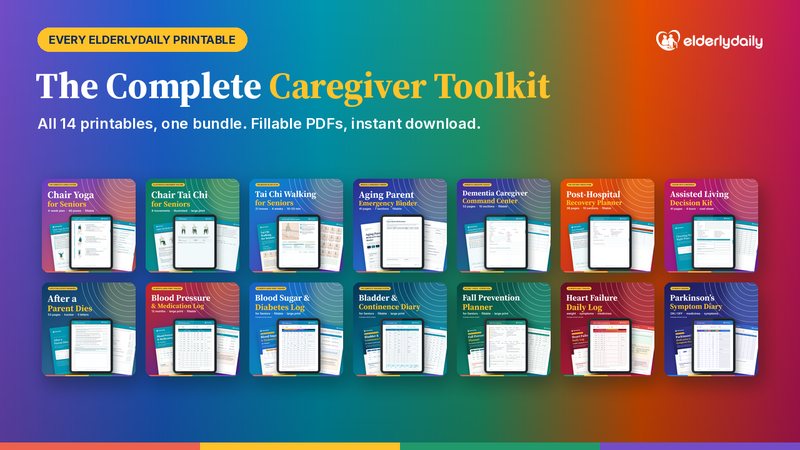
Want every ElderlyDaily printable at once?
The Complete Caregiver Toolkit — Every ElderlyDaily Printable
- Chair Tai Chi, Chair Yoga, and Tai Chi Walking with 6 follow-along videos
- Aging Parent Binder, Dementia Command Center and Post-Hospital Recovery Planner
- Assisted Living Decision Kit and the After a Parent Dies estate organizer
One-time purchase · Instant download · All 14 printables · fillable PDFs · instant download
Group games for senior centers and nursing homes
Group games work when everyone can join in from their chair and nobody is knocked out. These ten are reliable with mixed abilities:
- Trivia in teams, with questions from the decades they remember. Our 100 trivia questions for seniors are ready to print
- Bingo, played for fun. Large-print cards and small non-cash prizes keep it light
- Categories: name a fruit, a city or a car make for each letter, round the table
- Finish the phrase: read the start of a proverb or a famous saying and let the room finish it
- Picture charades: act out an everyday task (brushing teeth, driving, knitting) for the group to guess
- Twenty questions: one person thinks of a famous person or object; the room asks yes-or-no questions
- Price is right: guess what everyday items cost in 1960 and today
- Memory tray: show a tray of ten objects, cover it, and list them together
- Word chain: each word must start with the last letter of the one before
- Story circle: each person adds one sentence to a story
For activity staff, the keys are a big, clear display, a slow pace, a microphone or a seat close to the leader for people with hearing loss, and rounds short enough to end on a high.
An ElderlyDaily original
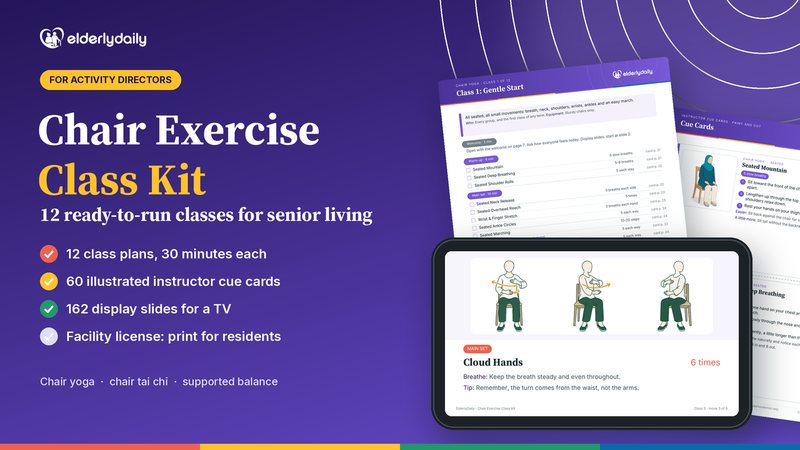
Chair Exercise Class Kit for Activity Directors
$49One-time purchase · Instant download · PDF · 58 pages + 162 slides · US Letter + A4
Memory and brain games
Brain games are easy to fit into a day and many can be played alone. Our free large-print versions are designed for older eyes:
- Crossword puzzles: free large-print crosswords to print
- Word search: large-print word searches, easy to hard
- Sudoku: large-print sudoku from 4x4 starter grids
- Make your own: the large-print puzzle maker builds a word search from family names or favourite words
- Matching or memory cards: turn cards face down and find pairs. Start with six pairs
- Jigsaw puzzles: 100 to 300 large pieces suit most people. See our puzzle picks
- Spot the difference and word scrambles, in large print
- Number games: simple maths quizzes, or counting down from 100 by sevens for the competitive
What does the research say? In the Lothian Birth Cohort, a long-running Scottish study, more than 1,000 people were tested every three years from age 70 to 79. Those who played non-digital games such as cards, chess, bingo and crosswords more often scored better on memory and thinking tests, and those who increased their game playing showed less decline. The researchers called it a “small but detectable association” and the study shows a link, not proof that games protect the brain (University of Edinburgh, 2019).
The National Institute on Aging puts it the same way: staying mentally and socially active is part of healthy cognitive ageing, alongside exercise, sleep and managing health conditions. Play because it is enjoyable; the benefits come with it.
Card and board games
Familiar games are the easiest to start, because the rules are already there. Play them for fun, not for money.
- Rummy or gin rummy: pairs and runs, at a gentle pace
- Uno: bright colours and simple rules; easy with grandchildren
- Go Fish and Crazy Eights: simple card games for mixed ages
- Dominoes: large, high-contrast tiles are easy to see and hold
- Checkers (draughts) and chess: a good pair game for a regular weekly match
- Scrabble and other word-tile games: large-print editions exist
- Connect Four and tic-tac-toe: quick rounds for short attention spans
Simple adaptations make a big difference:
- Large-print or jumbo playing cards for low vision
- A card holder (or an upturned shoebox lid with a slot) for arthritic hands
- Bigger pieces and high-contrast boards, with good overhead light and no glare
- Open hands: play with cards face up and help each other, so the game keeps moving
Video and tablet games for older adults
Screen games are a good choice for someone who lives alone, wakes early, or wants to play with grandchildren who live far away. The easiest starting points:
- Solitaire, mahjong tile-matching and jigsaw apps: familiar, calm and untimed
- Daily word puzzles such as Wordle and online crosswords: one short puzzle a day, often shared with family by text
- Word games with family: turn-based word games let grandparents and grandchildren play over days
- Motion-controlled sports games: bowling, golf and tennis on a games console get people moving, ideally seated or with a stable chair behind them
- Trivia on a smart speaker or display: voice games need no reading or typing. See Echo Show for seniors
Set the screen up first: larger text, brighter display, sound up, and in-app purchases switched off. A tablet with a large, clear screen is easier than a phone. Avoid games with timers or flashing lights for anyone who finds them stressful, and remove any game with real-money betting.
Active games, seated or standing
Gentle movement games bring laughter and a little exercise. Most work from a chair:
- Balloon volleyball: keep a balloon in the air across a seated circle
- Bean bag toss: into a bucket or onto a target on the floor
- Seated bowling: roll a soft ball at plastic pins from a chair
- Ring toss onto a stand placed on a table
- Pass the ball: call out a category as you pass (a colour, an animal)
- Indoor putting: a mat and a putter for those steady on their feet
- Parachute games: lift and lower a play parachute together, for groups
- Simon says, seated: follow-the-leader arm and leg movements
Clear the floor of trip hazards, use sturdy chairs without wheels, and let people play seated even if they can stand. For a structured exercise session, see chair exercises for seniors.
Games for someone with dementia
As memory changes, the goal of a game shifts from winning to taking part and feeling capable. Choose activities with no wrong answer:
- Sorting: buttons by colour, socks into pairs, coins by size
- Matching: picture cards, or the lids to a set of containers
- Picture reminiscence: old photos or picture books from their era, to talk about, not to quiz
- Simple jigsaws of 12 to 50 large pieces, with a picture they like
- Ball or balloon games that need no rules
- Familiar routines such as folding towels or setting a table, turned into a shared task
Avoid quiz-style questions that test memory (“Who is this?”), keep sessions short, and stop at the first sign of frustration. Our guide to activities for seniors with dementia at home has many more ideas, and fun questions to ask someone with dementia turns conversation into a gentle game.
How to make any game senior-friendly
- See it: large print, high contrast, bright even light, and glasses within reach
- Hear it: face the person, cut background noise, and seat people with hearing loss near the leader
- Hold it: bigger pieces, card holders, non-slip mats under boards
- Keep it short: two or three short rounds, finishing while it is still fun
- Play as teams: pairs and teams take the pressure off any one person
- No elimination: everyone plays to the end
- Keep it social: the conversation around the game often matters more than the game
Games are one part of a full day. See mental activities for seniors and social activities for seniors for more ideas.
Frequently asked questions
What games are good for elderly people?
Trivia, bingo played for fun, crosswords, sudoku, word searches, card games such as rummy and Uno, dominoes, checkers, Scrabble, jigsaw puzzles, simple tablet games and seated active games such as balloon volleyball. The best choice is one the person enjoys and can play successfully.
What are good group games for seniors in a nursing home?
Team trivia, large-print bingo for small non-cash prizes, categories, finish-the-phrase, picture charades, twenty questions, a memory tray, balloon volleyball and bean bag toss. Keep rounds short, play in teams, and make sure everyone can see and hear the leader.
Do games help prevent memory loss?
Games are linked with healthier thinking in later life, but they are not proven to prevent dementia. In a Scottish study of more than 1,000 people in their 70s, those who played more non-digital games showed slightly less decline in memory and thinking speed. Researchers described it as a small association.
What are good memory games for seniors?
Matching cards, crosswords, sudoku, word searches, a memory tray, word chains and trivia. Our large-print crosswords, word searches, sudoku and trivia are free to print.
What video games are good for older adults?
Calm, untimed games such as solitaire, mahjong tile-matching, jigsaw apps and daily word puzzles; turn-based word games played with family; and motion-controlled bowling or golf for gentle movement. Increase text size and turn off in-app purchases first.
What games can someone with dementia play?
Failure-free activities such as sorting objects, matching pictures, simple large-piece jigsaws, ball and balloon games, and looking at old photographs together. Avoid games that test memory.
Sources
- University of Edinburgh (J Gerontol B, Nov 2019). Games can protect thinking skills in older age — Lothian Birth Cohort 1936, ages 70 to 79
- National Institute on Aging (NIH). Cognitive Health and Older Adults
- National Institute on Aging (NIH). Loneliness and Social Isolation — Tips for Staying Connected
