
Activities for Seniors With Dementia at Home

Practical guidance based on dementia-care principles; adapt every activity to the individual’s interests, abilities, and stage.
The right activities do more than pass the time — they can help ease agitation, lift mood, and give a person with dementia a sense of purpose and connection. The secret is matching the activity to who they are and where they are now. ⬇ Download the free printable activity ideas card to keep handy.
Key takeaways
- A free printable activity ideas card covers all 8 activity types plus tips to make them work — download it here.
- Meaningful activity reduces agitation and sundowning, lifts mood, and gives purpose — it is care, not just entertainment.
- Match activities to the person’s lifelong interests and current abilities — success comes from meeting them where they are.
- Favor failure-free, purposeful, and sensory activities — the joy of doing matters more than the result.
- Music and reminiscence are especially powerful and reach people even in advanced dementia.
- Adapt as abilities change, and keep activities short, simple, and pressure-free.
Quick answer
What activities are good for seniors with dementia at home?
The best activities are matched to the person’s lifelong interests and current abilities and are failure-free — where there is no wrong way to do them. Great options include music (especially familiar songs), reminiscence (photos, old stories), simple purposeful tasks (folding laundry, sorting, gardening), sensory activities, gentle movement, art and crafts, and easy puzzles or games. Focus on the enjoyment and connection of doing, not the outcome, and keep activities short, simple, and pressure-free.
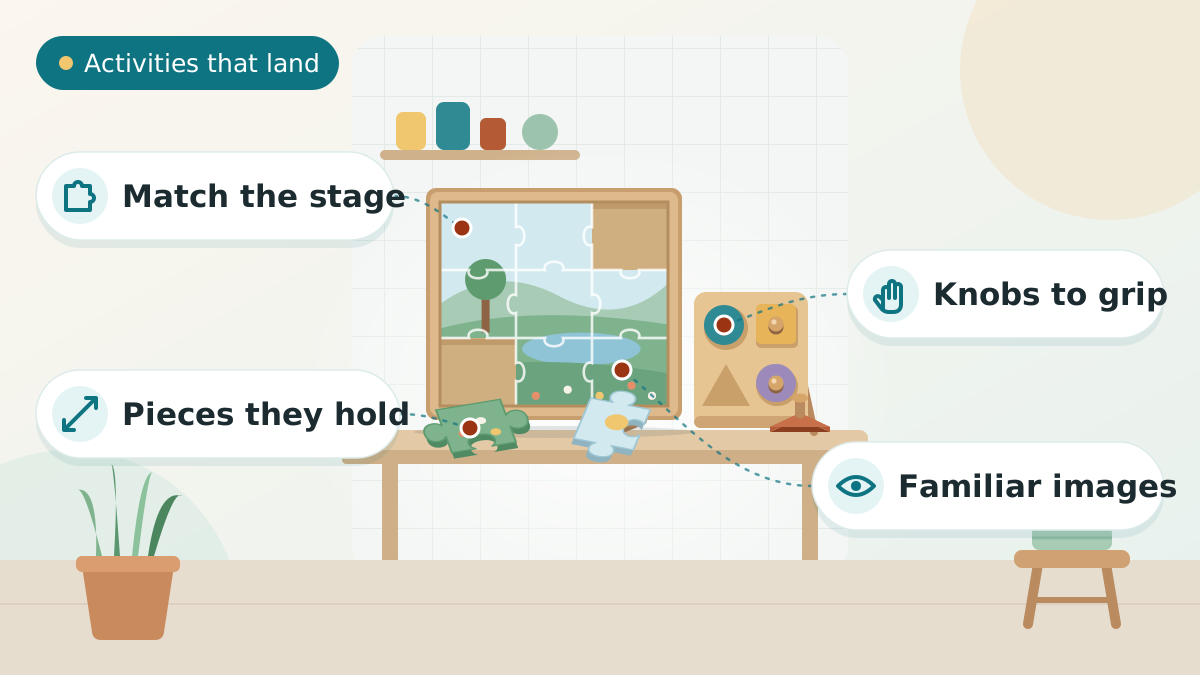
Get the free printable activity ideas card
The activity menu and success tips below are also available as a free printable PDF — a two-page card you can print and keep somewhere handy for the moment you need an idea.
Print it and keep it on the fridge or with the daily routine. Download the printable PDF here.
An ElderlyDaily original
Want the whole thing in one place?
Dementia Caregiver Command Center
- Daily care and medication logs in one place
- Behaviour-pattern tracking, to spot what makes a day harder
- Safety pages and caregiver handoff sheets for family and respite helpers
One-off purchase. Instant download.
Fillable PDF · US Letter + A4

Sponsored Pick
Tracki Mini GPS Tracker
Early-to-mid dementia, where the person will carry something but refuses to wear a device
Check PriceWhy activities matter in dementia
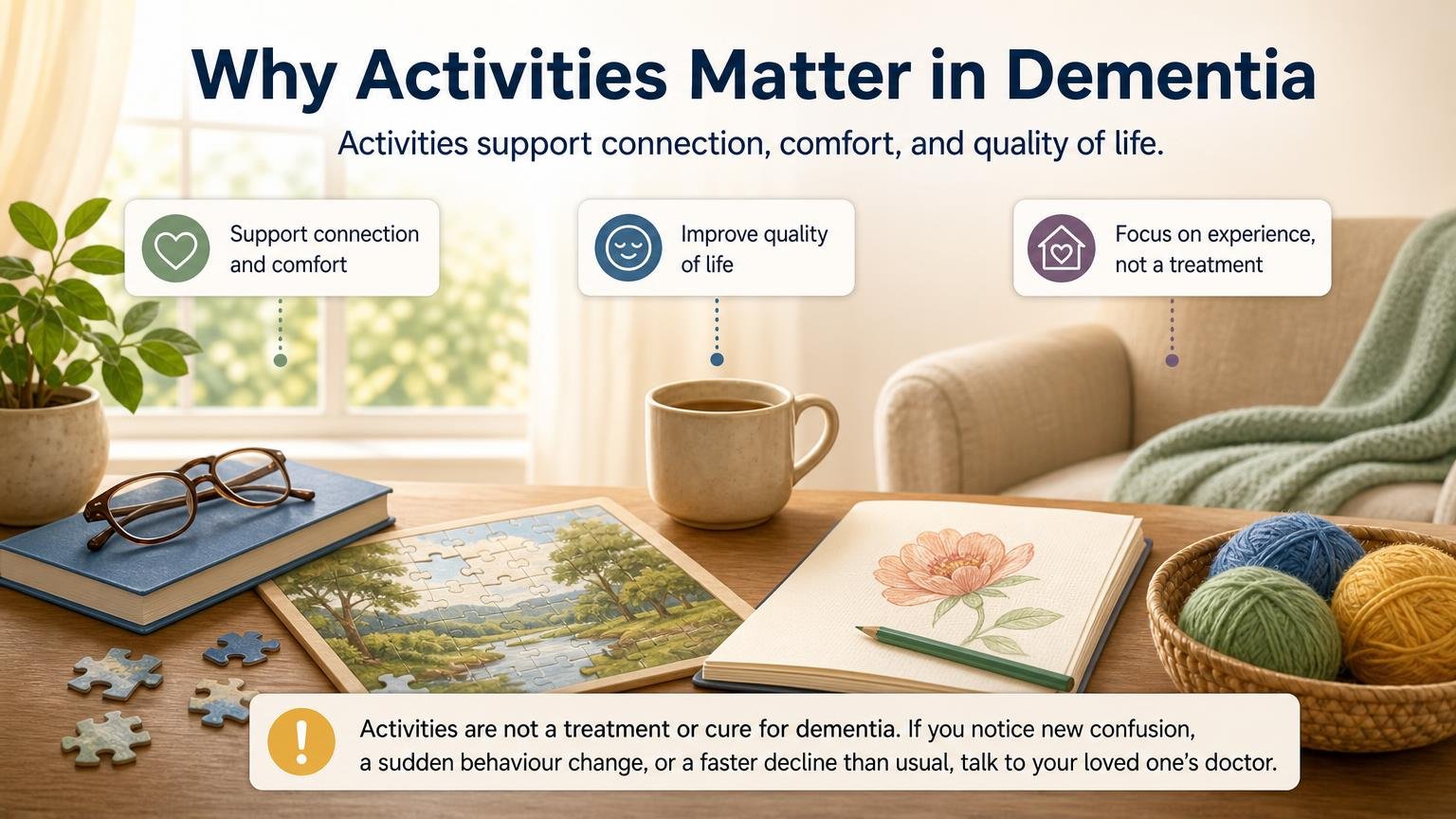
Engagement is genuinely therapeutic in dementia — it is not just a way to fill the hours. Meaningful activity reduces boredom and the agitation and sundowning that boredom feeds, lifts mood and reduces low feelings, provides a sense of purpose and dignity, and creates moments of connection and joy between the person and those around them. It can also channel restless energy that might otherwise lead to wandering.
The guiding principle is to shift focus from outcome to experience. It does not matter if the puzzle is finished, the flowers are arranged "correctly," or the story is accurate — what matters is that the person is engaged, comfortable, and enjoying the moment. With that mindset, and by matching activities to the individual, almost anyone can find things that bring pleasure.
A note on dementia care
Activities support connection, comfort, and quality of life — they are not a treatment or cure for dementia. If you notice new confusion, a sudden behaviour change, or a faster decline than usual, talk to your loved one’s doctor, since a sudden change can signal something treatable like an infection, pain, or a medication issue.
Match the activity to the person
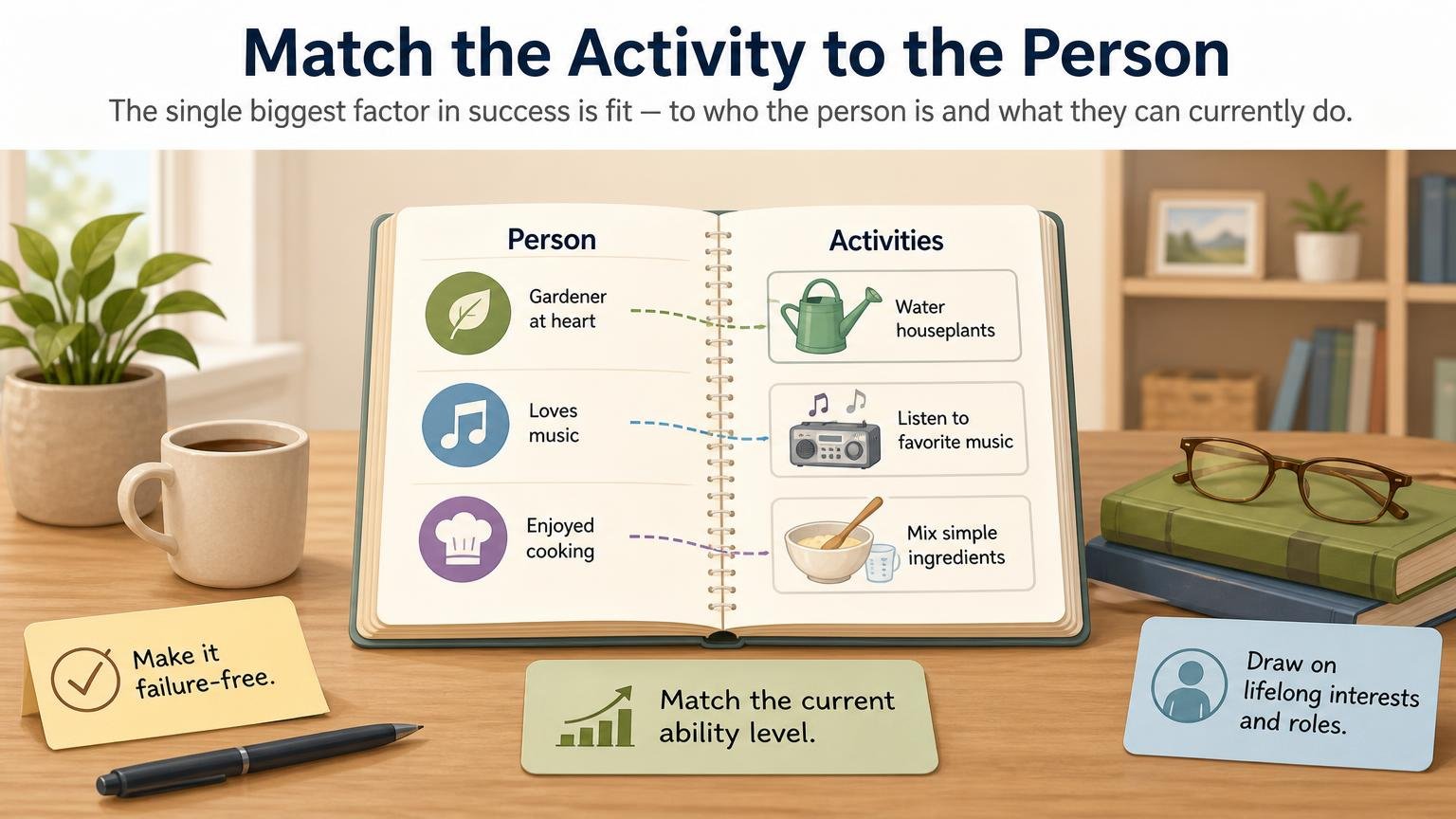
The single biggest factor in success is fit — to who the person is and what they can currently do:
- Draw on lifelong interests and roles — a former gardener may love handling plants; a lifelong cook, simple kitchen tasks; a music lover, their favourite songs. Familiar, meaningful activities land best.
- Match the current ability level. As dementia progresses, simplify — the same interest can be adapted (from tending a garden, to potting a plant, to simply feeling and smelling flowers).
- Make it failure-free. Choose activities with no wrong way to do them, avoiding anything that highlights loss or causes frustration.
- Keep it short and flexible — attention spans are shorter; follow the person’s engagement and stop before frustration or fatigue.
Good to know
When an activity stops working, it is usually too hard or too long — not a sign the person "can’t do activities." Simplify it, shorten it, or switch to something more sensory, and try again another time.
Activity ideas that work well
A menu to draw from, adapting to interest and ability:
- Music — listening to familiar songs from their youth, singing along, or gentle movement to music. Music is remarkably powerful and reaches people even in advanced dementia; it soothes and sparks memory.
- Reminiscence — looking through photo albums, familiar objects, or old films and music, and gently sharing memories. See fun questions to ask dementia patients for easy prompts.
- Simple purposeful tasks — folding laundry, sorting objects, matching socks, wiping the table, or helping prepare food. These give a valued sense of contributing.
- Sensory activities — hand massage, textured objects, fragrant flowers or baking smells, a soft blanket — calming and accessible at any stage.
- Gentle movement — a walk, chair exercises, or dancing, which also supports mobility and sleep.
- Art and craft — painting, coloring, simple crafts — creative and failure-free.
- Puzzles and games — dementia-friendly puzzles and activities pitched at the right level.
- Nature and animals — time outdoors, gardening or potting, birdwatching, or gentle contact with a pet.
Tips to make any activity a success
How you offer an activity matters as much as the activity itself:
- Choose a calm environment and the person’s best time of day (often morning), free of noise and distraction.
- Introduce it gently and simply — one clear step at a time, demonstrating rather than instructing where helpful.
- Join in. Doing it together provides connection and gentle guidance, and reduces any sense of being tested.
- Focus on enjoyment, not correctness — never correct or point out mistakes; there is no wrong way.
- Watch their cues — if they tire or become frustrated, ease off and switch to something calming.
- Build favourites into the daily routine so engagement is regular and predictable.
Adapting as dementia progresses
Activities should evolve with the person’s changing abilities, and the good news is that meaningful engagement remains possible at every stage:
- Earlier on — more complex and independent activities are possible: hobbies, games, outings, and involved tasks, adapted as needed.
- As it advances — simplify toward shorter, guided, and more sensory activities: music, hand massage, textured objects, simple sorting, and looking at photos together.
- In advanced dementia — the focus shifts to comfort and sensory connection: familiar music, gentle touch, soothing textures and scents, and a calm presence. Connection is always possible, even when words are gone.
See signs dementia is getting worse to anticipate changes, and remember that this engagement is part of good dementia care at home — and a source of respite and joy for you too.
Frequently asked questions
Is the dementia activity ideas printable free?
Yes — the printable activity ideas card is completely free, no sign-up required. It covers all 8 activity types (music, reminiscence, purposeful tasks, sensory, movement, art, puzzles, and nature) plus the tips that make any activity work, as a two-page card you can print and keep handy.
What activities are good for someone with dementia?
The best are matched to the person’s lifelong interests and current abilities and are failure-free. Strong options include music (especially familiar songs), reminiscence with photos and objects, simple purposeful tasks (folding laundry, sorting, food prep), sensory activities, gentle movement, art and crafts, dementia-friendly puzzles, and time with nature or animals. Focus on enjoyment and connection over any outcome.
Why are activities important for people with dementia?
Meaningful activity reduces boredom and the agitation and sundowning it feeds, lifts mood, provides purpose and dignity, channels restless energy that might lead to wandering, and creates moments of connection and joy. It is an important part of care, not just entertainment — which is why building enjoyable activity into the day matters.
How do I choose activities for my parent with dementia?
Match them to who the person is and what they can currently do: draw on their lifelong interests and roles, pitch the difficulty to their current ability (simplifying as dementia progresses), choose failure-free activities with no wrong way to do them, and keep them short and flexible. When an activity stops working, it is usually too hard or too long — simplify rather than giving up.
Why is music so good for dementia patients?
Music, especially familiar songs from a person’s youth, is remarkably powerful in dementia — it can soothe agitation, lift mood, and spark memory and emotion even in advanced stages when words are largely gone. Listening, singing along, or gentle movement to music are accessible, failure-free, and deeply connecting activities to return to often.
What activities work in later-stage dementia?
As dementia advances, shift toward shorter, guided, and sensory activities: familiar music, gentle hand massage and touch, soothing textures and scents, simple sorting, and looking at photos together. In advanced dementia the focus is comfort and sensory connection with a calm presence — meaningful connection remains possible even when words are gone.
How do I make an activity successful for someone with dementia?
Choose a calm environment and the person’s best time of day, introduce it gently one simple step at a time, join in to provide connection and guidance, focus on enjoyment rather than correctness (never point out mistakes), and watch their cues — easing off if they tire or get frustrated. Building favourites into the daily routine keeps engagement regular.
