
Free Chair Exercise Class Plan for Seniors: A 30-Minute Lesson Plan (PDF)

Gentle group exercise ideas for activity programs, not medical advice or therapy. Follow your facility’s policies and each resident’s care plan, and check with the care team if you are not sure a move suits someone.
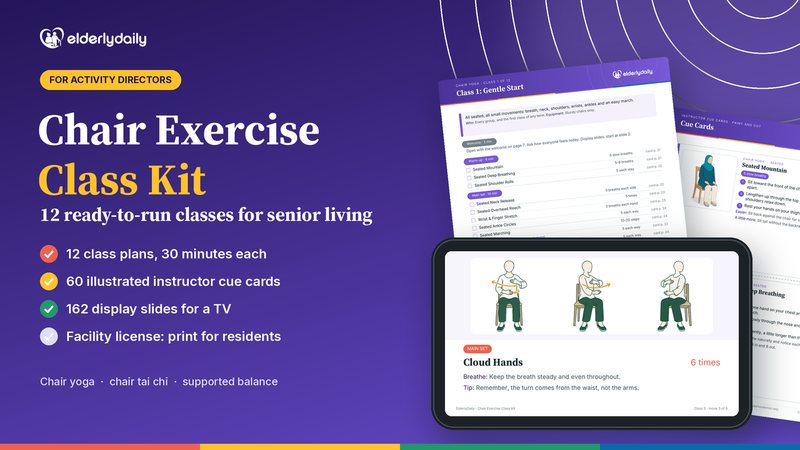
Leading a chair exercise group in assisted living, a senior center or an adult day program? This free class is ready to run: a timed 30-minute lesson plan, a cue card for every move, slides for the TV, and the setup and safety pages to read first. Everything is seated, so the whole group can join in.
Key takeaways
- A free, complete 30-minute class: Class 1, Gentle Start, from our Chair Exercise Class Kit. All seated, all small movements.
- A timed lesson plan: welcome 3 minutes, warm-up 6, main set 14, cool-down 5, close 2.
- 9 illustrated cue cards with the steps to say, the count, the breath cue and an easier option.
- Display slides for a TV or projector, so the whole room can follow.
- The kit’s room setup, safety and teaching pages. US Letter and A4, no sign-up.
Quick answer
Where can I get a free chair exercise class plan for seniors?
Download it free here: the chair exercise class plan (PDF) is a complete 30-minute seated class with a timed lesson plan, 9 illustrated cue cards, and the room setup, safety and teaching pages. There is an A4 edition and a slides PDF to show on a TV. No email or sign-up is needed.
Download the free class
The class plan comes in two paper sizes with the same 10 pages: US Letter in the US and Canada, A4 almost everywhere else. The slides are a separate file for the screen.
- Chair Exercise Class Plan, US Letter (PDF, 10 pages)
- Chair Exercise Class Plan, A4 (PDF, 10 pages)
- Class 1 display slides, 16:9 (PDF, 15 slides)
Showing the slides
Open the slides PDF on a laptop connected to your TV or projector and switch to full-screen view. The file opens with the kit’s index slide; Class 1 starts at slide 2, as the plan says. Use the arrow keys to move on.
An ElderlyDaily original
Leading a chair exercise group every week?
Chair Exercise Class Kit for Activity Directors
One-off purchase · Instant download · PDF · 58 pages + 162 slides · US Letter + A4
What is inside
The pages keep their numbers from the full Class Kit, so “card p. 21” on the plan is the page marked 21 at the bottom.
- How to use this sample: the five steps, from reading the safety pages to putting the slides on.
- Page 5, Room, Chairs & Staffing: a checklist for the chairs, the room, the residents and the staff.
- Page 6, Safety: who should check with their care team first, the signs to stop, and when to call 911.
- Page 7, Tips for Teaching a Seated Class: seven tips and the welcome to read at the start of every class.
- Page 8, Class 1: Gentle Start: the timed plan, with the count and card page for every move, and room for notes.
- Pages 21 to 25, cue cards: one card for each move, two to a page, to print and cut.
The class at a glance
Gentle Start suits every group and the first class of any term. It needs sturdy chairs and nothing else. The moves come from our Chair Yoga for Seniors program.
| Part | Time | Moves and count |
|---|---|---|
| Welcome | 3 min | The opening words below. Ask how everyone feels today. |
| Warm-up | 6 min | Seated Mountain (5 slow breaths), Seated Deep Breathing (5 to 8 breaths), Seated Shoulder Rolls (5 each way) |
| Main set | 14 min | Seated Neck Release (3 breaths each side), Seated Overhead Reach (5 times), Wrist & Finger Stretch (3 breaths each hand), Seated Ankle Circles (5 each way), Seated Marching (10 to 20 steps), then a second round of Shoulder Rolls, Ankle Circles and Marching |
| Cool-down | 5 min | Seated Relaxation (1 to 3 minutes) |
| Close | 2 min | Sit quietly for a moment. Water. Thank everyone and tell them what is next week. |
Say this to open every class
“Welcome. Sit toward the front of your chair with your feet flat. Move only as far as feels comfortable, and if anything hurts or you feel dizzy, stop and tell me.”
Set up the room
The NHS guide to sitting exercises advises a solid, stable chair without wheels, avoiding chairs with arms where you can, loose, comfortable clothing and some water to hand. For a group, the kit’s checklist adds:
- Chairs with no wheels and no swivel, set in a curve an arm’s length apart, so everyone can see you
- Feet resting flat on the floor, and a clear floor: no rugs, bags or cords
- Water within reach for everyone, and the screen where the whole group can see it
- Residents in non-slip shoes, with their glasses and hearing aids on, and walking aids parked within reach
- Anyone who uses a wheelchair stays in it with the brakes on and does the seated moves
- You know how to call for help, and you have checked the residents’ care plans for anything they should avoid
Safety: check first, and know when to stop
Ask the resident’s care team first if they have a heart condition, uncontrolled blood pressure, recent surgery or a joint replacement, dizziness, a recent fall, or a lung, bone or balance condition, or if you are not sure the moves suit them. After a hip replacement, check the resident’s own hip precautions before any move that bends forward from the hips, crosses the legs or ankles, or twists.
Stop the move, help them sit, and let them rest if they have
Chest pain, pressure or tightness; dizziness, light-headedness or feeling faint; unusual shortness of breath; sharp or increasing pain in a joint; or they feel unsteady. If someone has chest pain or severe breathlessness, stop the class, follow your facility’s emergency procedure and call 911 (or your local emergency number) straight away.
How to lead it
Seven tips from the kit’s teaching page:
- 1
Face the group and mirror them
When you say “right arm”, use your left, so they can copy you like a mirror.
- 2
Show first, then say it
Demonstrate the move once before the group starts. Keep the words short: one step at a time.
- 3
Count out loud, and breathe out loud
Slow, even counts. Cue the breath every time: “breathe in as the arms rise”.
- 4
Offer the easier option first
Every cue card has an easier and a stronger option. Say the easier one first, so nobody feels they are falling behind.
- 5
Watch faces, not just arms
Look for strain, breath-holding or confusion. Slow down or switch to the easier option.
- 6
Keep it the same each week
The same welcome, warm-up and close help residents, especially those living with memory loss, know what comes next.
- 7
End calmly
Finish seated. Ask everyone to sit quietly for a moment before they stand, and to have some water.
Want the other 11 classes?
This class is one of 12 in our Chair Exercise Class Kit, written for activity directors and life enrichment staff. The kit has three series of four classes (chair yoga, chair tai chi, and supported balance with standing moves at the chair), 60 illustrated cue cards, 162 display slides, an attendance log, a monthly calendar, class notes and three take-home handouts for residents. It also includes a Program Pack with a substitute instructor guide, a 12-month planner, certificates, posters and family templates. It comes with a facility license to print it for your residents: single facility or up to five locations.
An ElderlyDaily original
Chair Exercise Class Kit for Activity Directors
One-off purchase · Instant download · PDF · 58 pages + 162 slides · US Letter + A4
More free printables
See all 32 free printables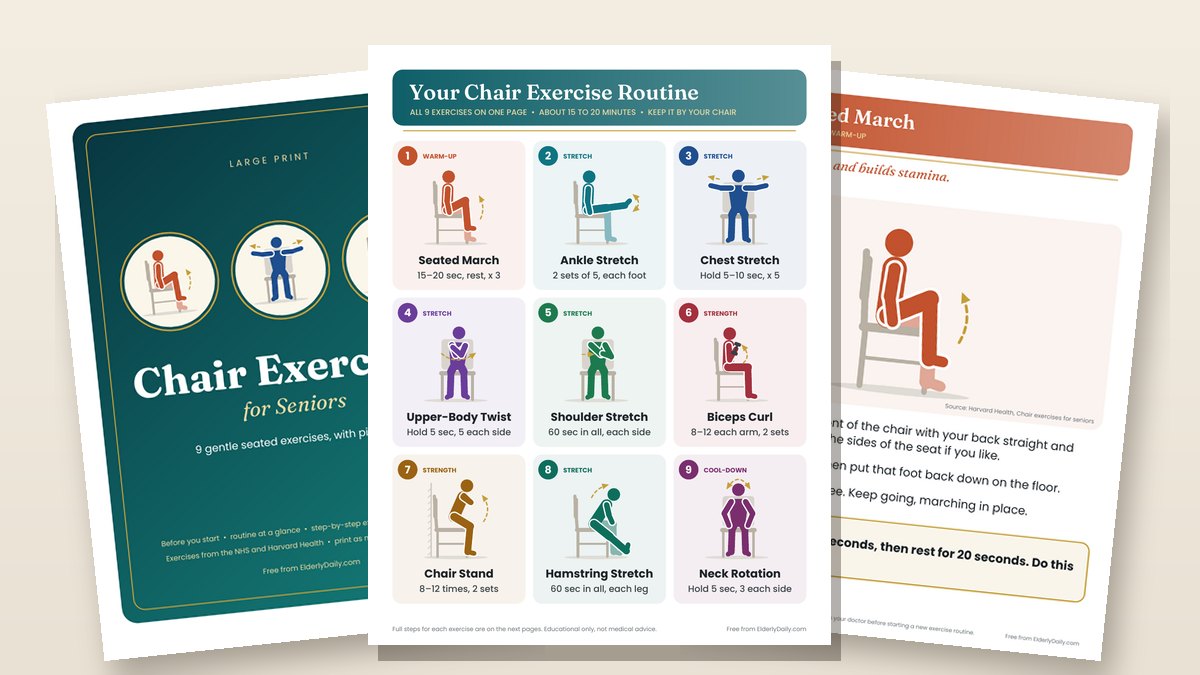 Chair Exercises with Pictures9 gentle seated exercises from NHS and Harvard Health guidance, a one-page routine chart and a weekly tick chart.Free PDF, no sign-up
- Chair Yoga Starter12 illustrated seated poses, a one-page wall chart and a 7-day tracker. Free; we email you the PDF.Free, emailed to you
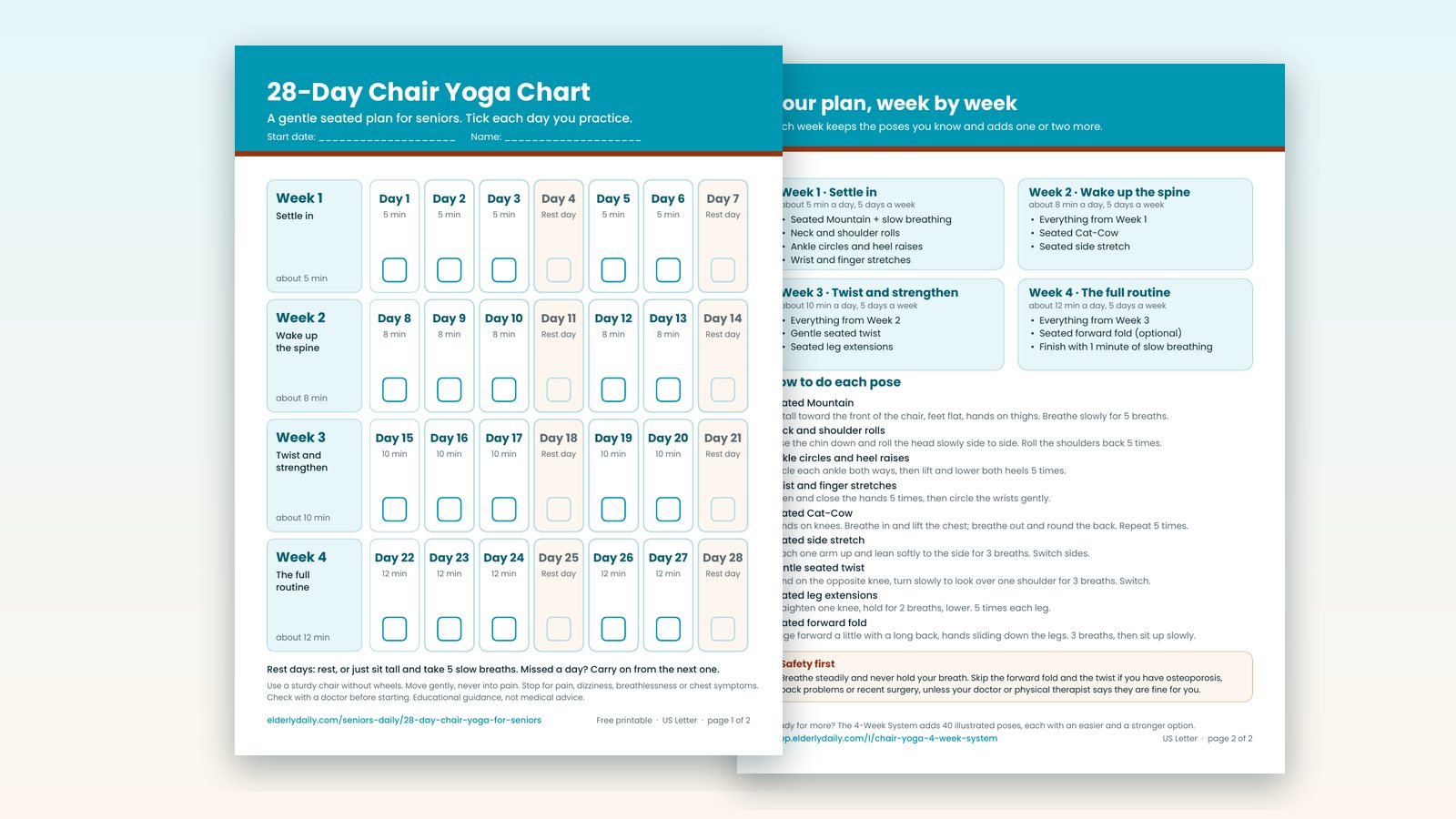 28-Day Chair Yoga ChartA gentle four-week seated plan that starts at about 5 minutes a day, with a tick box for every day and each pose explained.Free PDF, no sign-up
- Chair Tai Chi Chart8 seated tai chi movements with breathing cues and a 4-week plan. Free; we email you the PDF, and the full routine is on the page too.Free, emailed to you
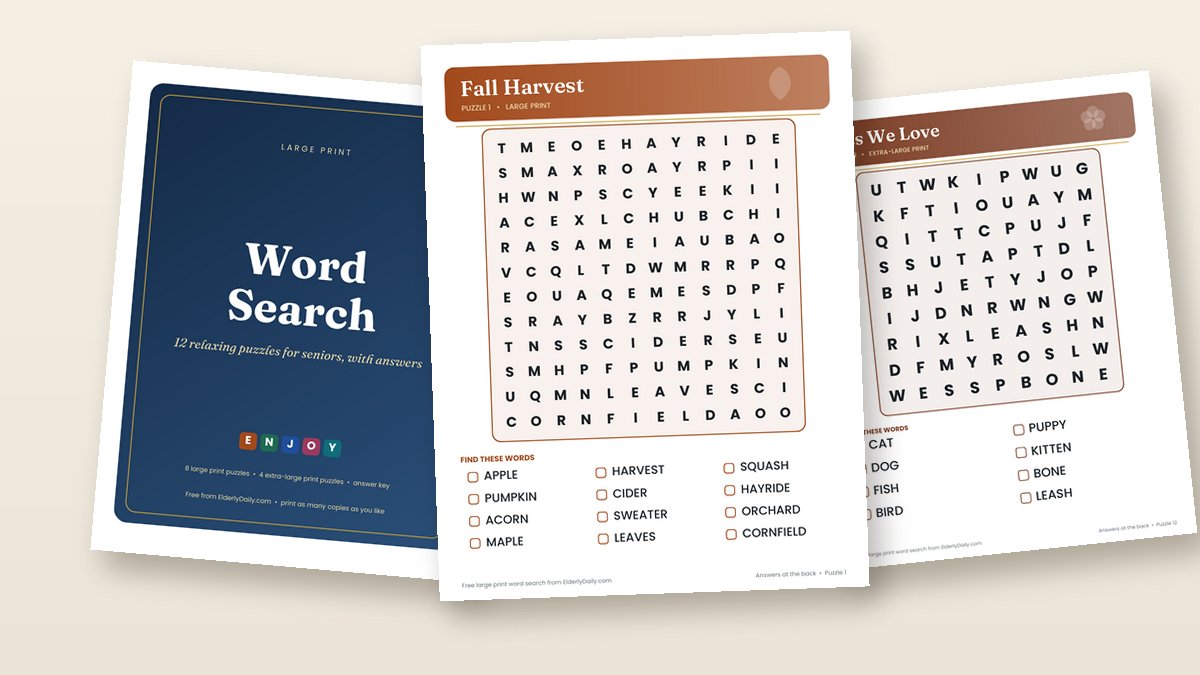 Large Print Word Search12 colorful puzzles in large and extra-large print. Words never run backwards, and the answers are included.Free PDF, no sign-up
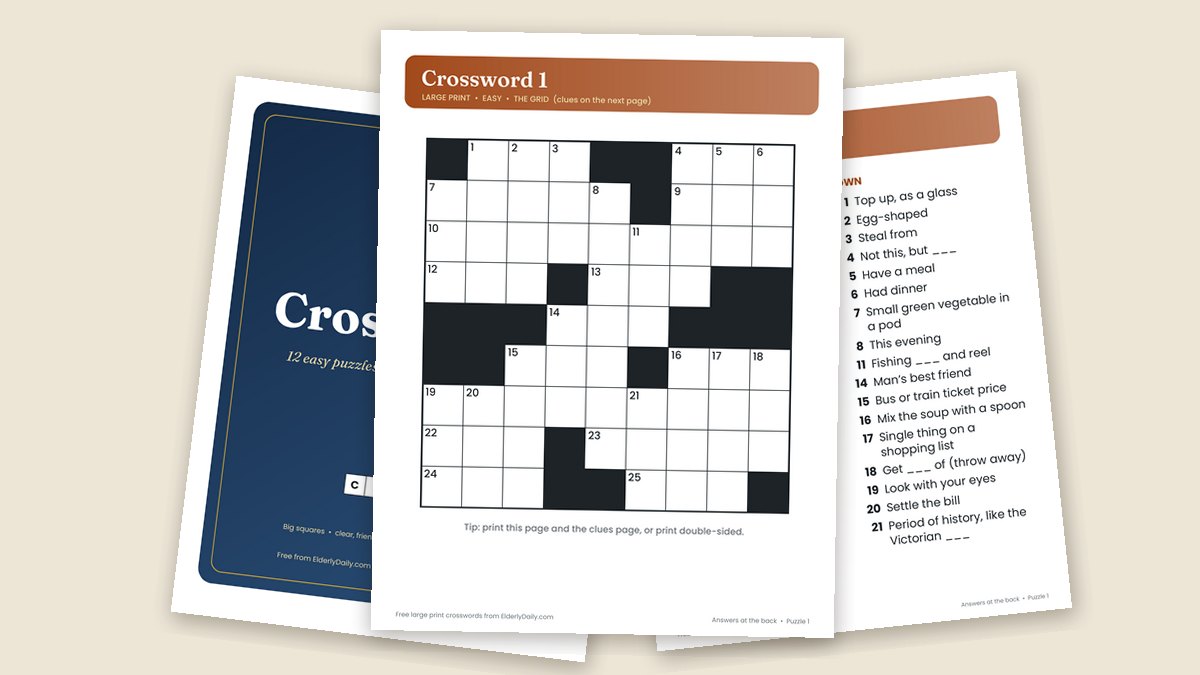 Large Print Crossword Puzzles12 easy newspaper-style crosswords with big squares, large-print clues on their own page and an answer key.Free PDF, no sign-up
Frequently asked questions
Is this chair exercise class plan really free?
Yes. All three PDFs download directly, with no email address, sign-up or payment. You are welcome to print the class and use it with your own group. Please don’t sell it or post the files online.
Can I use it in my assisted living community or senior center?
Yes, this free sample class can be printed and used with your group. The full Class Kit, with all 12 classes, comes with a facility license for one location or up to five locations run by the same organization.
Can residents in wheelchairs join in?
Yes. Every move in this class is done seated. Anyone who uses a wheelchair stays in it with the brakes on.
Who can lead the class?
The plan is written for activity staff and volunteers to lead, with the steps to say on every card. Follow your facility’s rules on who may lead exercise classes, and check residents’ care plans first.
How often should we run it?
Once or twice a week works well, and keeping the same welcome and close each week helps the group settle. The CDC recommends that adults 65 and older get at least 150 minutes of moderate activity a week, plus muscle-strengthening activities on at least 2 days and activities to improve balance (CDC). A gentle seated class is one part of that.
Do I need equipment?
Only sturdy chairs with no wheels and no swivel, ideally without arms, and water for everyone. A TV or projector is optional, for the slides.
