
Chair Tai Chi for Seniors: Free Printable Routine & PDF Chart

Educational guidance, not medical advice. Move within a comfortable range, and check with a doctor before starting — especially with a heart condition, uncontrolled blood pressure, recent surgery, or a recent fall.
In this guide
- Get the free printable chair tai chi chart
- A second seated routine: the Chair Yoga 4-Week System
- What chair tai chi actually is
- Does chair tai chi really work, and is it legit?
- Setting up your chair (this part matters)
- The 8 seated chair tai chi exercises
- Breathing and pace — the part most beginners get wrong
- A 4-week chair tai chi workout plan
- When to check with a doctor first
- FAQs
Chair tai chi is tai chi done sitting down — the slow, flowing movement and the breathing, without the standing balance demand. The whole eight-movement routine is free on this page. Want it on paper? We’ll email you the free word chart: all eight movements with breath cues, plus the four-week plan.
Key takeaways
- The whole routine is on this page — all eight seated movements in order, with breathing cues and repetitions. A free printable word chart of the routine comes by email. The illustrated edition, which draws each movement frame by frame with an arrow for where the hands travel, is a separate paid printable.
- Chair tai chi is real tai chi, adapted. The movements are the standard Yang and Sun style forms — Cloud Hands, Parting the Wild Horse’s Mane, Grasp the Sparrow’s Tail — done seated so there is no standing balance demand.
- The slowness is the exercise. If you cannot hold a conversation while you move, slow down rather than stop.
- Breathe in as the arms rise or open, out as they lower or push. Never hold your breath.
- A sturdy chair with no wheels and no swivel is the only equipment. A dining chair works better than an armchair.
Get the free chair tai chi chart
The whole routine on this page is free to use with no sign-up. If you’d like it on paper, enter your email and we’ll send the free printable word chart: all eight movements with breath cues and repetitions on one page, plus the four-week plan. US Letter and A4. Occasional gentle-movement tips after that. Unsubscribe anytime.
Going further: the illustrated edition
The free chart describes every movement in words. If you would rather see them, the Chair Tai Chi — Illustrated Edition draws all eight movements frame by frame, a full page each, so you can follow where the hands go without stopping to read mid-movement. A large-print edition is included.

Large-print edition included
An ElderlyDaily original
Want every movement drawn out, a full page each?
Chair Tai Chi — Illustrated Edition
- All eight movements, a full page each, drawn frame by frame
- A three-minute warm-up, plus five common mistakes and how to fix them
- A four-week plan with a practice tracker
One-off purchase. Instant download.
PDF · 24 pages · US Letter + A4
How to use the routine
Sit toward the front of a sturdy chair with your feet flat, and keep every movement slow — in tai chi the slowness is the exercise. Let the breath lead: in as the arms rise or open, out as they lower or come together. Start with about ten minutes, and stop if anything hurts or you feel dizzy.
Quick answer
How do you do chair tai chi for seniors?
Sit on a sturdy chair with no wheels, toward the front third of the seat, both feet flat on the floor. Work through the eight seated movements set out below — Cloud Hands, Parting the Wild Horse’s Mane, Grasp the Sparrow’s Tail and the rest — breathing in as the arms rise or open and out as they lower or push. Move slowly and within a comfortable range; the slowness is the exercise. Ten minutes three times a week is enough to start, building toward fifteen to twenty. If you want a second seated routine, our chair yoga routines cover similar ground with different movements. Check with a doctor before starting.
Get the free printable chair tai chi chart
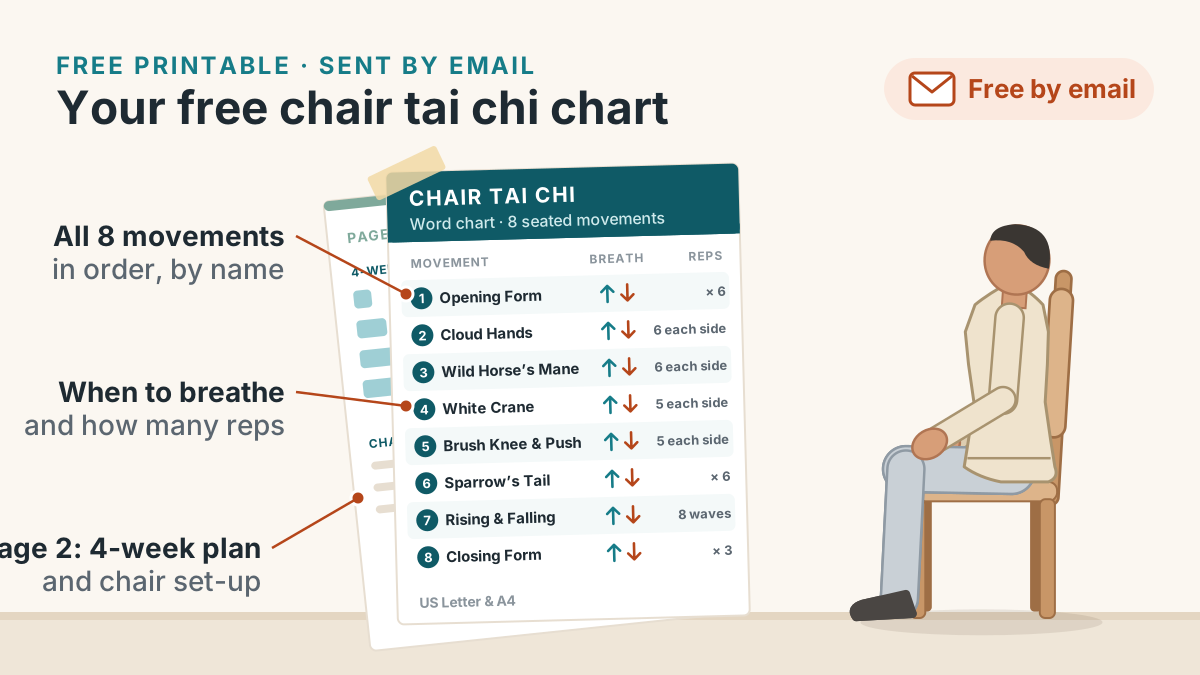
Everything you need to practise is on this page, and it is yours to use as often as you like. What a printed chart adds is that you stop looking at a screen — no scrolling mid-movement, no video to pause and rewind, and nothing to find again tomorrow. Enter your email in the box at the top of this page and we’ll send the free word chart: all eight movements, when to breathe and how many repetitions on one page, with the four-week plan and the chair set-up on the second. US Letter and A4.
If you would rather see each movement drawn, the paid illustrated edition draws all eight in pictures: two or three frames each, with an arrow showing where the hands go next, alongside what to do, when to breathe and how many repetitions. It carries the warm-up, the cool-down, five common mistakes, and the four-week plan for building from ten minutes to twenty. It is a one-off purchase rather than a sign-up, and it prints on US Letter or A4.
Print it and keep it somewhere you will actually see it — on the fridge, beside the chair you use, or in a folder with any other routines you follow. A chart within reach is one of the more reliable ways to turn a routine into a habit.
A second seated routine: the Chair Yoga 4-Week System
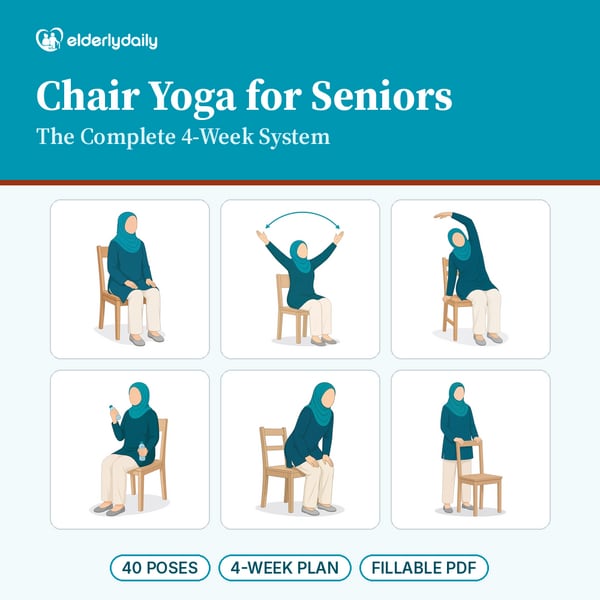
Some people like to alternate tai chi with a second seated routine on the days in between. Chair Yoga for Seniors — The Complete 4-Week System is our paid chair yoga program: a day-by-day plan that starts at about 10 minutes a day and builds gently week by week.
- 40 illustrated poses — mostly seated, plus 5 standing poses that use the chair for support — each with an easier and a stronger option.
- A 4-week, day-by-day program, with practice logs and a 28-day habit tracker.
- 7 mini-routines for different kinds of days: Gentle Start, Stiff Knees & Hips, Steady & Balanced, Everyday Strength, Hands, Arms & Shoulders, Morning Wake-Up and Evening Wind-Down.
- Large-print wall charts and a tap-to-jump pose library.
- Bonus: the Follow-Along Player for a laptop, tablet or TV. It works offline, with a hold timer (20, 30, 45 or 60 seconds, or your own), a rest timer, tap or auto-advance, an optional voice guide, side poses that switch sides halfway, large-text options and a streak tracker.
A fillable PDF, 48 pages, in US Letter and A4. It is a gentle movement guide, not medical advice — check with your doctor before starting a new routine.
An ElderlyDaily original
Chair Yoga for Seniors — The Complete 4-Week System
Bonus: Follow-Along Player
- Instant download
- Fillable PDF · 48 pages · US Letter + A4
The gear we recommend
Our pick in each essential, chosen with older adults in mind.

Sturdy Armless Dining Chair (AmazonBasics)
Regular home chair yoga use; stable, armless, correct seat height

ComfiLife Gel Enhanced Memory Foam Seat Cushion
A senior who sits for long stretches in a recliner, office chair, or wheelchair

TheraBand Professional Resistance Bands
Seniors who want a widely used resistance band for stretching and gentle strength
What chair tai chi actually is
Chair tai chi is traditional tai chi adapted for seated practice. The movements come mainly from the Yang and Sun styles, both of which are built around an upright posture, slow flowing arm movements, and a steady, even pace. Sitting down removes the standing balance demand while keeping everything else — the slow movement, the coordinated breathing, and the focused attention.
That matters, because it is what separates chair tai chi from simply moving your arms around while sitting. The circular arm movements take the shoulders, elbows, wrists and spine through their range of motion without loading the joints, which is why the Arthritis Foundation and the National Council on Aging both list tai chi among the low-impact options they recommend for older adults.
It is also genuinely beginner-friendly. There is nothing to buy, no subscription, and no prior experience needed. A full session runs fifteen to twenty minutes, and three to five sessions a week is a reasonable target.
Does chair tai chi really work, and is it legit?
It is a fair question, because "Chair Tai Chi" is also the name of several paid apps, and their heavy ads leave a lot of people asking whether the whole thing is a gimmick or a scam. The exercise itself is not. Seated tai chi is simply traditional tai chi with the standing balance demand removed, and tai chi is one of the most studied forms of gentle exercise for older adults.
The research is consistent: regular tai chi is linked to better balance, fewer falls, easier joints and steadier blood pressure, which is why the National Council on Aging, the CDC and the Arthritis Foundation all list it among the low-impact activities they recommend for seniors. The seated version keeps the slow movement, the coordinated breathing and the focus, though most of the research on falls and balance looked at standing tai chi.
What you do not need is a subscription. The complete eight-movement chair tai chi routine is free on this page, with no app, no login and no payment. The only optional extra is the illustrated chart to print, and even that is a one-off, not a subscription.
Setting up your chair (this part matters)
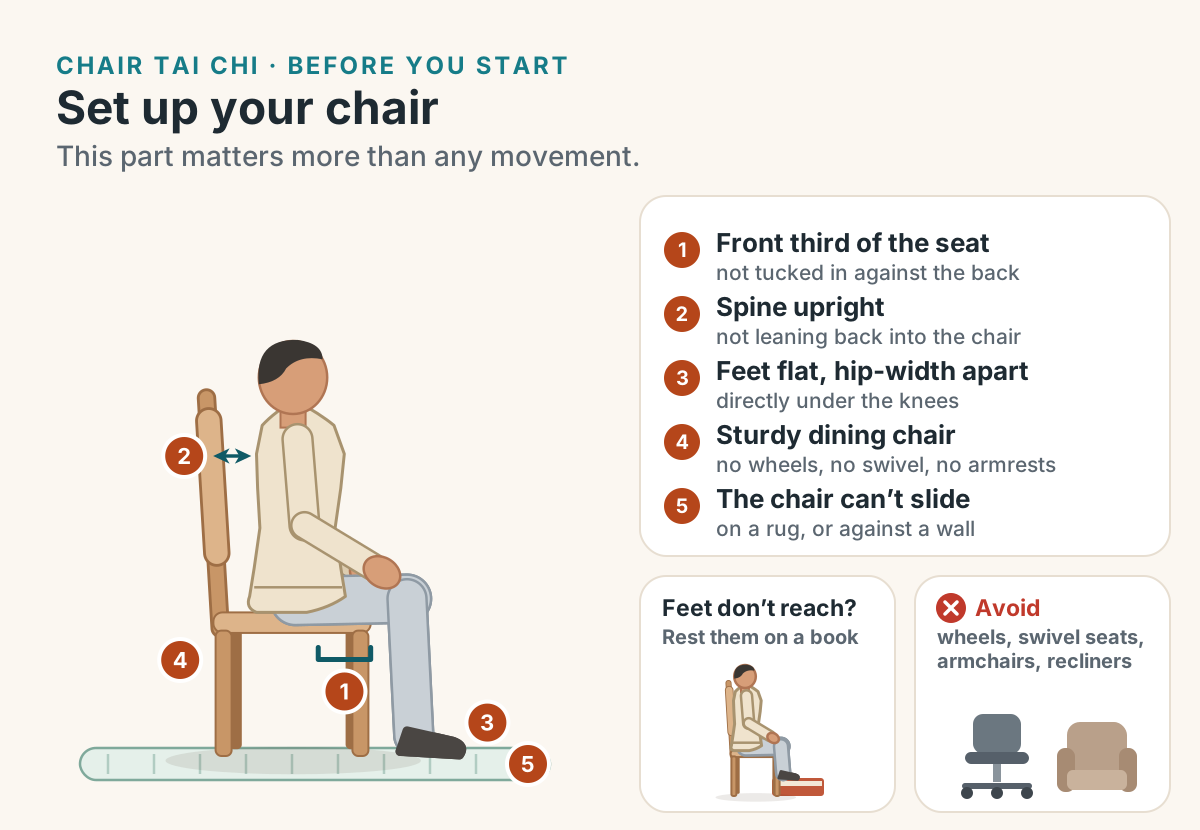
Use a sturdy chair with no wheels and no swivel. A dining chair works better than an armchair here — armrests get in the way of the side-to-side movements, and a soft recliner makes it hard to sit upright.
Sit toward the front third of the seat so your spine is upright rather than leaning back into the chair. Keep both feet flat and hip-width apart, directly under the knees. If your feet do not comfortably reach the floor, put a book under them rather than letting them dangle.
Check that the chair cannot slide. On a hard floor, put it on a rug or place it against a wall.
The 8 seated chair tai chi exercises
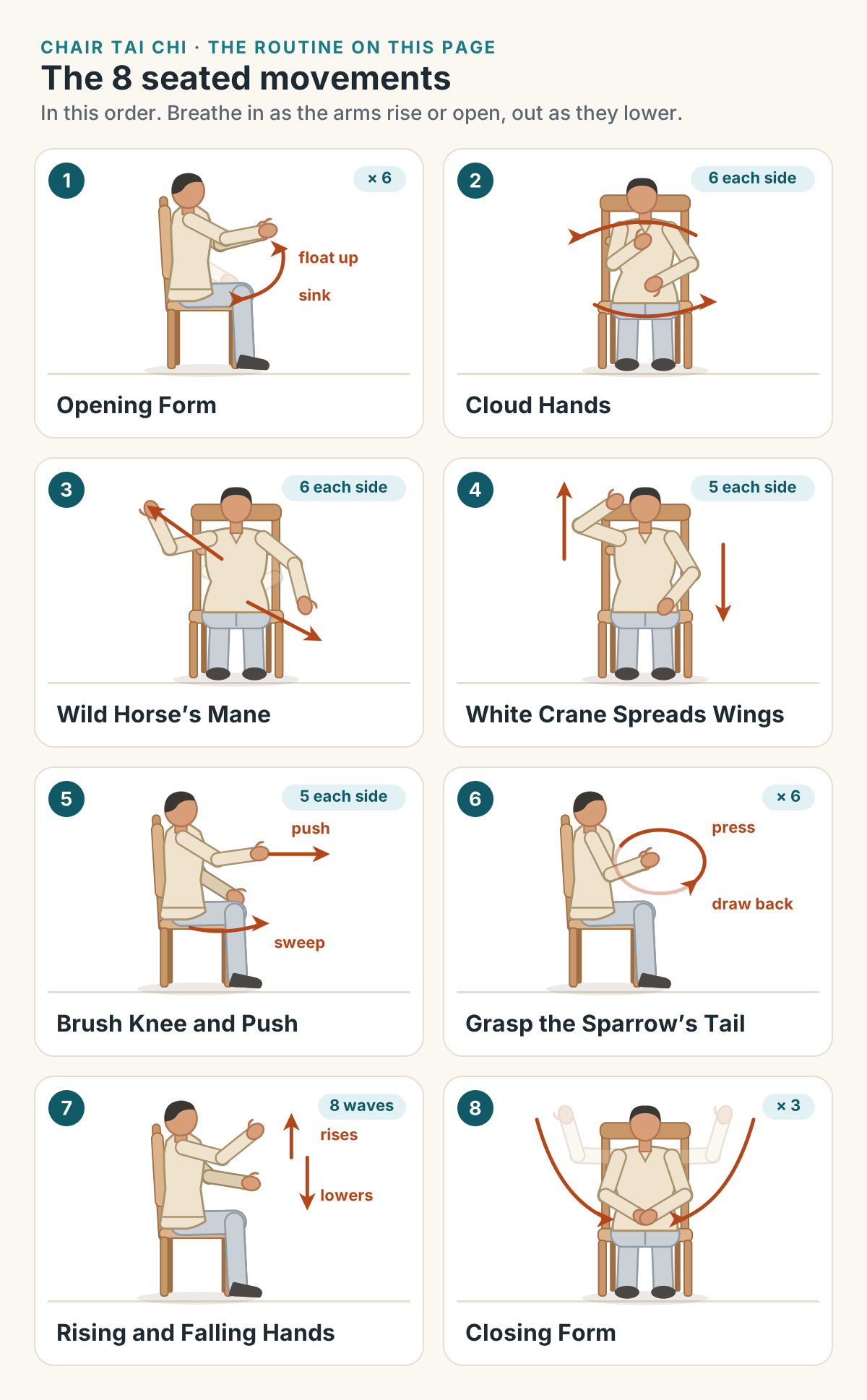
These are the eight seated chair tai chi exercises, in the order the printable chart uses them. Each one keeps its traditional name, because if you later look for a video or a class you will hear the same names used there.
- Opening Form (Wuji) — float both hands up to chest height, palms down, then let them sink. Six times.
- Cloud Hands (Yun Shou) — hands at chest and waist height, turning gently from the waist and swapping the hands as you go. Six each side.
- Parting the Wild Horse’s Mane (Ye Ma Fen Zong) — gather as if holding a ball, then open the arms apart on a diagonal. Six each side.
- White Crane Spreads Wings (Bai He Liang Chi) — one hand rises beside the temple as the other lowers to the thigh. Five each side.
- Brush Knee and Push (Lou Xi Ao Bu) — one hand sweeps above the thigh while the other pushes slowly forward. Five each side.
- Grasp the Sparrow’s Tail (Lan Que Wei) — roll the forearms forward as if pressing, then draw them back in a slow circle. Six times.
- Rising and Falling Hands — arms out front, one rising as the other lowers, passing like a slow wave. Eight waves.
- Closing Form (Shou Shi) — arms out and up, then float down the centre line to rest on the lower abdomen. Three times.
Breathing and pace — the part most beginners get wrong
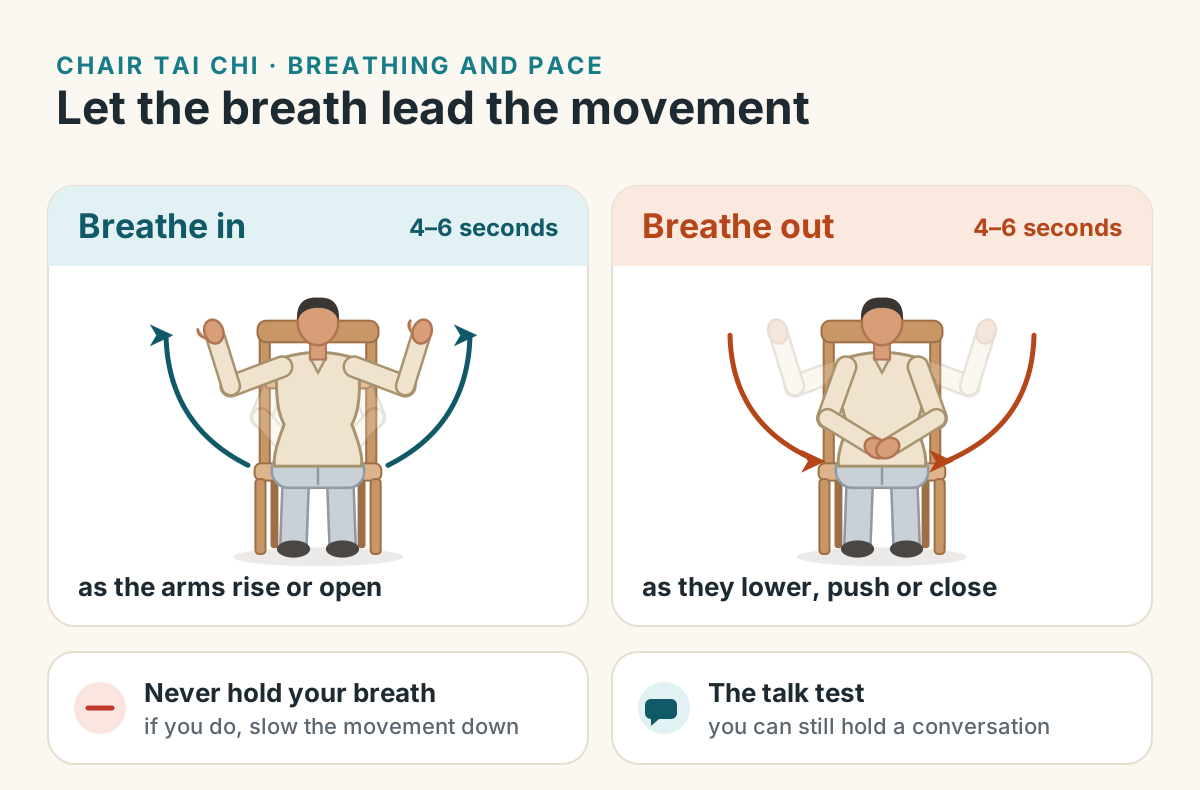
Breathing is what makes this tai chi rather than arm exercise. The rule is simple: breathe in as the arms rise or open, and breathe out as they lower, push, or come together. Never hold your breath. If you notice you are holding it, that is the signal to slow the movement down, not to push through.
Aim for slow breaths of roughly four to six seconds in and out, not quick puffs. And keep the movement slow — in tai chi the slowness *is* the exercise, so rushing removes most of the benefit.
A useful check: you should be able to hold a conversation throughout. If you cannot, slow down rather than stopping altogether.
A 4-week chair tai chi workout plan
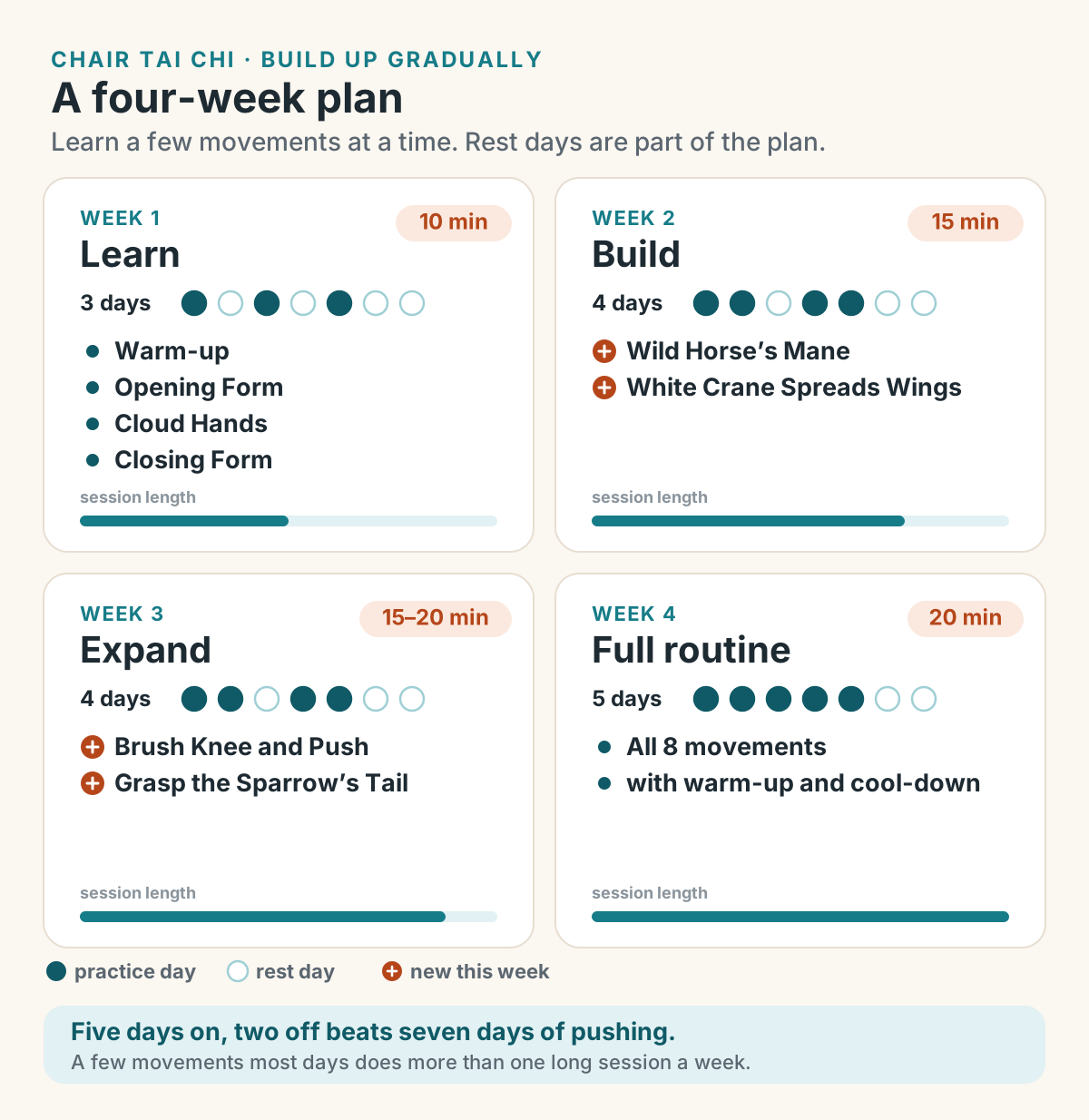
Think of it as a gentle seated workout that grows over four weeks. Do not try to learn all eight movements on day one — the printable lays out a gradual build:
- Week 1 — Learn. Three days, ten minutes. Warm-up, Opening Form, Cloud Hands, Closing Form.
- Week 2 — Build. Four days, fifteen minutes. Add Parting the Wild Horse’s Mane and White Crane Spreads Wings.
- Week 3 — Expand. Four days, fifteen to twenty minutes. Add Brush Knee and Push, and Grasp the Sparrow’s Tail.
- Week 4 — Full routine. Five days, twenty minutes. All eight movements with the warm-up and cool-down.
Rest days are part of the plan, not a failure. Older beginners usually progress better on five days on and two off than on seven days of pushing. Consistency matters far more than session length — a few movements most days beats one long session on a Sunday.
When to check with a doctor first
Chair tai chi is low-intensity and low-risk for most people, but check with a doctor before starting if there is a heart condition, uncontrolled blood pressure, a recent fall, recent surgery or a fracture, severe arthritis, dizziness, or significant cognitive impairment.
Stop straight away and seek advice if you feel chest pain, sharp joint pain, breathlessness, or dizziness during a session. Move only within a comfortable range — this is not a flexibility contest, and there is no benefit to pushing into pain.
When you finish, sit quietly for a moment before standing, and stand slowly using the chair for support if you need it.
More free printables
See all 25 free printables- Short Chair Yoga RoutinesTwo short seated routines: a 10-minute flow for circulation and flexibility, and a gentle morning wake-up for stiff joints.Free PDF, no sign-up
- Morning Chair YogaTwo short seated routines: a 10-minute flow for circulation and flexibility, and a gentle morning wake-up for stiff joints.Free PDF, no sign-up
- Seated Stretches for BeginnersA gentle top-to-bottom stretching routine for flexibility and comfort, with clear safety notes.Free PDF, no sign-up
- Bed-to-Chair ExercisesThree stages, in bed, the transfer and seated, for rebuilding strength after illness or time in bed.Free PDF, no sign-up
 Large Print Calendar 2027One month per page, extra-large dates and boxes big enough to write in. Starts November 2026 and runs to December 2027.Free PDF, no sign-up
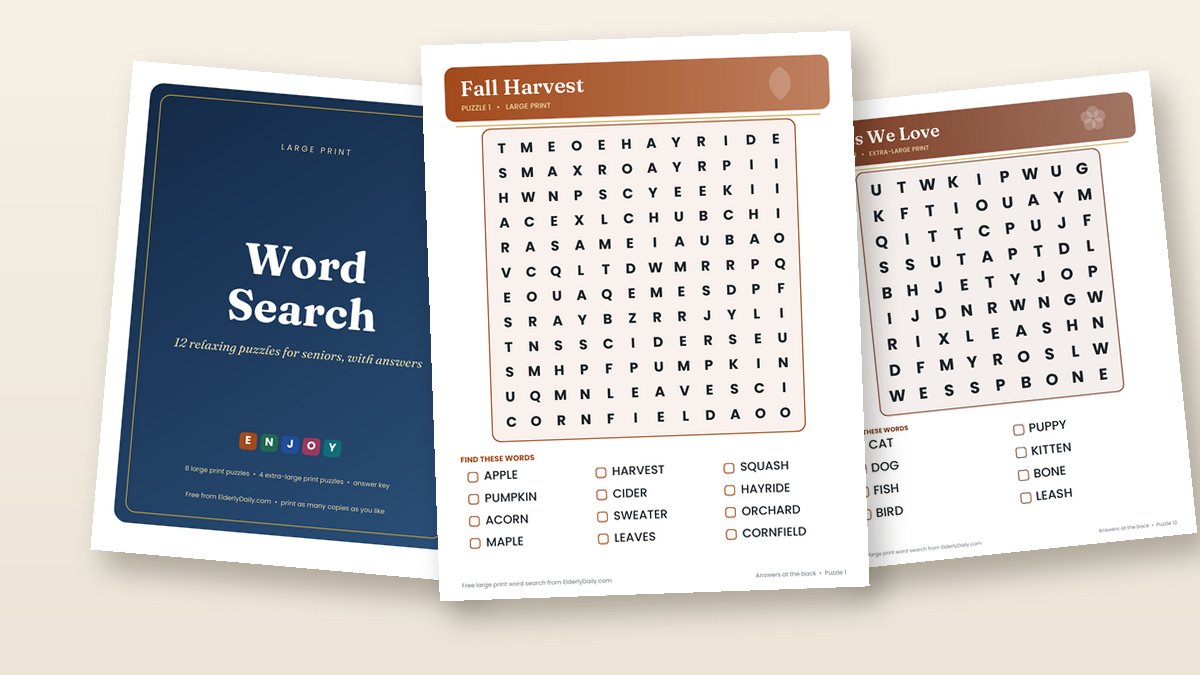 Large Print Word Search12 colorful puzzles in large and extra-large print. Words never run backwards, and the answers are included.Free PDF, no sign-up
Frequently asked questions
Is there a printable chair tai chi chart?
Yes, two. A free printable word chart — all eight movements with breath cues and repetitions on one page, plus the four-week plan — is emailed to you from the box on this page. The paid illustrated chair tai chi chart carries all eight seated movements as pictures — not just words — with breathing cues and repetitions, plus a warm-up, a cool-down, five common mistakes to avoid, and a four-week plan. It is a one-off purchase. The routine itself, including the order of the movements and the breathing, is set out in full on this page at no cost, so you can try it before deciding whether you want it on paper.
Is chair tai chi real tai chi?
Yes. The movements are the standard Yang and Sun style forms — Cloud Hands, Parting the Wild Horse’s Mane, Grasp the Sparrow’s Tail and the rest — adapted for seated practice. Sitting removes the standing balance demand, but the slow flowing movement, the coordinated breathing and the focused attention all stay. That is what makes it tai chi rather than seated arm exercise.
What kind of chair do I need for chair tai chi?
A sturdy chair with no wheels and no swivel. A dining chair usually works better than an armchair, because armrests restrict the side-to-side movements and a soft recliner makes it hard to sit upright. Sit toward the front third of the seat with both feet flat and hip-width apart. If your feet do not reach the floor, put a book under them. On a hard floor, put the chair on a rug or against a wall so it cannot slide.
How long should a chair tai chi session be, and how often?
A full session runs about fifteen to twenty minutes, and three to five times a week is a reasonable target. If you are starting out, ten minutes three times in the first week is plenty — the four-week plan in the printable builds up gradually. Consistency matters more than length.
How should I breathe during chair tai chi?
Breathe in as the arms rise or open, and out as they lower, push, or come together. Never hold your breath — if you catch yourself holding it, slow the movement down. Aim for slow breaths of roughly four to six seconds rather than quick puffs. You should be able to hold a conversation throughout; if you cannot, slow down rather than stopping.
Is chair tai chi safe if I have arthritis?
For most people with arthritis it is one of the gentler options available, because the circular arm movements take the joints through their range of motion without loading them. The Arthritis Foundation lists tai chi among the low-impact activities it recommends for older adults. That said, check with your doctor first if your arthritis is severe, and move only within a comfortable range — never into pain.
What is the difference between chair tai chi and chair yoga?
Both are done seated and both suit limited mobility, but they feel different. Chair tai chi is continuous and flowing — you keep moving slowly from one form into the next, and the emphasis is on circular motion and breath. Chair yoga holds positions for a few breaths at a time and puts more emphasis on stretching. Many people do both. If you want to compare, we have a free printable chair yoga chart and a free 28-day chair yoga plan as well.
Does chair tai chi really work for seniors?
Done slowly and regularly, it is a gentle way to keep the benefits of tai chi's movement and breathing, though most research has looked at standing tai chi. Seated tai chi keeps the parts of tai chi that matter: the slow flowing movement, the coordinated breathing and the focus. Regular tai chi is well studied in older adults and is linked to better balance, fewer falls, easier joints and steadier blood pressure, which is why the National Council on Aging, the CDC and the Arthritis Foundation all recommend it. Ten to twenty minutes, three to five days a week, is a reasonable target.
Is chair tai chi legit, or is it a scam?
The exercise is legitimate and evidence-based. The doubt comes from several paid "chair tai chi" apps whose aggressive ads make people wonder, and you do not need any of them. The full routine here is free, with no app and no subscription. If an ad promises dramatic weight loss from seated tai chi alone, treat that with caution: the real benefits are balance, mobility, circulation and calm, not fat loss.
Is chair tai chi free?
Yes. The complete eight-movement routine, including the order of the movements, the breathing and the four-week plan, is set out in full on this page at no cost, with no sign-up. There is also a free one-page word chart to print, sent by email. The only paid item is the optional illustrated edition, a one-off purchase for anyone who wants every movement drawn frame by frame.
Can men do chair tai chi, and does age matter?
Yes to both. Chair tai chi suits men and women, and it is especially well suited to older adults, including seniors over 60, 70 or 80 and anyone easing back into movement after an illness or a break. You set the pace and the range: move gently, stay within comfort, and build up with the four-week plan.
Are there free chair tai chi exercises for seniors with pictures?
Yes. The section on the eight seated movements above includes a drawing of all eight, with the path the arms take and the number of repetitions, and the routine is written out step by step beside it. The free emailed chart is a large-print word chart. If you would like every movement drawn frame by frame, a full page each, the paid Chair Tai Chi Illustrated Edition does that and includes a large-print version.
Sources
- National Institute on Aging (NIH). Four Types of Exercise Can Improve Your Health and Physical Ability
- Centers for Disease Control and Prevention. About Physical Activity and Arthritis
- Cochrane. Exercise for preventing falls in older people living in the community (2019)
