
Durable Power of Attorney: What It Is and How to Set One Up for a Parent (2026)

Checked against the Uniform Power of Attorney Act as enacted in state law, SSA and CFPB guidance, October 2026. Not legal advice.
In this guide
- What a durable power of attorney is, in plain terms
- Durable vs. regular power of attorney
- What an agent can do, and the powers that must be written in
- What a durable power of attorney can’t do
- How to set up a durable power of attorney for a parent
- Why the right powers matter for Medicaid
- If you’re the agent: your duties and the records to keep
- When a power of attorney ends
- What if it’s too late to sign one?
- When to talk to an elder law attorney
- FAQs
A durable power of attorney is the document that lets a son or daughter pay a parent’s bills, talk to the bank and handle a Medicaid application if the parent can no longer do it. It only works if it is signed in time and gives the right powers. Here is how it works, in plain English.
Key takeaways
- A durable power of attorney keeps working if your parent loses the ability to make decisions. A regular (non-durable) one stops at exactly that moment, when families need it most
- In states that adopted the Uniform Power of Attorney Act, a power of attorney is durable unless it says otherwise. Elsewhere the document may need durable wording, so check your state’s rules
- It covers money and property, not medical care. Health care decisions need a separate health care power of attorney (a health care proxy)
- Some powers, such as making gifts, creating a trust or changing beneficiaries, must be written in expressly. Those are the powers Medicaid planning often depends on
- It must be signed while your parent still has capacity. After that, the usual route is a court guardianship or conservatorship
- It ends when your parent dies. Social Security and the VA don’t accept it for benefits; they appoint a representative payee or fiduciary instead
Quick answer
What is a durable power of attorney?
A durable power of attorney is a legal document in which a person (the principal) names someone they trust (the agent) to handle their money, property and paperwork, and says that the agent’s authority continues if the principal later becomes incapacitated. That is the difference from a regular power of attorney, which ends when the principal loses capacity. It doesn’t cover medical decisions, it can’t be used after death, and it has to be signed while the principal still understands what they are signing.
What a durable power of attorney is, in plain terms
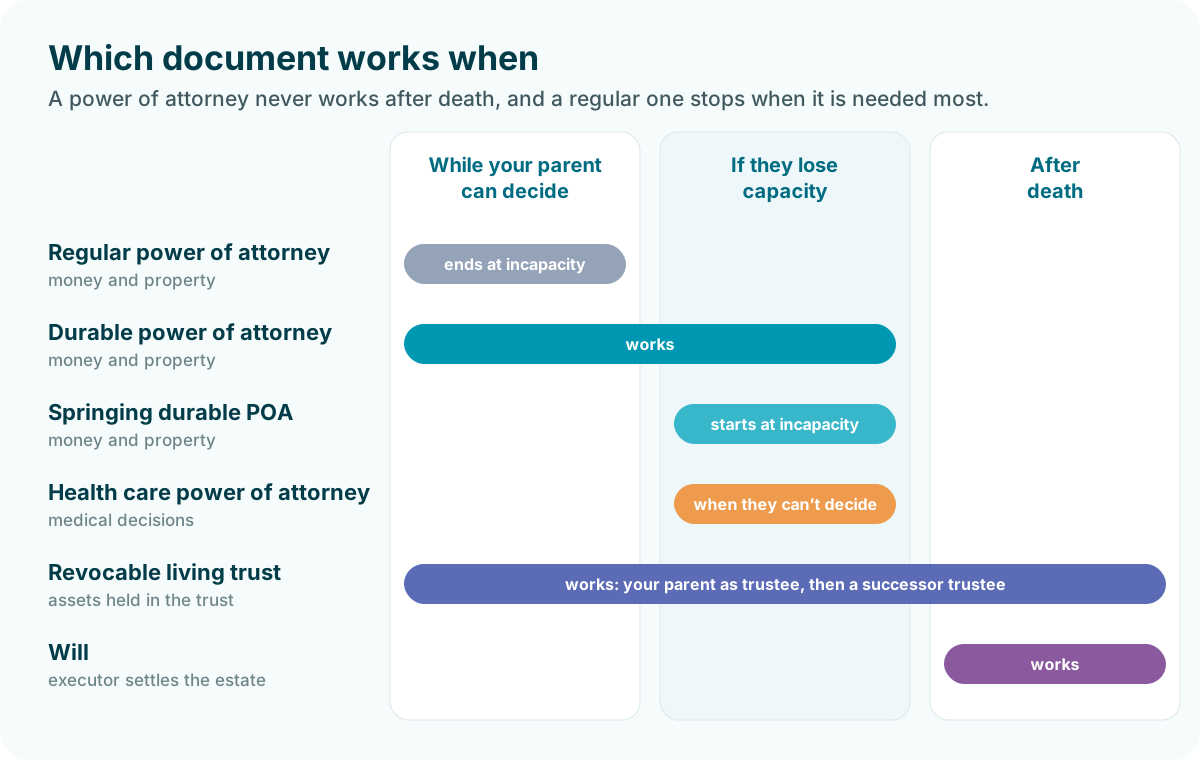
A power of attorney is a signed document in which one person, the principal, gives another person, the agent (sometimes called the attorney-in-fact), legal authority to act for them. The agent doesn’t have to be a lawyer. It is usually a grown child, a spouse or another trusted relative.
The word durable means the authority survives the principal’s incapacity. That matters because the most common reason a family needs a power of attorney is that a parent can no longer manage: after a stroke, as dementia progresses, or during a long illness. A non-durable power of attorney ends at exactly that point.
Under the Uniform Power of Attorney Act, which many states have adopted in their own law, the default is now the useful one: a power of attorney created under the act is durable unless it expressly says it ends on incapacity (West Virginia Code § 39B-1-104 is one example of the enacted text). States that haven’t adopted the act may require words such as “this power of attorney shall not be affected by subsequent disability or incapacity of the principal.” If you are using an older document, check that it contains durable language.
An ElderlyDaily original
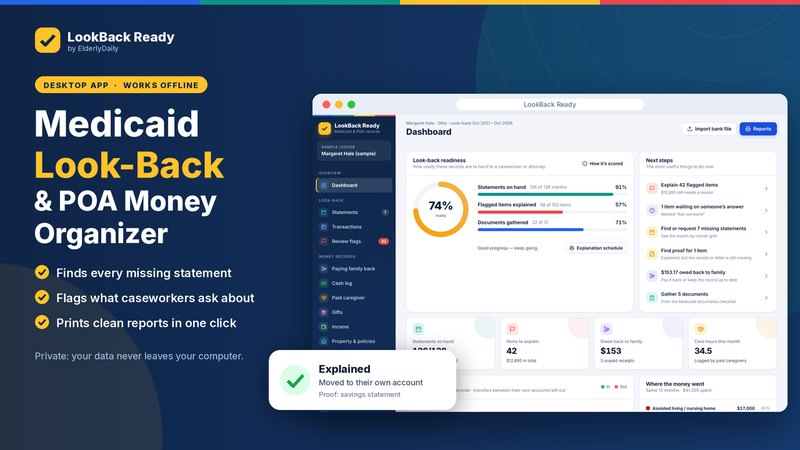
Getting a parent’s records ready for the look-back?
LookBack Ready: Medicaid Look-Back & POA Money Organizer
- A month-by-month checklist of every statement, for every account, closed ones included
- Imports bank download files and flags cash, checks, transfers and payments to family
- Explain each item once, with the proof and where it’s kept
One-time purchase · Instant download · Desktop app · Windows & Mac · works offline
Durable vs. regular power of attorney
All three types below can cover the same financial powers. What differs is when the agent can use them.
| Regular (non-durable) | Durable (immediate) | Springing durable | |
|---|---|---|---|
| Agent can act | As soon as it is signed | As soon as it is signed | Only after incapacity is confirmed, as the document defines it |
| If the parent loses capacity | Ends | Keeps working | Starts working |
| Ends | Incapacity, revocation or death | Revocation or death | Revocation or death |
| Typical use | One transaction, such as a house closing while abroad | Long-term planning for an older parent | A parent who wants no one acting while they are well |
| Watch out for | Useless for later-life planning | The agent can act now, so choose carefully | Banks may ask for proof of incapacity, which can mean delays exactly when bills are due |
Immediate or springing?
Many elder law attorneys prefer an immediate durable power of attorney for older parents, because a springing one needs a doctor’s letter or another trigger before anyone can use it. If your parent is uneasy about that, the agent can simply agree not to act until it’s needed. Ask your attorney which suits your state.
What an agent can do, and the powers that must be written in
A general durable power of attorney usually lets the agent handle almost all of a parent’s financial life:
- Pay bills, rent, care fees and taxes, and deal with banks and credit card companies
- Manage investments, retirement accounts and insurance policies
- Buy, sell, lease or refinance real estate
- Apply for benefits, including Medicaid for long-term care, and gather the records the application needs
- Hire and pay caregivers, lawyers and accountants
Some acts are risky enough that the uniform act lets an agent do them only if the document expressly grants them (Utah Code § 75A-2-201). Lawyers call these the “hot powers”:
- Create, amend, revoke or end a living trust
- Make gifts
- Create or change rights of survivorship, such as a joint account
- Create or change a beneficiary designation
- Delegate the agent’s authority to someone else
- Waive the right to a joint and survivor annuity or retirement survivor benefit
- Disclaim (turn down) property, or exercise a power of appointment
For the IRS, an agent who needs to represent a parent in a tax matter usually files Form 2848 as well. Ask the tax preparer before the first deadline.
Generic forms often leave out the powers families end up needing
A fill-in-the-blanks form may not include gifting or trust powers. Without them, an agent may not be able to move assets to a spouse, fund a trust or pay a family caregiver the way a Medicaid plan requires. Ask an elder law attorney which powers your parent’s document should spell out.
What a durable power of attorney can’t do
- Make medical decisions. That takes a separate durable power of attorney for health care, which names a health care proxy to make decisions if your parent can’t speak for themselves (National Institute on Aging). Many families sign both at the same appointment
- Override your parent. While your parent has capacity, they stay in charge. They can revoke the document or make their own decisions at any time
- Make or change their will. No agent can write or change a will for someone else
- Act after death. The authority ends when your parent dies. From then on, the executor named in the will (or an administrator appointed by the court) takes over
- Manage Social Security or VA payments. Social Security says a power of attorney does not give legal authority to manage a beneficiary’s Social Security or SSI payments. It appoints a representative payee instead. The VA has a similar fiduciary program for its benefits
- Benefit the agent. An agent who uses a parent’s money for their own benefit, without clear authority in the document, risks having to pay it back and, in serious cases, prosecution for financial exploitation
How to set up a durable power of attorney for a parent
The steps are similar in every state, though the signing rules differ. Start while your parent is well enough to take part in the conversation.
- 1
Talk about it early
The document is only valid if your parent understands what it does when they sign. With early dementia that window can still be open, but it narrows. An attorney can judge capacity at the signing, and a note from the doctor can help if it is ever challenged.
- 2
Choose the agent and a backup
Pick someone organized, honest and willing to keep records, and name a successor agent in case the first can’t serve. Co-agents are possible, but requiring two signatures on everything can stall urgent payments.
- 3
Use your state’s form or an attorney
Many states publish a statutory power of attorney form in their law. It is a reasonable starting point for simple finances. For Medicaid planning, a house, a business or a blended family, have an elder law attorney draft it, often alongside a health care directive and a will.
- 4
Decide on the special powers
Decide whether the agent may make gifts, create or fund a trust, change beneficiaries or pay family members for care, and write each one in. Decide whether the agent may be paid. Under the uniform act an agent is entitled to reasonable compensation unless the document says otherwise.
- 5
Sign it the way your state requires
Most states expect the signature to be notarized, and some also require witnesses. A signature acknowledged before a notary is presumed genuine under the uniform act, and real estate offices usually won’t record a document without it.
- 6
Store it and share copies
Keep the original somewhere safe that the agent can reach. Give copies to the agent, the successor and your parent’s main bank. If the agent may sell real estate, the county may need the document recorded first.
Why the right powers matter for Medicaid
When a parent needs nursing home care and can’t manage the paperwork, the agent under a durable power of attorney is usually the person who applies for Medicaid. That job has three parts, and the document should cover each one:
- Applying and proving finances. The state reviews five years of transfers before Medicaid pays for long-term care (the look-back period). The agent needs authority to request statements from every bank and to sign the application
- Spending down properly. Paying for care, home repairs or a prepaid funeral that meets state rules is normal spending, not a gift. Moving money to a spouse is exempt (look-back exemptions). Both need clear authority to act
- Planning moves. Gifts, trusts and caregiver agreements can change when Medicaid starts paying, and gifts inside the look-back can cause a penalty. An agent can only do these if the document grants them. A paid family caregiver needs a written agreement before payments start
If the document is silent on gifts and trusts, an agent who makes them anyway can face penalties from Medicaid and claims from other family members. That is why attorneys draft these powers deliberately, with limits, rather than leaving them out or granting them without limits.
If you’re the agent: your duties and the records to keep
An agent is a fiduciary: someone legally bound to act for another person, not for themselves. The Consumer Financial Protection Bureau’s guide for agents under a power of attorney sums up the duties in four rules:
- Act only in your parent’s best interest
- Manage their money and property carefully
- Keep their money and property separate from yours. Don’t put their money in your own account
- Keep good records of every payment, deposit and decision
Good records protect the agent as much as the parent. A Medicaid caseworker, a brother or sister, or a court can ask what happened to the money. A log of payments, with a receipt or invoice for each, answers that question in minutes. For cash withdrawals, repayments to family and pay for care, write down the reason on the day.
An ElderlyDaily original
LookBack Ready: Medicaid Look-Back & POA Money Organizer
$49One-time purchase · Instant download · Desktop app · Windows & Mac · works offline
When a power of attorney ends
- Your parent dies. The agent’s authority ends immediately. Bills, accounts and property then belong to the estate, which the executor handles
- Your parent revokes it, while they still have capacity, usually in writing and with notice to the agent and the bank
- The agent can’t serve and no successor is named
- Divorce or separation, if the agent is the spouse. Under the uniform act, filing for divorce, annulment or legal separation ends a spouse’s authority unless the document says otherwise
- A court appoints a guardian or conservator and limits or ends the power of attorney, which is rare
The handover at death catches many families out. An agent who keeps paying bills from a parent’s account after the death is no longer authorized to. Stop, tell the bank, and pass everything to the executor. Our checklist for when a parent dies covers what happens next, step by step.
An ElderlyDaily original
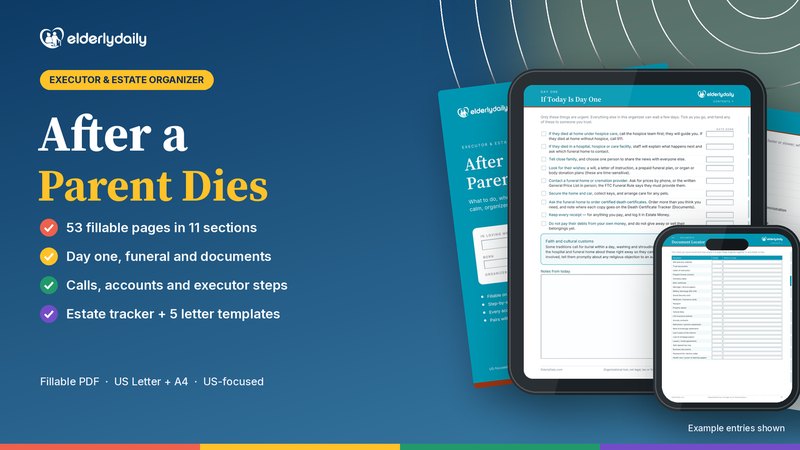
After a Parent Dies: Executor & Estate Organizer
$24One-time purchase · Instant download · Fillable PDF · 53 pages · US Letter + A4
What if it’s too late to sign one?
If your parent no longer has the capacity to sign, nobody can sign for them. The usual alternative is a guardianship or conservatorship: a court case in which a judge decides whether the person can manage their affairs and who should do it for them. It typically takes longer and costs more than a power of attorney, and it often comes with court reporting every year.
Before going to court, ask an elder law attorney whether anything simpler would work. Social Security can appoint a representative payee for benefit checks, and some accounts may already be joint or have a payable-on-death beneficiary. These help, but they don’t replace a power of attorney for a house, investments or a Medicaid application.
When to talk to an elder law attorney
A simple statutory form can work for a parent with modest savings and nothing complicated. Get legal help if any of these apply:
- Nursing home care, and Medicaid, may be needed in the next few years
- There is a house, a business, rental property or a family farm
- There are children from more than one marriage, or family members who disagree
- You want the agent to be able to make gifts, create a trust or pay a family caregiver
- Your parent’s memory is already changing
The National Academy of Elder Law Attorneys has a directory of members. If money is tight, LawHelp.org lists free legal aid by state, and the Eldercare Locator (1-800-677-1116) can connect you with local legal services for older adults.
Not legal advice
This guide explains how powers of attorney generally work so you know what to ask. State laws differ on signing rules, defaults and wording, and only an attorney licensed in your parent’s state can advise on their document.
Frequently asked questions
What is the difference between a power of attorney and a durable power of attorney?
A regular (non-durable) power of attorney ends if the principal becomes incapacitated. A durable power of attorney keeps working after incapacity, which is why it is the one used for planning for an older parent. Both end at death.
Does a durable power of attorney need to be notarized?
It depends on the state. Most states expect notarization, and some also require one or two witnesses. Under the Uniform Power of Attorney Act a signature acknowledged before a notary is presumed genuine, and banks and county recorders generally want a notarized document, so notarizing it is the safe choice everywhere.
Does a durable power of attorney expire?
Not unless the document sets an end date. It ends when the principal dies or revokes it, when no agent is able to serve, or, in many states, when a spouse-agent’s divorce or separation is filed.
Can a durable power of attorney make medical decisions?
No. A financial durable power of attorney covers money and property. Medical decisions need a durable power of attorney for health care, also called a health care proxy, which is a separate document.
Can a person with dementia sign a power of attorney?
Sometimes. What matters is whether they understand what the document does at the moment they sign it. Many people in the early stages of dementia still can. An attorney judges capacity at the signing, and a recent note from the doctor helps if the document is challenged later.
Can the agent be paid?
Under the Uniform Power of Attorney Act an agent is entitled to reimbursement of expenses and reasonable compensation unless the document says otherwise. If the parent may need Medicaid, any payment to a family member should be in writing and recorded, because unexplained payments can be treated as gifts in the look-back.
Is a durable power of attorney valid in another state?
Generally yes, if it was valid where it was signed. Under the uniform act a power of attorney executed in another state is valid if it complied with that state’s law. In practice, if your parent moves, have an attorney in the new state check it, because banks are more comfortable with a local form.
Can I use a power of attorney for my parent’s Social Security?
No. Social Security does not accept a power of attorney for managing benefits. Contact Social Security to be appointed as your parent’s representative payee.
Sources
- West Virginia Code (Uniform Power of Attorney Act). § 39B-1-104 — a power of attorney is durable unless it expressly provides that it is terminated by incapacity
- Utah Code (Uniform Power of Attorney Act). § 75A-2-201 — authority that requires a specific grant: trusts, gifts, survivorship, beneficiary designations
- Social Security Administration. Representative payee FAQ — a power of attorney gives no authority to manage Social Security or SSI payments
- Consumer Financial Protection Bureau. Managing Someone Else’s Money: help for agents under a power of attorney
- National Institute on Aging. Advance care planning: advance directives for health care, including the health care power of attorney
- U.S. Code (Cornell LII). 42 U.S.C. § 1396p — transfers of assets: the look-back date, the penalty period and exempt transfers
