
Long-Term Care Medicaid Eligibility and Asset Limits (2026)

Checked against the federal statute (42 U.S.C. § 1396p) and state Medicaid agency guidance, October 2026. Not legal advice.
For Medicaid to pay for a nursing home or care at home, a parent has to pass four tests. Here is each one with the 2026 figures, what doesn’t count, and how a spouse at home is protected.
Key takeaways
- Long-term care Medicaid has four tests: age or disability, care needs, income and assets, plus the 5-year look-back
- The usual asset limit is $2,000 for one person, the SSI figure most states use. Some states are higher: California’s is $130,000 from 2026
- The home, one car, personal belongings and small burial funds don’t count
- Most states let people qualify for long-term care with income up to $2,982 a month in 2026. Others use a spend-down or an income trust
- A spouse at home can keep part of the couple’s savings, between $32,532 and $162,660 in 2026 depending on the state, and may get a monthly income allowance
- On Medicaid in a nursing home, your parent keeps a personal needs allowance (at least $30 a month) and most of the rest of their income goes toward their care
Quick answer
What are the requirements for long-term care Medicaid?
To qualify for Medicaid long-term care, a person generally must be 65 or older, blind or disabled; need a nursing-home level of care; meet the state’s income rules (most states allow up to $2,982 a month in 2026, and others use a spend-down or an income trust); and have countable assets under the limit, usually $2,000 for one person. The home, one car and personal belongings usually don’t count. The state also reviews the past five years for gifts, and a spouse at home can keep part of the couple’s savings and income.
The four tests
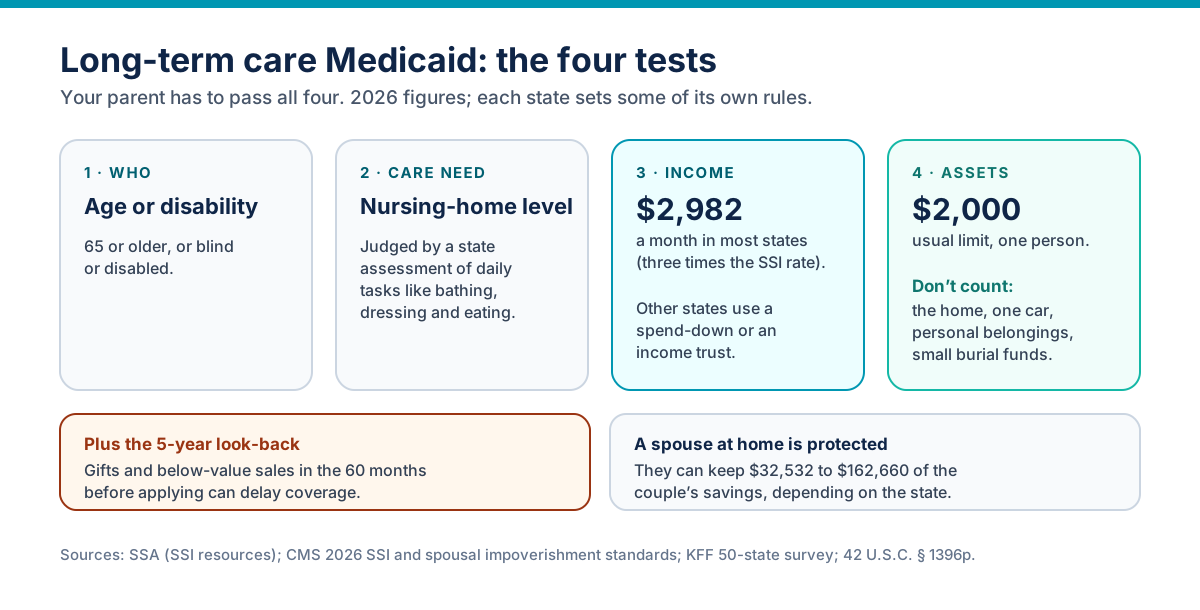
- Who: 65 or older, or blind or disabled
- Care need: a nursing-home level of care, judged by a state assessment of daily tasks such as bathing, dressing and eating. The same test applies to care at home through a Medicaid waiver
- Income: under the state’s limit, or a way to qualify above it (below)
- Assets: countable savings under the limit, usually $2,000 for one person
On top of the four tests, the state reviews the last five years for gifts and below-value sales: the Medicaid look-back.
An ElderlyDaily original
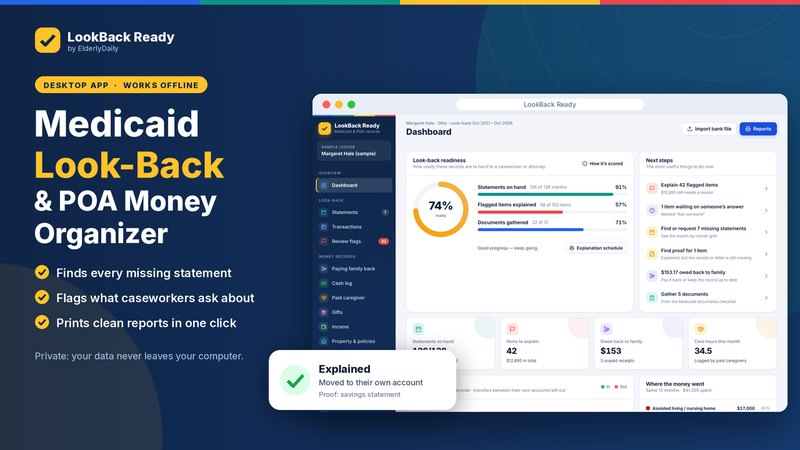
Getting a parent’s records ready for the look-back?
LookBack Ready: Medicaid Look-Back & POA Money Organizer
One-off purchase · Instant download · Desktop app · Windows & Mac · works offline
The asset limit: usually $2,000
Most states use the SSI asset limit of $2,000 for one person (KFF). Some are higher. California’s Medi-Cal brought back its asset limit on January 1, 2026 at $130,000 for one person, plus $65,000 for each additional household member (DHCS). Check your own state’s figure.
What usually counts:
- checking and savings accounts, and cash
- stocks, bonds, mutual funds and certificates of deposit
- property other than the home, such as a second car, land or a rental
- the cash value of life insurance when the policies’ total face value is over $1,500
- retirement accounts, which states treat in different ways
What usually doesn’t count, under the SSI rules most states follow (SSA):
- the home your parent lives in, up to the state’s home equity limit for long-term care ($752,000 to $1,130,000 in 2026)
- one vehicle, whatever its value, if it’s used for transportation
- household goods and personal effects, such as wedding and engagement rings
- burial spaces, and burial funds up to $1,500
- life insurance with a combined face value of $1,500 or less
For what happens to the home, see can Medicaid take your house?.
The income rules
Most states use a special income rule for long-term care: income up to 300% of the SSI benefit rate (KFF), which is $2,982 a month in 2026 (CMS).
If your parent’s income is higher, or the state doesn’t use that rule, there are two other routes:
- Medically needy spend-down. In states with a medically needy program (34 in KFF’s survey), medical and care bills are subtracted from income until it falls under the state’s limit
- A qualified income trust, often called a Miller trust. Income above the limit is paid into a special trust each month, and when your parent dies the state is repaid from what is left, up to what Medicaid paid (42 U.S.C. § 1396p(d)(4)(B))
Ask the state Medicaid office which route it uses. A qualified income trust has to be set up correctly, which is a job for an elder law attorney.
Where the income goes in a nursing home
Once on Medicaid in a nursing home, your parent keeps a personal needs allowance each month for things like clothing and haircuts: at least $30, the federal minimum, and $50 in the typical state in KFF’s 2022 survey. After allowances such as health insurance premiums and support for a spouse at home, the rest of their income goes to the nursing home, and Medicaid pays the remainder.
Protections for a spouse at home
When one spouse needs nursing home care and the other stays at home, federal spousal impoverishment rules stop the spouse at home from being left with nothing (CMS):
- Savings: the spouse at home can keep part of the couple’s countable savings. In 2026 that protected amount is at least $32,532 and at most $162,660, depending on the state’s rules and the couple’s assets
- Their own income: the income of the spouse at home isn’t counted toward their partner’s eligibility
- An income allowance: if their own income is low, they can receive part of their spouse’s income. The minimum monthly allowance is $2,705 from July 1, 2026 (higher in Alaska and Hawaii), and the maximum is $4,066.50
These rules are complicated and the figures change every year, so this is a good point to involve an elder law attorney.
How to apply for long-term care Medicaid
The application is mostly paperwork. Starting early is the best way to avoid a gap in paying for care:
- 1
Check the care needs
Ask the state or your local Area Agency on Aging about the level-of-care assessment for nursing home or home care Medicaid.
- 2
List every asset and income source
Every account, property and policy your parent owns, and every source of income, with current values.
- 3
Gather five years of statements
For every account, including closed ones. See how far back Medicaid looks at bank statements.
- 4
Apply, and answer requests quickly
Apply through the state or county Medicaid office. States must decide most applications within 45 days, or 90 days when eligibility is based on disability (42 CFR § 435.912).
An ElderlyDaily original
LookBack Ready: Medicaid Look-Back & POA Money Organizer
One-off purchase · Instant download · Desktop app · Windows & Mac · works offline
Frequently asked questions
What is the asset limit for Medicaid in 2026?
For long-term care, most states use $2,000 for one person, the SSI figure. Some states are higher; California’s is $130,000 from January 1, 2026. Medicare Savings Programs have a separate federal limit of $9,950.
Can I keep my house and still get Medicaid?
Usually, while you live there or intend to return, and as long as the equity is under the state’s limit for long-term care ($752,000 to $1,130,000 in 2026). The home can be subject to estate recovery after death.
How much money can a nursing home resident keep on Medicaid?
A monthly personal needs allowance set by the state, at least $30, plus countable assets under the state’s limit, usually $2,000. Most of the rest of their income goes toward their care.
Does Medicaid count my spouse’s income?
For nursing home Medicaid, the income of the spouse at home isn’t counted toward their partner’s eligibility. A spouse with low income may also receive an allowance from their partner’s income.
What is a Miller trust?
A qualified income trust used in some states when a person’s income is too high for long-term care Medicaid. Income above the limit goes into the trust each month, and the state is repaid from it after death, up to what Medicaid paid.
Can I give money away to get under the asset limit?
Gifts within five years of applying can cause a penalty period under the look-back. Spending on your own needs, such as care, bills and home repairs, is not a transfer.
Sources
- Social Security Administration. Understanding SSI — resources: what counts and what doesn’t
- KFF (2022). Medicaid financial eligibility in pathways based on old age or disability: findings from a 50-state survey
- CMS. Informational Bulletin, December 9, 2025 — 2026 SSI, spousal impoverishment and home equity standards ($752,000 to $1,130,000)
- CMS. Informational Bulletin, April 27, 2026 — updated 2026 SSI and spousal impoverishment standards
- California Department of Health Care Services. ACWDL 25-18 — transfers of assets for long-term care Medi-Cal (30-month look-back, from January 2026)
- U.S. Code (Cornell LII). 42 U.S.C. § 1396p — transfers of assets: the look-back date, the penalty period and exempt transfers
- Code of Federal Regulations (Cornell LII). 42 CFR § 435.912 — timeliness standards for eligibility decisions (45 and 90 days)
