
Medicaid Look-Back Exemptions: Transfers That Don’t Count (2026)

Checked against the federal statute (42 U.S.C. § 1396p) and state Medicaid agency guidance, October 2026. Not legal advice.
Not every gift inside the five-year window causes a penalty. Federal law lists the transfers that are exempt, and plenty of spending isn’t a transfer at all. Here is the full list, and what each one takes to prove.
Key takeaways
- Spending on the person themselves (their bills, care and things they use) is not a transfer at all
- Transfers to a spouse, a blind or disabled child, or a trust for a disabled person under 65 are exempt
- The home can go without penalty to a child under 21, a disabled child, a caregiver child who lived there two years, or a co-owner sibling who lived there one year
- A transfer can also be accepted if you show it was for another purpose, or if everything was given back
- If a penalty would leave someone without care, food or shelter, they can ask for an undue hardship waiver
- Every exemption needs proof. Gather it before you apply
Quick answer
What transfers are exempt from the Medicaid look-back?
Under federal law there is no penalty for transfers to a spouse (or for the spouse’s sole benefit), to a blind or disabled child, or to a trust solely for a disabled person under 65. The home can be transferred to a child under 21, a blind or disabled child, a sibling who co-owns it and lived there for a year before the parent entered care, or a son or daughter who lived there for two years and gave care that kept the parent at home. Transfers made for a reason other than qualifying for Medicaid, or that were fully returned, can also be accepted, and every state must offer an undue hardship waiver. Spending on the person’s own needs is not a transfer at all.
First: is it a transfer at all?
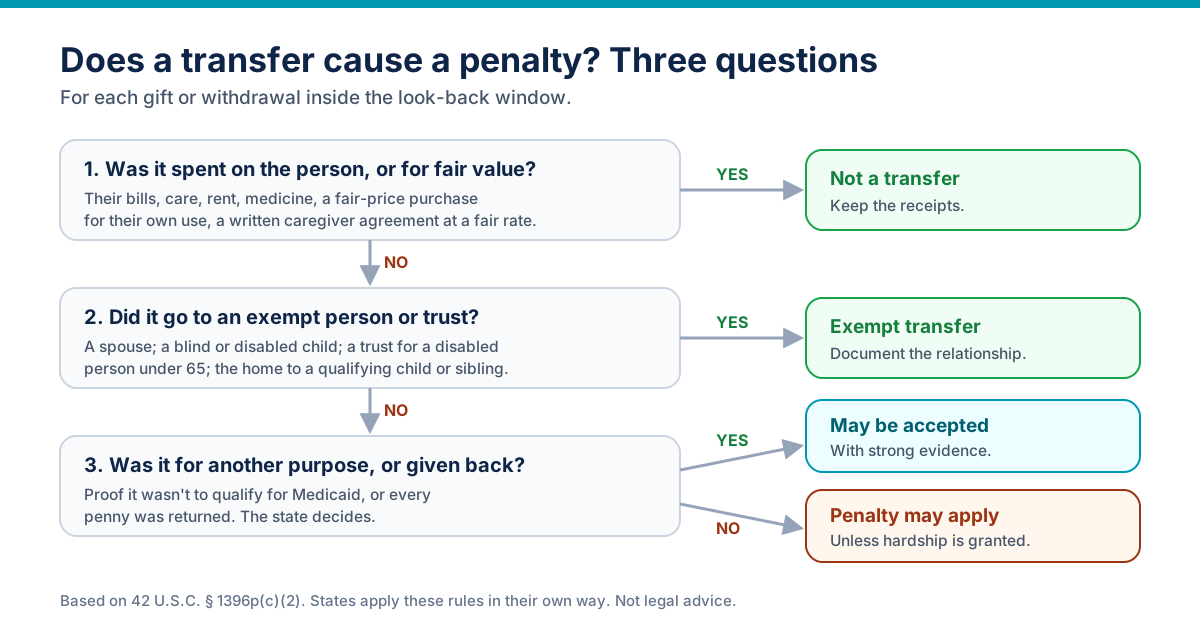
The look-back only penalizes assets given away, or sold, for less than they were worth. Most of what leaves an older person’s account isn’t that. These are normal spending, not transfers:
- Their own bills: rent, utilities, insurance premiums, taxes, and credit cards or loans in their name
- Their care: home care, adult day care, assisted living, nursing home bills, medical costs and equipment
- Things bought for their own use at a fair price: clothing, a hearing aid, a wheelchair, a car they use
- Repairs to the home they live in
- A prepaid funeral that meets the state’s rules
- Repaying a family member for things bought on the person’s behalf, with the receipts to show it
The proof is the receipt, the invoice or the bill. Keep each one with the statement month it belongs to.
An ElderlyDaily original
Getting a parent’s records ready for the look-back?
LookBack Ready: Medicaid Look-Back & POA Money Organizer
One-off purchase · Instant download · Desktop app · Windows & Mac · works offline
Transfers to exempt people and trusts
Federal law says no penalty applies to these, whenever they happen in the window (42 U.S.C. § 1396p(c)(2)(B)):
- A spouse. Anything transferred to the spouse, or to someone else for the spouse’s sole benefit. Both spouses’ savings are counted together when one of them applies for nursing home Medicaid, so this doesn’t make money disappear; it mainly matters in planning that a lawyer handles
- A blind or disabled child of any age, or a trust set up solely for that child
- A trust for a disabled person under 65, set up solely for their benefit
Disability is judged by the definition Social Security uses for SSI. An SSI or Social Security disability award letter is the usual proof.
Giving the home: the exempt cases
A home can be transferred without penalty only to these people (42 U.S.C. § 1396p(c)(2)(A)):
| Who receives the home | Condition |
|---|---|
| A spouse | None |
| A child under 21 | None |
| A blind or disabled child (any age) | Disability as defined for SSI |
| A brother or sister | Already owns part of the home, and lived there for at least one year immediately before the parent went into care |
| A son or daughter (the “caregiver child” rule) | Lived there for at least two years immediately before the parent went into care, and gave care that let the parent stay at home rather than in an institution |
Get advice before any deed is signed
Giving the home to anyone else, including a child who doesn’t meet these rules, is a transfer like any other. The caregiver child rule is the one families most often qualify for without knowing it, but states want proof of both parts: that the child lived there (mail, tax returns, a driver’s license) and that the care made the difference, often in a doctor’s statement. Ask your state what it accepts, and talk to an elder law attorney first. For a home that stays in your parent’s name, see can Medicaid take your house?
Transfers made for another reason, or given back
The law also says there is no penalty if the state accepts a satisfactory showing that (42 U.S.C. § 1396p(c)(2)(C)):
- the person meant to get fair value, or got something else of value, in return
- the transfer was made only for a reason other than qualifying for Medicaid
- everything given away has been returned
The second is hard to prove, and states weigh it case by case. Evidence that can help: the gift fits a long pattern (the same birthday check every year), it was made when the person was healthy with no reason to expect needing care, or it paid for a specific, documented purpose. A note written at the time, in a decision diary, carries far more weight than an explanation written years later.
Returning a gift in full removes the penalty. Some states also reduce a penalty when part of a gift comes back; ask how yours handles it.
The undue hardship waiver
Every state must have a way to waive a penalty that would cause undue hardship (42 U.S.C. § 1396p(c)(2)(D)). Under the Deficit Reduction Act of 2005, that means the penalty would deprive the person of medical care, so that their health or life would be in danger, or of food, clothing, shelter or other necessities of life.
- States must tell applicants that a hardship waiver exists, decide requests in a timely way, and let you appeal a refusal
- A nursing home can apply for the waiver on a resident’s behalf, with their consent (or their representative’s). While the request is pending, the state may pay to hold the resident’s bed for up to 30 days
- It is not automatic, and it is meant for people with no other way to pay. If family received the gift, expect to be asked why it can’t be returned
Gathering proof before you apply
Exemptions are claimed with evidence, not assumed, so collect it before the application goes in. For the statements themselves, see how far back Medicaid looks at bank statements.
- 1
Spending on the person
Receipts, invoices and bills, filed by the month of the statement they match.
- 2
Repaying family
The receipts for what they bought, and a note of the date and amount repaid.
- 3
Exempt people
Birth or marriage certificates showing the relationship, and an SSI or disability award letter where disability matters.
- 4
The home
The deed, proof of where the child or sibling lived (mail, tax returns, ID) and, for the caregiver child rule, a doctor’s statement about the care.
- 5
Another purpose
Anything written at the time: letters, emails, a decision diary entry, a pattern of the same gift in earlier years.
An ElderlyDaily original
LookBack Ready: Medicaid Look-Back & POA Money Organizer
One-off purchase · Instant download · Desktop app · Windows & Mac · works offline
Frequently asked questions
Are gifts under the IRS annual exclusion exempt from the Medicaid look-back?
No. The IRS annual gift exclusion is a tax rule and doesn’t apply to Medicaid. A gift inside the look-back window can cause a penalty however small it is under the tax rules.
Is paying a family caregiver exempt?
Paying fair value for real care isn’t a transfer, but many states treat payments to family as gifts unless there is a written agreement made before the care started, a reasonable rate and a record of the hours. Without those, expect the payments to be questioned.
Does the caregiver child exemption apply to grandchildren?
Not as federal law is written: it covers a son or daughter who lived in the home for two years and gave care that kept the parent out of an institution.
Is putting the house in a trust exempt?
Generally not. Moving the house into an irrevocable trust is usually treated as a transfer, with the same 60-month look-back, and a revocable trust doesn’t protect it at all because the person can still take it back. Trusts solely for a disabled child or a disabled person under 65 are the exceptions. This is a job for an elder law attorney.
Can a parent pay a grandchild’s tuition without a penalty?
Not under the exemptions. Paying someone else’s tuition is a gift like any other, so if it falls inside the window it can count.
Is giving money to a spouse a way to qualify?
Not by itself. Transfers between spouses aren’t penalized, but both spouses’ savings are counted together when one applies for nursing home Medicaid. The rules that protect the spouse at home are separate and worth an attorney’s advice.
