
Is There a 7-Year Look-Back for Medicaid? No. Here’s the Real Rule

Checked against the federal statute (42 U.S.C. § 1396p) and state Medicaid agency guidance, October 2026. Not legal advice.
If you’ve read that Medicaid checks seven years of gifts, you’re not alone. It is one of the most repeated mistakes about Medicaid. Here is the actual rule, and where the seven comes from.
Key takeaways
- There is no 7-year look-back for Medicaid in any US state
- Federal law sets the look-back at 60 months (5 years) for transfers made since February 8, 2006. Before that it was 36 months, or 60 for trusts
- California’s Medi-Cal uses 30 months for long-term care
- The 7-year figure most likely comes from the UK’s inheritance tax rule on gifts, or from advice about how long to keep tax records
- Outside California, a gift made six years before the application is outside the window, and one made four years before is inside it
Quick answer
What is the 7-year look-back period for Medicaid?
There isn’t one. Federal law sets the Medicaid look-back period at 60 months (5 years) before the application for long-term care, and California uses 30 months. No state looks back seven years. The 7-year figure usually comes from other rules: the UK’s seven-year rule on gifts and inheritance tax, or general advice about keeping financial records for seven years.
The real rule: 60 months
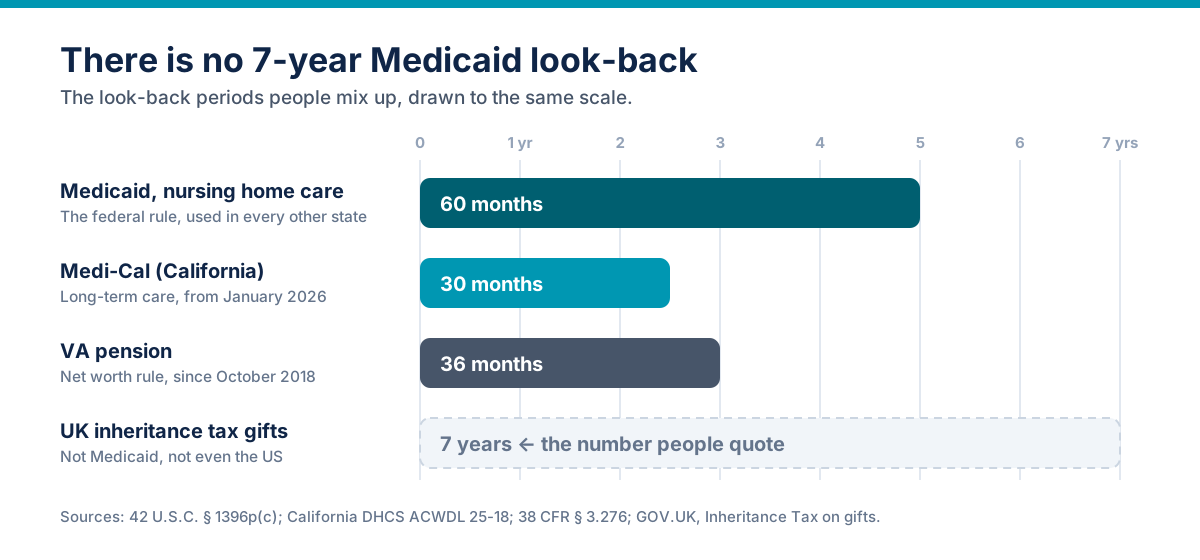
Federal Medicaid law sets the look-back date at 60 months before the application for any transfer made on or after February 8, 2006 (42 U.S.C. § 1396p(c)(1)(B)). Before the Deficit Reduction Act of 2005 changed it, the look-back was 36 months for most transfers and 60 months for trusts. It has never been seven years.
The window counts back from the application, so it moves. A gift made in March 2020 is outside the window for an application made in April 2026, but inside it for an application made in February 2025.
California is the one state that differs for nursing home care: Medi-Cal looks back 30 months. See the look-back period by state.
An ElderlyDaily original
Getting a parent’s records ready for the look-back?
LookBack Ready: Medicaid Look-Back & POA Money Organizer
One-off purchase · Instant download · Desktop app · Windows & Mac · works offline
Where the 7-year idea comes from
The seven usually comes from one of these:
- The UK’s seven-year rule. In the UK, gifts are free of inheritance tax if the giver lives for seven years after making them (GOV.UK). It is widely written about and easy to confuse with Medicaid, but it is a British tax rule
- Keeping records for seven years. The IRS says to keep tax records for seven years in one situation (a claim for a loss from worthless securities or a bad debt deduction); the general rule is three years (IRS). “Keep everything for seven years” is common advice, and it gets mixed up with the look-back
- Other look-backs with other lengths. The VA pension looks back 36 months at asset transfers made since October 18, 2018 (38 CFR § 3.276), and Medi-Cal looks back 30. None of them is seven years
- The old rules. Before 2006 the Medicaid look-back was 36 months, or 60 for trusts, and older articles still mix the numbers up
What actually matters for your family
Instead of seven years, focus on the 60 months before the application date:
- List anything given away in those 60 months: gifts to family, property sold cheaply, payments to relatives
- Check whether it was exempt. Gifts to a spouse or a disabled child, and spending on the person’s own needs, don’t count. See Medicaid look-back exemptions
- Gather the statements for every account in the window, including closed ones. See how far back Medicaid looks at bank statements
- Write down an explanation for every large withdrawal, with where the proof is
An ElderlyDaily original
LookBack Ready: Medicaid Look-Back & POA Money Organizer
One-off purchase · Instant download · Desktop app · Windows & Mac · works offline
Does waiting longer to apply help?
Once a transfer is more than 60 months old at the time of the application, Medicaid can’t penalize it. That is why some families who made a gift wait to apply, paying for care privately in the meantime. Whether that makes sense depends on the amount, the cost of care and the state. It is a decision to make with an elder law attorney, not from a rule of thumb.
Don’t delay an application on your own
From January 1, 2027 Medicaid can only pay bills from up to two months before the application for most older applicants, down from three. Waiting can leave a gap that nobody pays for.
Frequently asked questions
Is there a 10-year look-back for Medicaid?
No. The federal look-back is 60 months for every kind of transfer, including transfers into trusts.
Did the Medicaid look-back used to be 3 years?
Yes. For most transfers made before February 8, 2006 it was 36 months, with 60 months for trusts. The Deficit Reduction Act of 2005 made it 60 months for everything after that date.
Is the look-back 5 years in every state?
For nursing home Medicaid, every state except California, which uses 30 months for Medi-Cal. New York also has a 30-month look-back for home care on the books, but it had not started as of early 2026.
Does the VA have a look-back period?
Yes. VA pension has a 36-month look-back for asset transfers made on or after October 18, 2018, with a penalty of up to five years.
Where did I read about a 7-year look-back?
Most likely in something about the UK’s inheritance tax rule on gifts, or advice to keep records for seven years. Neither has anything to do with US Medicaid.
Sources
- U.S. Code (Cornell LII). 42 U.S.C. § 1396p — transfers of assets: the look-back date, the penalty period and exempt transfers
- CMS. State Medicaid Director Letter #06-018 — Deficit Reduction Act of 2005 transfer-of-assets provisions
- California Department of Health Care Services. ACWDL 25-18 — transfers of assets for long-term care Medi-Cal (30-month look-back, from January 2026)
- GOV.UK. Inheritance Tax: gifts — the UK seven-year rule (not a US Medicaid rule)
- IRS. How long should I keep records?
- Code of Federal Regulations (Cornell LII). 38 CFR § 3.276 — VA pension asset transfers, the 36-month look-back and the penalty period
- National Health Law Program (2026). New fixed home equity caps and retroactive coverage limitations will limit access to long-term care
