
How to Transfer Medicaid to Another State (2026 Guide)

Checked against the federal statute (42 U.S.C. § 1396p) and state Medicaid agency guidance, October 2026. Not legal advice.
Medicaid is run by each state, so it can’t move with you. Here is how to close one case, open another and avoid a gap in coverage, with the extra steps that matter if your parent needs long-term care.
Key takeaways
- You can’t transfer Medicaid. Each state runs its own program, so you close the case in the old state and apply in the new one
- Your parent can apply as soon as they live in the new state. States can’t require a minimum period of residence
- States must decide most applications within 45 days, or 90 days when eligibility is based on disability
- Retroactive coverage can pay bills from up to three months before the application month, if your parent qualified then. From 2027 it drops to two months for older and disabled applicants
- Nobody can have Medicaid in two states at once, and states must check addresses regularly from 2027
- Medicare doesn’t change, but a Medicare Advantage or drug plan may need switching, with two full months after the move to do it
Quick answer
Can you transfer Medicaid to another state?
No. Each state runs its own Medicaid program, so coverage doesn’t transfer. To move it, report the move to the old state so that case closes, then apply in the new state as soon as you live there. There is no minimum time you must have lived in the state. Most applications must be decided within 45 days (90 if based on disability), and retroactive coverage can pay recent bills, so apply straight away to avoid a gap.
Why Medicaid doesn’t transfer
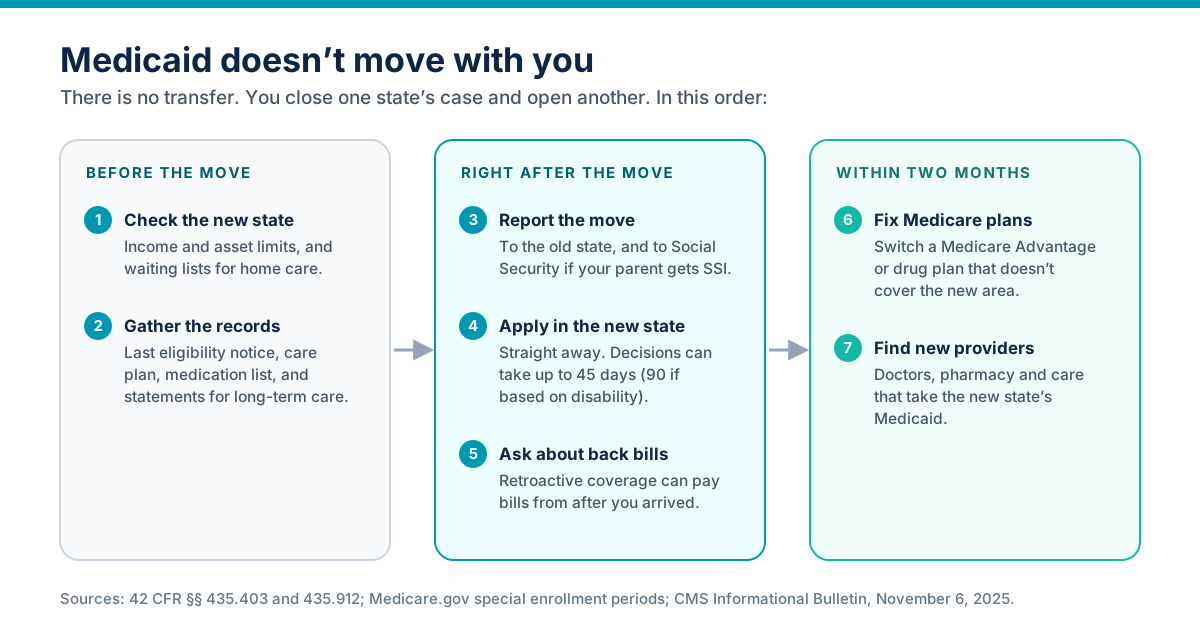
Each state runs its own Medicaid program within federal rules, with its own income and asset limits, services and waiting lists. A state has to cover its eligible residents, including residents who are temporarily away and plan to return, but not people who have moved to live somewhere else (42 CFR § 435.403).
Once your parent has moved, the old state will generally pay for care in another state only in limited cases: a medical emergency, when travelling back would put their health at risk, when the care is more readily available in the other state, or where people in that area normally use providers across the state line (42 CFR § 431.52).
Nobody can be enrolled in two states at once. Under the 2025 budget law, states must have a process to regularly get enrollees’ address information from January 1, 2027, and CMS must have a system to stop people being enrolled in more than one state by October 1, 2029 (CMS).
An ElderlyDaily original
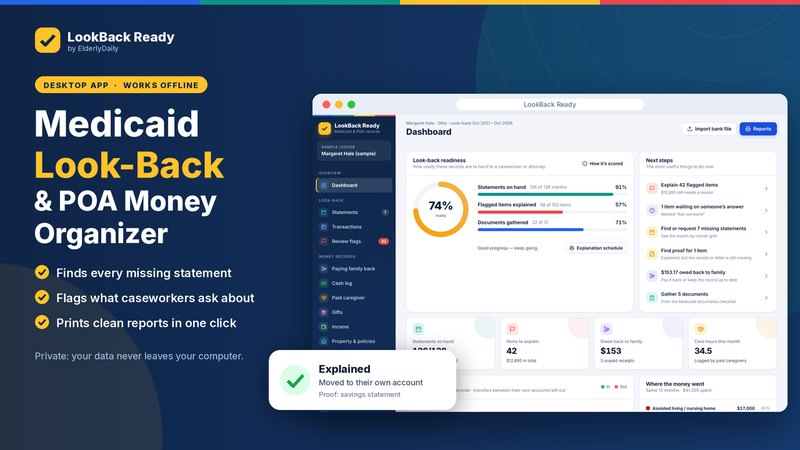
Getting a parent’s records ready for the look-back?
LookBack Ready: Medicaid Look-Back & POA Money Organizer
One-off purchase · Instant download · Desktop app · Windows & Mac · works offline

Sponsored Pick
Stander Wonder Pole Plus with Rotating Double Grab Bar
Renters, anyone who cannot drill, or spots with no convenient wall
Check PriceStep by step: moving Medicaid to a new state
The order matters, because the goal is no gap between the old coverage ending and the new one starting:
- 1
Check the new state’s rules before you move
Income and asset limits, and which services are covered, differ by state, so someone who qualifies in one state may not qualify in another. For care at home, ask about waiting lists: in 2024, about 40 states had waiting lists for some Medicaid home care programs (KFF).
- 2
Gather the records
The latest eligibility notice, proof of income (Social Security and pension award letters), recent bank statements, ID, the care plan and a medication list. For long-term care, the new state does its own look-back review, so bring the older statements too.
- 3
Report the move to the old state
Tell the old state’s Medicaid office the date of the move rather than closing the case early. The state has to give notice before it ends coverage.
- 4
Apply in the new state as soon as you arrive
There is no waiting period: your parent is a resident once they live in the state and intend to stay. States have to accept applications online, by phone, by mail and in person, and must decide most within 45 days, or 90 if eligibility is based on disability (42 CFR § 435.912).
- 5
Ask for retroactive coverage
If there were medical bills after the move, ask the new state to cover them. Retroactive coverage can reach back up to three months before the application month, as long as your parent qualified, including living in the state, at the time. From January 1, 2027 it drops to two months for older and disabled applicants (National Health Law Program).
- 6
Tell Social Security
If your parent gets SSI, report the new address. In most states SSI comes with Medicaid automatically; in others you apply separately, and Social Security will tell you where (SSA).
- 7
Sort out Medicare plans
Original Medicare works anywhere in the US. If a Medicare Advantage or drug plan doesn’t cover the new area, your parent can switch until two full months after the move, or from the month before if they tell the plan early. People with Medicaid can also make changes once a calendar month (Medicare.gov).
Moving a parent who needs long-term care
- Nursing home Medicaid. The new state does its own review, including the 5-year look-back (30 months in California), with its own penalty divisor. See the look-back period by state
- Moving straight into a nursing home. A state can’t refuse Medicaid because your parent didn’t live there before entering the facility, as long as they meet its residency rules. If a state arranges a placement in another state’s nursing home, the placing state stays responsible (42 CFR § 435.403)
- A parent who can’t say where they intend to live, for example because of advanced dementia, is covered by special residency rules. Ask the new state how it decides
- Home care waivers don’t move. A parent who gets care at home now may face a waiting list in the new state. In 2024 more than 710,000 people were on waiting lists, about a quarter of them older adults or people with physical disabilities (KFF)
Before moving a parent, line up the new state’s coverage, or a way to pay privately in the meantime, before giving notice to the current care provider.
Moving a parent closer to you
Our checklist for moving a parent to assisted living covers the practical side of the move itself.
An ElderlyDaily original
LookBack Ready: Medicaid Look-Back & POA Money Organizer
One-off purchase · Instant download · Desktop app · Windows & Mac · works offline
How to avoid a gap in coverage
- Keep the old coverage until the move actually happens, and report the move date rather than closing the case weeks early
- Refill prescriptions before leaving, and bring the medication list
- Apply in the new state the day your parent arrives, or as soon as you have proof of the new address
- Keep every medical bill and receipt from after the move, for retroactive coverage
- If a decision is taking longer than 45 days (90 for disability), ask the new state why, in writing
Frequently asked questions
How long does it take to get Medicaid in a new state?
States must decide most applications within 45 days, or 90 days if eligibility is based on disability. Retroactive coverage can then pay bills from up to three months before the application month, or two months for older and disabled applicants from 2027.
Do I have to live in a state for a certain time to get Medicaid?
No. States can’t require a minimum period of residence. Your parent counts as a resident once they live in the state and intend to stay.
Can I keep my old state’s Medicaid after I move?
Only while you still live there, or are away temporarily and plan to return. Once you have moved to live in another state, the old state generally won’t pay for care there except in emergencies and a few other limited cases.
Does Medicare change when you move to another state?
Original Medicare doesn’t. Medicare Advantage and Part D plans are local, so if the old plan doesn’t cover the new area, your parent can switch until two full months after the move.
What happens to a Medicaid waiver when you move?
It doesn’t move with you. Waivers are state programs with their own rules and often waiting lists, so apply for the new state’s program as early as you can.
Can you have Medicaid in two states at once?
No. You can only be covered by the state you live in, and states and CMS are expanding checks to find people enrolled in two states.
Sources
- Code of Federal Regulations (Cornell LII). 42 CFR § 435.403 — state residence for Medicaid
- Code of Federal Regulations (Cornell LII). 42 CFR § 431.52 — payments for services furnished out of state
- Code of Federal Regulations (Cornell LII). 42 CFR § 435.912 — timeliness standards for eligibility decisions (45 and 90 days)
- CMS. Informational Bulletin, November 6, 2025 — addressing enrollment in Medicaid or CHIP in more than one state
- Medicare.gov. Special enrollment periods — moving, living in an institution, and having Medicaid
- Social Security Administration. Understanding SSI — SSI and eligibility for Medicaid
- KFF (October 2024). A look at waiting lists for Medicaid home and community-based services from 2016 to 2024
- National Health Law Program (2026). New fixed home equity caps and retroactive coverage limitations will limit access to long-term care
