
How Far Back Does Medicaid Look? Bank Statements, Income and Assets

Checked against the federal statute (42 U.S.C. § 1396p) and state Medicaid agency guidance, October 2026. Not legal advice.
For nursing home Medicaid, the state can go through five years of a parent’s bank records. Here is what it looks at, what it doesn’t, and how to get every statement you need.
Key takeaways
- For long-term care Medicaid, the state can review the 60 months (5 years) of financial records before the application. California reviews 30 months
- Some offices ask for every statement from all 60 months up front, including closed accounts. Others ask for less and request more if something needs explaining
- Caseworkers look for money leaving to other people: cash, checks, transfers and payments to family, and for deposits that point to accounts not yet listed
- Income is judged on what the person receives now. The 5-year review is about assets given away
- Banks have to keep most records for five years, so old statements can usually be requested, sometimes for a fee
Quick answer
How far back does Medicaid look at bank statements?
For long-term care, Medicaid can review the 60 months (5 years) of financial records before the application date, looking for money or property that was given away. California reviews 30 months. Some local offices ask for every statement from the full 60 months up front; others ask for fewer and request more if they see something to explain. Income is judged on what the person receives now, not over five years.
The short answer, item by item
The 5-year look-back is about one thing: whether money or property was given away before the application. That decides which records the state reads, and how far back:
| What | How far back | Why the caseworker wants it |
|---|---|---|
| Bank and credit union accounts, including closed ones | Up to 60 months | To see money leaving to other people, and where large sums went |
| Investment and retirement accounts | Up to 60 months | Sales, withdrawals, and who received the money |
| Property: the home, land, vehicles | Up to 60 months | Any sale or deed change, and whether it was at fair value |
| Income | The current month or months | To decide whether income is under the limit and what the person pays toward care |
| Tax returns | Often several years | 1099s reveal interest and dividends, which can point to accounts not yet listed |
| Life insurance, annuities, trusts | Current values, plus any transfers in 60 months | Cash values count as assets; money moved into a trust can be a transfer |
An ElderlyDaily original
Getting a parent’s records ready for the look-back?
LookBack Ready: Medicaid Look-Back & POA Money Organizer
One-off purchase · Instant download · Desktop app · Windows & Mac · works offline
How many statements you’ll be asked for
Federal law lets the state review any transfer in the 60 months before the application. How many statements you have to hand over at the start depends on your state and even your county:
- Some offices ask for every statement from the full 60 months. Oklahoma Human Services, for example, asks for “the last sixty (60) months of statements on all accounts held in the past 60 months”, closed accounts included
- Erie County, New York asks for all bank and credit union transactions for the past 60 months, the source of every deposit and withdrawal of $2,000 or more, and four years of tax returns
- Other offices start with recent statements and ask for more months when something needs explaining
Ask your local Medicaid office for its document checklist before you start, and assume you will need the full five years for any account with large or unusual activity.
California is different
Medi-Cal’s look-back is 30 months, counted back from the month before the application, and months from January 2024 through December 2025 are not reviewed (DHCS ACWDL 25-18). See the look-back period by state.
What a caseworker looks for on a statement
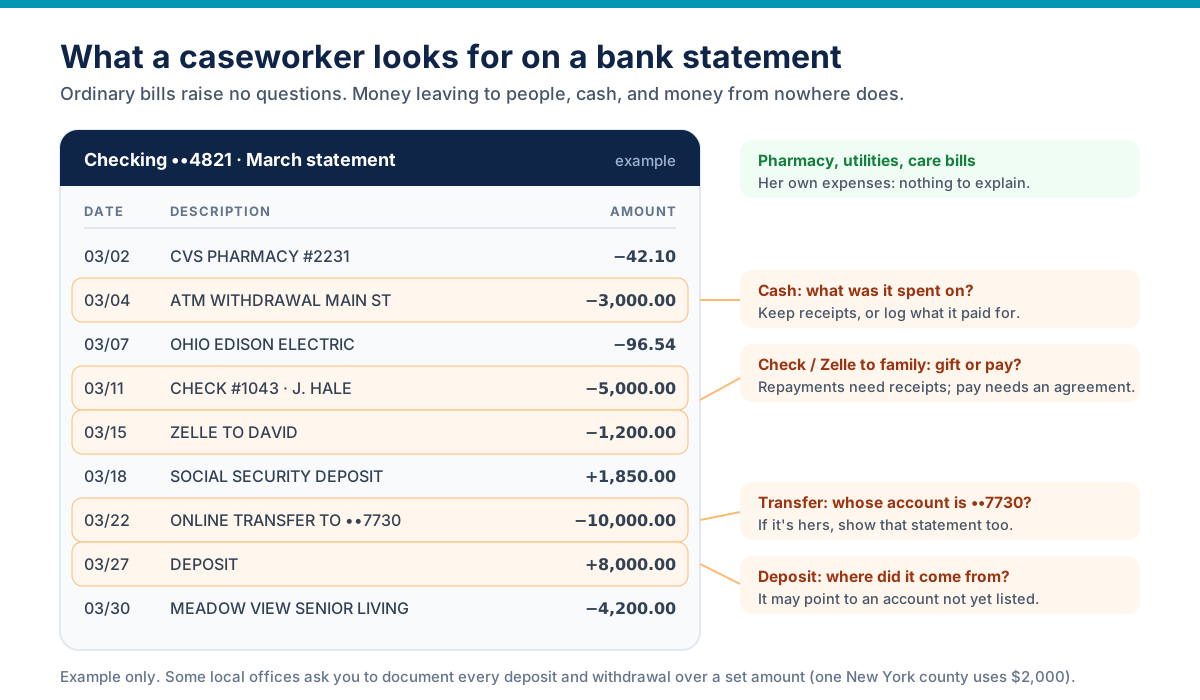
Ordinary spending on the person’s own life (groceries, utilities, medicine, the care bill) needs no explanation. Caseworkers stop on items like these:
- Cash withdrawals, especially large or regular ones
- Checks and app payments (Zelle, Venmo, PayPal) to people, above all to family members
- Transfers to other accounts. If the account belongs to the person, show its statements too; if not, explain who owns it and why
- Deposits from unknown sources, which may point to an account or an asset not yet listed
- Gaps: missing months, or an account that appears on a tax form but not on the application
Each of these can have a perfectly good explanation: cash that paid a home aide, a check that repaid a daughter for groceries she bought, a transfer into the person’s own savings. What matters is that you can show it.
How far back does Medicaid look at income?
For eligibility, Medicaid looks at the person’s current income: Social Security, pensions, annuity payments and the like, usually checked against recent award letters or deposits. Past income isn’t added up over five years.
Income still matters to the look-back in two ways. Income that came in and was then given away is a transfer like any other. And tax returns from earlier years can show interest or dividends from accounts that also need to be listed.
How far back does Medicaid look at assets?
Two different questions get asked about assets. Eligibility depends on what the person owns now, measured against the state’s asset limit. The look-back asks what they owned and gave away, or sold cheaply, in the previous 60 months.
Selling something at a fair price is not a problem, but the money from the sale has to be accounted for. If a parent sold a car for $8,000, the caseworker will want to see that $8,000 arrive in one of their accounts, or know what it paid for.
How to get statements from years ago
Online banking often shows only part of the history you need. The bank still has the records: under federal rules, banks have to keep most records for five years (31 CFR § 1010.430).
- 1
Download what you can first
Save every monthly statement available online as a PDF, and note which months are missing.
- 2
Request the missing months in writing
Give the account holder’s name, the last four digits of the account, and the exact months. If you are acting under a power of attorney, include a copy of it. Ask whether there is a fee.
- 3
Don’t forget closed accounts
The bank can still produce statements for an account closed in the last five years. If the bank merged or was bought, ask the bank that took it over.
- 4
Keep a record of each request
Note the date you asked and what you were told. If a statement never comes, that record shows the caseworker you tried.
Organizing five years of records
Five years of statements for three or four accounts can run to hundreds of pages. What helps is a checklist of every month for every account, a list of the items a caseworker will ask about, and a short explanation with proof for each one. For the rules behind all this, see our guide to the Medicaid look-back period.
An ElderlyDaily original
LookBack Ready: Medicaid Look-Back & POA Money Organizer
One-off purchase · Instant download · Desktop app · Windows & Mac · works offline
Frequently asked questions
Does Medicaid really check five years of bank statements?
For long-term care, the state can review any transfer in the 60 months before the application, and some offices ask for every statement from all five years. Others start with recent months and ask for more if something needs explaining. California reviews 30 months.
Does Medicaid look at my own bank account if I’m the parent’s caregiver?
The application covers accounts owned by the applicant and their spouse, including any joint account with a child. A child’s own separate accounts aren’t part of it, but money that moved from the parent into a child’s account will show up on the parent’s statements and may need explaining.
Do Zelle and Venmo payments count?
They show up on bank statements as money leaving the account, so a caseworker can ask about them like any check. Payments for the person’s own needs are fine; payments to family members need an explanation and proof.
What if I can’t get an old statement?
Ask the bank in writing and keep a record of the request. Explain the gap to the caseworker and offer other proof, such as year-end statements or tax forms. Don’t simply leave the account off.
Does Medicaid check bank accounts after approval?
Yes. Eligibility is reviewed again at renewal, usually once a year, and states can check accounts directly through their asset verification programs. Keep recording large transactions after approval too.
How far back does Medicaid look for a house sale?
Any sale or transfer of property in the 60 months before the application can be reviewed. Keep the closing statement, and show where the proceeds went.
Sources
- U.S. Code (Cornell LII). 42 U.S.C. § 1396p — transfers of assets: the look-back date, the penalty period and exempt transfers
- U.S. Code (Cornell LII). 42 U.S.C. § 1396w — the asset verification program every state runs for aged, blind and disabled applicants
- Oklahoma Human Services. Long-term care — the 60-month look-back and the statements needed for every account
- Erie County (NY) Department of Social Services. Medicaid long-term care eligibility — documents required, including 60 months of financial records
- California Department of Health Care Services. ACWDL 25-18 — transfers of assets for long-term care Medi-Cal (30-month look-back, from January 2026)
- Code of Federal Regulations (Cornell LII). 31 CFR § 1010.430 — financial institutions must keep required records for five years
