
What to Do When a Parent Dies: A Step-by-Step Checklist

Educational guidance for families in the US, not legal, tax or financial advice. Estate and probate rules vary by state; check with the probate court or an attorney where your parent lived.
In this guide
When a parent dies, the practical tasks arrive at the worst possible time. This checklist puts them in order: what has to happen in the first day or two, what can wait until next week, and what settling the estate usually involves, with links to the official US sources for each step.
Key takeaways
- First 48 hours: have the death pronounced, call the funeral home, secure the home, car and pets, and tell close family. Almost everything else can wait.
- The funeral home usually reports the death to Social Security, and that report also covers Medicare. If not, call 1-800-772-1213.
- Under the FTC Funeral Rule you can get prices by phone, a written price list, and buy only the items you want.
- Family members usually do not pay a parent’s debts from their own money; debts are paid from the estate, with a few exceptions.
- Telling one credit bureau is enough: it notifies the other two.
- The executor files the final income tax return, and the estate may need its own EIN and Form 1041.
Quick answer
What is the first thing to do when a parent dies?
First, make sure the death is legally pronounced: if hospice was caring for your parent, call the hospice team; if the death at home was sudden or unexpected, call 911. Then call a funeral home, tell close family, and secure the home, car and any pets. Bills, accounts and paperwork can wait a few days. The funeral home usually reports the death to Social Security, which also covers Medicare.

The first 24–48 hours
In the first day or two, only a handful of things truly need doing. Work through them in this order, and let everything else wait.
- 1
Have the death legally pronounced
If your parent died in a hospital or care home, staff will do this. If hospice was involved, call the hospice team first; they will guide what happens next. If the death at home was sudden or unexpected, call 911.
- 2
Call a funeral home
The funeral home can collect your parent once the death has been pronounced, and will explain the choices. You do not have to commit to anything on this first call.
- 3
Tell close family and friends
Make a short list of the people who should hear from you directly, and ask one person to help you phone the rest.
- 4
Secure the home, car and pets
Lock the house, collect keys, take in mail and post, check on any pets, and remove valuables or medicines that should not be left in an empty home.
- 5
Look for written wishes
Check for a will, prepaid funeral plan, burial or cremation wishes, or organ and body donation papers. Do not empty bank accounts or give away belongings yet.
If your family’s tradition calls for a quick burial
Some faiths and traditions call for burial within a day. Tell the hospital or hospice and the funeral home right away so they can plan around it.
Going further: the full organizer
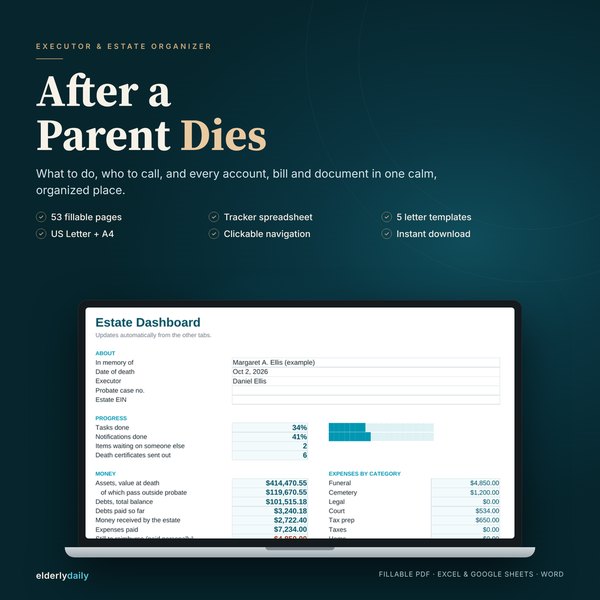
This page gives you the order of things. If you would like one place to keep it all, the After a Parent Dies: Executor & Estate Organizer is a 53-page fillable PDF that walks through these same steps, with a call script, a death certificate tracker and a page for every account, bill and document. It comes with an Estate Tracker spreadsheet that totals the money for you, and five letter templates for banks, creditors, a credit bureau, cancellations and an employer or pension plan.
Includes tracker + 5 letters
An ElderlyDaily original
Settling a parent’s estate?
After a Parent Dies: Executor & Estate Organizer
- A day-one page, a call script and a death certificate tracker
- Pages for every account, bill, document and payment, across 11 sections
- Estate Tracker spreadsheet: 64 tasks and 46 organizations listed, with totals
One-off purchase. Instant download.
Fillable PDF · 53 pages · US Letter + A4
One step at a time
Nothing beyond the first 48 hours needs to happen today. Most of what follows is paperwork that can wait a few days, and much of it can be shared with siblings or friends who ask how they can help.
The first week: funeral, death certificates and who to tell first
The funeral or memorial. Check for prepaid plans and written wishes first. Compare funeral homes if you can: by law they must give you prices on the phone (see your rights, below). If your parent was a veteran, ask about VA burial benefits, which can include burial in a VA national cemetery, a headstone or marker, and a burial allowance.
Death certificates. Many organizations ask for a certified copy of the death certificate. Ask the funeral home how to order copies, or find the vital records office for the state where your parent died through the CDC’s Where to Write for Vital Records. To decide how many, count the banks, insurers, pension plans and agencies on your list; some accept a photocopy, others insist on a certified copy.
Who to tell first:
- Social Security. The funeral home usually reports the death. If no funeral home is involved, call 1-800-772-1213. The same report covers Medicare.
- Your parent’s employer or pension plan, if they were still working or drawing a pension.
- Life insurance companies. If you are not sure a policy exists, the NAIC Life Insurance Policy Locator is a free search for policies and annuities.
- Their bank, so any payments that arrive after the death can be handled correctly (see below).
Payments after the death
Social Security does not pay benefits for the month a person dies. A payment for that month or later must be returned. If it came by direct deposit, tell the bank as soon as possible so it can send the money back. A surviving spouse may be eligible for a one-time $255 death payment; if there is no spouse, some children may be eligible.
If your parent died without a will
If there is no will, a court usually appoints someone, often called an administrator, to settle the estate. Who can be appointed, and who inherits, depends on the law of the state where your parent lived.
- Search carefully before deciding there is no will: desk drawers, a safe deposit box, files at home, and the offices of any attorney your parent used.
- Some property may pass outside the estate whether or not there is a will, such as accounts or policies with a named beneficiary or joint owner.
- Contact the probate court in the county where your parent lived to learn how the process starts there.
State rules differ
Probate and inheritance rules vary a great deal from state to state. If the estate includes a home, a business, debts larger than its assets, or a family disagreement, talk to a probate attorney before you act.
Notifying government, banks and accounts
USAGov keeps a list of agencies and organizations to notify after a death. Most will ask for your parent’s Social Security number and a copy of the death certificate. A checklist to work through:
- Government: Social Security and Medicare, the state motor vehicles office, the IRS, the passport office, state benefits, voter registration, and the VA if your parent was a veteran.
- Money: banks, credit card companies, investment and retirement accounts, and other financial companies.
- Credit bureaus: Equifax, Experian or TransUnion. Telling one is enough: it notifies the other two.
- Household: utilities, phone and internet, insurance, and memberships and subscriptions.
Send a copy of the death certificate, not the original, when you notify a credit bureau (Experian). Keep a simple log of who you called, the date, and what they asked for: it saves a lot of repeated calls.
Money owed to your parent may also be sitting with a state as unclaimed property. Unclaimed.org, run by the National Association of Unclaimed Property Administrators, links to every state’s free official search.
Your rights when arranging a funeral
The Federal Trade Commission’s Funeral Rule gives you clear rights when you deal with a funeral home:
- Funeral homes must give you prices by phone if you ask.
- You must get a written General Price List that you can keep.
- You can buy only the goods and services you want, and get an itemized statement of what you chose and what it costs.
- You can supply your own casket or urn, and the funeral home cannot charge a fee for handling it.
- No state law requires routine embalming for every death.
- No law requires a casket for cremation.
It is fine to ask a friend or relative who is less raw to make the price calls with you.
Debts: who pays?
According to the FTC, family members usually do not have to pay a deceased relative’s debts from their own money. Debts are paid from the estate, meaning what your parent owned. You may be personally responsible only if you:
- co-signed the debt with your parent;
- are the surviving spouse in a community property state, or in a state that requires spouses to pay certain debts; or
- were responsible for the estate and did not follow your state’s probate law.
If a debt collector contacts you about your parent’s debts, refer them to the person settling the estate.
Taxes the IRS describes
The person settling the estate is responsible for the tax returns. IRS Publication 559 is the IRS’s guide for survivors and executors. The main forms:
| Form | What it is for |
|---|---|
| Form 1040 or 1040-SR | Your parent’s final income tax return, for the year they died. It is due when their return would have been due had they lived. |
| Form 1310 | To claim a refund due to a deceased taxpayer, when it is needed. |
| Form 56 | Tells the IRS who the fiduciary is (the executor or administrator). File it once you have the information, including the EIN. |
| EIN | The estate needs its own employer identification number before an estate income tax return can be filed. |
| Form 1041 | The estate’s income tax return, required if the estate has $600 or more of gross income in a tax year, or a beneficiary who is a nonresident alien. |
Good to know
If your parent died before filing last year’s return, that return is still due as well. A tax professional can help when the estate has investments, a business or rental property.
Settling the estate as executor
Settling an estate usually takes months, not weeks. Here is a typical order of work. It is not a set of legal deadlines: your state, and the size of the estate, decide the real timetable.
- 1
Weeks 1–2
Funeral and death certificates. Find the will and key documents. Tell Social Security, banks and close contacts. Secure the home, car and valuables, and keep every receipt.
- 2
Month 1
Get legal authority to act from the probate court where needed. Apply for the estate’s EIN and open an estate bank account. Send notification letters and start a list of assets and debts.
- 3
Months 2–6
Value assets, search for life insurance with the NAIC locator and for unclaimed property. Pay valid debts and bills from the estate, cancel what is no longer needed, and deal with the home and belongings.
- 4
Months 6–12 and beyond
File the final income tax return and any estate returns. Pay final expenses, distribute what is left to the heirs, keep records of every payment, and close the estate with the court if your state requires it.
Caring for yourself
Grief and paperwork arrive together, and both are tiring. Spread the tasks out, say yes when people offer to help, and give each helper a specific job: making calls, sorting mail, collecting receipts.
- If you are also caring for a surviving parent, their own medical details, medicines and contacts matter now more than ever. The Aging Parent Medical & Emergency Binder keeps them in one place.
- If your surviving parent has recently been in hospital, our guides to what to expect after hospital discharge and recovery at home can help.
- Watch your own health too: see preventing caregiver burnout.
- For simple printable logs and checklists, browse our free printables for seniors and caregivers.
Frequently asked questions
What is the first thing to do when a parent dies?
Make sure the death is legally pronounced: call the hospice team if hospice was involved, or 911 if the death at home was sudden or unexpected. Then call a funeral home, tell close family, and secure the home, car and pets. Most other tasks can wait a few days.
Who do I need to notify when a parent dies?
Social Security (the funeral home usually reports the death, and it also covers Medicare), the state motor vehicles office, the IRS, the passport office, state benefits, voter registration, the VA if they were a veteran, banks, credit card companies, one credit bureau, utilities, insurance, and memberships and subscriptions. USAGov has a full list of agencies to notify.
Am I responsible for my parent’s debts?
Usually not. Under US law as the FTC describes it, family members do not usually have to pay a deceased relative’s debts from their own money; debts are paid from the estate. You may be responsible if you co-signed, if you are a surviving spouse in a community property state or a state that makes spouses pay certain debts, or if you were responsible for the estate and did not follow state probate law.
What happens if a parent dies without a will?
A court usually appoints an administrator to settle the estate, and state law decides who inherits. Accounts and policies with a named beneficiary or joint owner may pass outside the estate. The rules vary by state, so contact the probate court in the county where your parent lived.
How many death certificates do I need?
There is no set number. Count the organizations that will need proof of death: banks, insurers, pension plans, investment accounts, the motor vehicles office and so on. Some accept a photocopy, while others require a certified copy, so ask each one before ordering.
Do I need a lawyer to settle my parent’s estate?
Not always, but estate rules vary by state. A probate attorney is worth consulting if there is no will, the estate includes a home or business, debts may be larger than assets, or family members disagree. A tax professional can help with the final and estate tax returns.
Is there a printable checklist for what to do when someone dies?
This page works as a checklist you can follow step by step. If you want one place to keep everything, our After a Parent Dies organizer is a 53-page fillable PDF with checklists, a call script and pages for every account and bill, plus an Estate Tracker spreadsheet and five letter templates.
Sources
- Social Security Administration. What to do when someone dies — reporting a death and the one-time death payment
- USAGov. How to report a death to Social Security — Medicare, and returning payments for the month of death
- USAGov. Agencies to notify when someone dies
- USAGov. Death of a loved one — death certificates and next steps
- CDC / NCHS. Where to Write for Vital Records — death certificates by state
- Federal Trade Commission. The FTC Funeral Rule — your rights when arranging a funeral
- Federal Trade Commission. Debts and Deceased Relatives
- Experian. How to report the death of a relative to the credit bureaus
- IRS. File the final income tax returns of a deceased person
- IRS. Deceased taxpayers — filing the estate income tax return, Form 1041
- IRS. Instructions for Form 1041 — who must file
- IRS. Publication 559, Survivors, Executors, and Administrators
- U.S. Department of Veterans Affairs. Burials and memorials for Veterans
- NAIC. Life Insurance Policy Locator — free search for a deceased person’s policies and annuities
- NAUPA. Unclaimed.org — links to every state’s official unclaimed property search
