
Medicare Savings Programs: QMB, SLMB and QI Explained (2026 Limits)

Checked against Medicare.gov, Medicaid.gov and CMS 2026 figures, October 2026. Not legal advice.
If a parent’s income is too high for full Medicaid, their state may still pay their Medicare premiums. Here is what each program pays, the 2026 limits, and how to apply.
Key takeaways
- Medicare Savings Programs are run by state Medicaid programs and pay Medicare premiums, and with QMB, deductibles and copays too
- QMB: income up to $1,350 a month for one person in 2026. Pays Part A and B premiums, deductibles, coinsurance and copays
- SLMB (up to $1,616) and QI (up to $1,816) pay the Part B premium: $202.90 a month in 2026
- Federal resource limit: $9,950 for one person, $14,910 for a couple. Some states are more generous
- With QMB, Medicare providers aren’t allowed to bill your parent for Medicare deductibles, coinsurance or copays
- Members also get Extra Help with drugs, and the help isn’t subject to Medicaid estate recovery
Quick answer
What are QMB and SLMB?
QMB (Qualified Medicare Beneficiary) and SLMB (Specified Low-Income Medicare Beneficiary) are Medicare Savings Programs run by state Medicaid programs. QMB pays Medicare Part A and B premiums, deductibles, coinsurance and copays for people with income up to $1,350 a month (one person, 2026). SLMB pays the Part B premium for people with income up to $1,616 a month. Both have a federal resource limit of $9,950 for one person, though some states set higher limits or don’t count certain resources.
The four Medicare Savings Programs
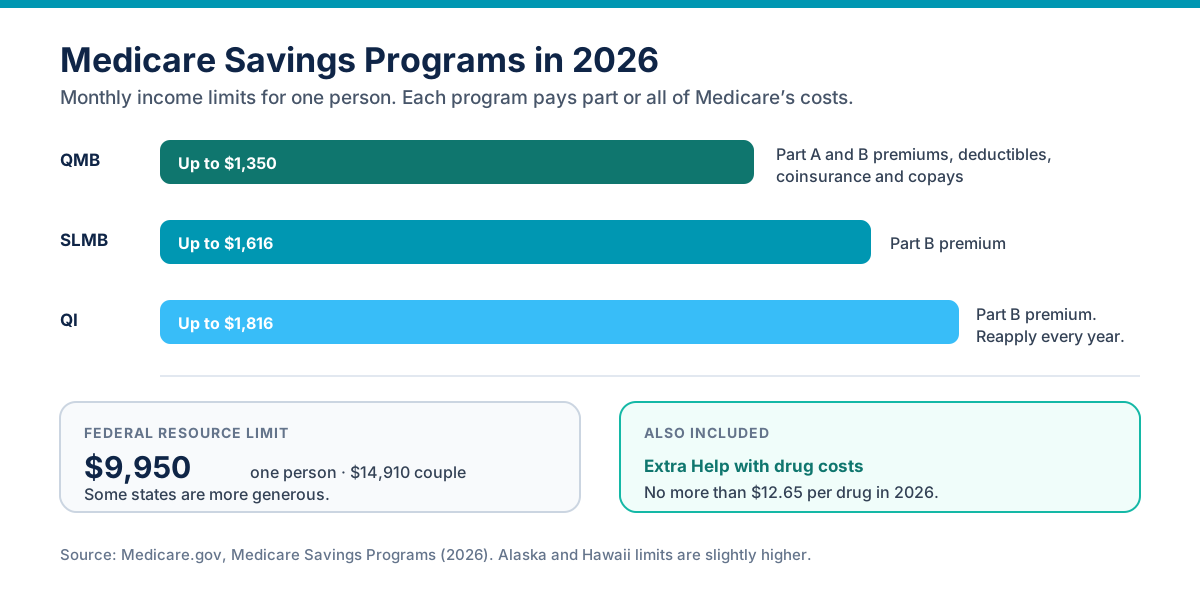
Medicare Savings Programs (MSPs) help pay Medicare costs for people with limited income and savings. You apply through your state, not through Medicare (Medicare.gov). For how the two programs fit together, see Medicare vs Medicaid.
| Program | What it pays | Monthly income limit (one person / couple) | Resource limit (one person / couple) |
|---|---|---|---|
| QMB | Part A premium (if your parent pays one), Part B premium, deductibles, coinsurance and copays | $1,350 / $1,824 | $9,950 / $14,910 |
| SLMB | Part B premium | $1,616 / $2,184 | $9,950 / $14,910 |
| QI | Part B premium | $1,816 / $2,455 | $9,950 / $14,910 |
| QDWI | Part A premium, for certain working people with disabilities under 65 | $5,405 / $7,299 | $4,000 / $6,000 |
An ElderlyDaily original
Getting a parent’s records ready for the look-back?
LookBack Ready: Medicaid Look-Back & POA Money Organizer
One-off purchase · Instant download · Desktop app · Windows & Mac · works offline
QMB: the most help
QMB pays the Part A premium for people who don’t get it free, the Part B premium, and Medicare’s deductibles, coinsurance and copays (Medicare.gov).
It also protects your parent from bills: Medicare providers aren’t allowed to bill a QMB member for services and items Medicare covers, including deductibles, coinsurance and copays. Your parent may still get a bill for a small Medicaid copayment, if one applies. Show both the Medicare card and the Medicaid or QMB card at every appointment.
Is QMB full Medicaid? Not on its own. CMS separates “QMB only”, which covers Medicare costs, from “QMB plus”, which is QMB together with full Medicaid benefits (CMS). The same split applies to SLMB.
SLMB and QI: help with the Part B premium
SLMB and QI both pay the Part B premium, which is $202.90 a month in 2026 (Medicare.gov), or about $2,435 a year.
- SLMB is for income up to $1,616 a month for one person
- QI is for income up to $1,816. Your parent must reapply every year, places are first-come, first-served with priority for last year’s members, and it is only for people who don’t qualify for other Medicaid
QMB, SLMB and QI members also get Extra Help with prescription drug costs, paying no more than $12.65 per drug in 2026.
What counts toward the limits
The federal resource limit is $9,950 for one person and $14,910 for a couple in 2026 (CMS). Resources are things like bank accounts, stocks and bonds. Under the SSI rules that MSPs build on, the home, one car, household goods and small burial funds don’t count (SSA).
States can be more generous: some don’t count certain types or amounts of income or resources, so a parent can qualify even above the federal limits. Medicare’s own advice is to apply even if you don’t think you qualify.
MSP help is also protected after death: Medicaid estate recovery can never include help with Medicare premiums and cost-sharing. See Medicaid estate recovery.
How to apply
If your parent is also heading toward long-term care, see long-term care Medicaid eligibility.
- 1
Gather the paperwork
The Medicare card, ID, proof of income (Social Security and pension award letters) and recent statements for every bank and investment account.
- 2
Apply through the state Medicaid office
MSPs are run by states, so the application goes to the state or county Medicaid office, not to Medicare. Many states take applications online.
- 3
Apply even if it looks close
States can disregard some income and resources, so a parent slightly over the federal limits may still qualify.
- 4
Check the premium stops
Once approved, the state pays the Part B premium, so it should stop being taken from your parent’s Social Security payment.
- 5
Renew on time
QI must be renewed every year. For QMB and SLMB, watch for the state’s renewal notices.
Frequently asked questions
Is QMB the same as Medicaid?
QMB is run by state Medicaid programs, but on its own it only pays Medicare costs. CMS calls that QMB only. People who have QMB together with full Medicaid benefits are QMB plus.
Is a Medicare Savings Program the same as Medicaid?
MSPs are run by state Medicaid programs, but they only help with Medicare costs: premiums, and with QMB, deductibles and copays. Full Medicaid covers much more, including long-term care.
What does SLMB cover?
SLMB pays the Medicare Part B premium, $202.90 a month in 2026. It doesn’t pay deductibles or copays.
Does QMB pay for prescriptions?
Not directly, but QMB, SLMB and QI members get Extra Help with drug costs, paying no more than $12.65 per drug in 2026.
Can a doctor bill me if I have QMB?
Medicare providers aren’t allowed to bill a QMB member for Medicare deductibles, coinsurance or copays. You may still get a bill for a small Medicaid copayment, if one applies.
Will Medicaid take back Medicare Savings Program payments after death?
No. Help with Medicare premiums and cost-sharing through a Medicare Savings Program isn’t subject to Medicaid estate recovery.
Sources
- Medicare.gov. Medicare Savings Programs — QMB, SLMB, QI and QDWI, 2026 limits
- CMS. Informational Bulletin, December 9, 2025 — 2026 SSI, spousal impoverishment and home equity standards ($752,000 to $1,130,000)
- CMS. Medicare–Medicaid dual eligibility categories (QMB only, QMB plus, SLMB, QI, QDWI)
- Medicare.gov. Medicare costs — 2026 Part A and Part B premiums and deductibles
- Social Security Administration. Understanding SSI — resources: what counts and what doesn’t
- Medicaid.gov. Estate recovery — who states must recover from, liens, and hardship waivers
