
Medicaid Waiver Payments: What They Are and Whether They’re Taxable (2026)

Checked against IRS guidance (Notice 2014-7 questions and answers, Publications 926 and 590-A) and state Medicaid sources, October 2026. Not tax or legal advice.
If you are paid to care for a parent through a Medicaid waiver program, that pay may be tax-free. Here is what counts, the one condition that decides it, and how to report it.
Key takeaways
- Medicaid waiver payments are what a Medicaid home care program pays a caregiver, often a family member, for care given through a waiver
- Under IRS Notice 2014-7 they can be excluded from income, as difficulty-of-care payments, when the person you care for lives with you, in your home
- Being related doesn’t matter: a son or daughter caring for a parent qualifies the same as anyone else
- Care given in a home you only visit doesn’t qualify, so that pay is taxable
- You can choose to count all of the payments as earned income for the earned income tax credit and the additional child tax credit
- Social Security and Medicare taxes depend on whether you are an employee. Workers paid through an agency generally pay them
Quick answer
Are Medicaid waiver payments taxable?
Not always. Under IRS Notice 2014-7, Medicaid waiver payments to a caregiver for the care of an eligible person who lives in the caregiver’s home are treated as difficulty-of-care payments and can be excluded from federal income. That applies to family members too. If the person you care for doesn’t live with you, the payments are taxable. You can choose to include excluded payments in earned income for the earned income tax credit.
What Medicaid waiver payments are
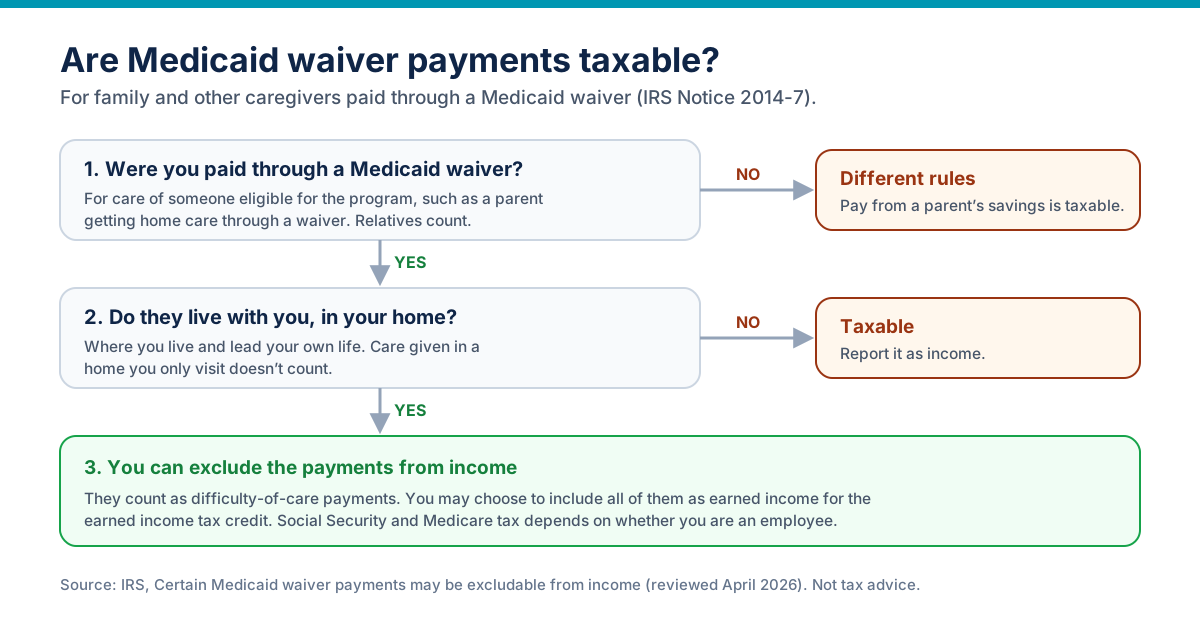
Most states let people who get home care through a Medicaid waiver hire their own caregiver, often a family member. The pay for that care, sent by the state, an agency or a payroll agent, is what the IRS calls a Medicaid waiver payment.
Since 2014 the IRS has treated these payments as difficulty-of-care payments, which are excluded from gross income, when they are paid for the care of an eligible person who lives in the caregiver’s home (IRS).
An ElderlyDaily original
Getting a parent’s records ready for the look-back?
LookBack Ready: Medicaid Look-Back & POA Money Organizer
One-off purchase · Instant download · Desktop app · Windows & Mac · works offline
The rule: tax-free if they live with you
- Relatives qualify. The IRS’s own example is a caregiver looking after their mother
- Your home is where you live and carry out the routines of your private life. It can be the other person’s home too, as long as it is also where you live
- A separate home doesn’t qualify. If you have your own home, where you live and keep your family routines, pay for care in someone else’s home is taxable
- More than one caregiver living in the home can each exclude their payments
Payments from other kinds of state Medicaid programs may also qualify, depending on how the program is designed, so ask the program or a tax professional.
| Situation | Federal income tax |
|---|---|
| Maria’s father lives with her. She is paid through his Medicaid waiver to help him bathe, dress and take his medicines. | Can be excluded: he lives in her home |
| James lives across town and visits his mother every day. He is paid through her waiver for the same kind of help. | Taxable: she doesn’t live in his home |
| Two sisters live with their mother in her house, and both are paid caregivers through her waiver. | Can be excluded by both: it is their home too |
How to report it
- On a W-2. Excludable payments may be shown in box 12 with code II. If they are included in box 1 instead, you subtract the excluded amount on Schedule 1 (Form 1040), line 8s (IRS)
- Working through an agency. The agency can rely on a written statement from you, signed under penalties of perjury, that the payments qualify
- Earned income credit. You may choose to include all (not part) of the excluded payments in earned income for the earned income tax credit and the additional child tax credit, if that gives you a bigger credit
- Social Security and Medicare. These depend on whether you are an employee. Workers paid through an agency are generally subject to them
- Retirement savings. You can elect to use excluded difficulty-of-care payments to make nondeductible IRA contributions (IRS Publication 590-A)
This is federal tax. State income tax rules can differ, so check your state’s too.
Not tax advice
Use this to know what to ask, then confirm with a tax professional or a free IRS Volunteer Income Tax Assistance (VITA) site.
If your parent pays you from their own money
Pay from a parent’s own savings isn’t a Medicaid waiver payment, so it is generally taxable income. If you count as their household employee and they pay you $3,000 or more in 2026, they generally owe Social Security and Medicare taxes on your wages (IRS Publication 926).
And if your parent may need Medicaid long-term care in the next five years, pay without a written agreement can be treated as a gift. See how Medicaid can pay a family caregiver.
An ElderlyDaily original
LookBack Ready: Medicaid Look-Back & POA Money Organizer
One-off purchase · Instant download · Desktop app · Windows & Mac · works offline
Frequently asked questions
What is a Medicaid waiver payment?
It is pay from a Medicaid home and community-based services waiver program to a caregiver, often a family member, for care given to someone enrolled in the program.
Do I have to report Medicaid waiver payments on my tax return?
If the payments qualify, you can exclude them from income. If your W-2 includes them in box 1, the IRS says to report the wages and then subtract the excluded amount on Schedule 1 (Form 1040), line 8s.
Does it matter if I am related to the person I care for?
No. Family caregivers qualify the same as anyone else, as long as the person lives in your home.
What if I live in my parent’s home instead of them living in mine?
It can still qualify if it is also your home: the place where you live and lead your private life. If you keep a separate home and only go to your parent’s to give care, the pay doesn’t qualify.
Can I still get the earned income tax credit?
Yes. You may choose to include all of the excluded payments in earned income for the earned income tax credit and the additional child tax credit.
Are Medicaid waiver payments subject to Social Security tax?
It depends on whether you are an employee. Caregivers paid through an agency are generally subject to Social Security and Medicare taxes.
Sources
- IRS. Certain Medicaid waiver payments may be excludable from income (Notice 2014-7 questions and answers)
- IRS. Publication 590-A, Contributions to IRAs — difficulty of care payments
- IRS. Publication 926 (2026), Household Employer’s Tax Guide
- KFF (January 2025). How do Medicaid home care programs support family caregivers?
