
Convalescent Home: What It Is, What Medicare Pays and How to Choose One (2026)

Medicare rules and 2026 amounts checked against Medicare.gov and CMS, October 2026. Not medical advice.
When a hospital says your parent isn’t ready to go home, the next stop is often what an older generation called a convalescent home. The name has changed, and so have the rules about who pays. Here is what it means today, and how to make the stay count.
Key takeaways
- A convalescent home is an older name for a place to recover after illness or surgery. Today it usually means the short-term rehab unit of a skilled nursing facility (a nursing home)
- Medicare covers up to 100 days of skilled nursing or rehab per benefit period, but only after a hospital stay of 3 days as an inpatient. Time under observation doesn’t count
- In 2026, days 1–20 cost $0; days 21–100 cost $217 a day; after day 100, your parent pays everything
- Someone who can manage 3 hours of therapy a day, 5 days a week may qualify for an inpatient rehabilitation facility instead, which is more intensive
- You can choose the facility. Check inspection and staffing data on Medicare’s Care Compare before you agree
- Medicare must give 2 days’ notice before covered care ends, and your parent can ask for a fast appeal
Quick answer
What is a convalescent home?
A convalescent home is a facility where people recover after a hospital stay, illness or surgery, with nursing care and therapy until they are strong enough to go home. The term is old-fashioned; today the same care is usually given in the short-term rehabilitation unit of a skilled nursing facility (nursing home), sometimes called subacute rehab. Medicare can cover up to 100 days after a qualifying 3-day inpatient hospital stay, with a $217 daily coinsurance from day 21 in 2026.
What “convalescent home” means today
Convalescence just means recovering. For most of the last century, a convalescent home was where people went to get their strength back after hospital. The name survives on some buildings and in everyday speech, but the facilities themselves are now licensed and paid for under other names:
- Skilled nursing facility (SNF): the most common meaning. A nursing home, or a wing of one, that provides daily nursing and therapy after a hospital stay. Families often hear it called “rehab” or “subacute care”
- Nursing home: the same building may also house long-term residents. A short rehab stay and a long-term stay are paid for very differently
- Recovery care at home: some families use the phrase for convalescent care at home, with home health nurses and therapists visiting
So if a discharge planner says your parent should go to a convalescent home, or rehab, or a SNF, ask exactly which kind of facility, and whether the stay is expected to be short-term.
An ElderlyDaily original
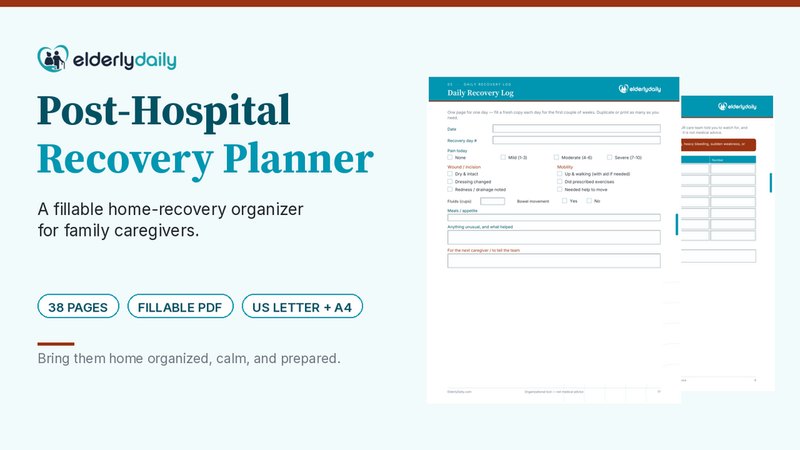
Bringing someone home from the hospital?
Post-Hospital Recovery Planner
- Discharge snapshot: care team, who to call and when, insurance and documents
- Medication reconciliation, a master list, a daily record and refills
- Daily recovery log, vitals log, and a symptom and pain log
One-time purchase · Instant download · Fillable PDF · 38 pages · US Letter + A4
The places a parent can recover after hospital
The hospital’s team recommends a setting based on how much medical care and therapy your parent needs, and how much therapy they can tolerate.
| Skilled nursing facility (rehab) | Inpatient rehabilitation facility | Home health care | |
|---|---|---|---|
| Who it suits | Needs daily nursing or therapy but can’t yet handle intensive rehab | Can take part in intensive therapy and is expected to improve measurably | Stable enough to be at home, and mostly unable to leave it |
| Therapy | Less intensive; the amount is set by each patient’s care plan | Generally 3 hours a day, at least 5 days a week, from more than one kind of therapist | Visits a few times a week |
| Doctor involvement | A physician oversees the care plan | A rehabilitation physician sees the patient at least 3 days a week | Ordered and reviewed by a doctor |
| Medicare entry rule | 3-day inpatient hospital stay first | A doctor certifies the need for intensive rehab | Homebound and needing skilled care |
| What your parent pays (2026) | $0 days 1–20; $217 a day days 21–100 | Treated like a hospital stay: the $1,736 Part A deductible per benefit period, then $0 to day 60 | Usually $0 for covered home health services |
Ask about an inpatient rehab facility
After a stroke, a hip fracture or a joint replacement, ask the hospital team whether your parent could manage an inpatient rehabilitation facility. Its rules require far more therapy each day (CMS), and for the right patient that can mean a faster recovery.
What Medicare pays for a convalescent stay
Medicare Part A covers a skilled nursing facility stay only when all of these are true (Medicare.gov):
- Your parent was an inpatient in hospital for at least 3 days in a row, not counting the day of discharge. Time in the emergency room or under observation doesn’t count, even overnight
- They go into a Medicare-certified skilled nursing facility, generally within 30 days of leaving hospital
- A doctor decides they need daily skilled nursing or therapy, for a condition treated in hospital or one that started during the rehab stay
In 2026 your parent pays nothing for days 1 to 20, $217 a day for days 21 to 100, and all costs from day 101 in each benefit period (CMS). The stay covers a semi-private room, meals, nursing, therapy, medicines and supplies. A Medigap policy may pay the daily coinsurance.
Medicare Advantage plans set their own rules: many waive the 3-day hospital requirement, but may require prior approval and use their own network of facilities. Call the plan before you choose.
Our skilled nursing guide explains the observation-status trap in more detail. Ask the hospital, in writing if possible: “Is my parent an inpatient, or under observation?”
Your parent doesn’t have to be improving
Medicare coverage of skilled care depends on whether your parent needs skilled care, not on whether they are still getting better. Under the Jimmo settlement, CMS confirmed that skilled therapy or nursing to maintain someone’s condition, or slow their decline, can be covered (CMS). If a facility says “no progress, so Medicare stops”, ask which skilled need has ended.
How to choose a convalescent home
Hospitals usually hand families a list of facilities with beds available, often with very little time to decide. Your parent has the right to choose among facilities that accept them. Use the time you have well:
- Look each one up on Medicare’s Care Compare: inspection results, nurse staffing, and short-stay measures such as how many patients return home or go back to hospital
- Ask how many hours of therapy a day your parent will get, and whether therapy happens at weekends
- Ask who the doctor is, and how often they see rehab patients
- Ask about falls, infection control and how call bells are answered at night
- If you can, visit at a mealtime, or ask someone who lives nearby to look in
- Check the facility takes your parent’s insurance, especially with a Medicare Advantage plan
If the first choice has no bed, ask the hospital to keep your parent on its waiting list and to tell you the moment one opens.
Making the stay count
The first days set the plan. Federal rules require the facility to write a baseline care plan within 48 hours of admission, and a full care plan within 7 days of completing its assessment, with the resident and their representative taking part as far as practicable (42 CFR § 483.21). Ask when the care plan meeting is, and go.
What to bring:
- Comfortable clothes that are easy to put on, and non-slip shoes for therapy
- Glasses, hearing aids and dentures, labeled with your parent’s name, plus chargers and spare batteries
- A list of medicines, allergies, doctors and diagnoses, and copies of insurance cards
- The power of attorney and health care proxy documents, if they exist
- A phone and a long charging cable, and a few familiar things from home
Visit often, at different times, and ask therapists what your parent can do now that they couldn’t last week. Those answers shape the discharge date and what you need at home.
When Medicare coverage ends, and how to appeal
Before Medicare-covered care ends, the facility must give your parent a Notice of Medicare Non-Coverage at least two days in advance. If you disagree, request a fast appeal from the independent reviewer named on the notice (the BFCC-QIO) by noon on the day before the date care is due to end (Medicare.gov).
If skilled care ends but your parent still can’t manage at home, they can stay as a private-pay resident, or move to assisted living or long-term nursing home care. That is a different decision with different costs: see assisted living vs. nursing home, and the Medicaid look-back if Medicaid may be needed.
Planning the way home
Discharge planning should start in the first week, not the last day. Ask the team for:
- The discharge date they are working toward, and what your parent needs to be able to do first
- Orders for home health nursing or therapy, and the agency’s name
- Equipment, such as a walker, shower chair or raised toilet seat, delivered before the day
- A written medication list, with what changed since hospital
- Follow-up appointments, and who to call with a problem in the first week
The first weeks home are when readmissions happen. Our guides to what to expect after discharge, setting up the home and recovery at home cover them step by step.
An ElderlyDaily original
Post-Hospital Recovery Planner
$19One-time purchase · Instant download · Fillable PDF · 38 pages · US Letter + A4
Frequently asked questions
What is the difference between a convalescent home and a nursing home?
Today they are often the same building. “Convalescent home” describes the purpose, recovering after hospital, and that care is usually given in a nursing home’s short-term rehab unit. A nursing home also provides long-term care for people who live there, which Medicare doesn’t cover.
How long can you stay in a convalescent home?
As long as needed, but Medicare covers at most 100 days per benefit period, and only while daily skilled care is needed. Many rehab stays last a few weeks. After coverage ends, a person can stay and pay privately, or use Medicaid if they qualify.
Does Medicare pay for a convalescent home?
Medicare Part A pays for short-term skilled nursing or rehab after a hospital stay of at least 3 days as an inpatient: $0 for days 1–20 and $217 a day for days 21–100 in 2026. It doesn’t pay for long-term custodial care.
What is subacute rehab?
Subacute rehab is short-term nursing and therapy after a hospital stay, given in a skilled nursing facility. It is less intensive than an inpatient rehabilitation facility, which generally requires about 3 hours of therapy a day.
Can my parent choose which rehab facility to go to?
Yes. Hospitals give a list of facilities, but the patient chooses among those that accept them and have a bed. Medicare Advantage members may be limited to the plan’s network.
What if my parent was under observation, not admitted?
Then the hospital time doesn’t count toward the 3-day requirement, and Original Medicare won’t pay for the rehab stay. Ask the hospital about status early, and check whether a Medicare Advantage plan waives the 3-day rule.
Sources
- Medicare.gov. Skilled Nursing Facility (SNF) Care Coverage
- CMS. MLN MM14279 — 2026 Medicare deductible and coinsurance amounts, including the $217 SNF daily coinsurance
- Medicare.gov. Inpatient rehabilitation care — what Part A covers and 2026 costs
- CMS (MLN compliance tips). Inpatient rehabilitation facilities — 3 hours of therapy a day, 5 days a week, and other admission criteria
- CMS. Jimmo v. Sebelius settlement — skilled care to maintain a condition, not only to improve it, can be covered
- Medicare.gov. Care Compare — nursing home inspections, staffing and quality measures
- Code of Federal Regulations (Cornell LII). 42 CFR § 483.21 — baseline care plan within 48 hours; comprehensive care plan; resident participation
- Medicare.gov. Fast appeals — the Notice of Medicare Non-Coverage and the BFCC-QIO deadline
