
Assisted Living vs. Nursing Home: Care, Cost and Who Pays (2026)

Costs from the CareScout Cost of Care Survey 2025; Medicare and Medicaid rules from CMS and federal regulations, checked October 2026. Not medical or legal advice.
In this guide
- Assisted living vs. nursing home at a glance
- The real difference: how much medical care there is
- Cost: assisted living vs. nursing home
- Who pays: Medicare, Medicaid and private pay
- How to tell which one your parent needs
- Moving between them: rehab stays and changing needs
- How to check quality before you choose
- Where memory care fits
- FAQs
Both are places a parent can live with help around the clock, so families often compare them on price. The real difference is medical: a nursing home provides licensed nursing care every day, and assisted living mostly doesn’t. That one difference drives the cost, the rules and who pays.
Key takeaways
- Assisted living is housing with personal care: help with bathing, dressing, medications and meals, for someone who doesn’t need daily nursing
- A nursing home provides 24-hour nursing care. Federal rules require licensed nurses around the clock and a registered nurse on site at least 8 consecutive hours a day, 7 days a week
- 2025 national medians: assisted living $6,200 a month; a nursing home $315 a day semi-private (about $9,580 a month) or $355 a day private (CareScout)
- Medicare pays for neither as long-term care. It covers a short skilled nursing stay after a 3-day hospital admission, with a $217 daily coinsurance from day 21 in 2026
- Medicaid must cover nursing home care in every state. For assisted living it can pay for the care, through state programs, but not the rent
- The deciding question: does your parent need skilled nursing every day, or help and supervision with daily life?
Quick answer
What is the difference between assisted living and a nursing home?
Assisted living is a residential community that gives help with daily activities such as bathing, dressing, medications and meals, for people who don’t need ongoing medical care. A nursing home (also called a skilled nursing facility) provides 24-hour nursing care and supervision for people with serious health needs, under federal rules. Nursing homes cost more: in 2025 the US median was $6,200 a month for assisted living and $315 a day for a semi-private nursing home room. Medicare covers neither for long-term care, while Medicaid covers nursing home care for people who qualify.
Assisted living vs. nursing home at a glance
The names overlap in everyday speech, but in law and in the bill they are different things.
| Assisted living | Nursing home | |
|---|---|---|
| Who it suits | Needs help with some daily activities and some supervision, but is medically stable | Needs daily skilled nursing, rehabilitation or round-the-clock supervision for complex health needs |
| Care provided | Personal care, medication help, meals, housekeeping, activities | Everything assisted living offers, plus nursing, wound care, IV medicines, therapy and medical monitoring |
| Nursing staff | Varies by state; often no nurse on site at night | Licensed nurses 24 hours a day; a registered nurse at least 8 hours a day, every day |
| Living space | Private apartment or studio, often with a kitchenette | Usually a shared (semi-private) or private room |
| Median cost (2025) | $6,200 a month ($74,400 a year) | $315 a day semi-private ($114,975 a year); $355 a day private ($129,575 a year) |
| Medicare | Doesn’t pay | Up to 100 days of skilled care after a qualifying hospital stay; not long-term care |
| Medicaid | May pay for care services through a state program; doesn’t pay room and board | Covers nursing home care in every state for people who qualify |
| Rules and inspections | Licensed and inspected by the state; no federal standards | Federal standards; inspected, with results on Medicare’s Care Compare |
An ElderlyDaily original
Touring places for a parent?
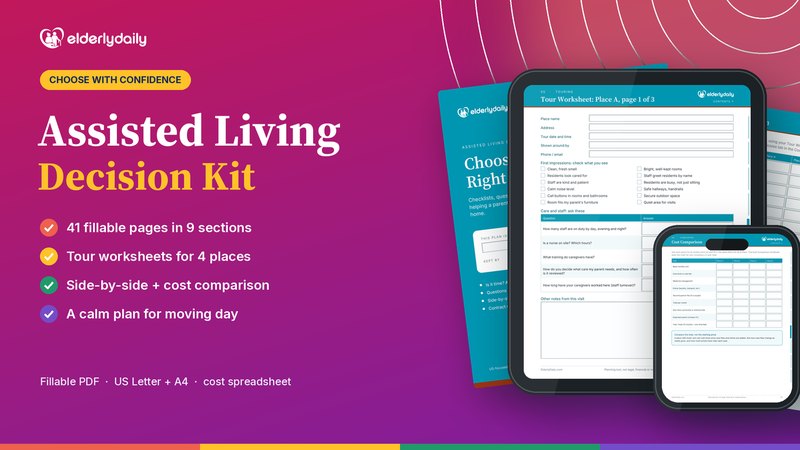
Assisted Living Decision Kit
- Every question in this guide, as Tour Worksheets for up to four places
- Side-by-side comparison of quality and the real monthly cost
- Cost spreadsheet: monthly totals, a 3-year projection and your budget gap
One-time purchase · Instant download · Fillable PDF · 41 pages · US Letter + A4
The real difference: how much medical care there is
A nursing home is a medical setting. Facilities that take Medicare or Medicaid have to meet federal requirements. Among them: enough licensed nurses on duty 24 hours a day, a registered nurse on site for at least 8 consecutive hours a day, 7 days a week, and a full-time registered nurse as director of nursing (42 CFR § 483.35). Residents have a care plan and a physician overseeing their care. This is the setting for someone who needs wound care, injections or IV medicines, help with feeding or breathing equipment, or two people to move them safely.
Assisted living is a housing setting with help. Staff help with the activities of daily living, such as bathing, dressing, using the toilet and taking medications, and provide meals, laundry and activities. There is no federal standard for assisted living. Each state licenses it and sets its own rules on staffing, training and which health needs a community may accept (HHS/ASPE compendium of state regulations). Some states allow assisted living to provide quite a lot of care. Others require a resident to move once they need nursing care regularly.
That is why the right question is not “which is nicer?” but “what care does my parent need on an ordinary day, and at 3 a.m.?” If the honest answer includes skilled nursing, assisted living usually isn’t allowed to provide it, however good the community is.
Not sure which level fits?
Our free care needs assessment asks about everyday abilities and points to a level of care, from help at home to skilled nursing. Take it before you start touring.
Cost: assisted living vs. nursing home
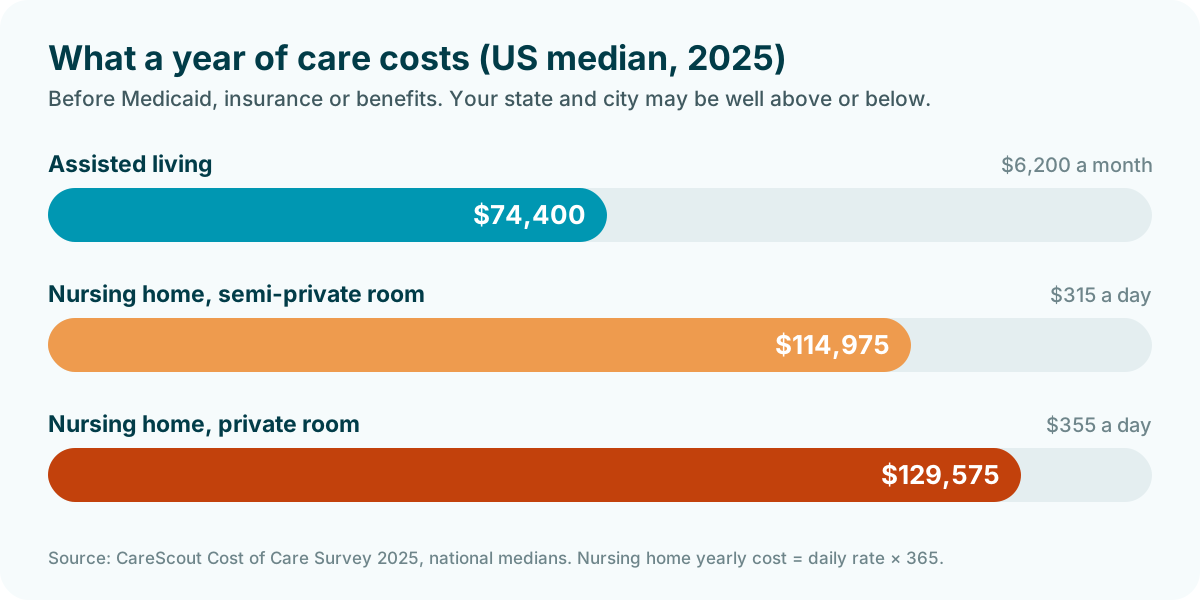
The CareScout Cost of Care Survey is the most widely used source of US long-term care prices. Its 2025 national medians:
- Assisted living: $6,200 a month, or $74,400 a year, up 5% on the previous year
- Nursing home, semi-private room: $315 a day, or $114,975 a year (about $9,580 a month), up 2%
- Nursing home, private room: $355 a day, or $129,575 a year (about $10,800 a month), up 1%
So a nursing home costs roughly 55% to 75% more than assisted living at the national median. But the gap in your area may be very different: prices vary widely by state and by city. Our senior care cost calculator shows the state medians side by side.
Compare like with like. An assisted living price is often a base rate for rent and meals, with care-level fees added as needs grow, while a nursing home’s daily rate includes nursing care. Ask every assisted living community for its full price at your parent’s current level of care, and what it would be one level up.
A cheaper bill can become a move
If your parent’s needs are close to the edge of what assisted living may provide, a lower monthly price can be short-lived: a second move a few months later is hard on someone frail, and on the family. Ask the community in writing which needs would require a move.
Who pays: Medicare, Medicaid and private pay
Medicare does not pay for long-term care in either setting. It doesn’t cover assisted living at all. For a nursing home, Part A covers short-term skilled nursing or rehabilitation after a hospital stay of at least three days as an inpatient, for up to 100 days in a benefit period (Medicare.gov). Days 1 to 20 cost nothing; days 21 to 100 cost $217 a day in 2026 (CMS). After that, or once skilled care is no longer needed, the family pays.
Medicaid is the main payer for long-term nursing home care. Nursing facility services are a mandatory Medicaid benefit, so every state covers them for people who meet its financial and medical rules (Medicaid.gov). For assisted living, many states pay for the care through a home and community-based services program, often a Medicaid waiver, but not for rent and food, and waiver places can have waiting lists.
Private pay covers most assisted living, and the first months of many nursing home stays. Long-term care insurance, veterans’ benefits and the proceeds from selling a home are the other common sources. Families planning to rely on Medicaid later should read about eligibility and asset limits and the 5-year look-back before moving money.
How to tell which one your parent needs
Assisted living is usually the better fit when your parent:
- Needs help with a few daily activities, such as bathing, dressing or medications
- Can move around, with a walker or wheelchair if needed, and transfer with little help
- Is medically stable, without daily nursing tasks
- Would benefit from company, meals and activities
- Can call for help and follow a safety plan
A nursing home is usually the better fit when your parent:
- Needs skilled nursing every day, such as wound care, injections or tube feeding
- Needs two people, or a mechanical lift, to move safely
- Has health problems that change quickly and need monitoring
- Is recovering from a hospital stay and needs daily therapy (often a short stay)
- Has dementia with needs beyond what a memory care unit can safely manage
Ask your parent’s doctor, and the hospital discharge planner if they are in hospital, what level of care they recommend, and why. Our guide to signs a parent may need assisted living walks through the everyday warning signs.
Moving between them: rehab stays and changing needs
Many families meet a nursing home first as a short rehab stay: after a hospital admission for a fall, a stroke or surgery, a parent spends a few weeks in a skilled nursing facility, often called a rehab center or convalescent home, then goes home or to assisted living. Our skilled nursing guide explains what Medicare covers during that stay.
The opposite move is also common. As needs grow, an assisted living resident may need a nursing home. Some communities, including continuing care retirement communities, offer assisted living and nursing care on one campus, which can make that move easier. Ask how transfers work and who decides.
How to check quality before you choose
For nursing homes, start with Medicare’s Care Compare, which publishes inspection results, staffing levels and quality measures for every Medicare- and Medicaid-certified facility. Read the inspection reports themselves, not just the summary.
For assisted living, there is no national database. Ask your state’s licensing agency for the community’s inspection reports and any complaints, and ask the community directly.
In both cases, visit more than once, including at a mealtime or in the evening, and use the same questions everywhere so you can compare. Our questions to ask when touring assisted living cover staffing, costs, contracts and the move-out rules.
An ElderlyDaily original
Assisted Living Decision Kit
$19One-time purchase · Instant download · Fillable PDF · 41 pages · US Letter + A4
Where memory care fits
Memory care for people with dementia is offered in both settings: as secure units inside assisted living communities, and as dementia units in nursing homes. The choice follows the same rule. If the person mainly needs supervision, structure and help with daily care, assisted living memory care often fits. If they also need daily nursing, a nursing home unit does. See memory care costs and options.
Frequently asked questions
Is assisted living cheaper than a nursing home?
Usually. In 2025 the US median was $6,200 a month for assisted living and $315 a day (about $9,580 a month) for a semi-private nursing home room, according to CareScout. Assisted living care fees can rise with needs, so compare the full monthly price at your parent’s level of care.
What is the difference between skilled nursing and assisted living?
Skilled nursing means care that has to be given or supervised by licensed nurses or therapists, such as wound care, injections or physical therapy. Nursing homes, also called skilled nursing facilities, provide it every day. Assisted living provides personal care and supervision but not ongoing skilled nursing.
Does Medicare pay for assisted living or a nursing home?
Medicare doesn’t pay for assisted living, or for long-term custodial care in a nursing home. It covers up to 100 days of skilled nursing or rehab after a hospital stay of at least three inpatient days, with a $217 daily coinsurance from day 21 in 2026.
Does Medicaid pay for assisted living?
It can pay for the care part, in many states, through a home and community-based services program or waiver. It doesn’t pay for room and board. Nursing home care, by contrast, is covered by Medicaid in every state for people who qualify.
Is a nursing home the same as a skilled nursing facility?
Mostly. “Skilled nursing facility” is Medicare’s term and “nursing facility” is Medicaid’s; many nursing homes are certified as both. Some people use “skilled nursing” for short rehab stays and “nursing home” for long-term care, but they are often the same building.
Can someone move from assisted living to a nursing home?
Yes, and it is common when needs grow beyond what the state allows assisted living to provide. Ask the community which needs would require a move and how much notice it gives.
What is a convalescent home?
An older term for a facility where people recover after illness or surgery. Today it usually means a nursing home or skilled nursing facility, especially for a short rehab stay after a hospital admission.
Sources
- CareScout (Genworth). Cost of Care Survey 2025 — national medians for assisted living, nursing homes and home care
- Code of Federal Regulations (Cornell LII). 42 CFR § 483.35 — nursing services: licensed nurses 24 hours a day, an RN 8 consecutive hours a day, 7 days a week
- HHS / ASPE. Compendium of Residential Care and Assisted Living Regulations and Policy — state-by-state rules
- Medicare.gov. Skilled Nursing Facility (SNF) Care Coverage
- CMS. MLN MM14279 — 2026 Medicare deductible and coinsurance amounts, including the $217 SNF daily coinsurance
- Medicaid.gov. Mandatory and optional Medicaid benefits — nursing facility services are mandatory
- Medicaid.gov. Home & Community-Based Services Authorities
- Medicare.gov. Long-term care — what Medicare doesn’t cover
- Medicare.gov. Care Compare — nursing home inspections, staffing and quality measures
