


Behind-the-Ear Hearing Aids With Glasses: How to Wear Both Comfortably

Research-based guidance from published hearing-care advice, FDA and Medicare, October 2026. Not medical advice: see an audiologist or doctor for fitting problems or ear pain.
In this guide
- Why glasses and hearing aids get in each other’s way
- How to put on and take off glasses and hearing aids
- Choosing glasses that work with hearing aids
- Which hearing aid styles clash least with glasses
- Fixing common problems
- Hearing glasses: an aid built into the frame
- Over-the-counter or audiologist?
- Our picks for glasses wearers
- FAQs
A behind-the-ear hearing aid and the arm of a pair of glasses both want the same small space on top of the ear. Most people manage both comfortably once they know the order to put them on, which frames help, and which hearing aid styles leave more room.
Key takeaways
- You can wear behind-the-ear (BTE) hearing aids with glasses. The usual advice is to put your glasses on first, then slip the hearing aid between the glasses arm and your ear
- Thin wire temples leave the most room. Thick plastic arms crowd the space behind the ear
- Receiver-in-canal (RIC) aids have a smaller case behind the ear, and in-the-ear styles avoid the clash entirely
- Take glasses off straight forward with both hands, so they don’t flip the hearing aid off
- Whistling, soreness or an aid that won’t sit flat are usually fit problems: adjust the frame or the aid before giving up
- Hearing glasses now exist: Nuance Audio frames build an OTC hearing aid into the glasses, for perceived mild-to-moderate loss
Quick answer
Can you wear behind-the-ear hearing aids with glasses?
Yes. Put your glasses on first, then place the behind-the-ear hearing aid between the glasses arm and your ear, and check it sits snugly rather than hanging away from the ear. Glasses with thin wire temples leave the most room. When you take your glasses off, lift them straight forward with both hands so the hearing aid stays in place. If behind-the-ear aids still feel crowded, a receiver-in-canal or in-the-ear style, or hearing glasses with the hearing aid built in, can help.
Why glasses and hearing aids get in each other’s way
A behind-the-ear hearing aid hooks over the top of the ear, with its case resting in the groove between the ear and the head and a tube or wire carrying sound into the ear canal. A glasses arm (the temple) runs along exactly the same groove. When both are there, people notice:
- Pressure or soreness behind the ear by the end of the day
- The hearing aid sitting at an angle or lifting away from the head
- Whistling, because the aid has been pushed out of position
- The hearing aid flipping off when glasses (or a face mask) come off
- The aid’s microphones covered by a thick frame arm, so sound is muffled
All of these have fixes, and most cost nothing.
An ElderlyDaily original
Want all of it in one organized binder?
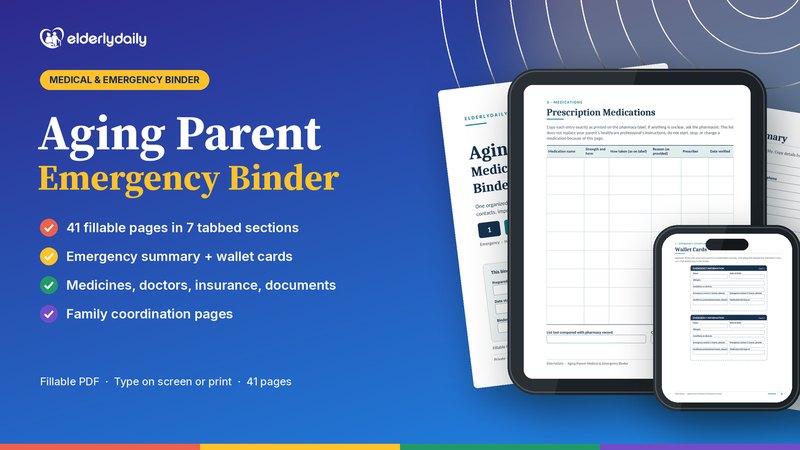
Aging Parent Medical & Emergency Binder
- Medical history, medications and emergency contacts in one place
- Seven sections: emergency, health, medications, care team, appointments, documents and family
- Type into it on screen, or print it and fill it in by hand
One-time purchase · Instant download · Fillable PDF · US Letter
How to put on and take off glasses and hearing aids
Hearing-care providers give the same basic routine (Miracle-Ear’s guide is one example). Practise in front of a mirror for the first few days.
- 1
Glasses first
Put your glasses on and settle them as you normally would.
- 2
Slide the hearing aid in behind the glasses arm
Lift the case of the hearing aid over the ear so it sits between the glasses arm and your ear, closer to the head, then place the dome or earpiece in the ear canal.
- 3
Check the fit
The aid should sit snugly against the head, not hanging away from the ear. Run a finger along the groove: you should feel the aid and the arm side by side, without the arm pressing on the aid’s microphones.
- 4
Take glasses off straight forward
Use both hands and lift the glasses straight forward, without tilting them up or to one side. Tilting is what knocks a hearing aid loose.
- 5
Check both ears afterwards
Especially when you are out. A small aid that falls onto a carpet or into a coat pocket is easily lost.
For a parent with poor dexterity or memory
Put the steps on a card by the mirror, keep a small tray where both devices live overnight, and check both ears after the glasses come off. A retention clip or cord that attaches the hearing aid to clothing or to the glasses arm can stop a dropped aid from being lost.
Choosing glasses that work with hearing aids
- Thin wire temples leave the most room behind the ear. Wide plastic (acetate) arms are the most likely to crowd a BTE aid
- Lightweight frames put less pressure on the top of the ear
- Adjustable temple tips: an optician can bend metal arms to curve around the hearing aid or sit a little higher or lower
- Take your hearing aids to the optician when choosing and fitting new frames, so the fit is checked with both in place
- Sports or retention straps are a poor idea with BTE aids, because they pull on the same spot
If your parent also has low vision, see our hearing and vision support guide for setting up the home for both.
Which hearing aid styles clash least with glasses
If behind-the-ear aids still feel crowded, the style matters more than the brand:
| Style | With glasses | Handling | Notes |
|---|---|---|---|
| Behind-the-ear (BTE) | Workable; the most crowded behind the ear | Easiest to handle and see | Larger case suits more power and stiff fingers |
| Receiver-in-canal (RIC) or mini BTE | Easier: a smaller case behind the ear | Easy | The speaker sits in the ear canal on a thin wire |
| In-the-ear (ITE) and in-the-canal | No overlap behind the ear | Harder with arthritis or tremor | Usually custom-made by a hearing professional |
| Completely-in-canal (CIC) | No overlap | Hardest: very small | Often not suitable for poor dexterity |
| Hearing glasses | The hearing aid is the glasses | Nothing extra to put in | Open-ear speakers; for perceived mild-to-moderate loss |
Don’t trade dexterity for discretion
Tiny in-canal aids avoid the glasses problem, but they are the hardest to insert, clean and change with stiff or shaky hands. For many older adults, a receiver-in-canal aid is the better compromise. Our best hearing aids for seniors review explains each style with examples.
Fixing common problems
- Whistling (feedback): usually the earpiece has been pulled partly out of the ear, or the glasses arm is pushing the aid. Re-seat the dome, check the aid sits flat, and ask about a different dome size
- Soreness behind the ear: try thinner or reshaped temples, and check the aid isn’t sitting on top of the arm. Persistent pain, redness or a sore that won’t heal needs a doctor or audiologist
- Muffled sound: the arm may be covering the microphones. Move the aid slightly forward or ask the optician to adjust the arm
- Aid falls off with glasses or a mask: take glasses off straight forward, remove masks with ear loops slowly, and consider a retention clip
- Sweat or skin irritation: wipe the aid and glasses arms daily and let the skin breathe at night
If hearing seems worse than before, rather than just uncomfortable, see signs hearing loss is getting worse.
Hearing glasses: an aid built into the frame
For people who already wear glasses all day, there is now another option. EssilorLuxottica’s Nuance Audio frames have microphones and small open-ear speakers built into the temples. They received FDA clearance in January 2025 as over-the-counter hearing software for adults with perceived mild-to-moderate hearing loss, launched in the US at about $1,100, and take prescription lenses (HearingTracker). A second-generation model, Nuance Audio 2.0 Plus, was reported in September 2026 from $829, with about 10 hours of battery (Glance).
Things to weigh:
- Nothing sits in or behind the ear, so there is no clash, and nothing small to lose
- They are only for mild-to-moderate loss; more severe loss needs a prescription aid
- They help only while the glasses are on, and they need charging every day
- They are sold through optical stores, so you can try them on and have lenses fitted at the same time
Over-the-counter or audiologist?
Since October 2022, adults 18 and over with perceived mild-to-moderate hearing loss can buy over-the-counter hearing aids without an exam or prescription (FDA). The FDA says to see a doctor first if there has been fluid, blood or pus from the ear, a sudden change in hearing, ear pain, severe dizziness, ringing in only one ear, or hearing that is much worse in one ear.
An audiologist can also solve fit problems that self-fitting can’t, such as custom earmolds, reshaped tubing or a different style. Original Medicare doesn’t pay for hearing aids or fitting exams, though some Medicare Advantage plans include a hearing benefit (Medicare.gov). For the difference between hearing aids and cheaper sound amplifiers, see hearing aid vs. amplifier.
Our picks for glasses wearers
All three come from our research-based hearing aid reviews; we haven’t tested them on a range of frames ourselves, so use the return window to try them with your own glasses:
- MDHearing VOLT 4 if your parent wants a classic behind-the-ear aid with physical buttons and no app. It is the easiest of our picks to handle, and MDHearing offers a 45-day trial
- Sennheiser All-Day Clear if a smaller case behind the ear matters most. It is a small receiver-in-canal aid with a strong independent lab grade for speech in quiet, Bluetooth calls and a 30-day trial
- ELEHEAR Beyond Pro if speech in noisy rooms is the main problem. It is our top-rated OTC aid in independent tests, but its case is larger than many receiver-in-canal aids, so try it with your glasses during its 45-day trial
Frequently asked questions
Can you wear hearing aids with glasses?
Yes. Most people wear both comfortably. Put glasses on first, then the hearing aid between the glasses arm and the ear, and take glasses off straight forward with both hands.
Do you put on glasses or hearing aids first?
Glasses first is the usual advice from hearing-care providers. Then slide the behind-the-ear hearing aid in between the glasses arm and your ear.
What is the best hearing aid style for glasses wearers?
Receiver-in-canal aids have a smaller case behind the ear, and in-the-ear styles avoid the overlap entirely. But tiny in-ear aids are harder to handle with arthritis, so many older adults do best with a receiver-in-canal aid.
Why does my hearing aid whistle when I wear glasses?
Usually because the glasses arm pushes the aid and pulls the earpiece partly out of the ear, letting sound leak back to the microphone. Re-seat the earpiece, make sure the aid sits flat, and ask about a better-fitting dome or a frame adjustment.
What glasses frames are best with hearing aids?
Lightweight frames with thin wire temples, which an optician can bend to curve around the hearing aid. Take the hearing aids along when choosing and fitting new frames.
Are there glasses with hearing aids built in?
Yes. Nuance Audio glasses from EssilorLuxottica build microphones and open-ear speakers into the frame. They are FDA-cleared over-the-counter hearing software for perceived mild-to-moderate hearing loss and take prescription lenses.
Sources
- U.S. Food and Drug Administration. OTC hearing aids: what you should know — adults 18+, perceived mild-to-moderate loss, warning signs
- Medicare.gov. Hearing aids — Original Medicare doesn’t cover hearing aids or fitting exams
- Miracle-Ear (hearing-care provider). Wearing hearing aids with glasses — order, frames and removal
- HearingTracker. Nuance Audio glasses US launch — FDA-cleared OTC hearing software in eyewear
- Glance (Sept 2026). Essilor unveils Nuance Audio 2.0 Plus — price, battery and features
