Sudden Hearing Loss in Seniors: Warning Signs and When to Act Quickly
Last Updated: February 2026
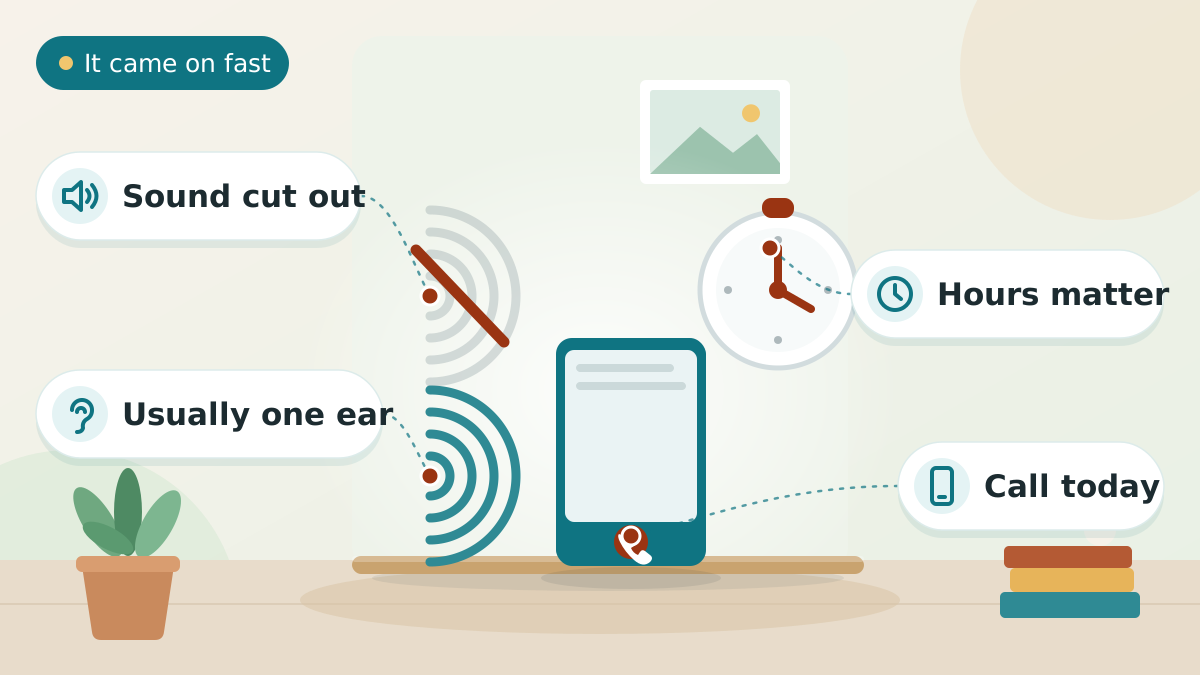
Sudden hearing loss is different from the slow hearing changes that come with age. It happens fast—over hours or days—and needs quick attention.
Most seniors lose hearing slowly over years. But sudden hearing loss is a medical concern. It can happen in one ear or both. It may come with ringing, pressure, or dizziness.
Early treatment matters. The sooner you see a doctor, the better the chance of recovery. Waiting can reduce treatment success.
This guide helps you know what to watch for, when to call the doctor, and what might cause sudden hearing changes.

Early action improves outcomes
This Is Not Normal Aging
Sudden hearing loss over hours or days is different from gradual age-related hearing decline. Contact a doctor or ENT specialist promptly—ideally within 72 hours.
Caregiver-Reviewed Health Guidance
This guide is written for caregivers and families. It explains sudden hearing loss warning signs, when to seek care, and what to expect.
Educational only. Not a substitute for emergency care or medical diagnosis. If you suspect sudden hearing loss, contact a healthcare provider promptly.
Key Points to Remember
Act within 72 hours: Early treatment improves recovery chances significantly.
One ear is common: Sudden loss often affects just one side.
Watch for dizziness: Balance problems may signal inner ear involvement.
Don't wait it out: Hoping it improves on its own can reduce treatment success.
Check medications: Some drugs can affect hearing suddenly.
Increase fall risk: Hearing loss affects balance and spatial awareness.
What Is Sudden Hearing Loss?
Sudden sensorineural hearing loss (SSHL) is a rapid decrease in hearing that happens over 72 hours or less. It's different from the gradual hearing decline most seniors experience.
Rapid Change
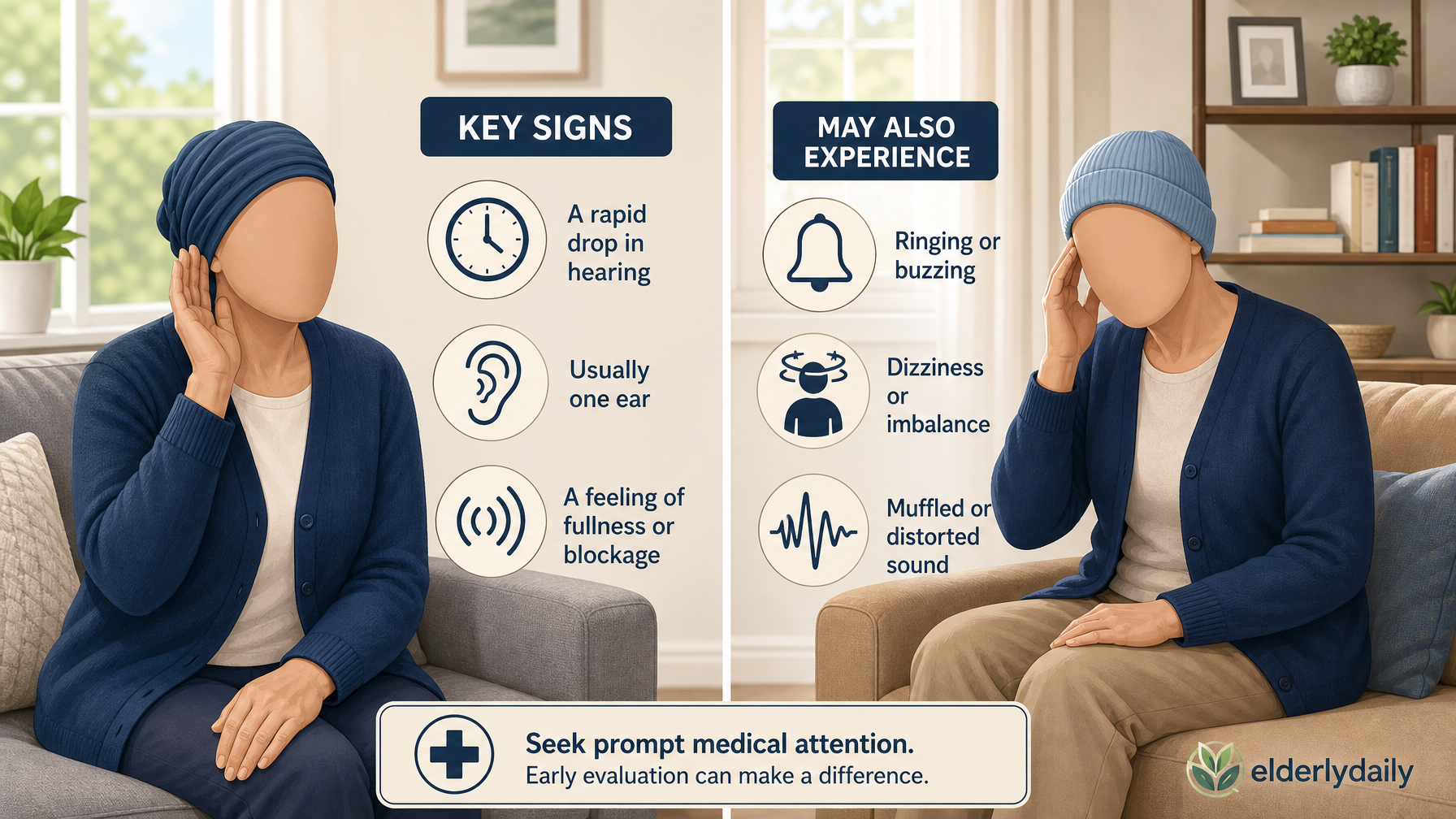
Hearing loss develops over hours to 3 days—not weeks or months. You may wake up with it or notice it suddenly during the day.
One Ear vs. Both Ears
Most cases affect only one ear. If both ears are affected, it may signal a more serious condition requiring immediate attention.
Different From Aging
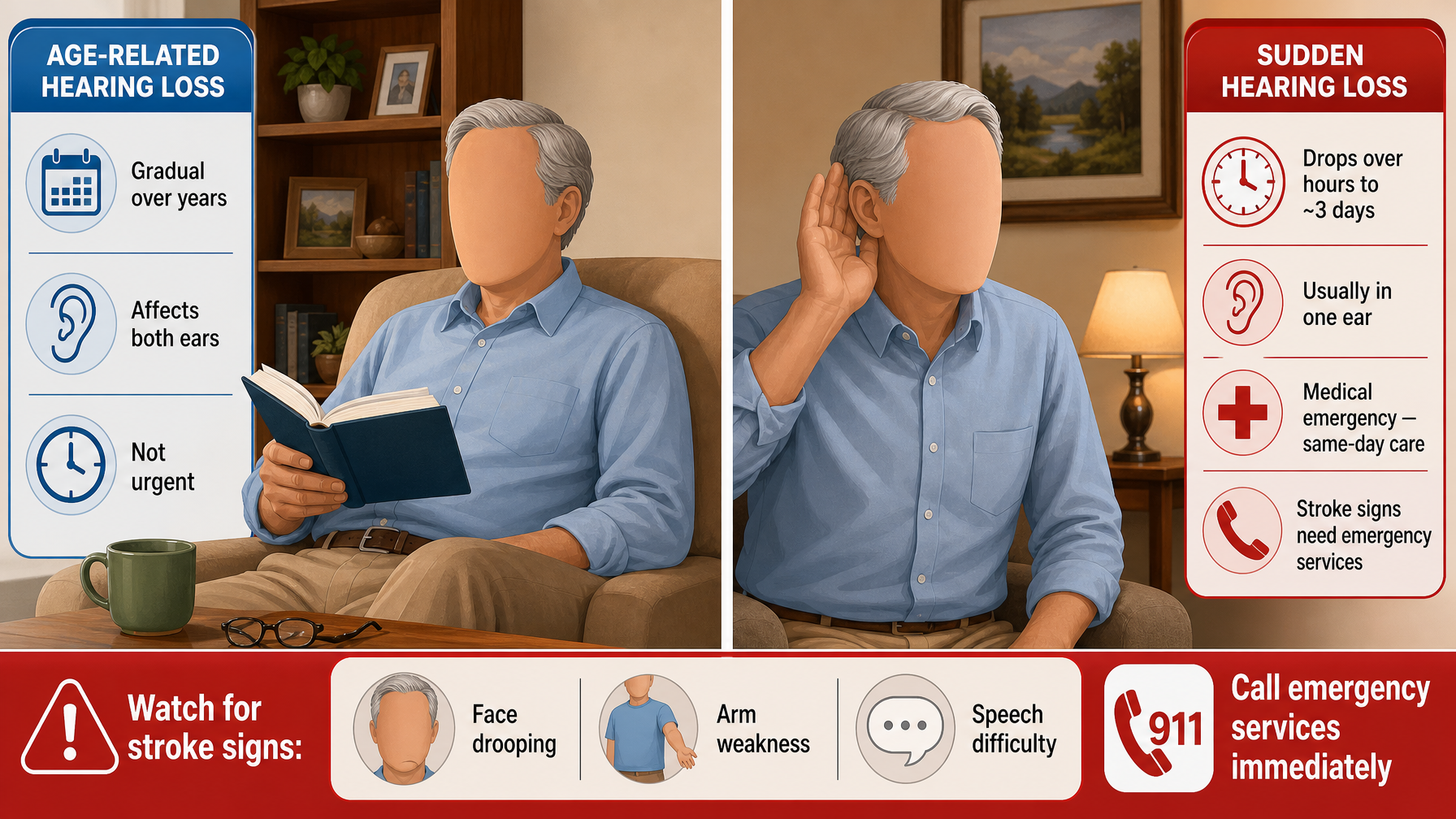
Age-related hearing loss (presbycusis) happens slowly over years and affects both ears. Sudden loss is a separate medical event.
For comprehensive strategies on supporting hearing and vision at home, read our Hearing and Vision Support Guide.
Early medical evaluation is critical for sudden hearing loss
Common Symptoms of Sudden Hearing Loss
Watch for these warning signs. They may appear alone or together:
Sudden Muffled Hearing
Sounds become muffled or distant in one ear. It may feel like your ear is "underwater" or "stuffed with cotton." You may have trouble understanding speech.
What it feels like: "I can hear people talking, but I can't make out the words."
Ear Fullness or Pressure
A feeling of fullness, pressure, or "plugged" sensation in the affected ear. It may feel similar to when your ears pop on an airplane, but it doesn't go away.
What it feels like: "My ear feels blocked, like I need to pop it."
Ringing (Tinnitus)
Ringing, buzzing, hissing, or roaring sounds in the affected ear. The sound may be constant or come and go. It can be mild or very loud.
What it sounds like: "There's a constant ringing that won't stop."
Dizziness or Imbalance
Feeling dizzy, unsteady, or like the room is spinning (vertigo). This suggests the inner ear—which controls balance—may be affected.
What it feels like: "I feel off-balance and the room is moving."
Don't Ignore These Signs
Even if symptoms seem mild, sudden hearing changes need medical evaluation. Early treatment within 72 hours gives the best chance of recovery.
When It May Be an Emergency
Some symptoms with sudden hearing loss require immediate emergency care. Call 911 or go to the ER if you see:
Call 911 If:
Sudden Complete Hearing Loss
Total or near-total loss of hearing in one or both ears within minutes to hours
Severe Dizziness
Room spinning violently, unable to stand or walk, severe nausea or vomiting
Stroke-Like Symptoms
Slurred speech, facial drooping, arm weakness, confusion, or difficulty walking
Severe Headache
Sudden, severe headache with hearing loss—especially if accompanied by vision changes or confusion
Recent Head Injury
Hearing loss after a fall, blow to the head, or accident
Call Doctor Same Day If:
Sudden Muffled Hearing
Noticeable hearing decrease in one ear over hours or days
New Loud Ringing
Sudden onset of loud tinnitus that wasn't there before
Ear Pressure
Feeling of fullness or blockage that doesn't clear with yawning or swallowing
Mild Dizziness
Feeling unsteady or slightly dizzy along with hearing changes
After New Medication
Hearing changes within days of starting a new drug
The 72-Hour Rule: Sudden hearing loss is often treated as a medical urgency. The sooner you start treatment (ideally within 72 hours), the better the chance of recovery. Don't wait to see if it improves on its own.
Don't wait—contact your doctor promptly
Possible Causes of Sudden Hearing Loss
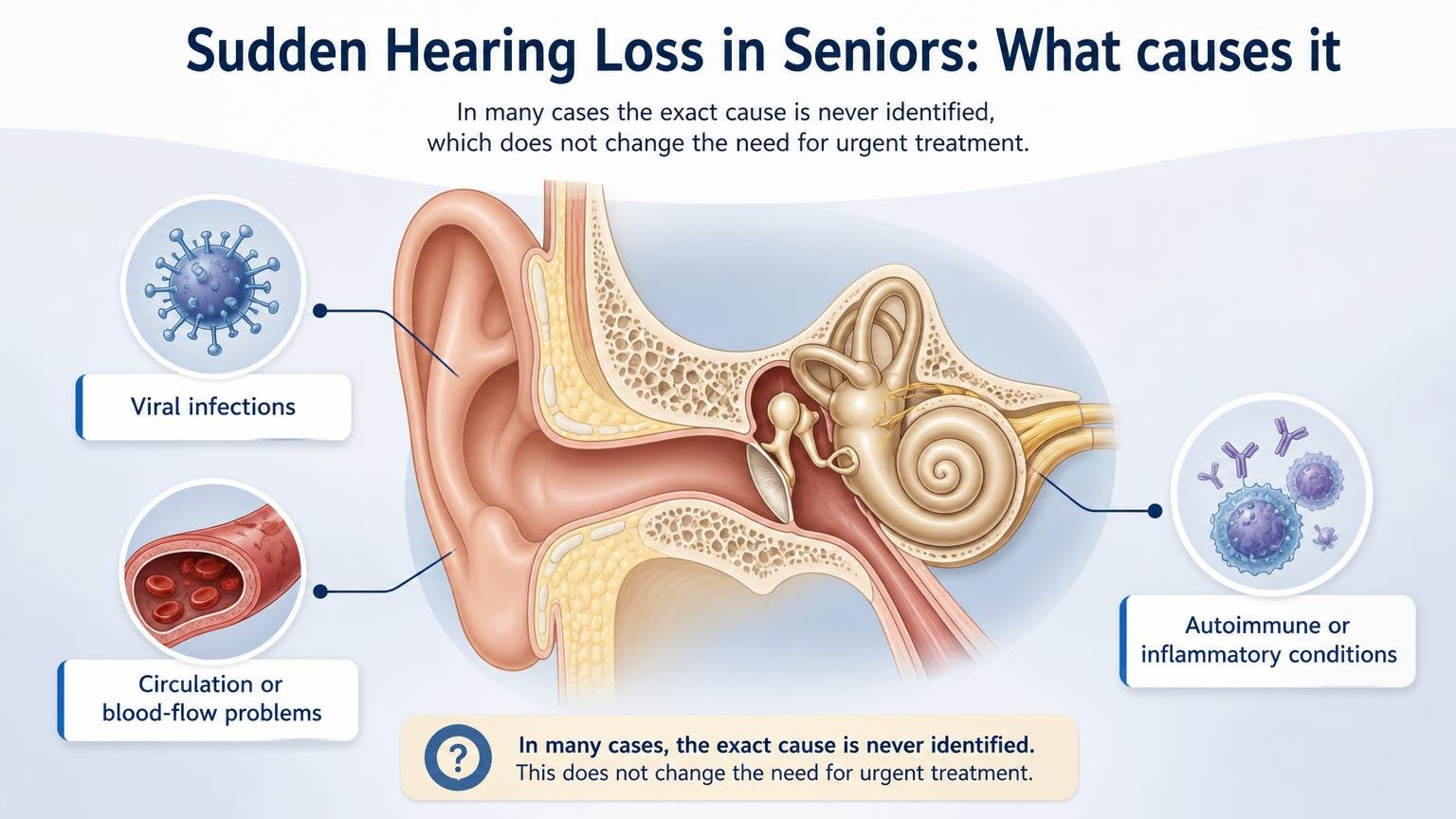
In many cases, doctors can't identify a specific cause. But these are the most common known reasons:
Viral Infection
Viruses can inflame the inner ear or auditory nerve. This is one of the most common causes. It may happen during or after a cold, flu, or other viral illness.
Common viruses: Herpes, mumps, measles, cytomegalovirus (CMV)
Circulation Issues
Reduced blood flow to the inner ear can damage hearing cells. This is more common in seniors with heart disease, high blood pressure, diabetes, or high cholesterol.
Risk factors: Smoking, blood clots, vascular disease
Medication Side Effects
Certain medications can damage hearing suddenly. These are called ototoxic drugs. Always tell your doctor if hearing changes after starting a new medication.
Common culprits: Some antibiotics, diuretics, chemotherapy drugs, high-dose aspirin
Ear Blockage
A large buildup of earwax can cause sudden hearing loss. This is the easiest cause to fix—removal brings instant improvement. Fluid from an ear infection can also block hearing.
Good news: This cause is reversible with simple treatment
Autoimmune Disease
Rarely, the immune system attacks the inner ear. This can cause sudden hearing loss, often in both ears. It may come with other autoimmune symptoms.
Examples: Lupus, rheumatoid arthritis, Cogan's syndrome
Unknown Cause (Idiopathic)
In about 85-90% of cases, doctors can't find a specific cause. This is called idiopathic sudden hearing loss. Treatment is still possible and often helps.
Still treatable: Steroids and other treatments can help even without knowing the cause
For guidance on managing medications safely, including recognizing side effects, read our Medication Management Guide.
Real Caregiver Stories
These real experiences show why quick action matters:
Margaret, 74 - Viral Infection
"My mother woke up one morning and couldn't hear out of her right ear. She said it felt 'plugged.' I called her doctor that same day. They saw her within 48 hours and started steroids. After two weeks, about 70% of her hearing came back. The doctor said acting fast made the difference."
What helped: Calling the doctor immediately, not waiting to see if it improved
Robert, 68 - Medication Side Effect
"My dad started a new antibiotic for pneumonia. Three days later, he complained of ringing in both ears and muffled hearing. I checked his medication list and called his doctor. They switched his antibiotic immediately. His hearing improved within a week. I'm glad I didn't assume it was just age."
What helped: Connecting the timing to new medication and reporting it quickly
Linda, 71 - Earwax Blockage
"My mom said she couldn't hear me one morning. I panicked and took her to urgent care. Turns out it was a large earwax blockage. They removed it, and her hearing came back instantly. The doctor said I was right to bring her in—you can't tell the difference without an exam."
What helped: Not assuming it was minor and getting it checked the same day
What Caregivers Should Do Immediately
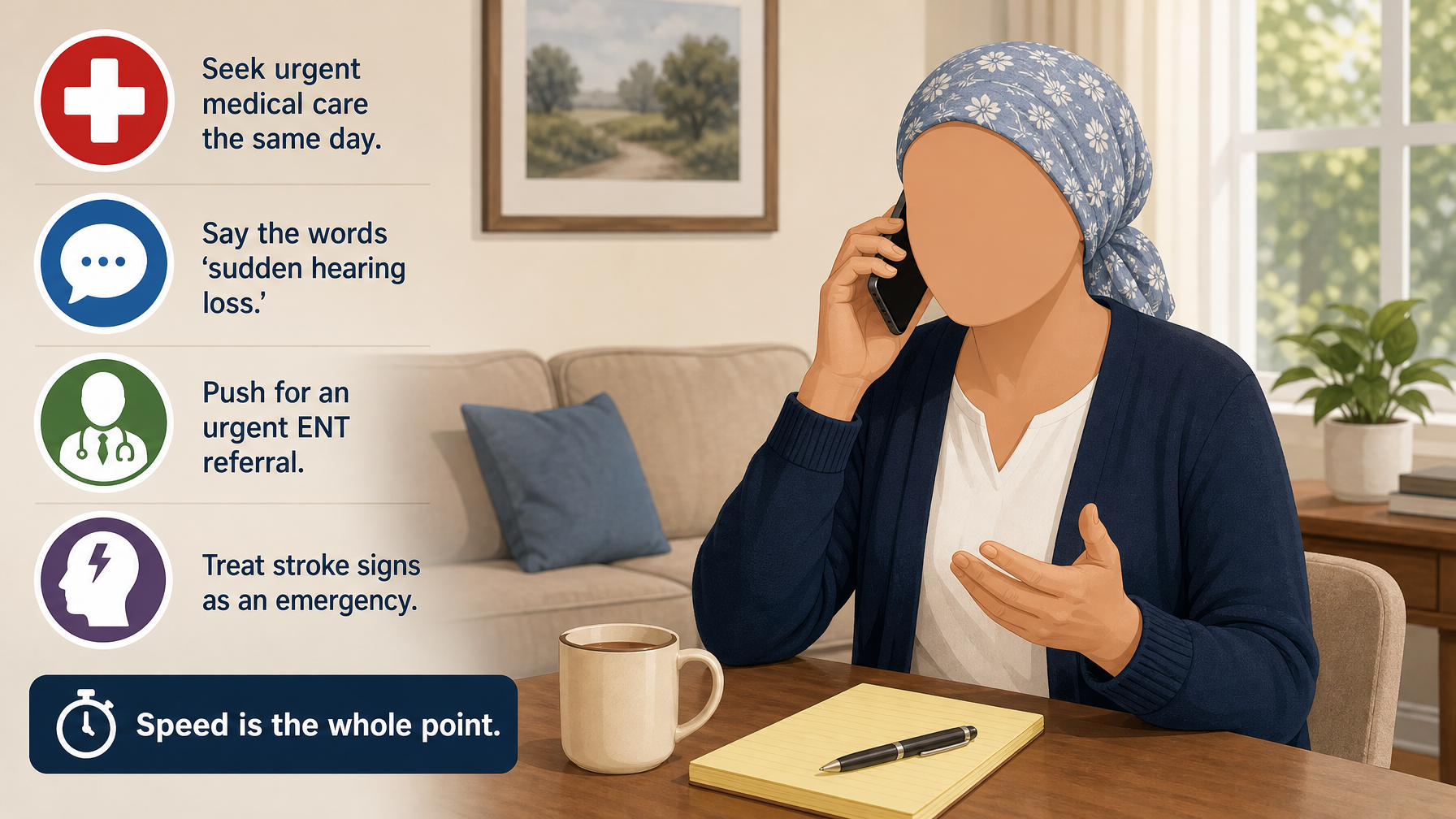
Quick action improves outcomes. Here's what to do if you notice sudden hearing loss:
Contact Primary Care or ENT
Call your parent's primary care doctor or an ear, nose, and throat (ENT) specialist. Explain that hearing loss happened suddenly—within hours or days.
What to say: "My parent woke up this morning and can't hear out of their right ear. It happened suddenly. We need to be seen today or tomorrow."
Seek Urgent Care If Severe
If you can't reach a doctor quickly, go to urgent care or the ER. Sudden hearing loss is treated as a medical urgency—not a routine appointment.
Don't wait for Monday: Weekend or evening hearing loss still needs prompt attention
Do Not Wait for It to "Improve on Its Own"
Many people hope sudden hearing loss will go away by itself. While some cases do improve spontaneously, waiting reduces treatment success. Early steroids work best.
Critical window: Treatment is most effective when started within 72 hours of onset
Bring Medication List
Write down all medications, supplements, and over-the-counter drugs your parent takes. Include when each was started. This helps the doctor identify possible medication-related causes.
Include: Prescription drugs, vitamins, herbal supplements, pain relievers
Note When It Started
Write down exactly when you first noticed the hearing loss. Was it sudden upon waking? Did it develop over a few hours? This timeline helps doctors determine urgency and treatment.
Also note: Any recent illnesses, injuries, loud noise exposure, or new activities
Never Try to Remove Earwax Yourself
If you suspect earwax blockage, see a doctor. Do not use cotton swabs, ear candles, or home irrigation kits. These can push wax deeper, damage the eardrum, or worsen hearing loss.
Hearing aids and assistive devices can help after treatment
Hearing Loss and Fall Risk
Sudden hearing loss—especially if it affects balance—can increase fall risk. Here's why and what to do:
Why Hearing Affects Balance
Reduced Spatial Awareness
You can't hear where things are around you. This makes navigation harder.
Inner Ear Connection
The inner ear controls both hearing and balance. Damage to one can affect the other.
Delayed Reaction Time
You may not hear someone approaching or a warning sound, reducing your ability to react.
Cognitive Load
Your brain works harder to process sounds, leaving less attention for balance and walking.
How to Reduce Fall Risk
Use Extra Caution
Walk more slowly. Use handrails. Avoid stairs when possible.
Improve Lighting
Bright lights help compensate for reduced spatial awareness from hearing loss.
Clear Pathways
Remove rugs, cords, and clutter. Make sure floors are clear.
Consider Assistive Devices
A cane or walker can provide extra stability if balance is affected.
Research shows: Even mild hearing loss can triple fall risk in seniors. For a complete fall prevention plan, read our Mobility & Fall Prevention Guide.
After Sudden Hearing Loss: How AI Technology Supports Recovery and Ongoing Safety
Sudden hearing loss is a medical emergency — but what happens after the initial treatment window closes is just as important. Even when partial hearing returns, many seniors are left with a permanent gap in their hearing profile that quietly raises their fall risk, increases cognitive load, and chips away at their confidence living independently. The traditional path forward — a $3,000–$7,000 prescription hearing aid after months of audiologist appointments — leaves too many seniors unprotected for too long.
In 2026, FDA-cleared over-the-counter AI hearing aids have changed that equation entirely. These devices use real-time AI sound processing to self-fit to the wearer's current hearing profile — adapting automatically to different environments without a single clinic visit. At under $300 and shipped directly to the door, they give seniors recovering from sudden hearing loss an immediate, affordable bridge to better hearing while they wait for specialist follow-up or decide on a long-term solution. For many, they become the permanent solution.
Alongside hearing correction, AI health wearables now give caregivers a passive safety net that doesn't require constant phone calls. Devices that monitor gait, balance, and heart rate can detect the subtle physical changes that follow hearing loss — the slight hesitation in stride, the increased reliance on visual cues, the elevated heart rate from the stress of straining to hear. When a senior's hearing changes suddenly, pairing an OTC AI hearing aid with a smart wearable gives both the senior and their family a complete, technology-backed safety system that works around the clock.
Don't let the recovery window close without a safety plan.
OTC AI hearing aids and smart health wearables are now the fastest, most affordable way to restore hearing clarity and monitor safety after sudden hearing loss — no waiting list, no $6,000 price tag. Discover how the latest AI tools are helping seniors recover faster and stay safer at home in 2026.
Read the 2026 Ultimate Guide to AI Technology for SeniorsOTC AI Hearing Aids
FDA-cleared, self-fitting AI hearing aids under $300. Real-time adaptive sound processing — no audiologist visit required.
See Top OTC AI Picks →AI Health Wearables
Smart wearables that monitor balance, gait, and heart rate — giving caregivers real-time safety data after sudden hearing changes.
Explore AI Wearables →Traditional Hearing Aids
Prescription-grade hearing aids reviewed for seniors — comparing fit, sound quality, and long-term hearing support.
Compare Hearing Aids →Treatment Options
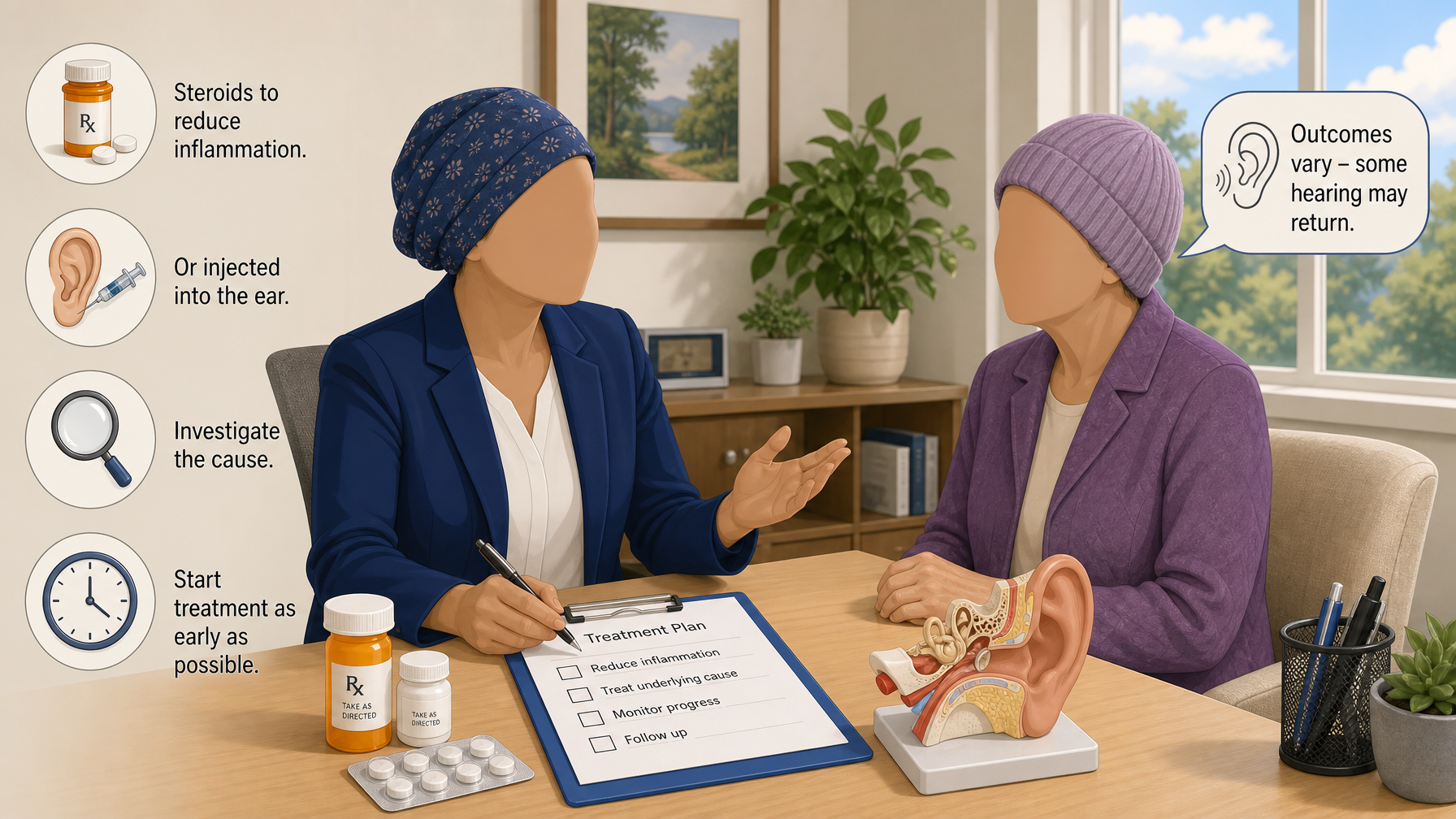
Treatment depends on the cause and severity. Your doctor may recommend:
Steroids (If Prescribed)
Corticosteroids are the most common treatment for sudden hearing loss. They reduce inflammation in the inner ear. Treatment usually starts within 72 hours for best results.
How given:
- • Oral pills (prednisone) for 10-14 days
- • Injections directly into the ear (intratympanic)
- • Sometimes both methods together
Side effects: Steroids can raise blood sugar, cause insomnia, or affect mood. Your doctor will monitor you.
Hearing Aids
If hearing doesn't fully return, hearing aids can significantly improve quality of life. Modern devices are small, comfortable, and effective. Many connect wirelessly to phones and TVs.
Types available:
- • Behind-the-ear (BTE) models
- • In-the-ear (ITE) models
- • Completely-in-canal (CIC) models
- • Rechargeable options
Assistive Listening Devices
These devices help you hear better in specific situations. They work with or without hearing aids.
Common devices:
- • Amplified telephones with large buttons
- • TV listening systems (wireless headphones)
- • Personal amplifiers for conversations
- • Doorbell flashers and vibrating alarms
Other Treatments
Depending on the cause, your doctor may recommend:
- Earwax removal: Professional cleaning if blockage is the cause
- Medication changes: Switching or stopping ototoxic drugs
- Antibiotics: If bacterial infection is suspected
- Hyperbaric oxygen: In some specialized cases
- Cochlear implants: For severe permanent loss
Fall Prevention Steps
Supervised Walking
Stay close when your parent walks, especially if they have dizziness.
Use Assistive Devices
A cane or walker provides extra stability during recovery.
Clear Pathways
Remove rugs, cords, and clutter. Make sure floors are clear.
Bathroom Safety
Install grab bars. Use non-slip mats. Add a shower chair if needed.
Nighttime Precautions
Use motion-sensor night lights. Keep a flashlight by the bed.
For a complete fall prevention strategy, including home modifications and mobility support, read our Mobility & Fall Prevention Guide.
Sudden vs. Gradual Hearing Loss
Understanding the difference helps you know when to act quickly:
Sudden Hearing Loss
Timeline
Happens over hours to 3 days
Pattern
Usually affects one ear
Symptoms
May include ringing, pressure, dizziness
Action Needed
See doctor within 72 hours
Treatment
May respond to steroids or other medical treatment
Gradual Age-Related Loss
Timeline
Develops over months to years
Pattern
Usually affects both ears equally
Symptoms
Difficulty hearing high-pitched sounds, conversations
Action Needed
Schedule routine hearing test
Treatment
Hearing aids, assistive devices
When in Doubt, Get It Checked
If you're not sure whether hearing loss is sudden or gradual, see a doctor. It's better to check and find out it's minor than to wait and miss a treatment window.
How Doctors Diagnose Sudden Hearing Loss
Your doctor or ENT specialist will do several tests to find the cause:
Physical Exam
- Look inside ears with otoscope
- Check for earwax blockage
- Test balance and coordination
- Review medication list
Hearing Tests
- Audiogram (hearing test)
- Tuning fork tests
- Speech recognition test
- Tympanometry (eardrum test)
Blood Tests
- Check for infection
- Test blood sugar levels
- Check thyroid function
- Look for autoimmune markers
Imaging (If Needed)
- MRI of inner ear and brain
- CT scan if trauma suspected
- Rule out tumors or stroke
- Check blood vessel problems
Recovery Outlook
Recovery depends on the cause and how quickly treatment starts:
Full Recovery Possible
About 50-60% of people with sudden hearing loss recover some or all hearing, especially with early treatment. Earwax removal brings instant improvement.
Partial Recovery
Some hearing may return over weeks to months. Hearing aids can help with remaining loss. Many people adapt well with assistive devices.
Permanent Loss
If hearing doesn't return, hearing aids, cochlear implants, or assistive listening devices can significantly improve quality of life. Support is available.
The 72-Hour Window: Research shows that starting treatment within 72 hours of sudden hearing loss gives the best chance of recovery. Don't delay.
Living With Hearing Loss
If hearing doesn't fully return, these strategies help:
Hearing Aids
Modern hearing aids are small, effective, and easier to use than ever. Many connect to phones and TVs.
Best Hearing AidsAssistive Devices
Amplified phones, TV listening systems, and doorbell flashers help you stay connected and safe.
Support StrategiesCommunication Tips
Face the person when talking. Speak clearly but don't shout. Reduce background noise. Use visual cues.
Patience and understanding matter
Medications That Can Affect Hearing
Some medications can cause sudden or gradual hearing loss. Always tell your doctor about hearing changes:
High-Risk Medications
Certain Antibiotics
Gentamicin, tobramycin, and other aminoglycosides
Loop Diuretics
Furosemide (Lasix), bumetanide—especially high doses
Chemotherapy Drugs
Cisplatin and carboplatin
High-Dose Aspirin
Usually reversible when stopped
Moderate-Risk Medications
NSAIDs
Ibuprofen, naproxen—usually with long-term use
Quinine
Used for malaria or leg cramps
Some Antidepressants
Rare but possible side effect
Erectile Dysfunction Drugs
Very rare but documented cases
Never stop medications without talking to your doctor. If you suspect a medication is affecting hearing, call your doctor to discuss alternatives. For more on medication safety, read our Medication Management Guide.
Questions to Ask Your Doctor
Bring these questions to your appointment:
What caused this hearing loss?
What treatment do you recommend?
How long until we know if treatment is working?
What is the chance of recovery?
Could any of my medications be causing this?
Do I need to see an ENT specialist?
What warning signs should I watch for?
When should I follow up?
More Helpful Guides
Learn more ways to support hearing and overall health:
Frequently Asked Questions
Medical Disclaimer
This guide is for educational purposes only. It is not medical advice and does not replace professional healthcare evaluation or emergency care.
Sudden hearing loss requires prompt medical attention. If you or someone you care for experiences sudden hearing changes, contact a healthcare provider immediately—ideally within 72 hours.
Do not use this information to diagnose or treat hearing loss. Always follow your doctor's specific instructions regarding treatment, medications, and follow-up care.
Call 911 or go to the emergency room if sudden hearing loss is accompanied by: stroke symptoms, severe dizziness, severe headache, recent head injury, or complete hearing loss.
ElderlyDaily.com provides educational content for caregivers and families. We are not medical professionals. Always consult qualified healthcare providers for diagnosis and treatment.
Need More Support?
Learn comprehensive strategies for hearing and sensory support