How Hearing Loss Increases Fall Risk in Seniors (And What Caregivers Can Do)
Last Updated: February 2026
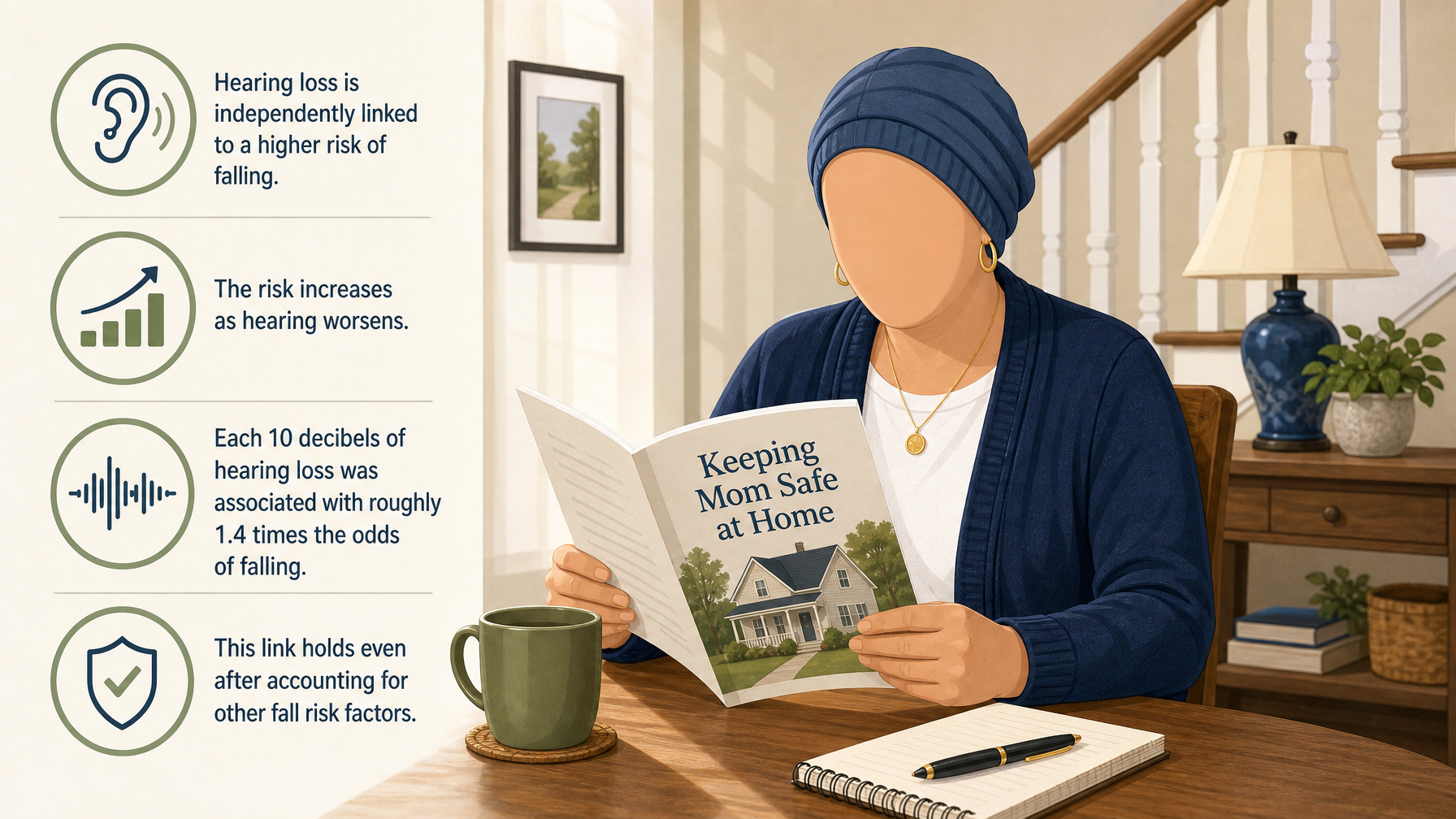
Hearing loss affects more than communication. It also impacts balance and spatial awareness. Seniors with hearing loss are three times more likely to fall.
Your ears do more than hear. They help you know where you are in space. They help you react to sounds around you. When hearing declines, balance and safety decline too.
This guide explains the connection between hearing and falls. It shows you practical ways to keep your loved one safe.

Hearing affects balance more than you think
Caregiver-Reviewed Safety Guidance
This guide is based on medical research, audiologist recommendations, and real caregiver experiences. It explains the connection between hearing loss and falls in clear, practical terms.
Educational only. This is not medical diagnosis or treatment advice. Always consult with your loved one's healthcare provider about hearing concerns and fall risk.
Key Points to Remember
Hearing loss triples fall risk: Even mild hearing loss increases falls significantly.
Inner ear controls balance: Hearing and balance share the same system.
Hearing aids can help: Proper hearing aids may reduce fall risk by 30%.
Environmental changes matter: Better lighting and clear paths help compensate.
Watch for subtle signs: Turning head frequently or startling easily are warning signs.
Act early: The sooner you address hearing loss, the better the outcomes.
The Hidden Link Between Hearing and Balance
Most people think hearing loss only affects communication. But your ears do much more than hear. They play a critical role in balance and spatial awareness.
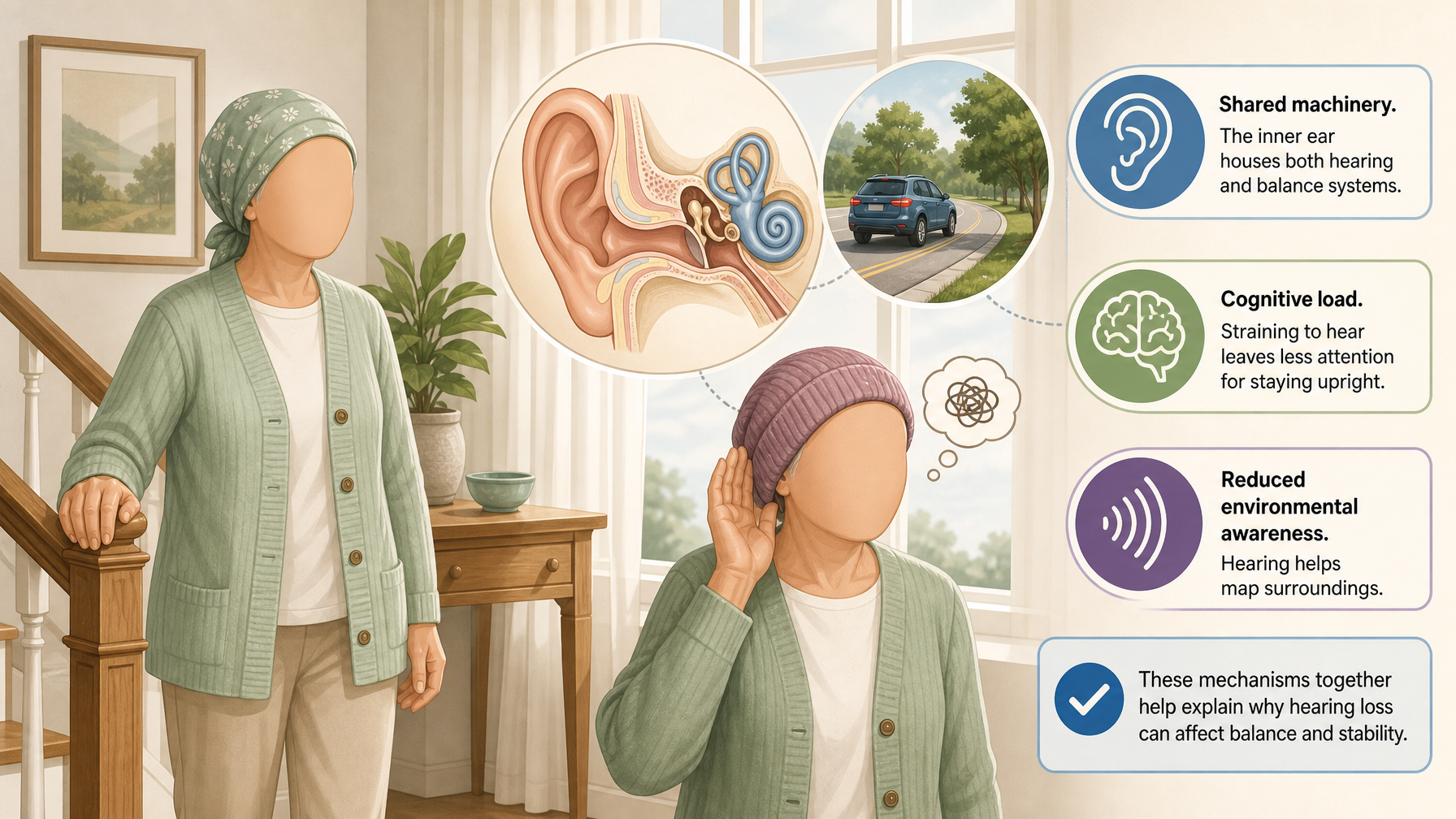
The inner ear contains the vestibular system. This system tells your brain where your body is in space. When hearing declines, this balance system often weakens too.
Inner Ear Role in Balance
Vestibular system
Fluid-filled canals detect head movement and position
Spatial orientation
Tells your brain if you're upright, tilted, or moving
Coordination with vision
Works with eyes to maintain steady walking
Automatic adjustments
Makes constant micro-corrections to keep you upright
Reduced Environmental Awareness
Can't hear approaching hazards
Miss sounds of people, pets, or objects nearby
Reduced auditory cues
Can't hear your own footsteps or movement sounds
Slower reaction time
Takes longer to respond to unexpected situations
Difficulty judging distance
Sound helps estimate how far away things are
Delayed Reaction Time
When you can't hear well, your brain works harder to process sounds. This leaves less mental energy for balance and quick reactions.
Cognitive Overload
- • Brain struggles to process unclear sounds
- • Less mental energy for balance
- • Slower response to trip hazards
- • Increased mental fatigue
Physical Impact
- • Hesitant, cautious walking
- • Reduced walking speed
- • Poor posture from straining to hear
- • Delayed catch reflexes
For comprehensive strategies on supporting seniors with hearing and vision challenges, read our Hearing and Vision Support at Home guide.
Signs Hearing Loss May Be Affecting Stability
These behaviors suggest hearing loss is impacting balance and safety:
Turning Head Frequently to Hear
Your loved one constantly turns their head to hear conversations or sounds. This head turning disrupts balance and increases fall risk.
What you see:
- • Twisting body to hear TV or conversations
- • Leaning forward to catch words
- • Unsteady when turning to respond
- • Losing balance during head turns
Misjudging Distance
Sound helps us judge how far away objects are. Without good hearing, seniors may bump into furniture or misjudge steps.
What you see:
- • Bumping into doorways or furniture
- • Missing the chair when sitting down
- • Stepping too high or too low on stairs
- • Reaching for objects that are farther away
Startling Easily
When you can't hear someone approaching, you get startled. This sudden surprise can cause a loss of balance or a fall.
What you see:
- • Jumping when someone enters the room
- • Losing balance when surprised
- • Grabbing furniture when startled
- • Avoiding busy or noisy places
Increased Nighttime Falls
At night, seniors often remove hearing aids. Without hearing or vision, they rely only on touch and memory. This makes nighttime bathroom trips very risky.
What you see:
- • Falls during nighttime bathroom trips
- • Disorientation in the dark
- • Bumping into walls or furniture
- • Hesitant, shuffling nighttime walking
Important to Know
These signs often develop gradually. Family members may not notice until a fall happens. If you see any of these behaviors, schedule a hearing evaluation. For nighttime safety strategies, read our Nighttime Falls in Seniors guide.
Regular hearing tests help catch problems early
Why Hearing Loss Raises Fall Risk
The connection between hearing and falls involves multiple factors:
Missed Auditory Cues
Sound gives constant information about your environment. You hear footsteps behind you. You hear a door opening. You hear your own feet on the floor.
Without these sounds:
• You don't know someone is approaching from behind
• You can't hear if you're shuffling or dragging your feet
• You miss warning sounds like creaking floors or moving furniture
• You can't gauge the texture of the floor by sound (carpet vs. tile)
Reduced Confidence While Walking
Hearing loss creates uncertainty. Seniors become less confident about moving around. This fear and hesitation actually increases fall risk.
The confidence cycle:
• Can't hear surroundings → Feel uncertain and anxious
• Anxiety → Walk more cautiously and slowly
• Slow, hesitant walking → Muscles weaken from reduced activity
• Weak muscles → Higher fall risk and more fear
Cognitive Overload
Your brain has limited processing power. When it works hard to understand sounds, it has less energy for balance and coordination.
What happens:
• Brain exhausted from straining to hear
• Less attention available for walking safely
• Difficulty multitasking (walking and talking)
• Slower processing of visual and physical cues
Increased Isolation and Inactivity
Hearing loss makes social situations difficult. Seniors may avoid going out. This leads to muscle weakness and higher fall risk.
The isolation cycle:
• Hearing loss → Avoid social situations
• Stay home more → Less walking and movement
• Reduced activity → Muscles weaken
• Weak muscles → Higher fall risk when you do move
The Good News
Understanding this connection means you can take action. Addressing hearing loss, improving home safety, and encouraging movement can significantly reduce fall risk.
For comprehensive fall prevention strategies, read our Fear of Falling in Elderly guide.
The Research Behind the Connection
Multiple studies show the strong link between hearing loss and falls:
Tripled fall risk with even mild hearing loss (25 dB)
Johns Hopkins Medicine study
Increased fall risk for every 10 dB of hearing loss
Archives of Internal Medicine
Fall risk reduction possible with proper hearing aids
JAMA Otolaryngology study
Real Caregiver Stories
These real experiences show how hearing loss affects safety:
Dorothy, 76 - Hearing Loss & Falls
"My mother fell three times in six months. We thought it was her knees. Then her doctor tested her hearing. She had moderate hearing loss in both ears. After she got hearing aids, she stopped falling. She says she can hear her feet now and knows where she is in the room."
What helped: Hearing aids plus motion-sensor night lights
James, 68 - Sudden Hearing Change
"Dad suddenly couldn't hear out of his left ear. Within days, he started stumbling. He would turn his head to hear us and lose his balance. The doctor said his inner ear was inflamed. After treatment, his balance improved. Now we know hearing and balance are connected."
What helped: Quick medical treatment and temporary walker use
Carol, 82 - Nighttime Falls
"I kept falling at night going to the bathroom. I didn't realize I was relying on hearing to know where I was. Without my hearing aids in, I couldn't orient myself in the dark. Now I keep a night light on and my hearing aids in a case right by my bed. No more falls."
What helped: Motion-sensor night lights and bedside hearing aid storage
Practical Steps to Reduce Risk
You can take action today to improve safety. Here are five proven strategies:
Schedule a Hearing Evaluation
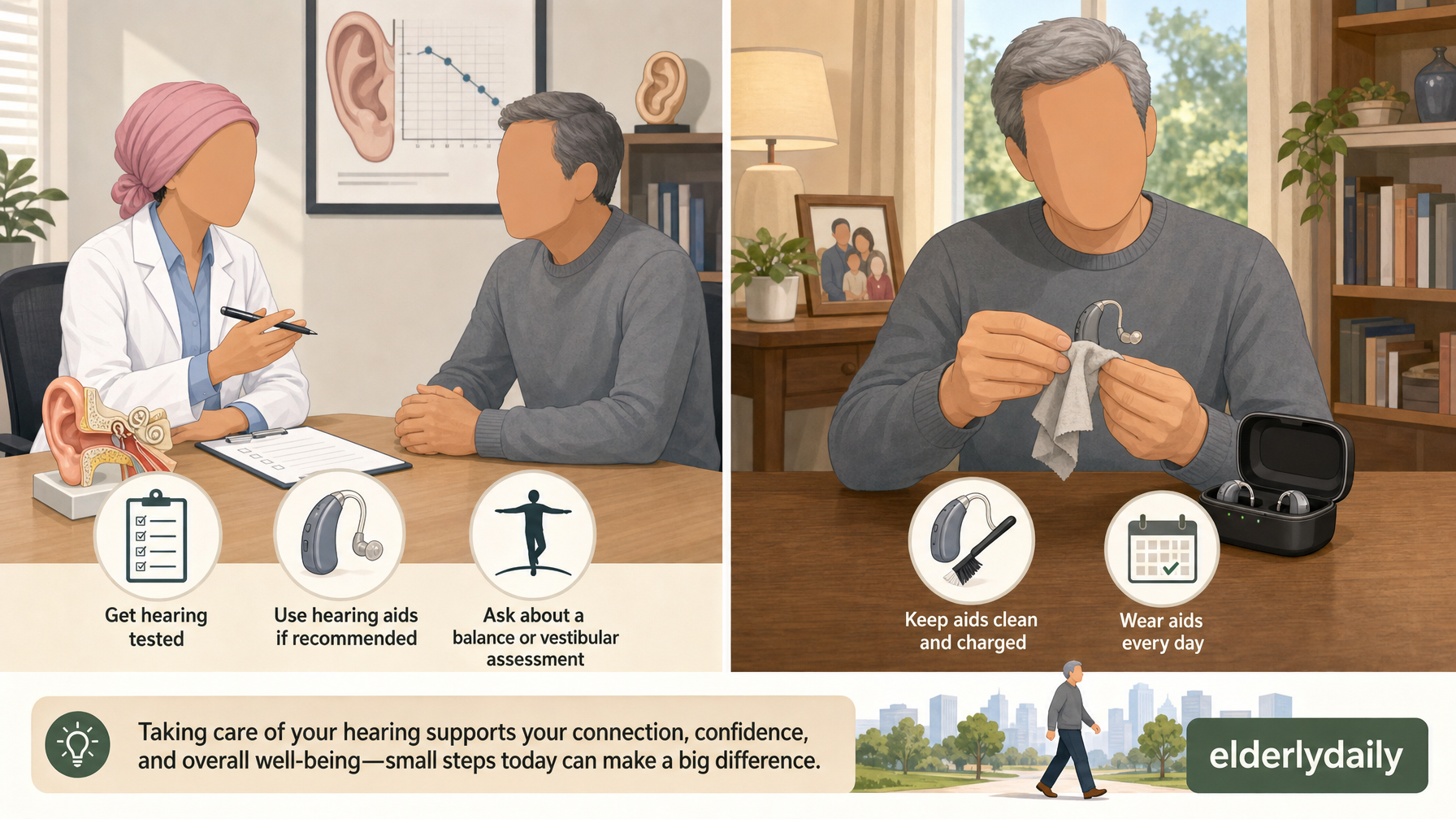
The first step is knowing the extent of hearing loss. An audiologist can test hearing and recommend solutions.
What to Expect
- • Hearing test (audiogram)
- • Speech recognition test
- • Ear examination
- • Balance assessment if needed
Questions to Ask
- • How severe is the hearing loss?
- • Could it affect balance?
- • Would hearing aids help?
- • Are there other treatment options?
Get Proper Hearing Aid Fit
Hearing aids must fit correctly to help with balance. Poorly fitted aids won't provide the spatial awareness benefits.
Good Fit Signs
- • Comfortable to wear all day
- • Clear sound without feedback
- • Stays in place during movement
- • Easy to insert and remove
Poor Fit Signs
- • Painful or uncomfortable
- • Whistling or feedback noise
- • Falls out during activity
- • Sounds too loud or too quiet
See our Best Hearing Aids for Elderly review for top-rated options.
Improve Home Lighting
When hearing is reduced, vision becomes even more important. Excellent lighting helps compensate for hearing loss.
Daytime Lighting
- • Open curtains and blinds
- • Use 100-watt equivalent LED bulbs
- • Add lamps in dark corners
- • Light hallways and stairways well
Nighttime Lighting
- • Motion-sensor night lights in hallways
- • Bathroom night light always on
- • Bedside lamp within easy reach
- • Glow-in-the-dark light switch markers
Remove Tripping Hazards
Seniors with hearing loss can't hear when they're about to trip. Clear pathways become even more critical.
Remove throw rugs
They slide and bunch up
Secure electrical cords
Tape them down or hide them
Clear clutter
Keep floors completely clear
Remove low furniture
Coffee tables and ottomans are hazards
Encourage Balance Exercises
Regular balance exercises can help compensate for hearing-related balance problems. Even 10-15 minutes daily makes a difference.
Recommended Exercises:
Single-leg stands: Hold a chair, lift one foot for 10-30 seconds
Heel-to-toe walk: Walk in a straight line, heel touching toe
Sit-to-stand repetitions: Stand up and sit down 10 times
Chair yoga: Seated exercises that improve core strength
For complete exercise instructions, read our Balance Exercises for Seniors guide.
Supervise Exercise Sessions
Seniors with hearing loss may not hear you if you warn them about losing balance. Stay close during exercises. Use visual cues and gentle touch to guide them.
The 2026 Upgrade: OTC AI Hearing Aids That Also Reduce Fall Risk
Traditional prescription hearing aids are genuinely effective — but they carry a barrier that stops millions of seniors from ever getting them. A quality pair costs between $3,000 and $7,000, and the process involves months of audiologist appointments, fittings, and adjustments. For many families, that wait time alone means a parent spends another year straining to hear, overloading their brain, and quietly accumulating fall risk that nobody is measuring.
In 2026, FDA-cleared over-the-counter AI hearing aids have removed that barrier entirely. These devices use real-time AI sound processing to self-fit to the wearer's hearing profile — adapting automatically to noisy restaurants, quiet bedrooms, and outdoor environments without a single clinic visit. At under $300 and shipped directly to the door, they put effective hearing correction within reach for the seniors who need it most, right now, without a waiting list.
The fall-risk benefit is direct and measurable. When a senior can hear clearly, their brain stops burning cognitive resources on the exhausting work of straining to interpret sound. That freed-up mental bandwidth goes back to balance, spatial awareness, and gait control. They can hear their own footsteps, detect uneven surfaces, and react to sounds in their environment before a stumble becomes a fall. Studies show proper hearing correction can reduce fall risk by up to 30% — and OTC AI aids now deliver that benefit without the $6,000 price tag.
Could better hearing cut your parent's fall risk by 30%?
OTC AI hearing aids now deliver prescription-level sound correction for under $300 — no audiologist required. By restoring spatial awareness and reducing the cognitive strain of hearing loss, they directly address one of the most overlooked drivers of senior falls. Discover how the hearing-balance connection is reshaping fall prevention in 2026.
Read the 2026 Ultimate Guide to AI Technology for SeniorsOTC AI Hearing Aids
FDA-cleared, self-fitting AI hearing aids under $300. Real-time sound processing that adapts to any environment.
See Top OTC AI Picks →Traditional Hearing Aids
Prescription-grade hearing aids reviewed for seniors — comparing fit, sound quality, and fall-risk reduction.
Compare Hearing Aids →AI Health Wearables
Smart wearables that monitor balance, gait, and heart rate — giving caregivers real-time safety data.
Explore AI Wearables →Hearing aids and mobility aids work together for safety
Environmental Modifications That Help
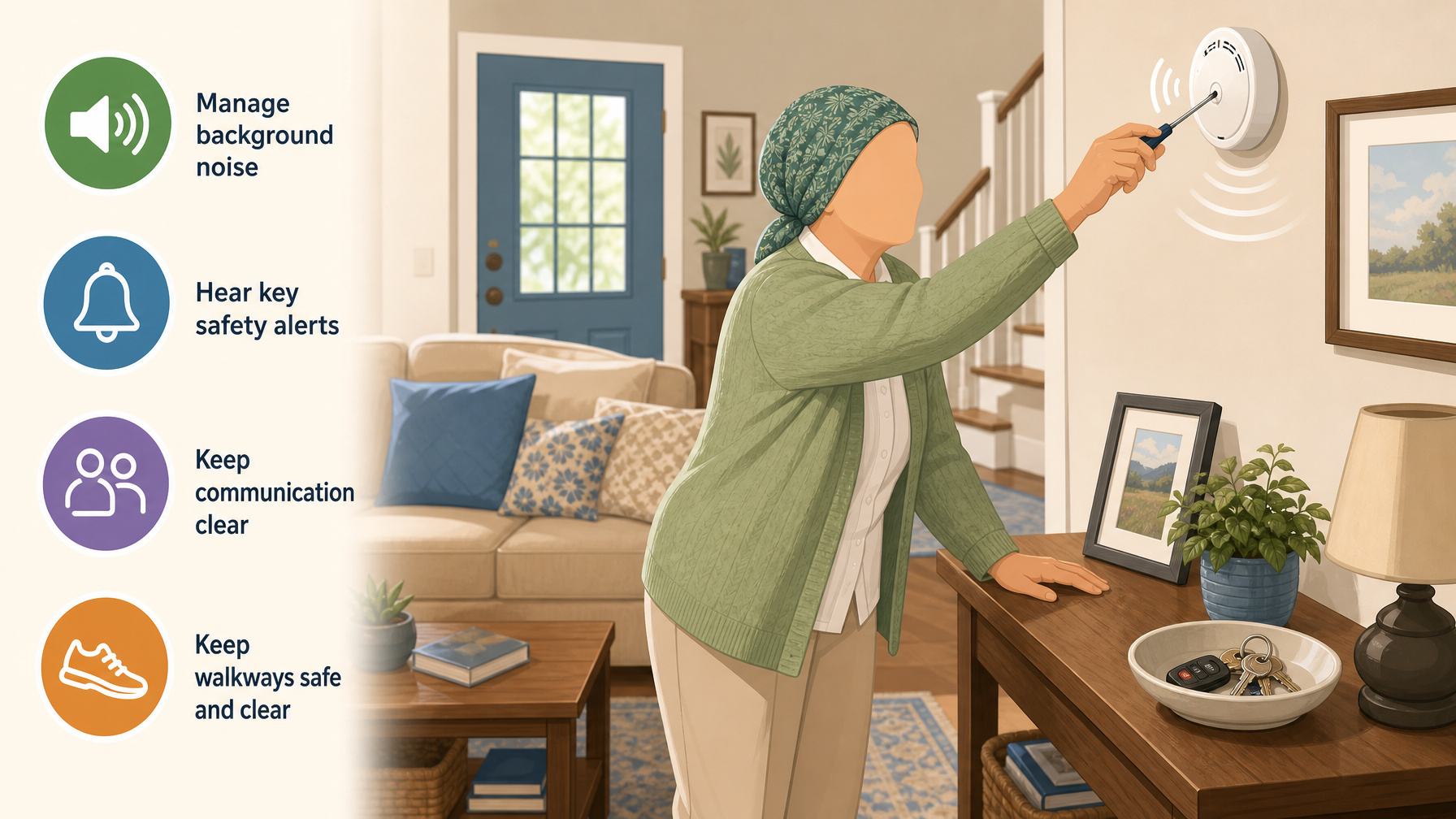
These home changes help seniors with hearing loss move more safely:
Night Lights
Motion-sensor night lights are essential. They turn on automatically when someone walks by. This helps seniors who remove hearing aids at night.
Where to Place Them:
- • Bedroom to bathroom pathway
- • Inside bathroom near toilet
- • Hallways and stairways
- • Kitchen entrance
Clear Walkways
Seniors with hearing loss can't hear when they're about to bump into something. Keep pathways completely clear.
Clear These Areas:
- • Bedroom to bathroom path (most critical)
- • Kitchen walkways
- • Living room traffic areas
- • Entryways and doorways
Rule: If you can't walk through with your eyes closed, it's not clear enough.
Bathroom Grab Bars
The bathroom is the most dangerous room. Grab bars provide support when hearing and balance are both compromised.
Essential Locations:
- • Next to toilet (both sides if possible)
- • Inside shower or tub
- • Outside shower entrance
- • Near bathroom sink
Medical Alert Devices
Seniors with hearing loss may not be able to call for help after a fall. A medical alert device provides emergency access.
Best Features for Hearing Loss:
- • Fall detection (automatic alert)
- • Two-way voice with loud speaker
- • Visual confirmation lights
- • Waterproof for bathroom use
Combining Multiple Strategies Works Best
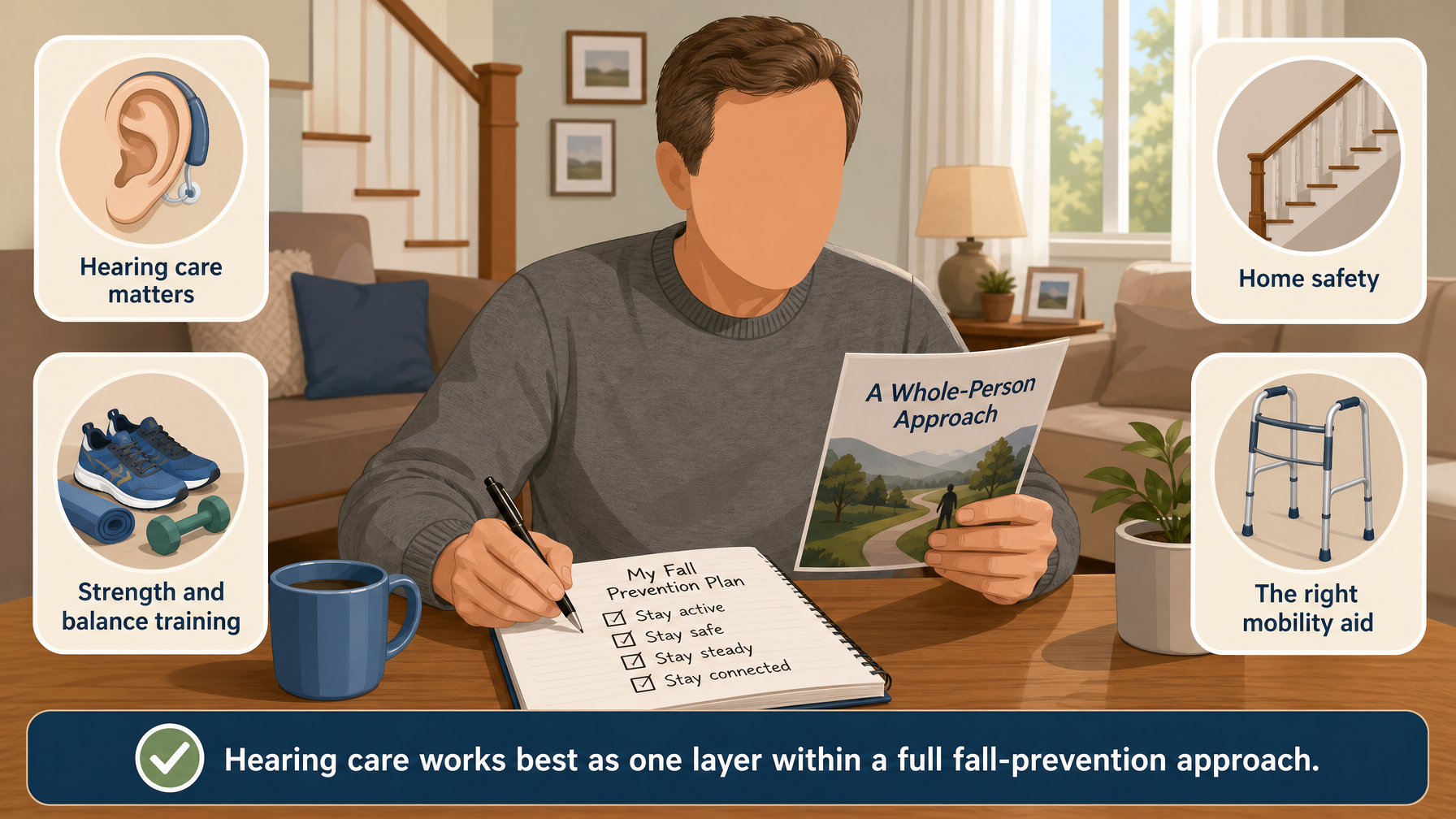
Don't rely on just one solution. Hearing aids plus good lighting plus clear pathways plus grab bars creates layers of protection.
Each layer reduces risk. Together, they can cut fall risk by 50% or more.
How Hearing Aids Can Reduce Falls
Properly fitted hearing aids do more than help you hear conversations. They can improve balance and reduce fall risk:
How They Help Balance
Restore spatial awareness
You can hear where you are in a room
Reduce cognitive load
Your brain has more energy for balance
Improve reaction time
You hear hazards before you reach them
Increase confidence
Less fear means steadier walking
Adjustment Period
Week 1-2
Sounds seem loud. Wear aids 2-4 hours daily.
Week 3-4
Getting used to it. Wear aids 6-8 hours daily.
Week 5-6
Feeling natural. Wear aids all waking hours.
Week 8+
Balance improvement becomes noticeable.
Important: Hearing aids take time to help with balance. Don't expect immediate results. Keep using fall prevention strategies during the adjustment period.
Balance Exercises for Seniors with Hearing Loss
These exercises help compensate for hearing-related balance challenges:
Single-Leg Stand
Hold a sturdy chair. Lift one foot slightly off the ground. Hold for 10 seconds. Switch legs.
Start: 10 seconds each leg
Goal: 30 seconds each leg
Heel-to-Toe Walk
Walk in a straight line. Place your heel directly in front of your toes. Use a wall for support.
Start: 10 steps with wall
Goal: 20 steps without wall
Seated Marching
Sit in a sturdy chair. Lift one knee, then the other. March slowly for 30 seconds.
Start: 30 seconds
Goal: 2 minutes
For a complete balance exercise program, read our Balance Exercises for Seniors guide.
When to Talk to a Doctor
Some situations require medical attention. Know when to seek help:
Call Doctor Same Day If:
- Sudden hearing changes: Hearing gets worse over hours or days.
- New dizziness: Room spinning or severe unsteadiness.
- Repeated falls: Two or more falls in six months.
- Ear pain or drainage: Could indicate infection.
- After starting new medication: Some drugs affect hearing and balance.
Schedule Appointment If:
- Gradual hearing decline: Hearing has gotten worse over months.
- Balance problems: Unsteady walking or frequent near-falls.
- Hearing aids not helping: Still having balance issues with aids.
- Avoiding activities: Staying home due to hearing or balance concerns.
- No hearing test in 2+ years: Regular testing is important.
What to Tell the Doctor
Bring this information to the appointment:
Hearing Information
- • When hearing loss started
- • One ear or both ears affected
- • Sudden or gradual change
- • Any ear pain, ringing, or fullness
- • Current hearing aids (if any)
Fall & Balance Information
- • Number of falls in past 6 months
- • When falls happen (day/night)
- • Dizziness or vertigo symptoms
- • Activities that feel unsteady
- • Current mobility aids used
If hearing loss is sudden (over hours or days), seek medical attention immediately. Read our Sudden Hearing Loss in Seniors guide for emergency warning signs.
More Helpful Guides
Learn more ways to keep your loved one safe:
Frequently Asked Questions
Medical Disclaimer
This guide is for educational purposes only. It is not medical advice, diagnosis, or treatment. It does not replace professional healthcare guidance.
Every senior's hearing loss and fall risk is different. What works for one person may not work for another. Always consult with your loved one's healthcare providers before making changes to their care plan.
Consult appropriate professionals:
- Audiologist for hearing evaluation and hearing aid fitting
- ENT (ear, nose, throat) doctor for medical hearing problems
- Physical therapist for balance assessment and exercises
- Primary care physician for overall health and medication review
- Occupational therapist for home safety modifications
If your loved one experiences sudden hearing loss, severe dizziness, or a serious fall, seek immediate medical attention. Do not wait.
Ready to Improve Safety?
Get a complete fall prevention plan and hearing support strategies