
AngelSense Review for Seniors with Dementia
 By SK Kutubuddin, Founder & Senior Care Researcher Updated October 29, 2026
In this guide
- Pros and cons
- What AngelSense is, and who it is built for
- How much AngelSense costs
- How to get AngelSense for free or paid for
- Battery life: plan on charging it every night
- How the tracking and alerts work
- Listen-in, two-way voice, and does AngelSense record?
- Fall detection and the SOS button
- Is AngelSense waterproof?
- AngelSense vs AirTag, Jiobit and other trackers
- What AngelSense says
- How it compares to other dementia trackers
- Frequently asked questions
AngelSense locks onto clothing so it stays on, reports location as often as every 10 seconds during a search, and lets you talk to the wearer through a speaker that answers itself. It is also one of the most expensive trackers to run.
AngelSense is the tracker to buy when the real problem is that the device keeps coming off. It locks to clothing with magnetic pins that only a magnetic key opens, so a person with dementia cannot simply pull it off and leave it on the kitchen table. When they do wander, Runner Mode switches location updates to every 10 seconds, and you can call the device and hear or speak to them without them pressing anything.
The trade-offs are just as clear. It is one of the costliest trackers to run, at roughly $45 to $65 a month depending on the plan, and the tracker lasts up to 24 hours a charge, so it needs charging every night. Voice is capped at 60 minutes a month, and fall detection is a beta add-on with its own fee. For someone in the early stages who still keeps a device on, a Tracki Mini does the locating job for far less. Once devices start disappearing, AngelSense is the strongest option we have found.
We may earn a commission when you buy through links on this page, at no extra cost to you. Read our affiliate disclosure.
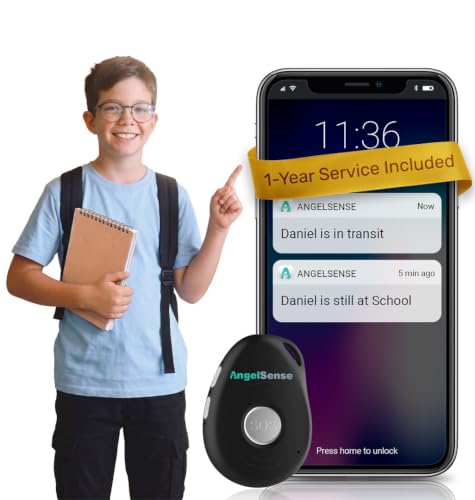
AngelSense GPS Tracker (4G, Subscription Required)
A family caring for someone with moderate-to-advanced dementia who wanders and takes off every other tracker you give them
- The locking attachment needs a magnetic key to remove, so it stays on a person who takes off watches and pocket trackers
- Runner Mode updates location every 10 seconds during a search, fast enough to follow someone on foot
- Auto-answer speakerphone lets you talk to a confused person without them pressing a button
- Learns daily routines and alerts you to unfamiliar places, not just geofence crossings
- Unlimited guardians, so siblings, carers and day programmes can all receive alerts
- Can often be paid for through Medicaid waivers and other programmes, which is rare among trackers
Type
4G cellular GPS tracker with built-in SIM
Wear
Locks to clothing; opens only with a magnetic key
Updates
Every 10 sec in Runner Mode; 30 sec in transit; up to 30 min when at a known place
Battery
Tracker up to 24 hours (2 hr charge); Watch up to 16 hours
Voice
1-way listen-in and 2-way auto-answer speaker, 60 min/month
Alerts
Wandering, unfamiliar place, arrival/departure, SOS (Watch)
Fall detection
Beta, extra monthly fee
Running cost
About $45–$65/month by plan (confirm at angelsense.com)
Waterproof
Tracker no (waterproof pouch sold separately); Watch IPX7
What we like
- The locking attachment needs a magnetic key to remove, so it stays on a person who takes off watches and pocket trackers
- Runner Mode updates location every 10 seconds during a search, fast enough to follow someone on foot
- Auto-answer speakerphone lets you talk to a confused person without them pressing a button
- Learns daily routines and alerts you to unfamiliar places, not just geofence crossings
- Unlimited guardians, so siblings, carers and day programmes can all receive alerts
- Can often be paid for through Medicaid waivers and other programmes, which is rare among trackers
- 30-day money-back period from when the kit arrives (first device)
Worth noting
- One of the most expensive trackers to run: roughly $45–$65 a month, plus an activation fee on some plans
- The tracker lasts up to 24 hours, so it must be charged every night, and battery is shorter for about two weeks while it learns routines
- Voice is capped at 60 minutes a month across listening and talking
- Fall detection is still in beta, cannot catch every fall, and costs extra
- The tracker itself is not waterproof; you need the separate waterproof pouch, or the Watch
- Larger and more visible than a pocket tag or a shoe insole
- Mainly sold direct, with plans that renew; read the contract terms before choosing a plan
Buy it if…
- Your loved one takes off or loses every other device
- They have wandered already, or you are seeing exit-seeking behaviour
- You want to hear what is happening around them, or talk to them, the moment they are found
- Several family members or carers need the same alerts
- You may qualify for Medicaid waiver or state assistive-technology funding
Look elsewhere if…
- Early stage, and they will reliably carry a pocket device: the Tracki Mini costs far less to run
- They refuse anything visible: a GPS SmartSole hides inside a shoe
- They live fairly independently and need to call a 24/7 monitoring centre: look at a medical alert system
- Nobody can charge a device every single night
What AngelSense is, and who it is built for
AngelSense is a cellular GPS tracker designed for people who cannot be relied on to keep a device on themselves, or to explain where they are. It began as a tracker for children with autism and now sells an elderly version marketed to families caring for someone with Alzheimer’s or another dementia.
There are two devices. The AngelSense GPS tracker (the current generation is called GPS4) is a small rounded unit that sits in a sleeve or pouch and locks onto clothing. The AngelSense Watch is a wrist-worn version with an SOS button. Both have their own built-in 4G SIM, so they report position wherever there is mobile coverage, with no phone needed on the wearer.
What makes it different from a normal GPS tag is the attachment. The tracker fixes to a waistband, belt or undershirt with magnetic pins, and the pins only release with a separate magnetic key that you keep. To the wearer, it simply does not come off. For dementia care that matters more than any feature on the spec sheet, because a tracker in a drawer finds nobody.
The starter kit includes the GPS device, the magnetic key, three fasteners and a sleeve. Optional accessories include a sensory-friendly sleeve, a cut-to-fit belt, an undershirt with a pocket, an armband, a belt clip, a lanyard and a waterproof pouch.
How much AngelSense costs
AngelSense is a subscription service. The device does nothing without a plan, and the plan is where most of the cost sits. These are the plan prices reported by SafeWise in April 2026. AngelSense changes offers often and its own pricing page shows prices at checkout, so confirm the current price at angelsense.com before you buy.
The device itself lists at around $229 but is often included free on a 12-month plan. Extra devices on the same account are reported at about $30 a month each. Every plan includes unlimited tracking and alerts, unlimited guardians and safe places, 60 minutes a month of voice, the built-in SIM, an onboarding call, free shipping and a 30-day money-back period from when the kit arrives (first device only).
How to think about it: at about $540 a year on the annual plan, AngelSense costs several times as much as a basic tracker like the Tracki. That gap is the price of the locking clip, the voice features and the routine-learning alerts. If the person still keeps a device on, you are paying for features you do not need yet.
Coupon codes: AngelSense runs periodic promotions, such as a free device or a reduced activation fee, on its own site. We do not have an exclusive code. Be cautious with coupon sites that promise large percentage discounts.
| Plan | Monthly cost | Activation | Commitment |
|---|---|---|---|
| Month-to-month | About $64.99 | $59 | None; cancel any time |
| Monthly, 1-year contract | About $49.99 | $19 | 12 months |
| Annual (paid upfront) | About $44.99 (~$539.88/year) | Check at checkout | 12 months |
How to get AngelSense for free or paid for
Many families ask whether AngelSense can be free. It can sometimes be fully or partly funded, but not through Original Medicare, which does not normally cover GPS trackers. AngelSense’s own funding guide for older adults lists these routes:
- Medicaid Home and Community-Based Services (HCBS) waivers. Many states let waiver funds pay for assistive technology that keeps a person safe at home. Ask the care coordinator or case manager, and ask for the device to be added to the care plan.
- Medicare Advantage plans. Some plans include extra safety or monitoring benefits. Call the plan and ask specifically about GPS or personal locator devices.
- State assistive-technology programmes. Every state has one, and some fund or loan devices.
- Easter Seals and local non-profits, including Area Agencies on Aging and local Alzheimer’s organisations.
- Tax deductions. A tracker bought for a medical need may count as a medical expense. Check with a tax professional.
The practical step is to get the need written down: a note from the doctor that the person has dementia and a history of, or risk of, wandering makes every one of these applications easier.
Battery life: plan on charging it every night
AngelSense states the GPS tracker lasts up to 24 hours on a charge and takes about two hours to recharge. The Watch lasts up to 16 hours and charges in about an hour. Some older reviews quote longer figures. The 24-hour number is the manufacturer’s current one.
Two details catch families out. First, battery life is shorter for roughly the first two weeks while the system learns the person’s routine and places. Second, “up to 24 hours” means up to. Weak signal, a lot of time on the move, and frequent listen-in calls all drain it faster.
In practice this is a nightly charge, like a phone. The easiest routine is to unlock it at bedtime, charge it while they sleep, and lock it back on when they dress. If they get up and wander at night, a door alarm or bed alarm covers the hours when the tracker is on the charger.
How the tracking and alerts work
AngelSense does not update on one fixed schedule. According to its help centre, the device updates up to every 30 minutes when the person is at a known place, more often once they move, every 30 seconds while they are in transit, and every 30 seconds for the first 10 minutes at an unfamiliar place.
When someone is missing, Runner Mode switches updates to every 10 seconds. In newer app versions it starts automatically when you open the app, and it stops five minutes after you close the app. It needs mobile signal to receive the start command, so it may not start in a dead zone.
The alerts are where AngelSense earns its price. Instead of only drawing a fence around the house, it learns the person’s normal places and routes, and tells you when they arrive somewhere, leave somewhere, or turn up somewhere unfamiliar. For a person who walks the same loop every day, an “unknown place” alert is often the first sign something is wrong.
Indoors, it uses Wi-Fi as well as GPS, and optional beacons can show which part of a building or home someone is in.
Listen-in, two-way voice, and does AngelSense record?
You can call the device from the app in two ways. 1-way voice lets you listen to what is happening around the wearer. 2-way voice opens a speakerphone that answers automatically, so you can talk to someone who is confused or frightened without them having to find and press a button. For a person with dementia who has wandered, hearing a familiar voice say “stay where you are, I’m coming” can matter as much as the map.
Voice time is capped at 60 minutes a month on every plan, shared between listening and talking. That is plenty for emergencies but not enough to check in by voice every day.
Does AngelSense record? No. AngelSense states the device cannot record audio or video. Listening is live only, and the company says voice quality is limited and not suited to eavesdropping. Voice features can be switched off for set hours, for example while the person is at a day programme.
Privacy and consent: using a tracker for the safety of a person you care for is widely accepted in dementia care. Where you can, involve them while they can still take part in the decision, or act through a health-care power of attorney or guardian, and follow your state’s rules on listening devices.
Fall detection and the SOS button
Fall detection exists, but treat it as a bonus rather than a reason to buy. According to AngelSense, it is still in beta, enabled through Customer Care, and works by spotting an impact followed by a period of no movement that you set. You get a “We detected a Fall” app notification or email. AngelSense says plainly that it cannot detect every fall, that vigorous activity can trigger false alerts, and that it plans to charge about $9 a month on monthly plans, or $7.50 a month on annual plans, once it leaves beta.
Alerts go to family through the app, not to a 24/7 monitoring centre. If falls are the main worry, a medical alert system with fall detection that connects to a live operator is the better tool.
The SOS button is on the AngelSense Watch, where you hold it for three seconds once it is enabled in the app. That only helps if the person can still understand and remember to use it, which is often not the case in later-stage dementia.
Is AngelSense waterproof?
The GPS tracker itself is not waterproof. AngelSense sells a waterproof sleeve or pouch for it, which is worth buying if the person walks in the rain or might go into water. Do not put the bare tracker through the wash. Unlocking it before clothes go in the laundry basket should be part of the evening routine.
The AngelSense Watch is rated IPX7, which covers splashes and brief immersion, but it is not designed for swimming.
AngelSense vs AirTag, Jiobit and other trackers
AirTag vs AngelSense: these are not the same kind of product. An AirTag has no GPS or SIM of its own. It reports a location only when someone else’s iPhone passes nearby, and Apple builds in alerts that tell other people an unknown AirTag is moving with them. It is a good backup in a wallet. It is not a safeguard for a person who wanders.
Jiobit vs AngelSense: Jiobit, from Life360, is a small clip-on cellular tag made mostly for children and pets. It is cheaper and lighter, but it has no voice and no locking attachment. It suits someone who will keep it on. AngelSense suits someone who will not.
Tracki vs AngelSense: the Tracki Mini is a real cellular tracker that costs far less to buy and run, with about five days of battery at real-time updates. It has no voice, no SOS, and nothing stopping it being taken out of a pocket.
SmartSole vs AngelSense: the GPS SmartSole hides inside a shoe, so the wearer does not know it is there. It only works when those shoes are worn, and it has no voice. It is the answer for someone who rejects anything visible.
What AngelSense says
The following are AngelSense’s own marketing claims from the product listing, not our independent findings. Details can change over time — check the current Amazon listing for the latest.
- AngelSense markets its elderly tracker for people with Alzheimer’s and dementia, with unlimited GPS tracking, wandering and unfamiliar-place alerts, arrival alerts with estimated arrival times, and unlimited guardians.
- The company states the GPS tracker battery lasts up to 24 hours with about a two-hour charge, and the Watch up to 16 hours with about a one-hour charge.
- AngelSense states the device locks to clothing with magnetic pins that open only with the supplied magnetic key.
- The company states the device cannot record audio or video, and that fall detection is in beta and cannot detect all falls.
- AngelSense’s funding guide lists Medicaid HCBS waivers, state assistive-technology programmes, Easter Seals, local programmes and possible tax deductions as ways to pay.
How it compares to other dementia trackers
AngelSense is our overall pick for dementia wandering because it solves the hardest problem, keeping the device on, better than any other tracker we have reviewed. The alternatives win on price, discretion, or when the person needs to call for help themselves.
- Tracki Mini GPS Tracker — a fraction of the running cost and about five days of battery at real-time updates, but it lives in a pocket and can be taken out and set down. The better first step in early-stage dementia.
- GPS SmartSole — a tracker sealed inside a shoe insole, invisible to the wearer. No voice, and it only works in those shoes. The answer for someone who refuses any visible device.
- Medical Guardian Mini Guardian — a mobile medical alert with a help button to a 24/7 monitoring centre. The better category when the person can still call for help themselves.
Frequently asked questions
Yes, especially for moderate-to-advanced dementia where the person wanders and removes other devices. Its locking attachment keeps it on, Runner Mode updates every 10 seconds during a search, and the auto-answer speaker lets you talk to them once you find them. It is expensive to run and needs charging every night, so for early-stage dementia a cheaper pocket tracker is often enough.
SafeWise reported, in April 2026, about $64.99 a month with no contract (plus a $59 activation fee), about $49.99 a month on a one-year contract ($19 activation), or about $44.99 a month on the annual plan paid upfront (around $540 a year). The device lists at around $229 but is often included free on a 12-month plan. Prices and offers change, so check angelsense.com before buying.
It can sometimes be funded. AngelSense lists Medicaid Home and Community-Based Services (HCBS) waivers, state assistive-technology programmes, Easter Seals and local non-profits, and some Medicare Advantage plans. Original Medicare does not normally cover it. A doctor’s note confirming dementia and wandering risk helps any application. A tracker bought for a medical need may also be tax-deductible; check with a tax professional.
AngelSense states up to 24 hours for the GPS tracker, with about a two-hour recharge, and up to 16 hours for the Watch. Battery life is shorter for about the first two weeks while it learns routines, and heavy use of voice or weak signal reduces it further. Plan to charge it every night.
No. AngelSense states the device cannot record audio or video. You can listen live (1-way voice) or talk through its auto-answer speaker (2-way voice), with 60 minutes a month included. Voice features can be turned off for set hours.
The GPS tracker is not waterproof. AngelSense sells a waterproof sleeve or pouch for it. The AngelSense Watch is rated IPX7, which covers splashes and brief immersion but not swimming.
Yes, but it is in beta. It must be turned on by Customer Care and alerts family through the app or email, not a monitoring centre. AngelSense says it cannot detect every fall and plans to charge about $9 a month on monthly plans, or $7.50 a month on annual plans, once it leaves beta.
Not for a person who wanders. An AirTag has no GPS or cellular connection of its own and only reports a location when someone else’s iPhone passes nearby, and anti-stalking alerts can warn others it is moving with them. Use it as a backup in a wallet, not as the main safeguard.
For a lower monthly cost, the Tracki Mini is a real cellular GPS tracker for someone who will carry it in a pocket. For someone who refuses visible devices, the GPS SmartSole hides inside a shoe. If the person can still call for help, a mobile medical alert with a 24/7 monitoring centre is the better category. Our full comparison is in the best GPS trackers for dementia patients guide.
AngelSense lists a toll-free number, 1-888-999-2023, on its website, along with a help centre at angelsense.com/help. Fall detection is switched on through Customer Care.
AngelSense GPS Tracker (4G, Subscription Required)
Best for: A family caring for someone with moderate-to-advanced dementia who wanders and takes off every other tracker you give them
More reviews
