
Dementia Wandering: Why It Happens and How to Keep Them Safe

Educational guidance based on dementia-care principles; not medical advice. If a person with dementia is missing, treat it as an emergency and call for help immediately.
Wandering is one of the most frightening dementia behaviors, because getting lost can be dangerous. Understanding why it happens — and layering prevention with safety measures — can help keep a loved one protected without taking away their freedom to move.
Key takeaways
- Wandering is usually purposeful in the person’s mind — searching, restlessness, boredom, or trying to "go home" or "to work" — not random.
- Reduce it by meeting the underlying need — activity, routine, reassurance, exercise, and addressing discomfort — before relying on restriction.
- Layer safety measures: secure exits, door alarms, GPS trackers, and ID on the person.
- Plan ahead for the worst case — have a recent photo, key information, and a response plan ready, and consider a wandering-response registry if available locally.
- If the person is missing, act immediately — search nearby, then call emergency services; do not wait.
Quick answer
How do I stop a person with dementia from wandering?
First reduce the urge by meeting the underlying need — a predictable routine, regular activity and exercise, reassurance, and addressing hunger, pain, boredom, or restlessness. Then layer safety measures: secure and camouflage exits, fit door alarms and consider a GPS tracker, and make sure the person carries ID. Plan ahead with a recent photo and key details. If they go missing, search the immediate area and call emergency services without delay.
Why people with dementia wander
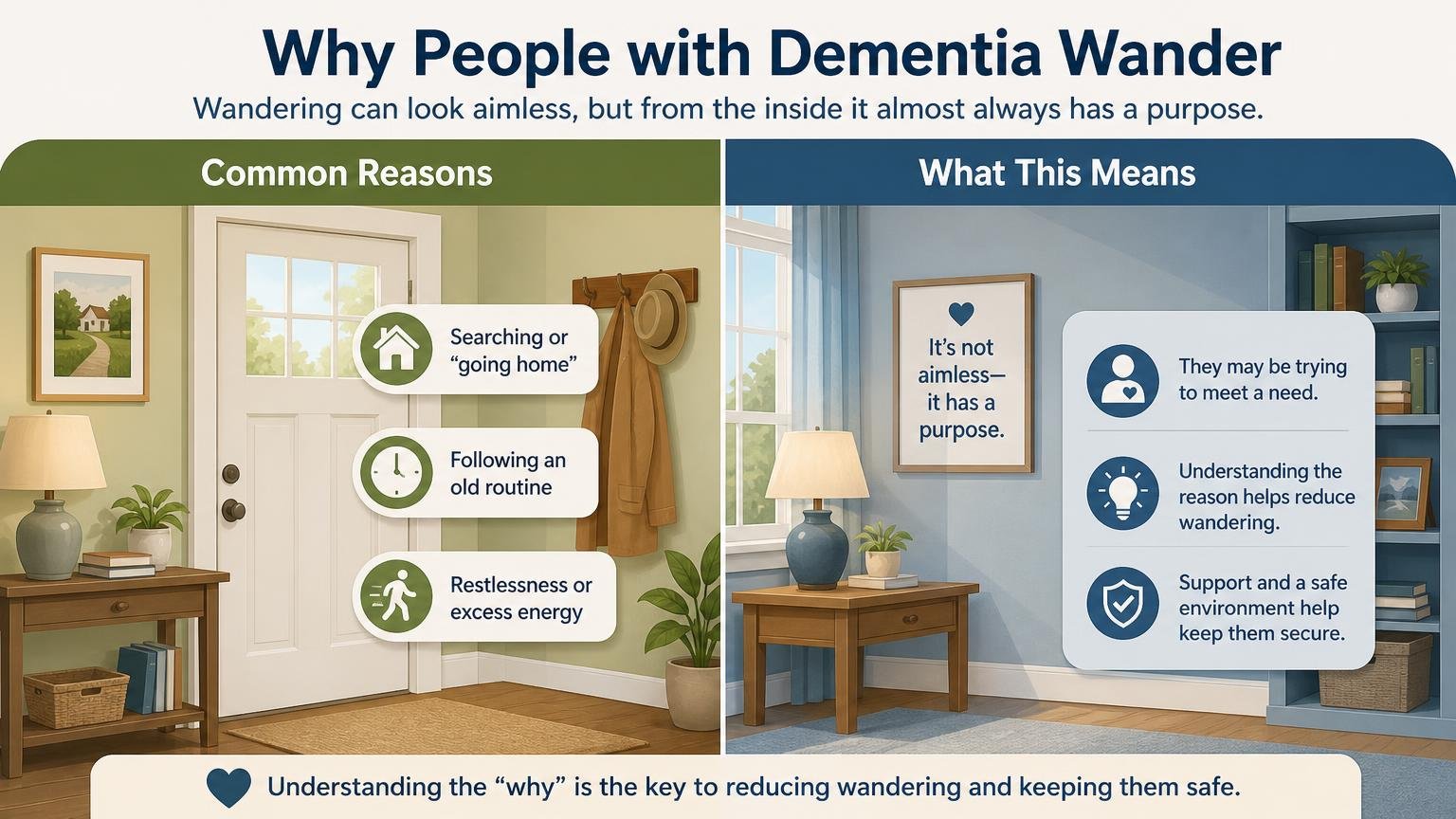
Wandering is common — the Alzheimer’s Association estimates that about 6 in 10 people with dementia will wander at least once. Wandering can look aimless, but from the inside it almost always has a purpose — understanding that purpose is the key to reducing it. A person with dementia may be acting on a memory, a need, or a feeling they can no longer express in words.
- Searching or "going home" — even when they are home, dementia can make a familiar place feel unfamiliar, prompting a search for a home, person, or time that feels real to them.
- Following an old routine — heading "to work" or "to pick up the children," reliving a long-ingrained habit.
- Restlessness or excess energy — a need to move, especially with too little daytime activity.
- Boredom or under-stimulation — with nothing to do, moving becomes the activity.
- Discomfort or an unmet need — pain, hunger, thirst, needing the toilet, or wanting to escape noise or overstimulation.
- Confusion and disorientation, particularly in the late day with sundowning or at night.
An ElderlyDaily original
Want the whole thing in one place?
Dementia Caregiver Command Center
- Daily care and medication logs in one place
- Behaviour-pattern tracking, to spot what makes a day harder
- Safety pages and caregiver handoff sheets for family and respite helpers
One-off purchase. Instant download.
Fillable PDF · US Letter + A4

Sponsored Pick
Tracki Mini GPS Tracker
Early-to-mid dementia, where the person will carry something but refuses to wear a device
Check PriceReducing wandering by meeting the need
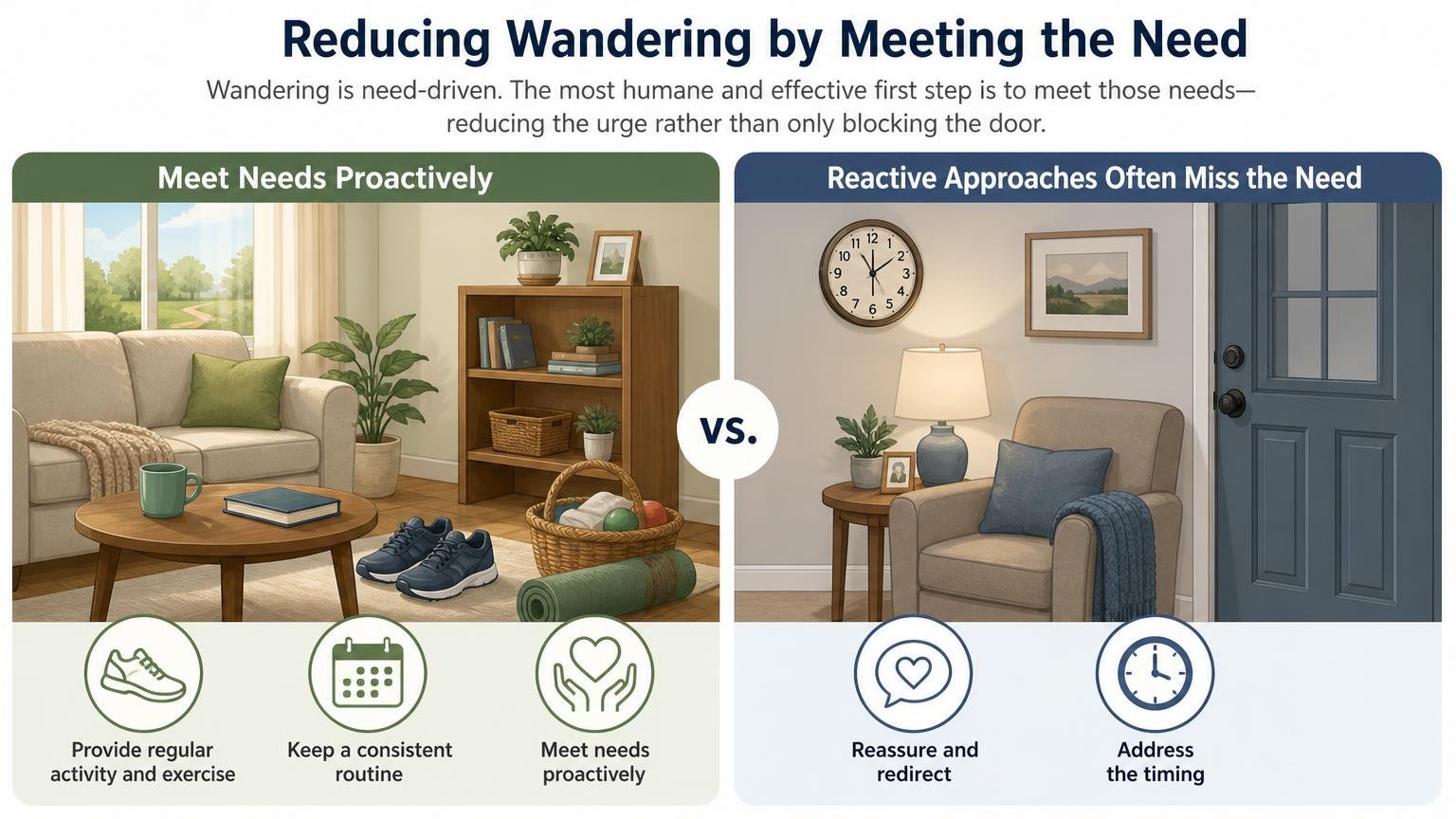
Because wandering is need-driven, the most humane and effective first step is to meet those needs — reducing the urge rather than only blocking the door. This preserves dignity and freedom of movement:
- Provide regular activity and exercise — safe daily walks and meaningful activities channel restless energy and reduce the drive to wander.
- Keep a consistent routine so the day feels predictable and less anxiety-provoking — see dementia daily routine.
- Meet needs proactively — regular toileting, meals and drinks, and comfort checks head off wandering driven by discomfort.
- Reassure and redirect when the person wants to leave — validate the feeling ("You want to get home — let’s have a cup of tea first") and gently redirect, as in how to calm a dementia patient.
- Address the timing — if wandering peaks in the late day, work on sundowning; if at night, on sleep.
Good to know
When someone insists on leaving, arguing rarely works and often escalates. Agreeing, walking with them briefly, and gently redirecting ("Let’s go together — but let’s have lunch first") is usually far more effective than a locked door and a "no."
Securing the home
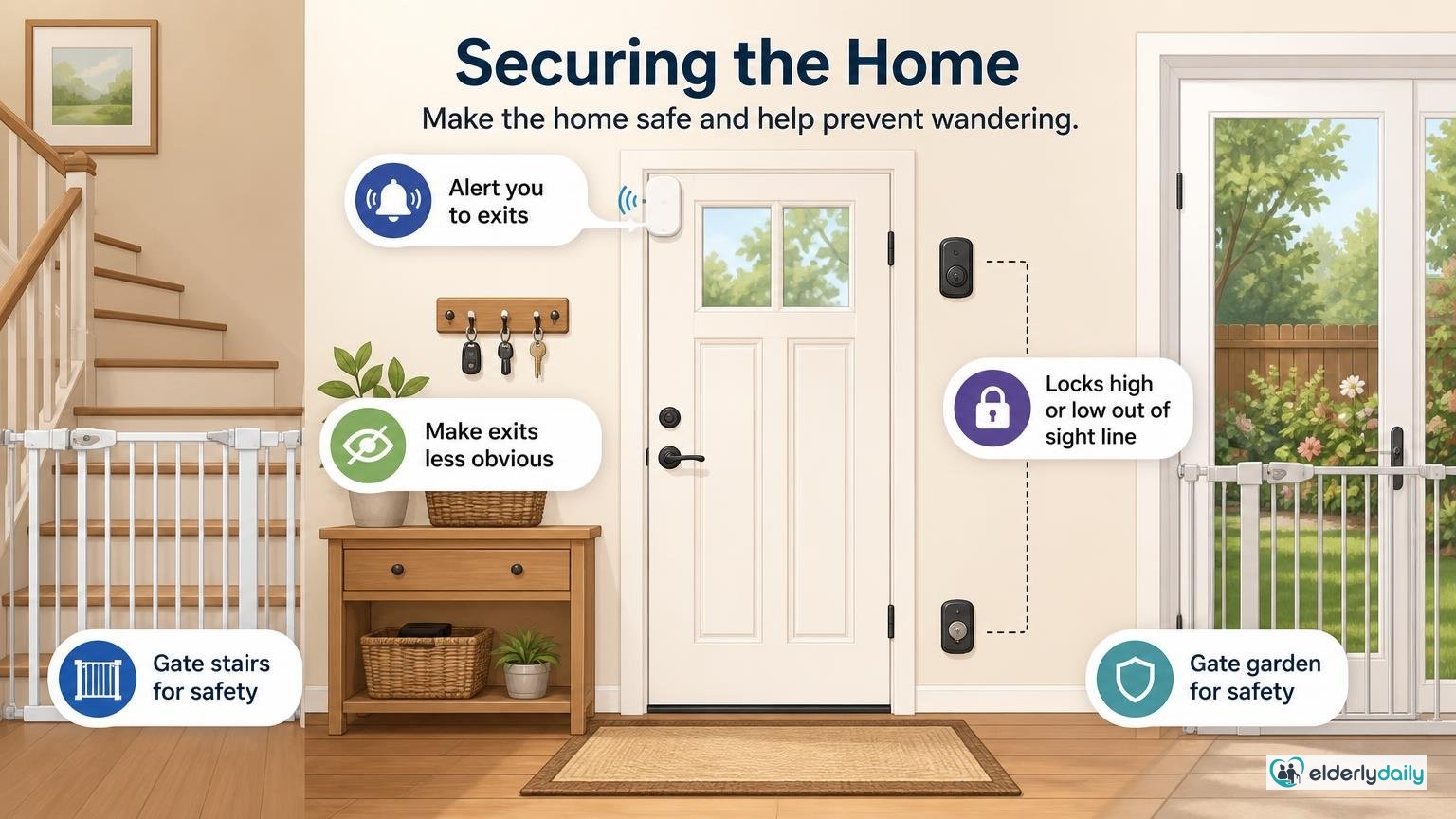
Alongside meeting needs, make the home safe so that if the urge strikes, the person cannot slip out unnoticed into danger:
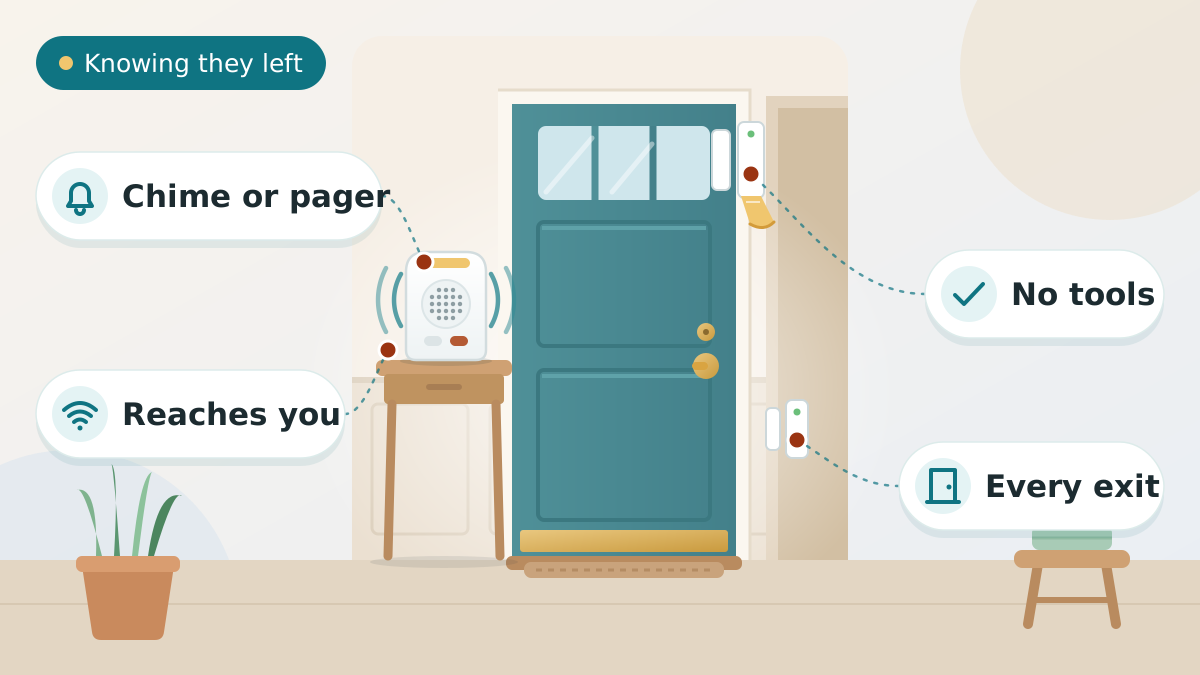
- Alert you to exits — fit door alarms or exit sensors so you know immediately if an outside door opens, day or night.
- Make exits less obvious — locks placed high or low out of the usual sight line, or visually camouflaging doors, can reduce the impulse to leave (use judgment and never compromise fire safety or trap the person).
- Use monitoring where helpful — monitoring systems or a bed alarm can alert you to night-time movement.
- Reduce triggers near doors — keep coats, shoes, keys, and bags out of sight if they cue "time to go."
- Secure the wider environment — gates on stairs and, where relevant, in the garden, plus general home safety and fall prevention.
Safety first
Never lock a person with dementia in alone in a way that would trap them in a fire or emergency, and never restrain them. The goal is to alert you and slow an exit, not to imprison — safety and dignity both matter.
Technology and ID for locating
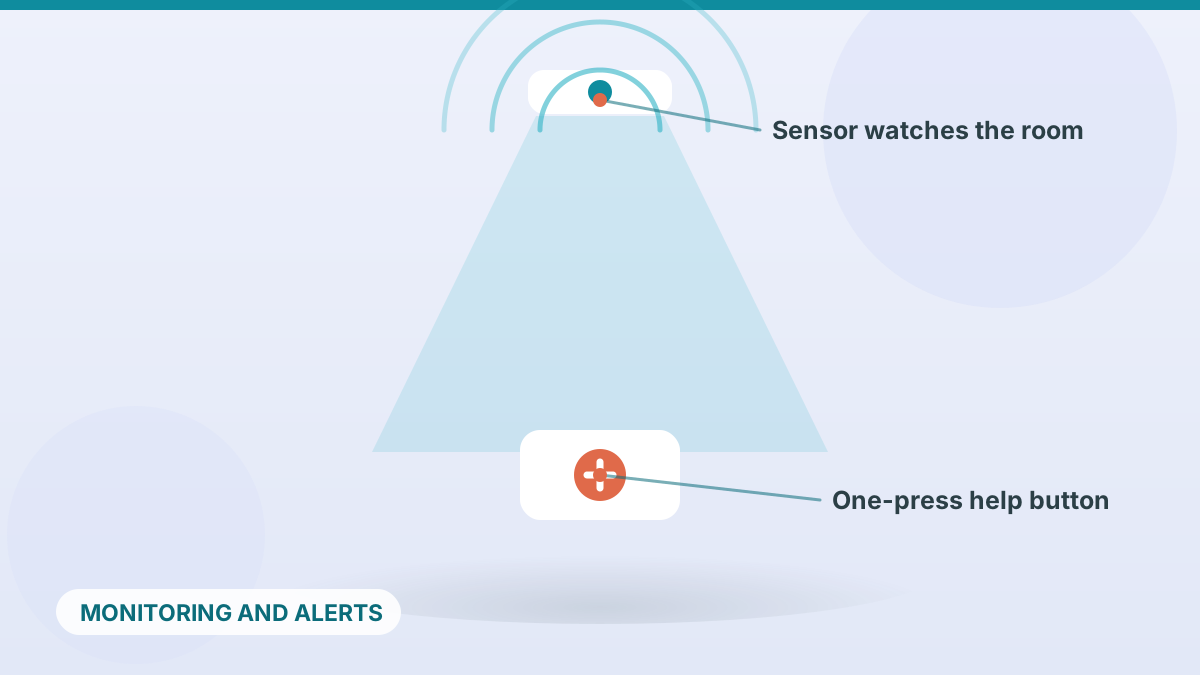
If the person does get out, being able to find them quickly is vital. Prepare these in advance:
- GPS location devices — a GPS tracker worn as a pendant, watch, or in a shoe lets you locate the person quickly if they wander. This is one of the most valuable safeguards for someone at risk.
- Identification on the person — an ID bracelet or card with their name, "memory impairment," and an emergency contact number, so anyone who encounters them can help.
- Consider a wandering-response or "safe return" program if one is available in your area, which helps reunite people quickly.
- Tell neighbors and nearby shops that the person has dementia and may wander, and share your contact number — a watchful community is a real safety net.
Have a plan before it happens
The time to prepare is before a wandering incident, so that if it happens you can act fast:
- Keep a recent, clear photo of the person readily available.
- Have a written note of key details — description, medical conditions, medications, places they might head (a former home, workplace, or a favourite spot).
- Know your immediate response plan — where to check first, who to call, and how to give responders the photo and details fast.
- Identify the most likely destinations — people with dementia often head toward a meaningful place from their past.
What to do if they go missing
If a person with dementia is missing, treat it as an emergency — they can be at serious risk from traffic, weather, or getting lost, and time matters:
- 1
Search the immediate area right away
Quickly check the home, garden, and nearby surroundings, and the direction of any likely destination — many people are found close by soon after.
- 2
Call emergency services without delay
If not found within a few minutes, call emergency services. Do not wait — tell them the person has dementia and is a vulnerable adult, and provide the photo and details you prepared.
- 3
Use your GPS device
If the person wears a GPS tracker, use it to locate them and guide responders.
- 4
Enlist help
Alert neighbors, nearby shops, and any wandering-response program, and mobilize family to search likely spots.
- 5
After they are safe, review
Once the person is safe, reflect on what triggered it and tighten prevention — more activity, better exit alerts, or addressing the timing.
Safety first
Do not delay calling for help out of embarrassment or hope that they will return. A missing person with dementia is a genuine emergency — fast action gives the best chance of finding them safely.
Frequently asked questions
Why do people with dementia wander?
Wandering is usually purposeful from the person’s perspective — searching for a home, person, or time that feels real; following an old routine like "going to work"; restlessness or excess energy; boredom; or an unmet need such as pain, hunger, or needing the toilet. Confusion, sundowning, and night-time disorientation also drive it. Understanding the reason is key to reducing it.
How do I stop my parent with dementia from wandering?
Start by meeting the underlying need — regular activity and exercise, a predictable routine, proactive comfort and toileting, and reassurance with gentle redirection when they want to leave. Then layer safety: secure and camouflage exits, fit door alarms, use monitoring, and remove door cues like coats and keys. Reducing the urge is more humane and effective than only locking doors.
What technology helps with dementia wandering?
GPS location devices (worn as a pendant, watch, or in a shoe) let you find the person quickly if they wander, and door alarms or exit sensors alert you the moment a door opens. Monitoring systems and bed alarms help with night-time movement. Pair technology with ID on the person and, where available, a wandering-response program.
Is it safe to lock someone with dementia in the house?
You can secure exits and use alarms to slow an exit and alert you, but you must never trap the person in a way that would prevent escape in a fire or emergency, and never restrain them. The aim is safety with dignity — alerting you and reducing the impulse to leave, not imprisonment. Always preserve fire-safe exits.
What should I do if my parent with dementia goes missing?
Treat it as an emergency. Immediately search the home, garden, and nearby area and any likely destination, and if not found within a few minutes, call emergency services — say the person has dementia and is a vulnerable adult, and provide a recent photo and details. Use any GPS device, alert neighbors, and do not delay out of embarrassment.
Should someone with dementia who wanders wear a GPS tracker?
For someone at real risk of wandering, yes — a GPS tracker is one of the most valuable safeguards, letting you locate them quickly and guide responders. Combine it with identification on the person (name, "memory impairment," and a contact number) so anyone who encounters them can help.
Sources
- Alzheimer's Association. Wandering (prevention and safety)
- National Institute on Aging (NIH). Coping With Alzheimer's Behaviors: Wandering and Getting Lost
