
GPS SmartSole Review
 By Kutubuddin, Founder & Senior Care Researcher Updated October 16, 2026
In this guide
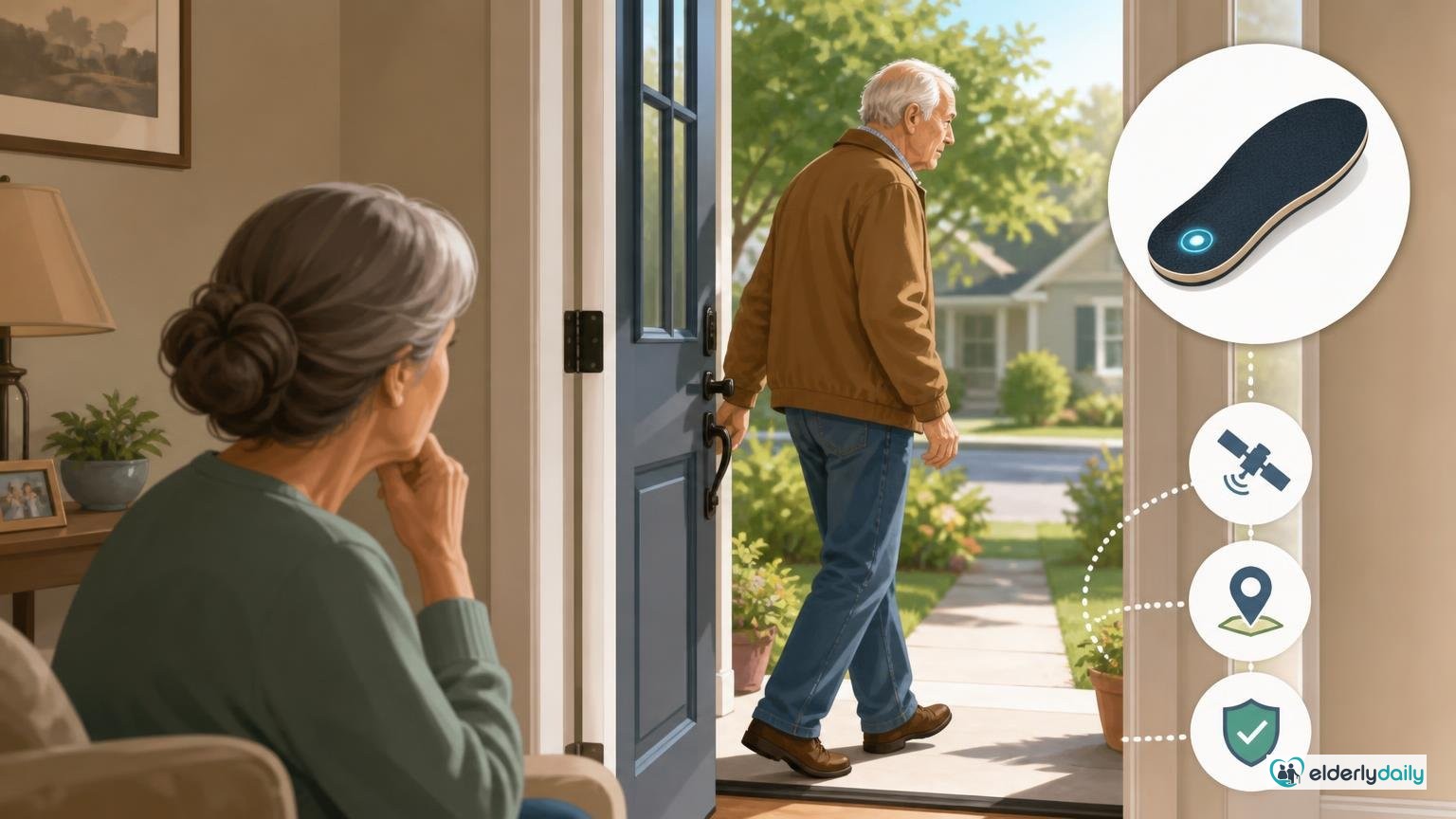
The GPS SmartSole hides a 4G tracker inside a trim-to-fit shoe insole. It is the answer when every wearable ends up in a drawer — with two real constraints: it only works when the shoes are on, and it needs charging every couple of days.
The GPS SmartSole solves a problem no wearable can. When someone removes bracelets, unclips pendants and empties their pockets, a tracker sealed inside a shoe insole is invisible, cannot be felt underfoot, and is unlikely to be noticed or removed. For late-stage dementia that is not a marginal advantage — it is the difference between a tracker that works and one that sits in a drawer.
Two constraints decide whether it fits: it only tracks when the shoes are being worn, so if your relative wanders in slippers or barefoot, this is the wrong tool. And the battery runs two to four days, with the manufacturer recommending you charge it daily — lifting the insole out and putting it on a charging pad as a nightly routine. It also does not track outside the United States. Be honest about which situation you are buying for.
We may earn a commission when you buy through links on this page, at no extra cost to you. Read our affiliate disclosure.

GPS SmartSole — Hidden GPS Tracking Shoe Insole (MetAlert)
A person in the later stages of dementia who removes every visible tracker, but still puts shoes on to leave the house
- Hard for the wearer to notice or remove, an advantage no clip, pendant or watch can match, though it only tracks while the shoes are worn.
- Completely invisible, so it does not trigger the resistance that visible devices often provoke
- Real-time tracking with geofence alerts by text and email through the MetAlert portal
- Trim-to-fit sizing across three sizes covers most adult shoes
- Water resistant and sealed within the foam, so ordinary weather and foot moisture are fine
- Wireless charging pad included — no fiddly cable to connect to a small device
Type
Hidden 4G GPS tracker inside a shoe insole
Sizing
Three trim-to-fit sizes; big kids to adults
Thickness
13 mm — noticeably thicker than a normal insole
Weight
~100 g per insole
Material
Polyurethane, sealed and water resistant
Battery
2–4 days; charge daily is the maker’s advice
Charging
Wireless pad included; 2–4 hours to full
Coverage
US only — **does not track internationally**
Running cost
Monitoring subscription required
What we like
- Hard for the wearer to notice or remove, an advantage no clip, pendant or watch can match, though it only tracks while the shoes are worn.
- Completely invisible, so it does not trigger the resistance that visible devices often provoke
- Real-time tracking with geofence alerts by text and email through the MetAlert portal
- Trim-to-fit sizing across three sizes covers most adult shoes
- Water resistant and sealed within the foam, so ordinary weather and foot moisture are fine
- Wireless charging pad included — no fiddly cable to connect to a small device
- FCC, IC and CE certified
Worth noting
- Only works when the shoes are on — no protection if someone wanders in slippers, socks or bare feet
- Battery runs two to four days and the maker recommends charging daily, which means lifting the insole out every night
- Does not track internationally — US coverage only
- At 13 mm it is noticeably thicker than a standard insole; a wide or half-size-larger shoe is often needed
- Coverage must be tested on arrival, and there are areas where it simply will not report
- Not intended for high-impact activity, and performance may degrade for wearers over 250 lb
- Not approved by TSA for in-flight use
- Significant upfront cost plus an ongoing monitoring subscription
Buy it if…
- Your relative removes, hides or refuses every visible tracker you have tried
- They reliably put shoes on before leaving the house
- Wandering has already happened, or the risk is high enough to justify the cost
- Someone in the household can manage a nightly charging routine
- You are tracking within the United States
Look elsewhere if…
- Your relative wanders in slippers, socks or bare feet — a pocket or clip-on tracker stays with them regardless of footwear
- You need the person to be able to call for help — look at a medical alert with an SOS button
- Nobody can commit to charging a device most nights
- You need tracking outside the United States
- Foot problems, orthotics or diabetic footwear needs mean an extra 13 mm in the shoe is not safe — ask a podiatrist first
How a tracker fits inside an insole
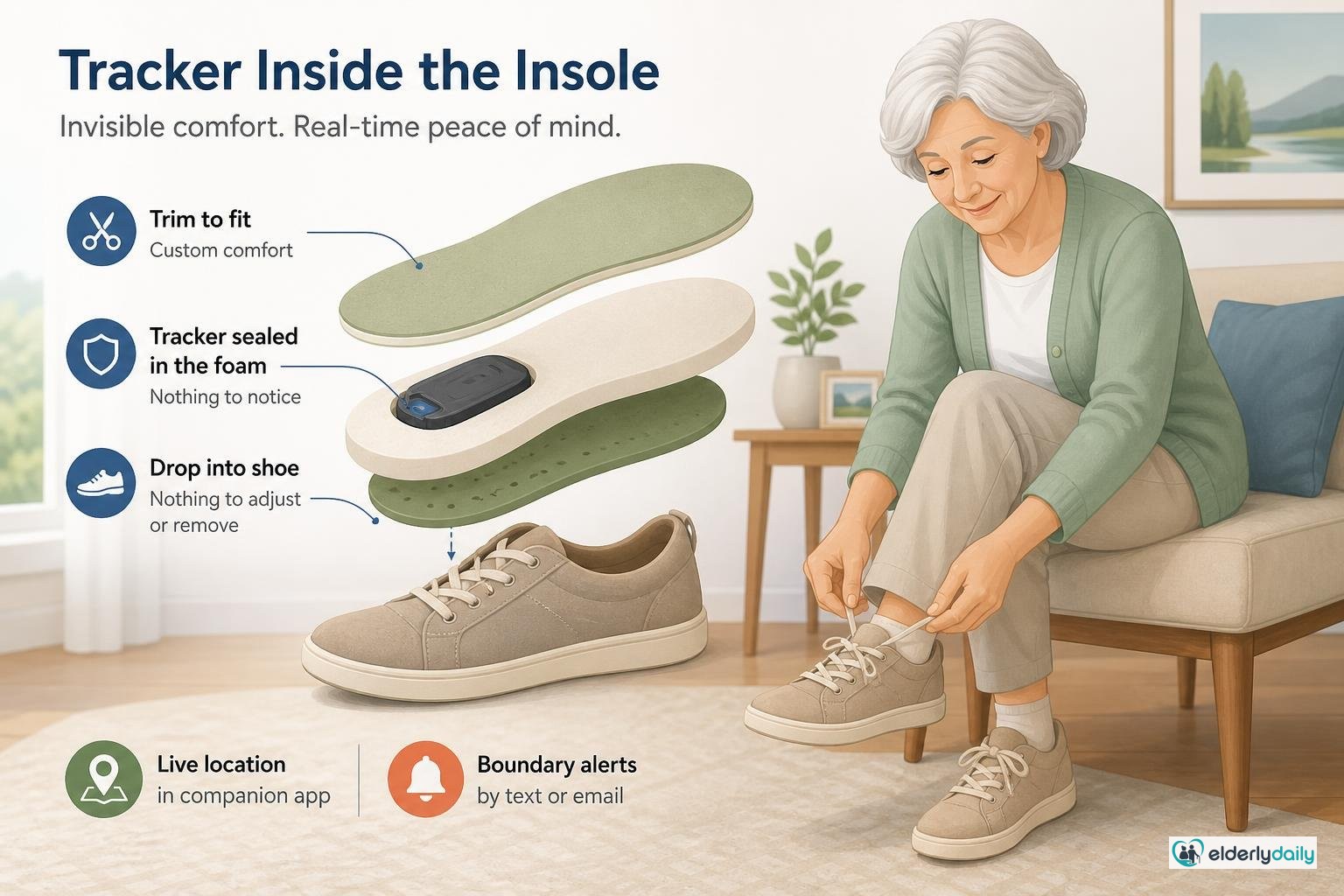
The GPS SmartSole is a shoe insert with a 4G cellular GPS tracker sealed inside the foam. You trim it to fit, drop it into the shoe, and from the wearer’s point of view nothing has happened — there is no device to notice, adjust or remove.
The tracker reports to MetAlert’s monitoring portal, and you see the position in a companion app. You can draw geographic boundaries, and crossing one triggers an alert by text or email. That is the same core function as any real-time tracker; the innovation is entirely in where it lives.
It comes in three trim-to-fit sizes covering big kids through adults, in US sizing. One insole carries the tracker — the other is a matching blank so the shoes feel even.
It is worth being clear about what this design buys you. Every other tracker on the market can be taken off. A pendant can be lifted over the head, a bracelet unclipped, a pocket emptied. For someone in the later stages of dementia, that is not a hypothetical: removing unfamiliar objects is common, and a device that ends up in a drawer protects nobody. The insole is the only form factor that removes the decision from the wearer entirely.
The limitation that decides everything
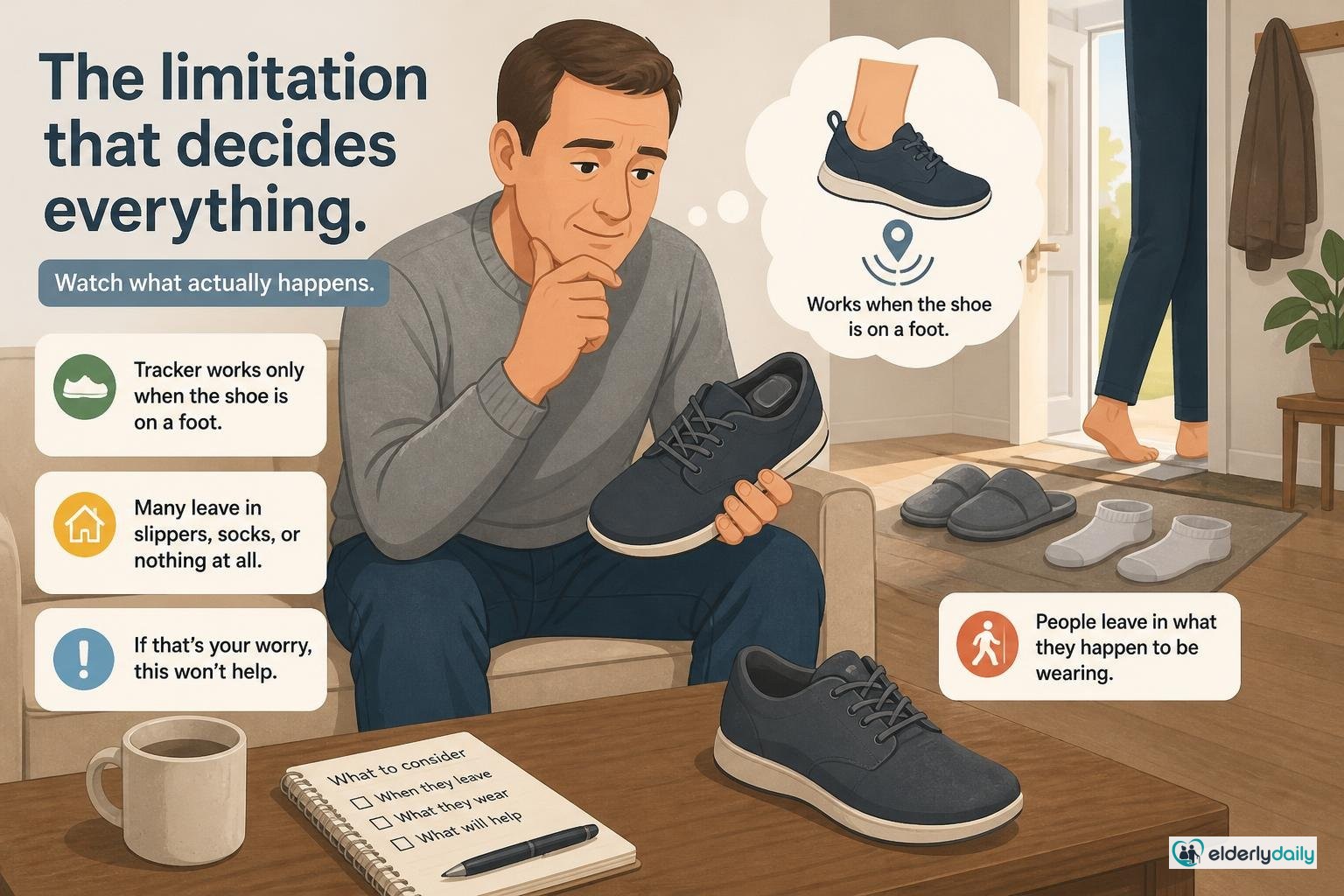
A tracker in a shoe only works when the shoe is on a foot. That sounds obvious written down, and it is the single most important thing to think through before buying.
A great many wandering incidents involve someone leaving the house in what they happen to be wearing — which is sometimes slippers, sometimes socks, occasionally nothing at all. If that describes what you are worried about, the SmartSole will not help, and no amount of other strengths compensates.
It works when the person has an established routine of putting shoes on to go out, and that routine survives their confusion. Many people retain it well into the disease, because it is deeply habitual. Others lose it early.
Two practical steps before you commit. Watch what actually happens over a few weeks — not what usually happens, but what happened the last two or three times they went to the door unexpectedly. And if the household has more than one pair of outdoor shoes in regular use, plan for that: one insole tracks one pair, so either consolidate to a single pair for going out or budget accordingly.
Battery life and the nightly routine
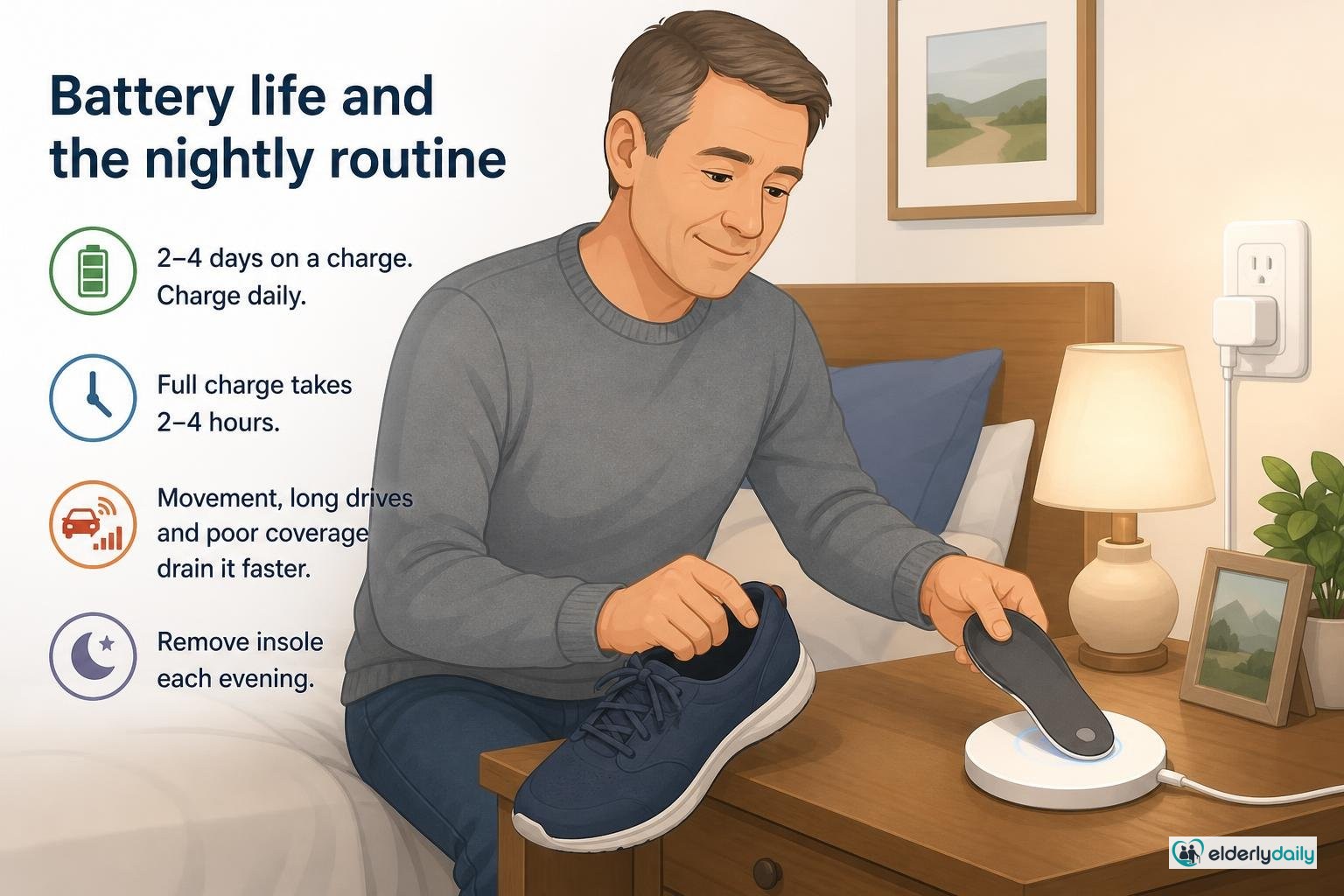
MetAlert states two to four days on a charge, and recommends charging daily, like a smartphone. A full charge takes two to four hours on the wireless pad supplied.
Take the daily advice seriously rather than treating four days as the number. Continuous movement, long car journeys and areas of poor coverage all drain it faster, and those are precisely the circumstances that coincide with a wandering episode.
The practical implication is a routine: the insole comes out of the shoe in the evening, goes on the charging pad, and goes back in the morning. Aligning it on the pad is straightforward — the status light turns solid blue when it is seated correctly — but it is a task somebody has to remember every night, indefinitely.
Be honest about whether that routine will hold. In a household where one person is already managing medications, meals and appointments, one more nightly task is not nothing. If it is likely to be forgotten, a tracker with a five-day battery that lives in a pocket may protect better in practice, even though it is theoretically easier to remove.
Fit, comfort and footwear
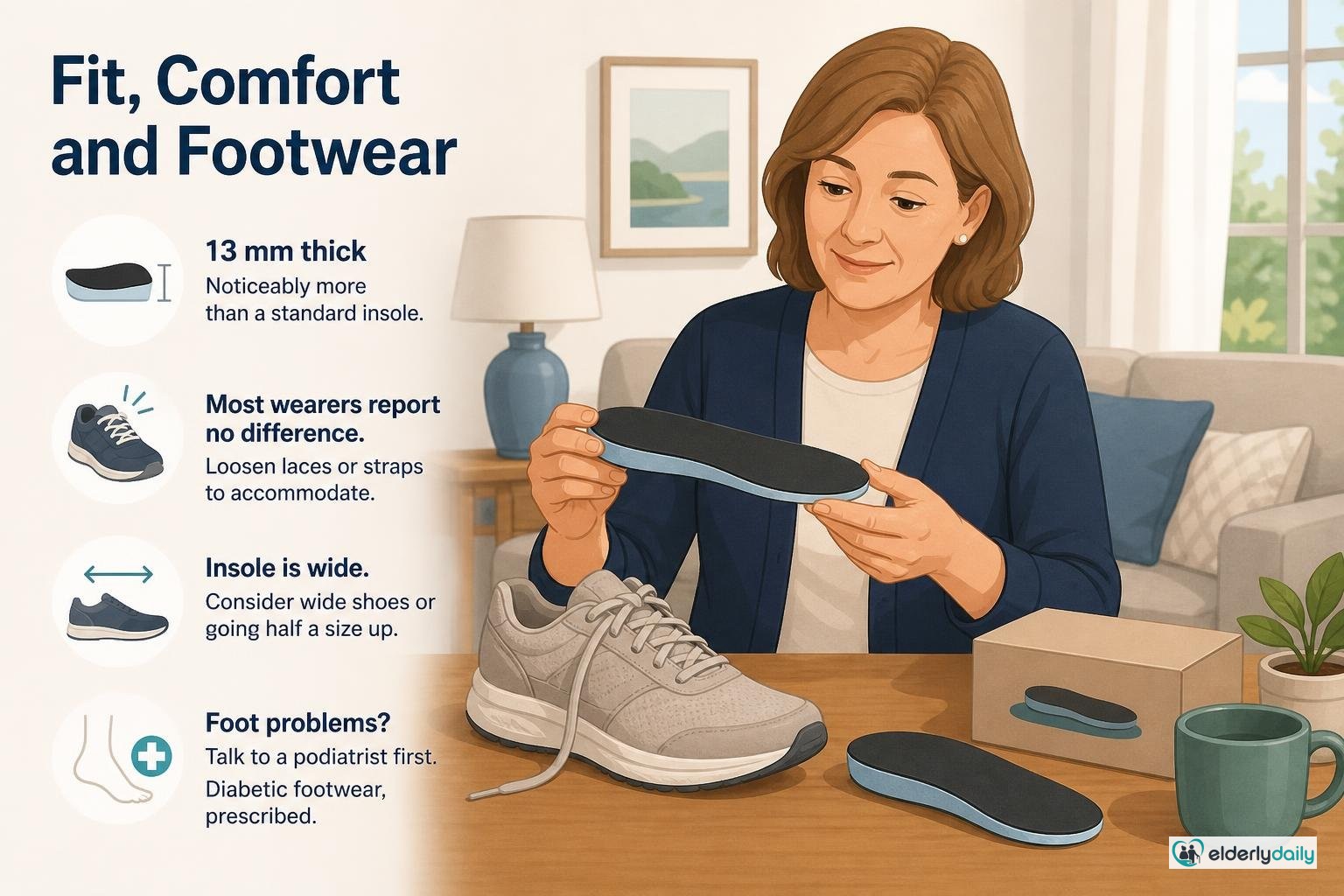
The SmartSole is 13 mm thick, which is noticeably more than a standard insole. MetAlert says most wearers report no difference in their footwear, and suggests loosening laces or straps to accommodate it. The insole is also wide, and the company recommends considering a wide shoe or going half a size up.
For most people in ordinary trainers or walking shoes this is a non-issue. For anyone with existing foot problems it deserves a conversation with a podiatrist first. Diabetic footwear, prescribed orthotics and shoes fitted after a foot ulcer all exist because pressure distribution inside the shoe matters clinically. Adding 13 mm of polyurethane to that is not a neutral change, and older adults with reduced sensation may not feel a pressure point developing.
It is not designed for high-impact activity, and MetAlert notes that wearers over roughly 250 lb may see reduced performance and product life.
The unit is sealed within the foam and water resistant — rain and ordinary foot moisture are fine — but it should not be submerged for long periods.
Coverage, testing and what it will not do
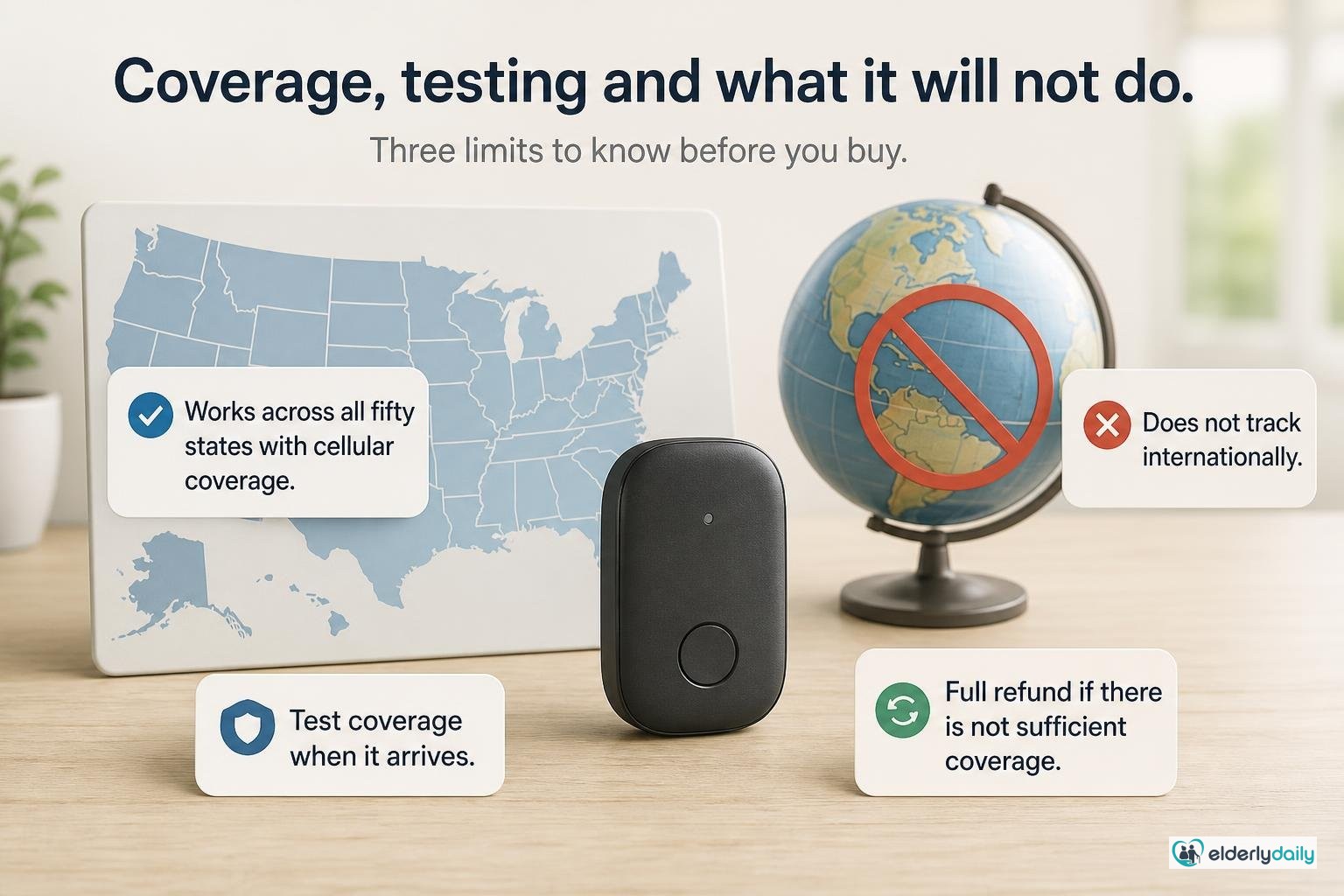
Three limits are worth knowing before you buy rather than after.
It does not track internationally. Units bought in the US work across all fifty states where there is cellular coverage, and nowhere else. If your family travels abroad, or you are buying from outside the US, this is disqualifying.
You must test coverage when it arrives. MetAlert says so directly, and offers a full refund if there is not sufficient coverage in your area. Carry it around the routes the person actually takes and confirm the portal reports where you are. Cellular tracking has holes, and you want to find them now rather than during an incident.
There is no way for the person to call for help. Like every locator, this is a one-way device: it tells you where somebody is, and gives them no means of telling you anything. If the priority is the person summoning help after a fall, a mobile medical alert with a monitored button is a different product category.
One small practical note: it is not TSA approved for in-flight use, so it comes out of the shoe before flying.
What MetAlert says
The following are MetAlert’s own marketing claims from the product listing, not our independent findings. Details can change over time — check the current MetAlert website for the latest.
- MetAlert describes the GPS SmartSole as the world’s first patented hidden wearable GPS insole, designed for people who wander — including seniors with Alzheimer’s or dementia, people with autism, and veterans with traumatic brain injury.
- The company states the insole lasts two to four days on a charge and recommends charging it daily, with a full charge taking two to four hours on the included wireless pad.
- MetAlert states the product works across all fifty US states in areas of cellular coverage, does not track internationally, and offers a full refund if there is insufficient coverage in the buyer’s area.
- The brand notes the insole is water resistant but should not be submerged, is not intended for high-impact activity, and that wearers over 250 lb may experience reduced performance or product life.
- MetAlert lists FCC, IC and CE certification, and states the product is not TSA approved for in-flight use.
How it compares to other dementia trackers
The SmartSole occupies a category of one: it is the only mainstream tracker the wearer cannot remove. That makes the comparison less about features than about behaviour. If devices keep coming off, this is the answer. If they do not, something cheaper and easier to charge will serve you better.
- AngelSense GPS Tracker (our independent #1) — the next best answer to removal — a magnetic lock needing a key tool, plus two-way voice and an SOS button the SmartSole does not have. Visible, but very hard to take off.
- Tracki Mini GPS Tracker — far cheaper, five-day battery, and works regardless of footwear — but it lives in a pocket and can be taken out and set down. The better first step if removal is not yet the problem.
- Medical Guardian Mini Guardian — a monitored help button with GPS — the right category when the priority is the person calling for help rather than you finding them.
Frequently asked questions
Yes, within its design. It reports real-time location through MetAlert’s monitoring portal and sends geofence alerts by text and email, and because the tracker is sealed inside the insole the wearer cannot remove it. The two things that decide whether it works for you are not technical: the shoes have to be on for it to track anything, and somebody has to charge it most nights. Get those right and it does the job it was built for better than any wearable.
MetAlert states two to four days on a single charge, and recommends charging daily like a phone. A full charge takes two to four hours on the wireless pad included. Continuous walking, long car journeys and areas of poor cellular coverage drain it faster — which unhelpfully describes the conditions of an actual wandering episode, so treat the daily advice as the plan rather than the maximum.
It comes in three trim-to-fit sizes covering big kids to adults in US sizing, so it fits most ordinary shoes once trimmed. It is 13 mm thick and wide, though, so MetAlert suggests loosening laces or straps, and considering a wide shoe or going half a size larger. If the wearer has diabetic footwear, prescribed orthotics or any history of foot ulcers, check with a podiatrist before adding it — pressure inside the shoe matters clinically, and reduced sensation means a problem may not be felt developing.
Then the SmartSole tracks nothing. This is the product’s central limitation and the main reason to think carefully before buying. If your relative has ever left the house in slippers or socks, a tracker that stays with them regardless of footwear — a clip-on, or a tamper-resistant wearable — will protect them better, even though it is theoretically removable. Watch what actually happens over a few weeks before deciding.
No. MetAlert states that units purchased in the United States work across all fifty states in areas of cellular coverage, and that the product does not track internationally at this time. If your family travels abroad, or you are buying from outside the US, this rules it out.
Yes. The insole reports through MetAlert’s monitoring portal, and that requires a paid service plan on top of the hardware. The subscription is what pays for the cellular connection and the alerting service, so the device does nothing without it. Check current plan options and cancellation terms directly with MetAlert before ordering, as pricing changes.
No. The SmartSole is a locator, not an alert device — there is no button and no two-way voice. It tells you where somebody is; it gives them no way to tell you anything. If the priority is your relative being able to summon help, for instance after a fall, a mobile medical alert pendant with a monitored button is the right category of product, and some families use both.
GPS SmartSole — Hidden GPS Tracking Shoe Insole (MetAlert)
Best for: A person in the later stages of dementia who removes every visible tracker, but still puts shoes on to leave the house
