
Rotating Beds for Seniors: What They Do, Who They Suit, and What They Cost

Written from manufacturer specifications and published coverage rules. We have not tested these beds hands-on — where that matters to a decision, this guide says so.
In this guide
- First: five different products share this name
- The problem this actually solves
- Who a rotating bed genuinely suits — and who it does not
- The cheaper things to try first
- What the market actually offers
- The StarSleep Orin, specifically
- What they cost, and what Medicare will and will not pay
- What to check before you order one
- What to expect once it is in the room
- FAQs
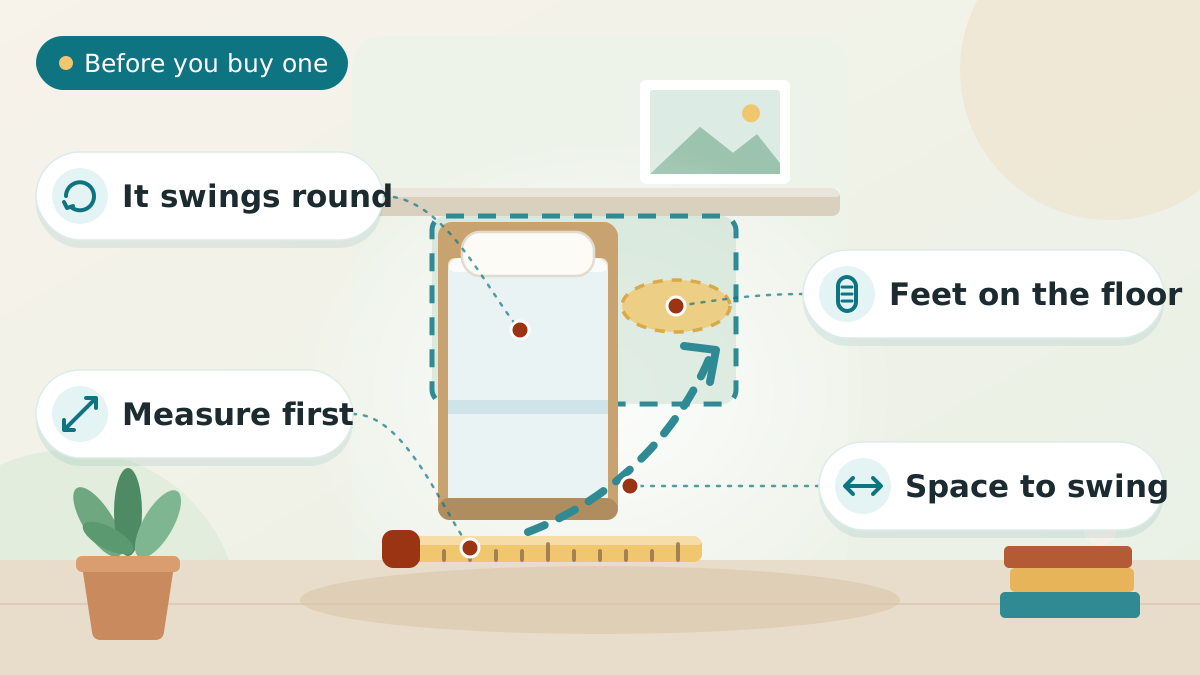
A rotating bed turns the mattress platform toward the edge of the bed, so someone faces out instead of twisting across it. It solves a real and specific problem — but it is a four-figure purchase, it is not right for everyone, and five completely different products are sold under the same name.
Key takeaways
- Five different products are called "rotating beds" and only one helps with transfers. The second most-searched one is not even care equipment — it is a fold-away furniture bed. Buying the wrong category is the expensive mistake in this market.
- They suit someone who still has some lower-body strength but for whom getting in and out of bed has become unsafe. If a person cannot bear weight at all, a rotating bed is the wrong tool — that situation needs a lift.
- Medicare does not pay for them. Rotation and sit-to-stand functions fall outside every hospital-bed coverage code. A basic hospital bed may be covered; a rotating one is a private purchase.
- Expect $3,500–$5,000. There is no budget tier in this category. If that is out of reach, the alternatives below solve the same problem for a fraction as much and are worth trying first.
- Measure before you order. These are large, heavy beds that ship in two cartons, and you must choose which side the bed turns toward at the point of purchase — it is not a setting you change later.
Quick answer
What is a rotating bed and who is it for?
A rotating bed is an electric care bed whose mattress platform turns roughly 90 degrees toward the side of the bed, bringing the person to a seated position facing out — so they step out forwards instead of twisting sideways across a mattress. It is designed for people who can still take some weight through their legs but find bed exits difficult, unsafe, or impossible without help, and for the family caregivers doing the lifting. It is not a solution for someone who cannot bear weight at all, and Medicare does not cover it. Prices generally run $3,500 to $5,000.
Where to see the Orin
The bed most US readers arrive here having already seen, usually from a social ad. We have not tested it. If you already know a transfer-assist bed is the right category for you, this is where to look at it — and there is a fuller, plainer account of what it does and does not do further down this page.
First: five different products share this name
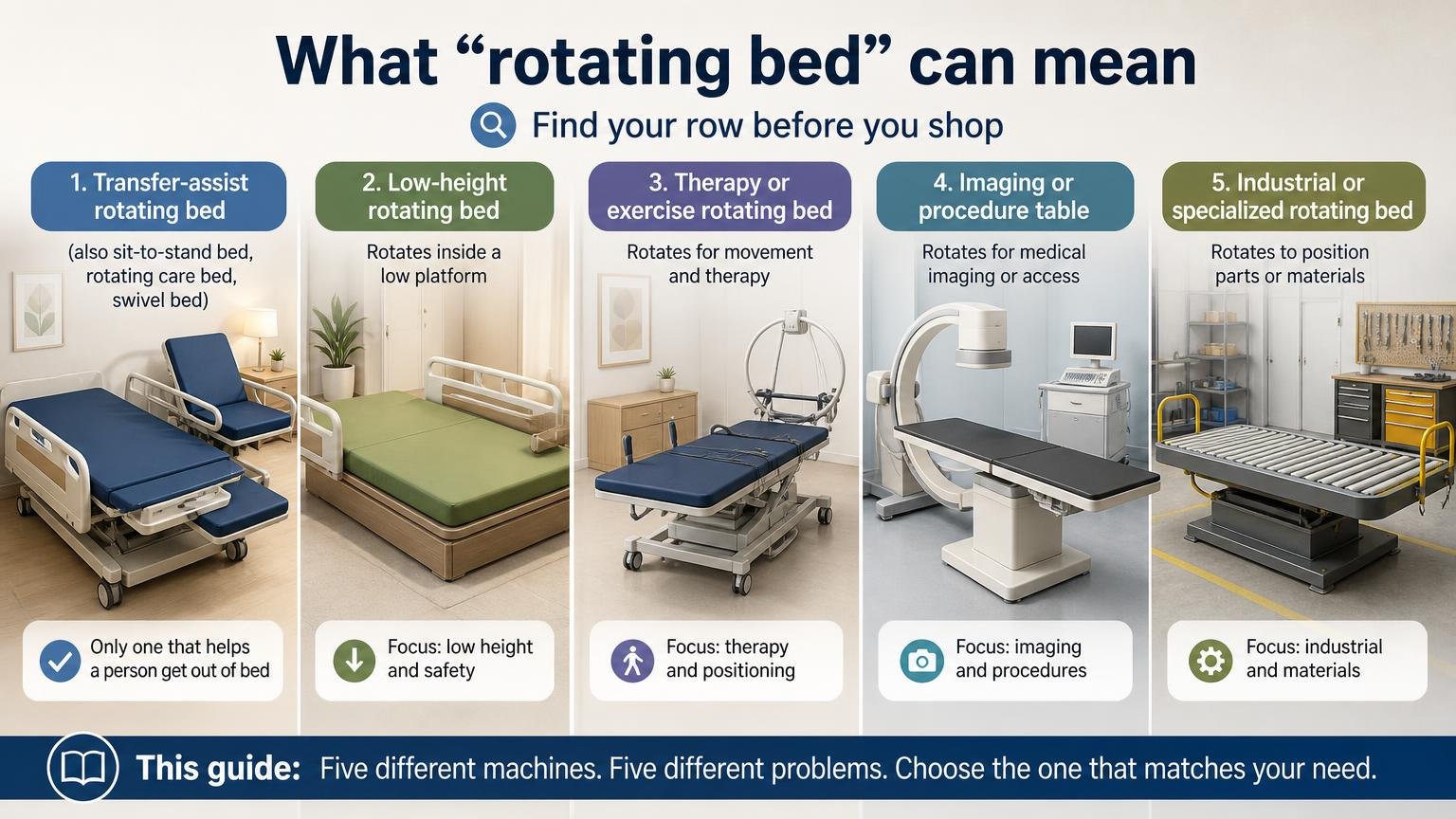
This is the most expensive confusion in the category, and it is worth clearing up before anything else. Search for a rotating bed and you will be shown five genuinely different machines that solve five unrelated problems. Only one of them helps a person get out of bed.
| What it is called | What it actually does | Who it is for |
|---|---|---|
| Transfer-assist rotating bed (also sit-to-stand bed, rotating care bed, swivel bed) | The mattress platform turns about 90° so the person ends up seated at the edge of the bed, facing out | This guide. Someone who can still take some weight through their legs but struggles to get out of bed |
| Lateral-turning mattress or bed (turning bed, patient-turning bed) | Slowly shifts a person side to side while they stay lying down. Does not assist transfers | Pressure-injury prevention for someone largely bedbound |
| Continuous-rotation ICU bed (RotoRest, RotoProne, kinetic therapy bed) | Rotates a critically ill patient continuously to manage the lungs | Hospital intensive care. Not home equipment in any sense |
| Rotating Murphy bed (wall bed, cabinet bed, bookcase bed) | A bed that folds or pivots into a wall unit, often with a desk or shelving on the other face | Saving floor space in a small room. Furniture, not care equipment |
| Round or 360° rotating bed (revolving bed) | A circular bed on a turntable, usually so the occupant can face a window or television | A design or luxury feature. No mobility function |
Check what the product actually does, not what it is called
Before buying anything described as a rotating bed, confirm in the specifications that the sleeping surface turns toward the side of the bed and that the product describes itself as helping with transfers or bed exit. If the description talks about pressure relief, repositioning, turning the person while they remain lying down, folding into a wall, or facing a view, it is one of the other four categories.
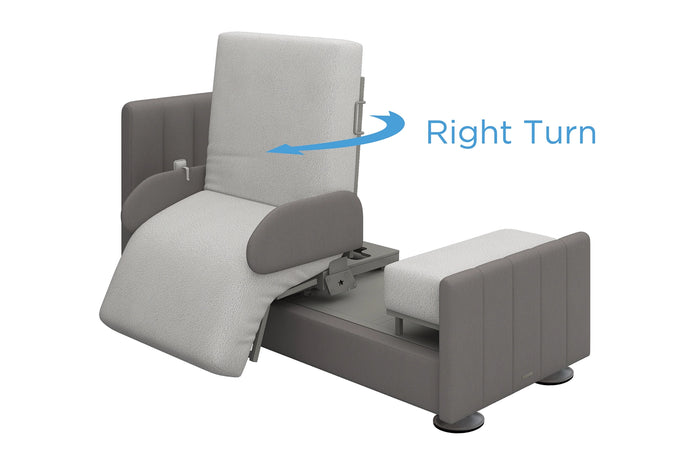
Sponsored Pick
StarSleep Orin Smart Rotating Bed
Turns to bring someone to the bedside for transfers. Needs some standing strength -- not for full-assist.
Check PriceThe problem this actually solves
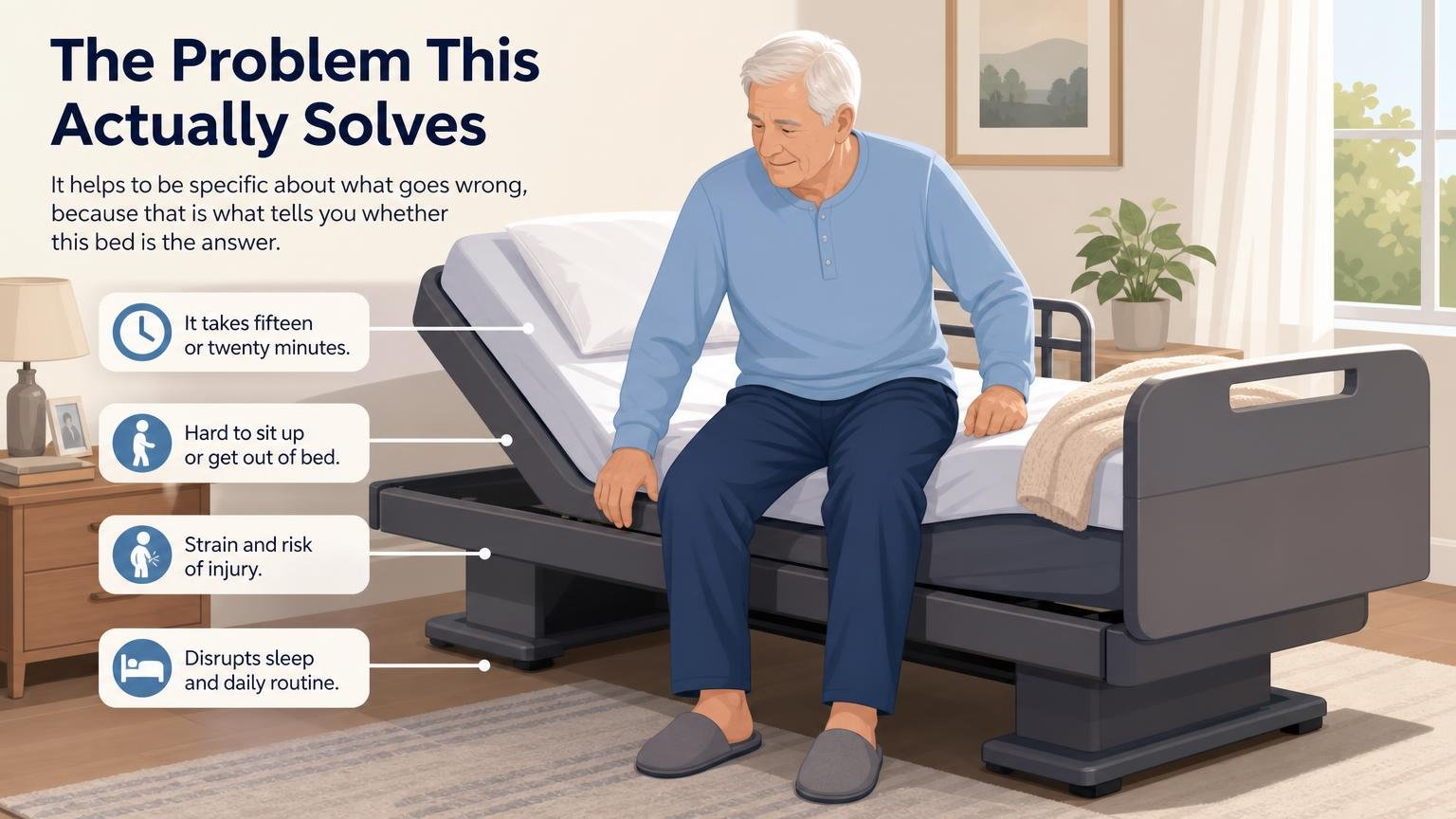
It helps to be specific about what goes wrong, because that is what tells you whether this bed is the answer.
Getting out of an ordinary bed is a sequence, not a single movement. You roll onto your side. You push up on one elbow while swinging your legs over the edge. You end up seated, twisting your spine against the mattress the whole way. Then you stand. For most of us that is automatic. When hips hurt, when a shoulder will not bear weight, when Parkinson’s makes starting a movement the hard part, or when one side is weak after a stroke, the sequence stops working — usually at the twist.
What that looks like day to day:
- It takes fifteen or twenty minutes to get out of bed in the morning, and it is exhausting before the day has started.
- Someone stops drinking after six in the evening so they will not have to attempt it at 3am. That is a real and common trade, and it causes its own problems.
- A caregiver does the lifting — often a spouse of similar age, often several times a night.
- The person waits rather than asking for help again, which is where a lot of falls happen.
- Someone starts sleeping in a recliner because getting out of a chair is easier than getting out of a bed. It works, and it is hard on the back and the circulation.
A rotating bed changes one thing: it removes the twist. The platform turns the person as a unit, so they arrive at the edge of the bed already facing out and already seated, at a height where their feet reach the floor. Everything after that — standing, walking — is unchanged.
The honest test
If the hard part is the twist and the sitting up, this bed addresses it directly. If the hard part is the standing — the person gets to the edge fine but cannot rise from there — a rotating bed will not fix that, and a powered lift chair or a proper assessment is the better spend.
Who a rotating bed genuinely suits — and who it does not
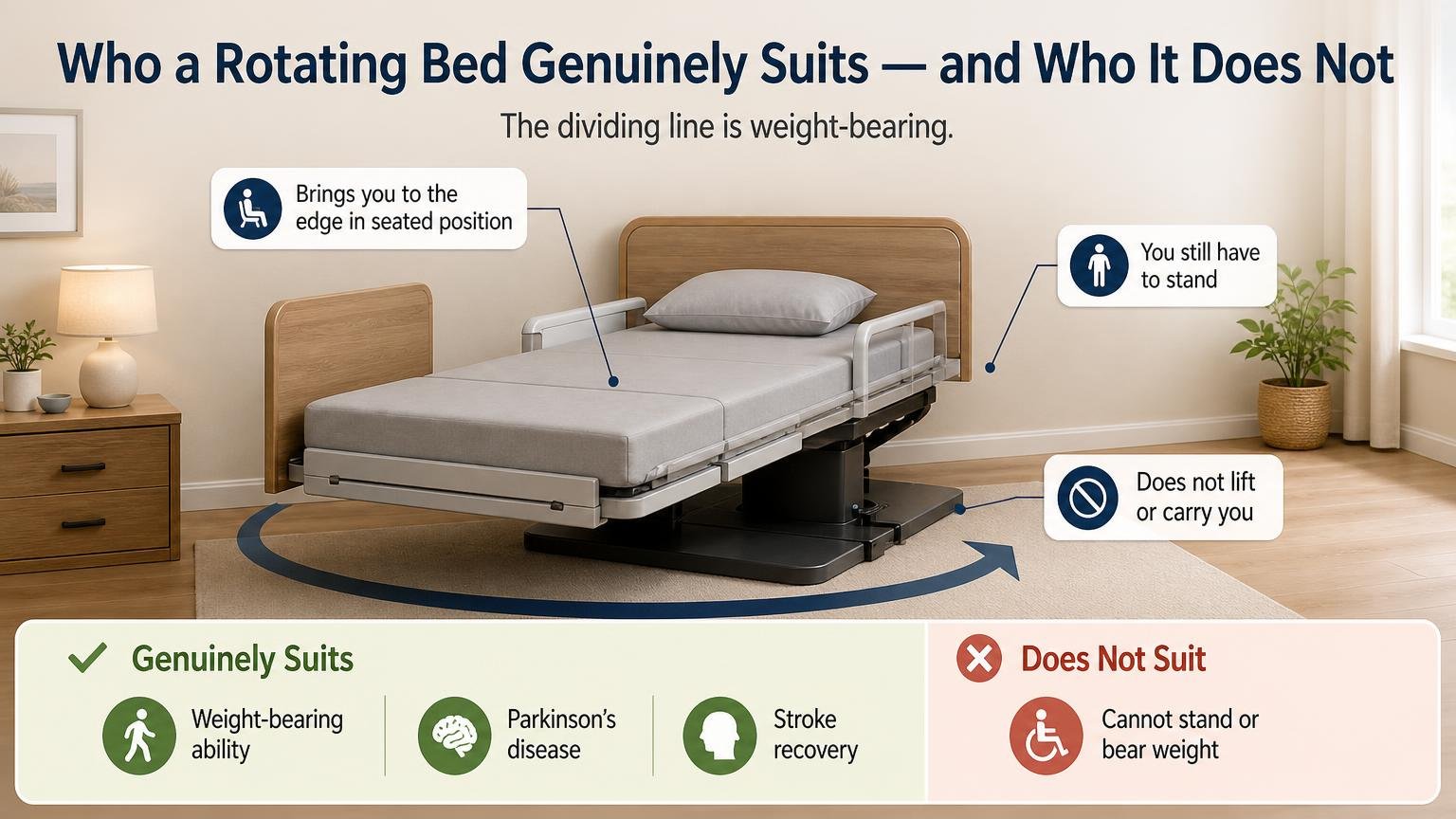
The dividing line is weight-bearing. A rotating bed brings someone to the edge of the bed in a seated position. From there, they still have to stand — the bed does not lift them onto their feet, and it does not carry them.
So it fits a fairly specific person: someone who can still take weight through their legs and complete a stand, but for whom the twisting, shuffling and pushing involved in getting out of an ordinary bed has become slow, painful, frightening, or genuinely unsafe. Manufacturers say this themselves — StarSleep’s own fit note for its beds reads "best suited for users who have some lower-body strength for daily transfers".
Conditions where this pattern is common:
- Parkinson’s disease — where initiating a movement is the hard part, and bed mobility is often affected long before walking is.
- Stroke recovery — where one side does not contribute, so the push-up-on-one-elbow step fails.
- Multiple sclerosis, particularly with fatigue that is worse at either end of the day.
- The months after a hip or knee replacement, where the twist is specifically what the surgeon told them not to do.
- Spinal cord injury with preserved lower-limb function — a real audience here, though the picture varies enormously and an OT assessment matters more than usual.
- Arthritis and general age-related weakness combined with a fear of falling.
It is the wrong tool in two situations, and both matter:
- The person cannot bear weight at all. If transfers already require lifting dead weight, what is needed is a hoist or ceiling lift and training in how to use it — not a bed that delivers someone to an edge they cannot stand up from. Ask for an occupational therapy assessment before spending anything.
- The problem is mostly confidence or a small amount of leverage. If someone can get out of bed but finds it a struggle, the cheap equipment in the next section very often solves it, and a four-figure bed is not required.
Get an assessment before a purchase this size
An occupational therapist or physical therapist can watch the actual transfer and tell you what is failing — strength, balance, bed height, or technique. That single visit routinely changes what a family buys, sometimes from a four-figure bed to a thirty-dollar handle, and sometimes in the other direction. See our guide to safe transfer techniques.
The cheaper things to try first
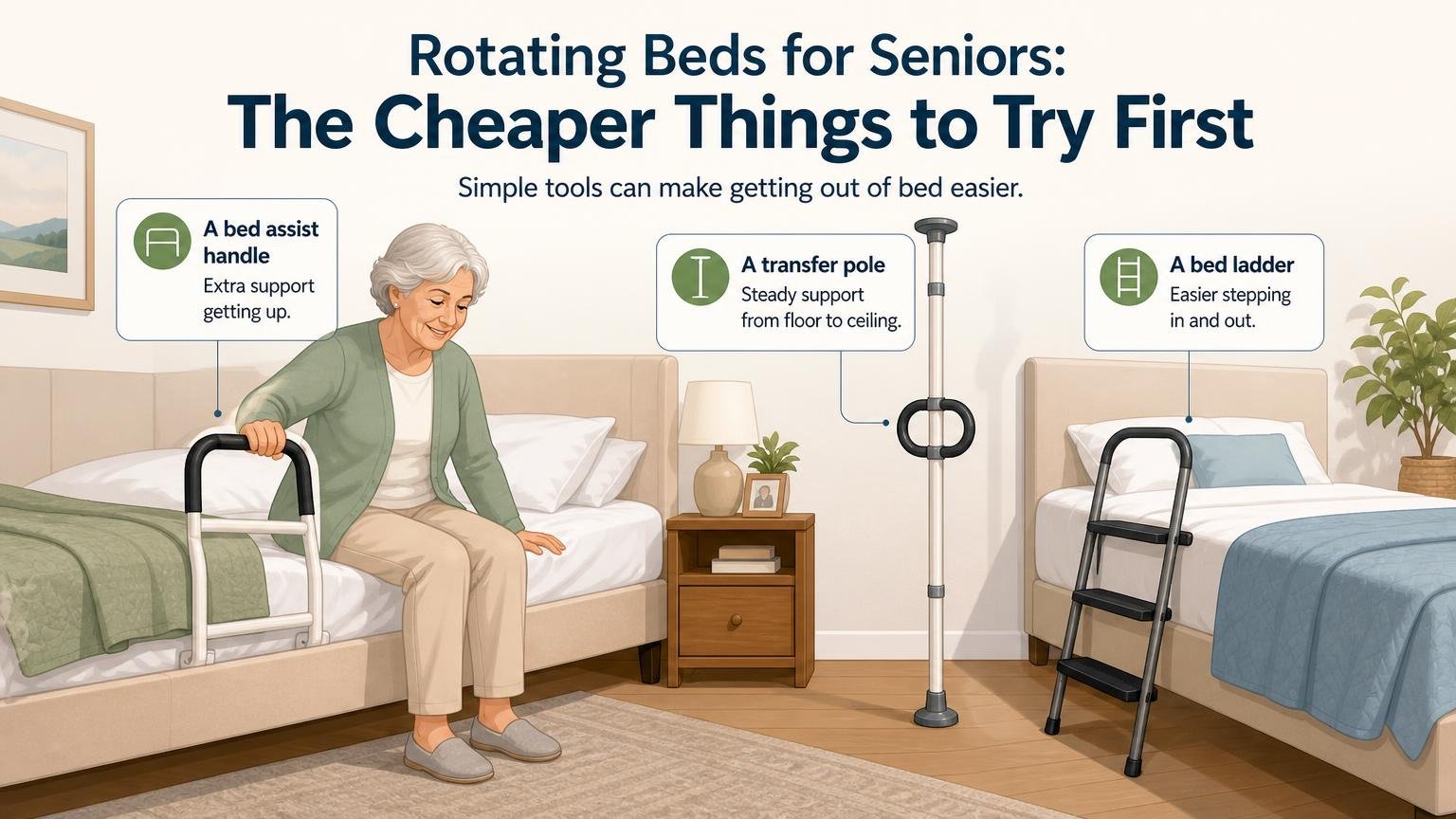
Almost everyone arriving at rotating beds got there from the same problem: someone is struggling to get out of bed. That problem has a ladder of solutions, and the bottom rungs cost between about thirty and three hundred dollars. It is worth working up the ladder rather than starting at the top.
- A [bed assist handle](/reviews/best-bed-assist-handles) gives something solid to grip and push against. Read the bed rail safety guide first — this category has a serious entrapment record and is not right for someone who is confused at night.
- A [transfer pole](/reviews/best-transfer-poles-for-seniors) runs floor to ceiling beside the bed and gives a firm vertical grip to pull up on. For a lot of people this is the single most effective thing in the list.
- A [bed ladder](/reviews/best-bed-ladders-for-seniors) helps someone pull themselves from lying to sitting when the core is weak but arms and grip still work.
- Raising or lowering the bed so the person’s feet reach the floor with knees at roughly a right angle. A bed at the wrong height makes standing far harder than it needs to be, and this fix is free.
- An [adjustable bed](/reviews/best-adjustable-beds-for-seniors) that raises the head brings someone from lying to sitting, which for many people is the genuinely difficult half of the movement.
A rotating bed earns its cost when those have been tried and the transfer is still unsafe, or when a caregiver is being injured doing it several times a day. That last point is not a small consideration: caregiver back injury is one of the most common reasons home care stops being possible at all, and it is worth reading about caregiver burnout alongside any equipment decision.
A cheap test that predicts the answer
For a few nights, help the person out of bed by supporting them around the shoulders and guiding the turn — no lifting. If that small amount of help with the TURN is enough for them to get up, a rotating bed is doing exactly the job you have been doing by hand. If they still cannot stand once they are seated at the edge, it is not the right purchase.
What the market actually offers
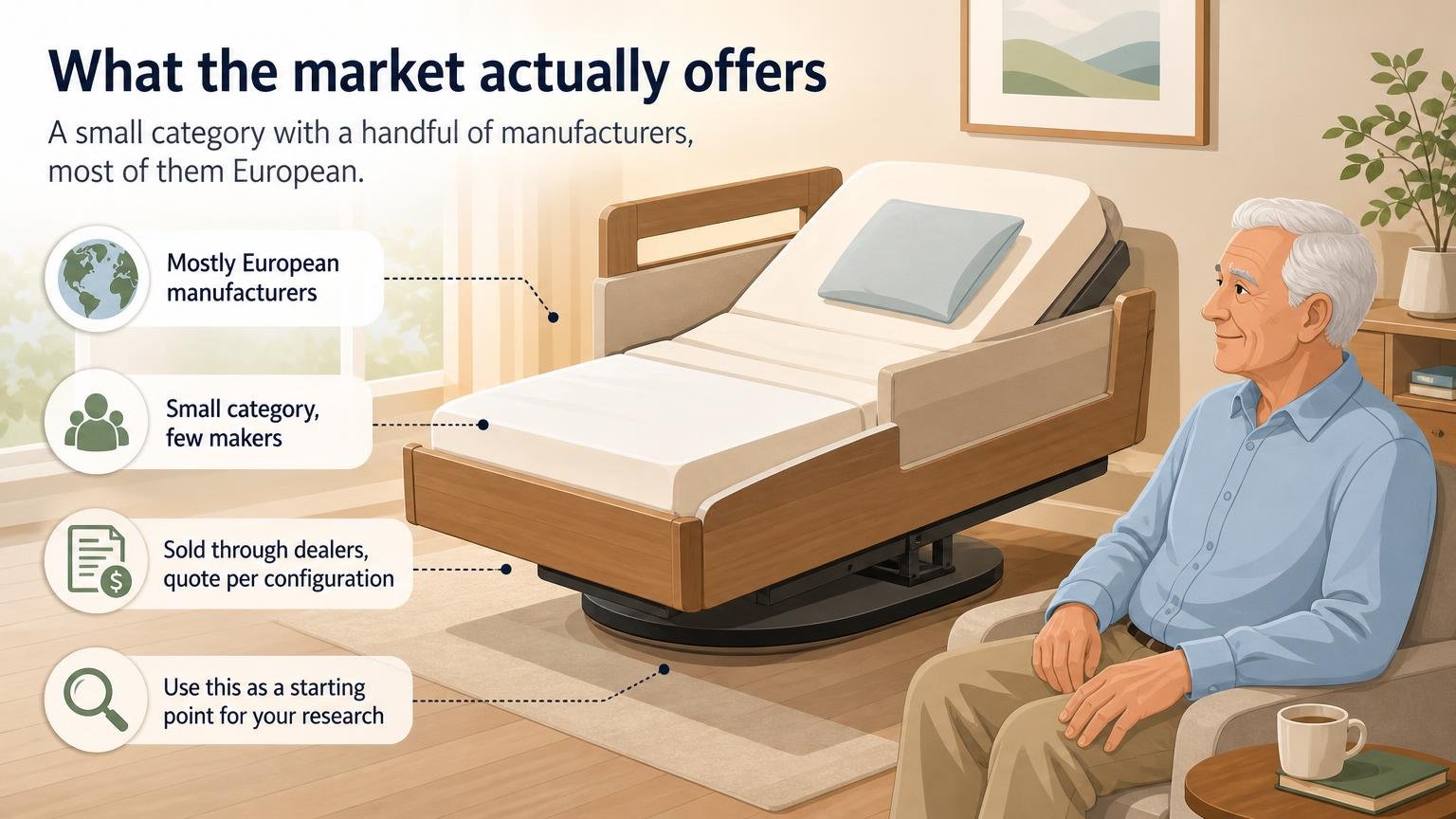
This is a small category with a handful of manufacturers, most of them European, and no budget tier. Several of these makers sell through dealers who quote per configuration rather than publishing a price, so treat the landscape below as a starting point for your own enquiries rather than a price list.
| Maker | Where sold | Notes |
|---|---|---|
| StarSleep (Orin, Arlo) | US, direct online | The most visible US brand online, with the clearest published specs and financing. Covered in detail below |
| RotoBed | Denmark, US and UK dealers | One of the longest-established makers in this category. Sold as RotoBed Free, Change and Home |
| RotoFlex (Theraposture) | UK, direct and dealer | UK market leader; sold with assessment and installation rather than as a boxed product |
| Elevra | US dealers | Sold as a rotating hi-lo lift bed — combines rotation with height adjustment |
| Opera Beds | UK, direct and dealer | Publishes a genuinely useful buying guide on the category, worth reading even if you buy elsewhere |
| Med-Mizer | US, medical supply channel | ActiveCare rotating hospital bed — closer to a clinical hospital bed than home furniture |
Why so few names?
A rotating platform has to carry a person, a mattress and a frame safely through a turn, thousands of times, without racking or pinching. That is a harder engineering problem than it looks, which is why the category has stayed small and expensive while ordinary adjustable beds have become commodity items. If you find one that is dramatically cheaper than everything here, check very carefully what it actually does — it is usually one of the other four categories in the table above.
The StarSleep Orin, specifically
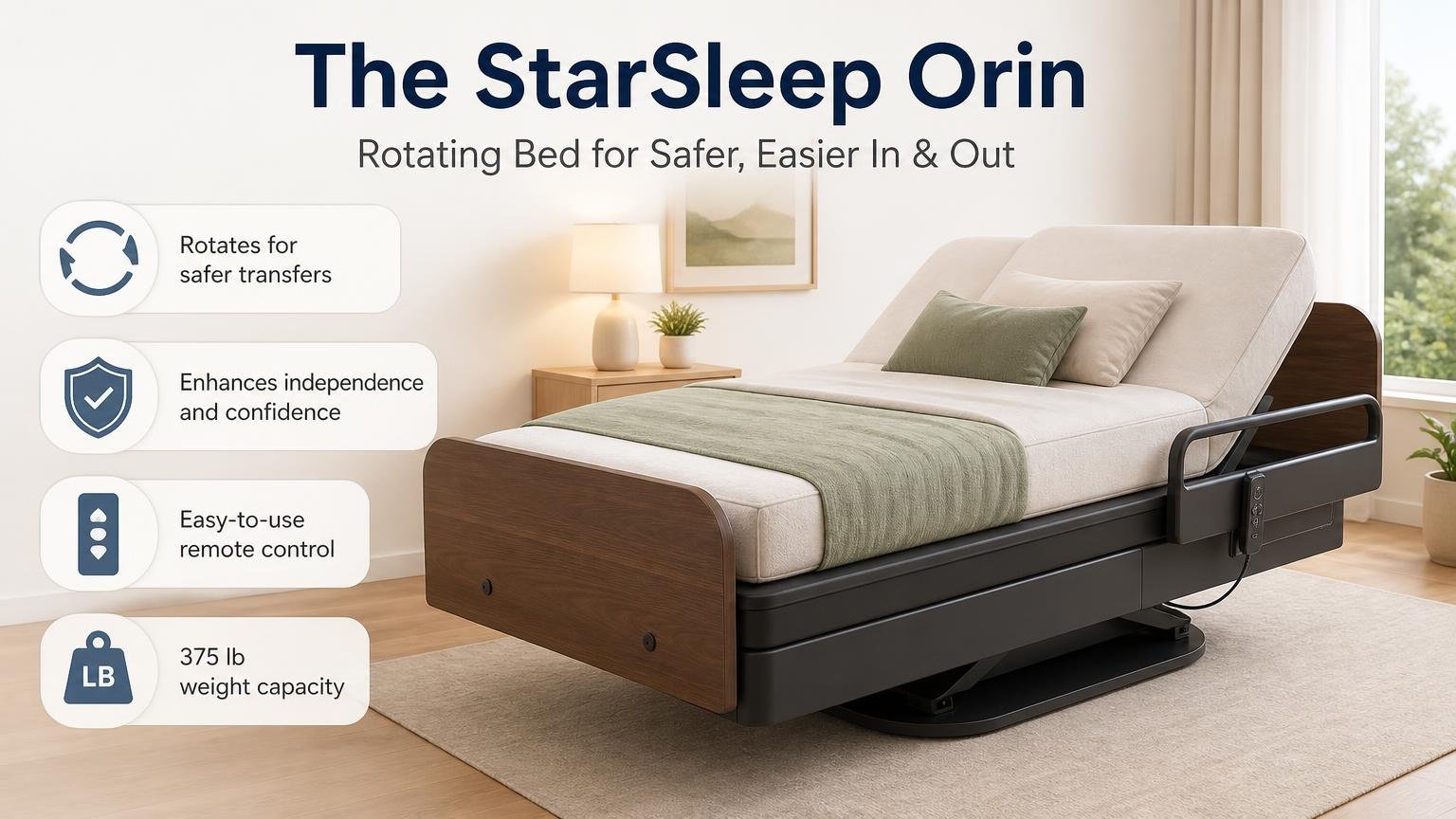
The offer card near the top of this page links to this bed. Here is the fuller account, so you can judge it against everything above rather than from a product listing alone.
The Orin is a transfer-assist rotating bed sold direct to consumers online rather than through a medical dealer. That is unusual in this category and it cuts both ways: the pricing and specifications are published openly, which is genuinely helpful, but you do not get the assessment and in-home fitting that a dealer-sold bed like a RotoFlex normally includes.
What is verifiable from the manufacturer’s own specifications:
- 375 lb weight capacity, and it fits users from about 4′9″ tall.
- Rotation of 90°, with head elevation to 75° and leg elevation to 25°.
- Mattress sits 22.5″ from the floor — which matters, because that is roughly a chair height and is what makes standing from it feasible.
- 10-year frame warranty, 3-year drive system, 1-year parts. The drive system term is the one to look at: on any powered bed the motor is what fails, not the frame.
- Left-turn or right-turn is chosen at the point of order and cannot be changed afterwards.
- Ships in two cartons (roughly 218 lb and 108 lb) with standard delivery to the door; in-home white-glove setup is a paid extra.
What we would want you to know before deciding: StarSleep’s own fit note says the bed suits users who have some lower-body strength for daily transfers, which is the same limit that applies to every bed in this category and the single most important thing on this page. It also carries 30 published customer reviews at the time of writing — more independent feedback than most beds here have, but still a small sample for a purchase this size.
What they cost, and what Medicare will and will not pay
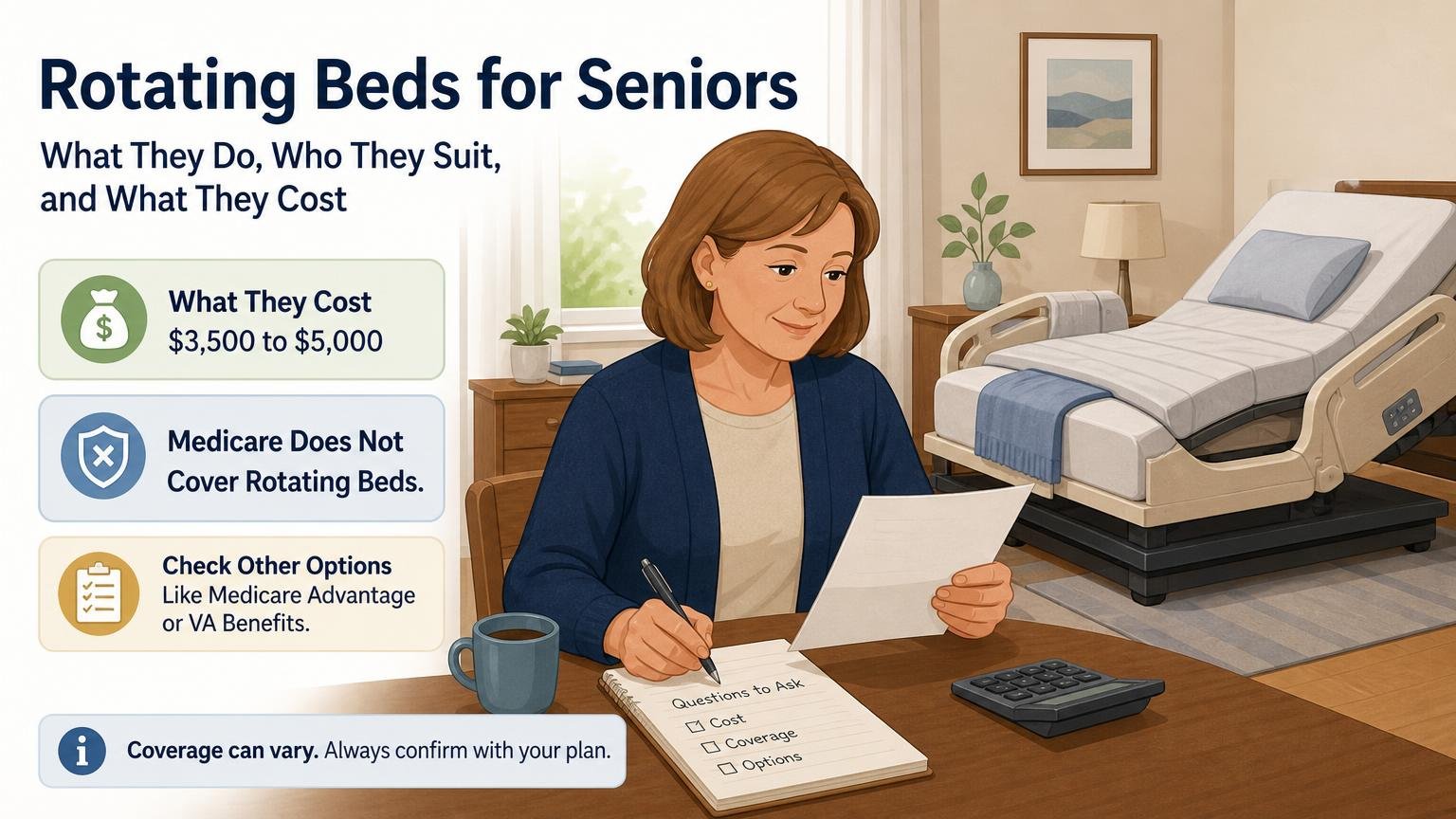
We normally avoid publishing prices, because they go stale. This category is the exception: the price is the single biggest factor in whether a rotating bed is even a possibility for a family, and finding it out only after clicking through wastes everyone’s time. Rotating transfer beds generally run from around $3,500 to $5,000, before any delivery or setup upgrade. There is no budget tier.
Medicare does not cover rotating beds. This is the part families most often learn too late. Medicare Part B does cover a basic hospital bed as durable medical equipment when a doctor documents medical necessity — typically as a 13-month rental, after which you own it, with the usual deductible and 20% coinsurance. But coverage is written around clinical function, not comfort or design, and rotation, sit-to-stand mechanisms, hi-low positioning for caregiver convenience and furniture-style designs sit outside every hospital-bed coverage code. They are private purchases.
That does not make a rotating bed unreasonable — it makes it a different kind of decision. The comparison families actually face is rarely "bed versus grab bar". It is closer to "a one-time four-figure purchase that keeps someone at home, versus the ongoing monthly cost of in-home help or a care facility". Our senior care cost calculator is the honest way to run that comparison for your own situation before committing.
Routes that sometimes help, none of them guaranteed:
- A covered basic hospital bed instead. If the person may qualify on medical necessity, ask the doctor about that route first — it may not be the bed you wanted, but it may be the bed that is paid for.
- Medicare Advantage supplemental benefits. Some plans carry home-safety or assistive-equipment allowances that Original Medicare does not. Worth one phone call to the plan.
- State Medicaid HCBS waivers. Home and Community-Based Services waivers exist specifically to keep people out of facilities, and equipment is sometimes within scope. Rules vary enormously by state.
- VA benefits. For veterans, HISA grants and the adaptive-housing programmes can cover home medical equipment and modifications.
- Medical expense deduction. Equipment bought for a diagnosed medical need can count toward the itemised medical deduction under IRS Publication 502. Keep the prescription and the receipt.
- Manufacturer financing. Several makers, StarSleep included, offer instalment plans. It does not reduce the total, but it changes whether the purchase is possible this month.
Ask before you assume you are not covered
Coverage turns on what the doctor documents about function, not on the diagnosis label. If someone genuinely cannot be positioned safely in an ordinary bed, that is worth a conversation with the prescribing doctor even if a rotating bed itself will not be covered — a covered basic hospital bed plus a transfer pole is a far cheaper combination that solves many of the same problems.
What to check before you order one
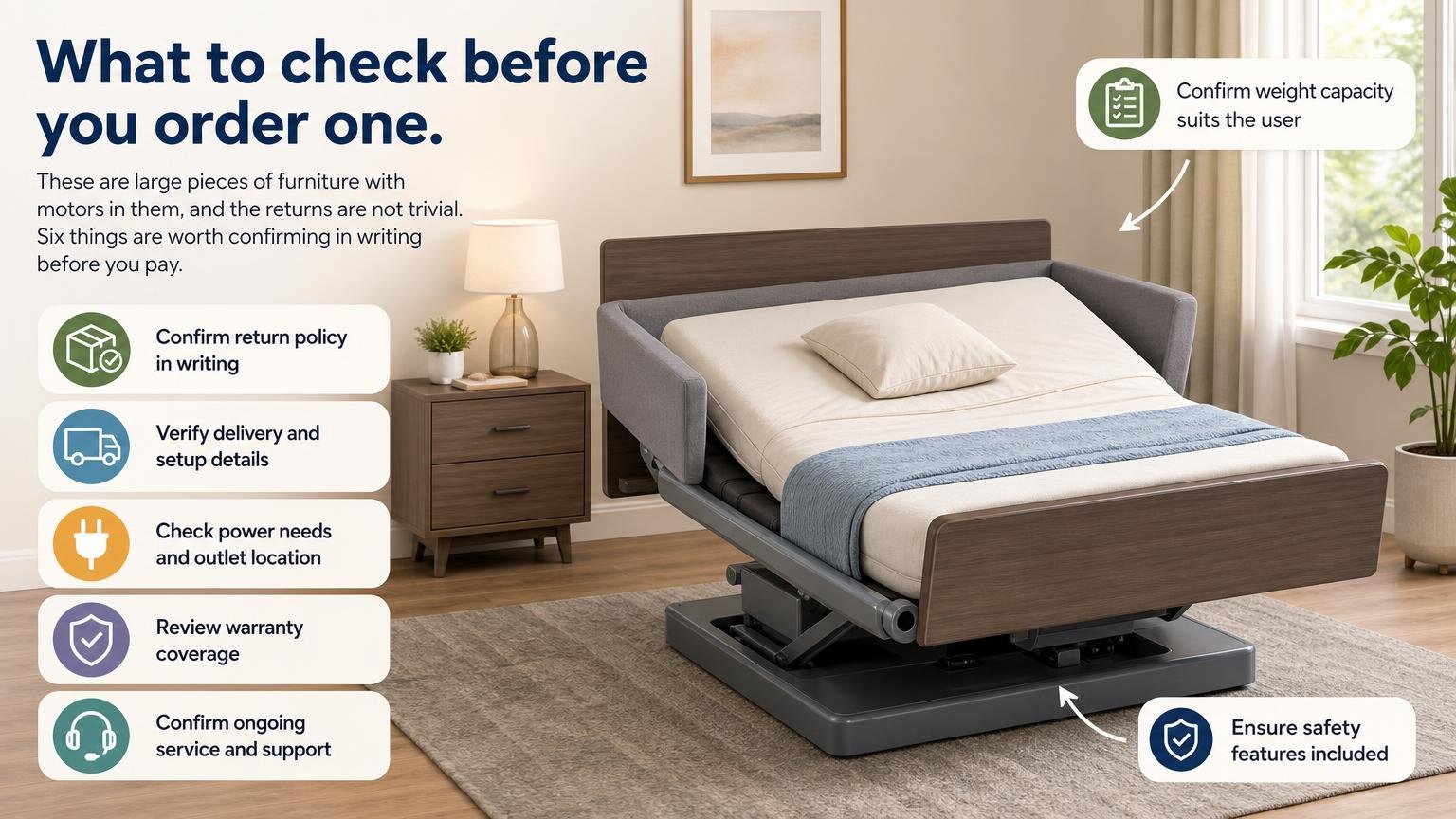
These are large pieces of furniture with motors in them, and the returns are not trivial. Six things are worth confirming in writing before you pay.
- 1
Which side it turns toward
Rotating beds are built to exit left or right, and you usually choose at the point of ordering. Work out which side of the bed the person actually gets out of, allowing for where the bathroom is, where a wheelchair would park, and which is their stronger side. Getting this wrong is not a settings change.
- 2
The room, doorways and stairs
Measure the room with the bed in its rotated position, not just flat — the platform swings out and needs clear floor. Then measure the route in. These beds arrive in two cartons that can each weigh well over a hundred pounds, so also think about stairs and whether anyone will be there to help.
- 3
Mattress height against the person’s leg
The whole point is that they arrive seated at a height they can stand from. Sit the person on a dining chair: if their feet are flat and their knees are at roughly a right angle, that seat height is your target. Compare it to the bed’s published floor-to-mattress figure — around 22–23 inches is typical.
- 4
Weight capacity with a real margin
Check the stated capacity against the actual user, not approximately. Capacities in this category commonly sit between roughly 375 and 450 lb; models vary, and the higher-capacity option is not always the more expensive one.
- 5
What the warranty actually covers
Warranties here are usually split — a long one on the frame, a shorter one on the motor and drive system, and a year on remotes and small parts. The motor is the part that does the work and the part most likely to fail, so the motor term matters more than the headline frame number. A ten-year frame with a one-year motor is a weaker promise than it first appears.
- 6
Delivery, setup and what happens if it does not work out
Standard delivery generally means the cartons arrive at your door and assembly is yours. White-glove setup — in-home delivery, assembly, positioning and packaging removal — is usually several hundred dollars extra and is often worth it for a bed of this weight. Confirm whether removing an existing bed is included, because it frequently is not, and read the return terms before you order: on an item this heavy, return shipping alone can run into the hundreds.
On "FDA approved"
You will see beds in this category described as FDA approved. Treat that phrase carefully. Home care beds of this kind are generally listed or registered with the FDA rather than going through the approval pathway used for high-risk medical devices, and the two are not the same thing. It is not a reason to avoid a product — but it is not the safety guarantee the wording implies, and it should not be what decides your purchase.
What to expect once it is in the room
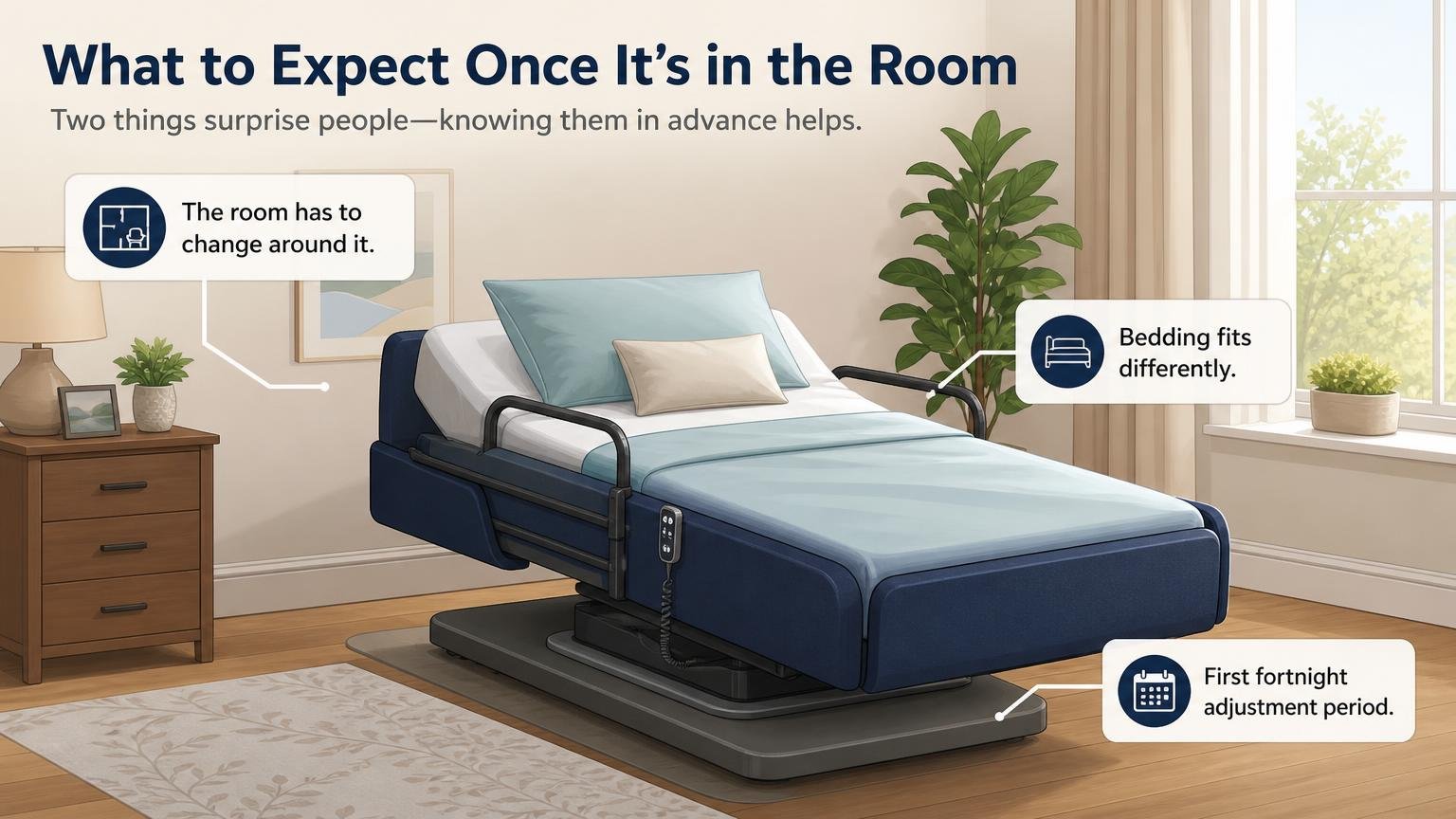
Two things surprise people, and knowing them in advance makes the first fortnight easier.
There is a learning curve, and it is mostly about trust. The first few times the platform turns underneath someone, the instinct is to grab the edge and tense up, which fights the movement. It usually settles within a week. Standing beside the person for the first several turns — not helping, just being there — shortens that considerably.
The room has to change around it. The bed needs clear floor on the exit side permanently, not just at setup. Rugs, a bedside chair, a laundry basket, a trailing lamp cable: all of these end up in the swing path, and the whole safety case for the bed depends on that space staying empty. It is worth doing a proper bedroom safety pass at the same time rather than treating the bed as a standalone fix.
Also worth planning for:
- Bedding fits differently. A platform that moves does not take a heavy tucked-in duvet well; most people move to a lighter, untucked arrangement.
- Keep the remote tethered. A remote that has slid behind the bed on the far side is a genuine problem for someone who cannot get out unaided.
- Know the manual override. Ask, before delivery, what happens in a power cut and how the bed is lowered by hand. If the answer is not in the manual, that is worth knowing before you buy, not after.
Frequently asked questions
Does Medicare pay for a rotating bed?
No. Medicare Part B covers a basic hospital bed as durable medical equipment when a doctor documents medical necessity, usually as a 13-month rental. But rotation, sit-to-stand functions and hi-low positioning for caregiver convenience fall outside every hospital-bed coverage code, so rotating beds are private purchases. It is still worth asking your doctor about a covered basic hospital bed, which may solve part of the problem at far lower cost, and worth checking Medicare Advantage supplemental benefits, state Medicaid HCBS waivers and VA programmes.
How much does a rotating bed cost?
Generally $3,500 to $5,000 before delivery or setup upgrades. There is no budget tier in this category — the engineering involved in turning a loaded platform safely keeps prices high. White-glove in-home setup typically adds several hundred dollars more. If you find something advertised far below this range, check carefully what it actually does; it is usually a lateral-turning mattress, a Murphy bed or a round novelty bed rather than a transfer-assist bed.
Is a rotating bed the same as a bed that turns someone to prevent bedsores?
No, and this is the most costly confusion in the category. Lateral-turning mattresses shift a person from side to side while they remain lying down, to prevent pressure injuries in people who are largely bedbound. They do not help anyone get out of bed. A transfer-assist rotating bed turns the sleeping surface toward the edge of the bed so the person ends up seated facing outward. Confirm which one a product is before buying.
What is a rotating Murphy bed — is that the same thing?
No. A rotating or pivoting Murphy bed is furniture: a bed that folds or rotates into a wall unit, often with a desk or bookcase on the reverse face, to save floor space in a small room. It has no mobility or transfer function at all. It is one of the most-searched meanings of "rotating bed", which is why it appears constantly in search results alongside genuine care equipment.
Will a rotating bed work if my parent cannot stand at all?
Generally no. A rotating bed brings someone to a seated position at the bedside, but they still have to stand from there. If transfers already involve lifting a person’s full weight, the appropriate equipment is a hoist or ceiling lift, together with training in how to use it safely. Ask for an occupational therapy assessment before buying anything in this situation.
What should I try before spending this much?
A bed assist handle, a floor-to-ceiling transfer pole, a bed ladder, adjusting the bed to the right height so the feet reach the floor, or an adjustable bed that raises the head. These cost between roughly thirty and a few hundred dollars and resolve the problem for many people. A rotating bed makes sense when those have been tried and the transfer is still unsafe, or when a caregiver is being injured doing it repeatedly.
How much space does a rotating bed need?
More than the bed’s flat footprint, because the platform swings out toward the exit side. Measure the room with the rotation in mind, not just the bed dimensions, and leave clear floor on the exit side permanently — not only at setup. Also measure the route in: these beds typically arrive in two cartons that can each weigh over a hundred pounds.
Which side should the bed turn toward?
Whichever side the person actually gets out of, allowing for the position of the bathroom, where a wheelchair or walker would wait, and which is their stronger side. This is usually chosen when you order and is not something you can change afterwards, so it is worth getting right.
Are rotating beds used for spinal cord injury or stroke?
Sometimes, and the answer depends entirely on preserved lower-limb function rather than on the diagnosis. The same weight-bearing test applies: the bed brings someone to a seated position at the edge, and they must be able to stand from there. Because the picture after a spinal cord injury or stroke varies so widely, an occupational therapy assessment matters more in these cases than in most, not less.
What happens in a power cut?
This varies by manufacturer and it is worth asking before you buy rather than after. Some powered beds include a battery backup or a manual lowering route; others do not, and the documentation is not always explicit. If someone depends on the bed to get up, knowing the answer in advance is part of the purchase decision, not a detail.
Sources
- Medicare.gov. Durable Medical Equipment (DME) Coverage
- U.S. Food and Drug Administration. A Guide to Bed Safety: Bed Rails in Hospitals, Nursing Homes and Home Health Care
