
3 Best Heavy-Duty & Bariatric Lift Chairs
 By Kutubuddin, Founder & Senior Care Researcher Updated October 2026
In this guide
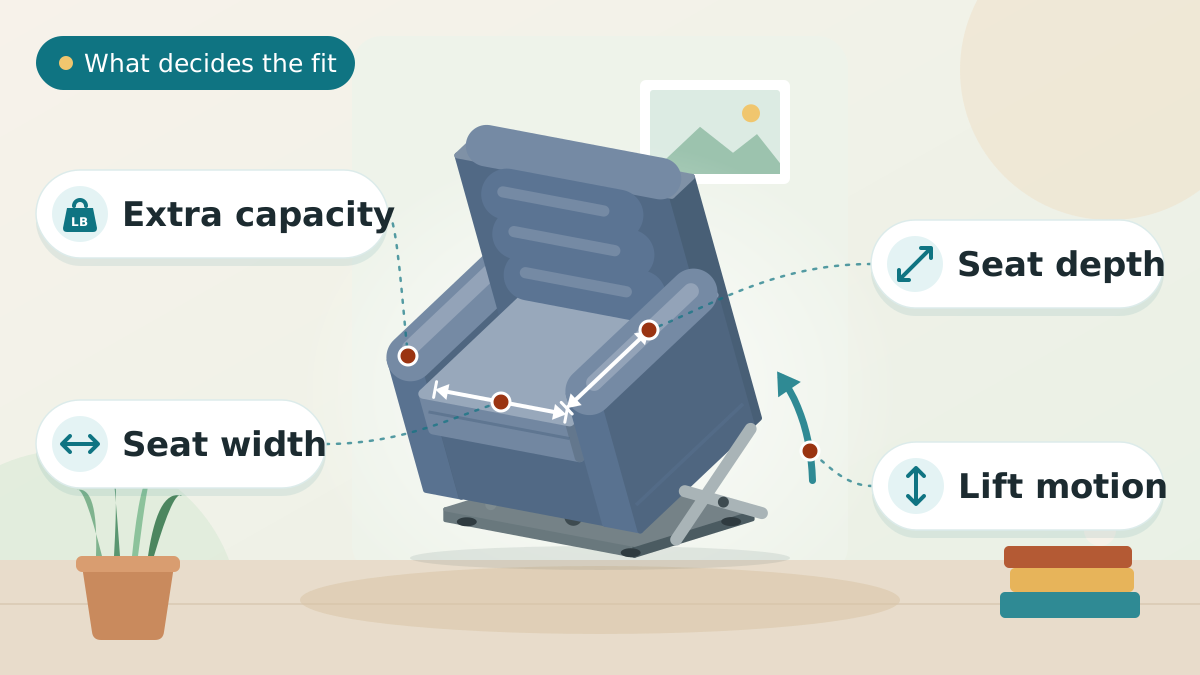
Almost every page about heavy-duty lift chairs leads with weight capacity and stops there. Capacity is one of three measurements that matter, and alone it still gets you the wrong chair: seat width decides whether hours of sitting presses someone against the armrests, and seat depth and back height decide whether the lift actually brings them to standing rather than tipping them forward.
Get any of the three wrong and several hundred pounds has been spent on furniture that does not do its job. Below are three chairs that genuinely differ from each other, the measurements to take first, and what to do if more than 500 lb is needed.
We may earn a commission when you buy through links on this page. Read our affiliate disclosure.

Our Top Pick
MCombo R7777 Heavy Duty Lift Chair
The most balanced of the three on the measurements that matter.
- Dual motors mean the back and footrest move separately — a true lay-flat position
- Thick-gauge steel frame with a high-torque motor, rated to 500 lb
- Two-year warranty covering mechanism, electrics, upholstery and frame
- Pull-out cup holder keeps the armrest surface clear to push up from
- Assembles in about twenty minutes without tools, arriving in three boxes
Weight capacity
500 lb
Seat width
28 in
Motors
Dual, independent
Max recline
165 degrees
Recommended height
5 ft 7 in to 6 ft 2 in
Warranty
2 years, limited
Top 3 Picks — Find Your Situation
Best forSomeone up to 500 lb between about 5’7" and 6’2" who wants a chair that lies flat
- Dual motors mean the back and footrest move separately — a true lay-flat position
- Thick-gauge steel frame with a high-torque motor, rated to 500 lb
- Two-year warranty covering mechanism, electrics, upholstery and frame
Watch out: The manufacturer recommends it for users 5 ft 7 in to 6 ft 2 in — shorter users may find the seat too deep to stand from
 Big Man 500 lb Power Lift ReclinerBest for taller users
Best forTaller users whose legs overhang a standard footrest
- Deeper cushion and extended footrest suit longer legs
- Five-year limited warranty on the steel frame and lift base
- Dual motors with independent back and footrest
Watch out: A deeper seat is the wrong direction for a shorter user
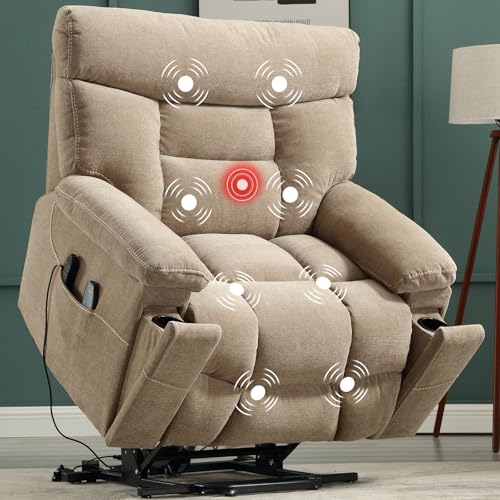 CANMOV Dual Motor Power Lift ReclinerBest entry capacity
Best forUp to 450 lb, in a room where the chair’s own footprint is a constraint
- Listing states UL safety certification — the only one of the three that does
- Smallest overall footprint here at 43 inches wide
- Full dimensions published, including seat height, which most listings omit
Watch out: The listing states it fits users with a BMI of 40 or below. BMI 40 is the threshold for class III obesity, so a chair sold as oversized is telling you it may not suit the people most likely to be looking for one. Check the seat width against the person rather than relying on the capacity figure
MCombo R7777 Heavy Duty Lift Chair
Someone up to 500 lb between about 5’7" and 6’2" who wants a chair that lies flat
On paper the MCombo and the Big Man chair look almost identical — both 500 lb, both 28 inches across the seat, both dual motor. The difference is what they are shaped for. The MCombo is built around a stated height range of 5 ft 7 in to 6 ft 2 in, which covers most adult men and taller women. The Big Man chair is deeper, which is better for long legs and worse for short ones.
What earns it the top slot is the warranty breadth rather than its length. Two years covering the reclining and lifting mechanisms, the electrical system, the upholstery and cushions, and the frame is a wider net than a longer warranty on the frame alone. On a powered chair, the parts that fail are the motor and the hand control, not usually the steel.
It is also the plainest of the three. No massage, no heat. For a chair being bought as a mobility aid rather than a recliner, that removes a category of things to go wrong, and it removes the burn risk discussed further down for anyone with reduced sensation.
What we love
- Dual motors mean the back and footrest move separately — a true lay-flat position
- Thick-gauge steel frame with a high-torque motor, rated to 500 lb
- Two-year warranty covering mechanism, electrics, upholstery and frame
- Pull-out cup holder keeps the armrest surface clear to push up from
- Assembles in about twenty minutes without tools, arriving in three boxes
Things to consider
- The manufacturer recommends it for users 5 ft 7 in to 6 ft 2 in — shorter users may find the seat too deep to stand from
- Faux leather can feel warm for long sitting
- No massage or heat, if those matter to you
Right for you if
- ✓The person weighs up to about 450 lb, leaving headroom under the 500 lb rating
- ✓They are roughly 5 ft 7 in to 6 ft 2 in
- ✓They will sleep or nap in the chair, so a true lay-flat position matters
- ✓You want the fewest powered features that can break
Maybe skip it if
- !They are under about 5 ft 6 in — the seat depth will work against standing
- !They need more than 500 lb, which means going outside Amazon entirely
- !Heat and massage are the reason you are buying a chair at all
Getting started
- →Measure the doorway and the turn into the room before ordering. These arrive in three boxes but assemble into a single large object.
- →Leave the wall clearance the manufacturer specifies behind the chair, or it will not recline fully.
- →Assemble it where it will live. A finished lift chair is too heavy for one person to reposition.
- →Test the lift with the person present before the delivery boxes are broken down, in case the fit is wrong.
How it compares to our runner-up
The Big Man chair matches it on capacity and width and beats it on frame warranty, with five years against two. Choose the Big Man if the person is tall or their legs overhang a standard footrest; choose the MCombo if they are average height and you would rather have broad cover on the parts that actually fail.
How we picked
We do not own or test these chairs. Every specification below comes from the manufacturer’s own listing and is quoted rather than paraphrased where the number matters. We deliberately do not repeat the performance percentages that appear in some of these listings — claims like a stated percentage improvement in lift efficiency, or in caregiver burden, are unsourced marketing figures and we will not pass them on as facts. We checked each product against CPSC recall data, and we looked into the recall history of powered recliners as a category, which turned up a hazard worth a section of its own.
Our picks, reviewed
MCombo R7777 Heavy Duty Lift Chair
The most balanced of the three on the measurements that matter. 500 lb capacity on a thick-gauge steel frame, a 28-inch seat, and two motors so the back and footrest move independently — which is what lets it lie genuinely flat rather than stopping at a lounging angle. The two-year warranty covers the mechanisms, the electrics, the upholstery and the frame, which is broader than the one-year cover on cheaper chairs. The one number to check against the person first is the recommended height range.
What we like
- Dual motors mean the back and footrest move separately — a true lay-flat position
- Thick-gauge steel frame with a high-torque motor, rated to 500 lb
- Two-year warranty covering mechanism, electrics, upholstery and frame
- Pull-out cup holder keeps the armrest surface clear to push up from
- Assembles in about twenty minutes without tools, arriving in three boxes
Keep in mind
- The manufacturer recommends it for users 5 ft 7 in to 6 ft 2 in — shorter users may find the seat too deep to stand from
- Faux leather can feel warm for long sitting
- No massage or heat, if those matter to you
- Weight capacity
- 500 lb
- Seat width
- 28 in
- Motors
- Dual, independent
- Max recline
- 165 degrees
- Recommended height
- 5 ft 7 in to 6 ft 2 in
- Warranty
- 2 years, limited
Big Man 500 lb Power Lift Recliner
Same 500 lb capacity and 28-inch seat width as our top pick, but with a 24-inch deep cushion and an extended footrest — the difference that matters if the person is tall and their legs hang off a standard chair. It also carries the longest structural cover here: five years on the steel frame and lift base, against two years and one year on the others. If you are choosing between this and the MCombo, choose on leg length and on how much you value that frame warranty.
What we like
- Deeper cushion and extended footrest suit longer legs
- Five-year limited warranty on the steel frame and lift base
- Dual motors with independent back and footrest
- Flip-open arm storage, cup holders, side pockets, USB and USB-C
- Chenille fabric is cooler against the skin than faux leather
Keep in mind
- A deeper seat is the wrong direction for a shorter user
- Heat and massage need care where sensation is reduced — see the section below
- Arrives in three packages that may turn up on different days
- Weight capacity
- 500 lb
- Seat width
- 28 in
- Seat depth
- 24 in, with extended footrest
- Motors
- Dual, independent
- Massage
- 8 points, plus lumbar heat
- Warranty
- 5 years on frame and lift base
CANMOV Dual Motor Power Lift Recliner
The option for someone who needs more than a standard recliner but not the full bariatric build — 450 lb and a 27-inch seat, in a chair with a smaller overall footprint than the two above at 43 inches wide. It is the only one of the three whose listing states UL safety certification. It also publishes the most complete dimensions, which is genuinely useful when you are measuring a room. Read the fit note in the cons before choosing it.
What we like
- Listing states UL safety certification — the only one of the three that does
- Smallest overall footprint here at 43 inches wide
- Full dimensions published, including seat height, which most listings omit
- Dual motors with an infinite position lock, reclining to 160 degrees
- Four massage zones with a 15, 30 or 60 minute timer
Keep in mind
- The listing states it fits users with a BMI of 40 or below. BMI 40 is the threshold for class III obesity, so a chair sold as oversized is telling you it may not suit the people most likely to be looking for one. Check the seat width against the person rather than relying on the capacity figure
- Lowest capacity here at 450 lb, and a one-year warranty against two and five
- Heat and massage need care where sensation is reduced — see the section below
- Weight capacity
- 450 lb
- Seat
- 27 in wide, 21 in deep
- Overall
- 43 in W x 39 in D x 43 in H
- Seat height
- 20 in
- Motors
- Dual, independent
- Warranty
- 1 year
What to look for
The three measurements that decide fit
Weight capacity is the number every listing shouts about, and on its own it will still get you the wrong chair. Three measurements decide whether a lift chair works for a particular person.
- Weight capacity. Bariatric in this category means built for over 300 lb. Capacities step up through roughly 375, 400, 450, 500, 600 and 700 lb. Do not buy at the number.
- Seat width. Standard recliners run about 20 to 22 inches between the arms. Heavy-duty models run 26 to 33. Too narrow is not merely uncomfortable: someone sitting for hours pressed against the armrests gets skin irritation, and in a person with fragile skin or reduced mobility that is a pressure-injury risk rather than a nuisance.
- User height. This one is almost never mentioned and it decides whether the chair does its job. Seat depth and back height determine whether the lift brings someone up onto their feet or tips them forward out of it. Specialist manufacturers size the same chair Medium, Large and Tall for this reason, spanning roughly 4 ft 0 in to 6 ft 8 in.
A chair that fits the hips but not the leg length will not get someone standing, which is the only reason to buy a lift chair rather than a recliner.
Buy with headroom — and know what actually fails
The commonest mistake is buying at the limit: a 500 lb chair for someone who weighs 490 lb.
What fails when a lift chair is overloaded is not dramatic. The frame does not collapse. The motor goes first — it slows, then stalls, then stops lifting, usually outside the warranty period. The result is a person left sitting in the chair that was supposed to get them up, and a repair on an item too heavy to send back easily.
The rule is the same as for a transfer bench or a bed rail: leave real margin. If the person is within about 50 lb of the rating, go up a tier. Weight also fluctuates, and a chair bought this year is meant to last several.
One motor, two, or three
Motor count is the single feature that changes what the chair can do, and the listings rarely explain it.
- Single motor — two-position. The back and footrest move together on one mechanism. It reclines to roughly 45 degrees. Fine for sitting and watching television; it will not lie flat.
- Dual motor — infinite position. Back and footrest move independently, so the chair can hold any combination, including flat. All three chairs here are dual motor. This is the minimum for anyone who will sleep in the chair, and for anyone who needs their legs raised above heart level for swelling.
- Triple motor. Adds independent lumbar or headrest adjustment. Found mainly on specialist chairs bought through dealers rather than online.
If the person is likely to spend nights in the chair — which is common after surgery, or with breathing or reflux problems — dual motor is not optional.
The measurements to take before you order
Ten minutes with a tape measure saves a return that costs more than the delivery.
- Hip width, sitting down. Measure across the widest point while the person is seated, then add two inches. That is the minimum seat width, not the ideal.
- Floor to the back of the knee, sitting with feet flat. This should be close to the chair’s seat height. A seat that is too high leaves feet dangling; too low and standing is harder.
- Back of knee to the back of the seat. This is the seat depth they need. Too deep and they will slide forward or perch on the edge.
- Wall clearance. Check the manufacturer’s figure and measure the space behind where the chair will sit. Most need several inches to recline fully.
- Doorways and the turn. These arrive in boxes but leave as one large object. Measure the narrowest point on the route.
If you need more than 500 lb
This is worth saying plainly, because searches for 600 lb bariatric lift chairs are common and the honest answer is short.
Above about 500 lb you are largely outside what is sold on Amazon. Chairs rated 600 and 700 lb exist, with seat widths up to 33 inches and sometimes three motors, but they come from specialist manufacturers sold through medical equipment dealers rather than general retail. Golden Technologies and Pride Mobility are the two names you will meet most often.
That changes how you buy, mostly for the better. A dealer will measure the person, order the correct size rather than a one-size model, deliver into the room and assemble it, and handle warranty service on site. You will pay more than an online price, and the difference buys the fitting and the service call.
If you are in that range, start by asking a local medical equipment supplier what they stock rather than searching for a product link that does not exist.
Heat, massage and reduced sensation
Two of the three chairs here include heated lumbar pads and massage, and almost every lift chair in this price range does. It is worth a moment of thought before switching them on.
Heat is a burn risk for anyone whose sensation is reduced. Diabetic neuropathy is common in this population, and someone who cannot reliably feel temperature in their back or legs may not notice a heating element becoming uncomfortable. The same applies after a stroke, with spinal problems, and with some medications.
- If sensation is reduced anywhere the pad touches, do not use the heat function.
- If you are unsure, ask the GP or district nurse — it is a quick question with a definite answer.
- Check the skin over the lower back after the first few uses if heat is used at all.
- Massage is a different question from heat, and generally safe, though it is worth checking with a clinician where there is a clotting disorder, a recent fracture, or an unhealed wound.
None of this is a reason to avoid a chair with these features. It is a reason to know which switch does what before the chair is in daily use.
Power lift chairs and visiting children
This one is genuinely surprising, and no retailer page mentions it.
Powered recliner mechanisms generate substantial force — enough that the moving parts are a real hazard for small children and pets. The CPSC has specifically identified entrapment risks in motorised recliners, with guidance that the opening between the seat and the leg rest be kept to five inches or less to prevent head entrapment.
The precedent is not theoretical. In 2011 a retailer recalled about 375,000 glider recliners after two children under the age of two were found trapped by the neck in the frame. Powered recliners have also been recalled where the mechanism could bend and the chair back detach, and in 2017 a major manufacturer recalled power supplies sold with its lift chairs for a shock hazard.
- Keep the hand control out of reach, or unplug the chair, when small children are visiting.
- Never let a child play underneath or behind a powered recliner.
- Check the gap between seat and leg rest when the chair is part-reclined — that is where the risk sits.
- Register the chair with the manufacturer so you are contacted if there is a recall.
Delivery is the part nobody warns you about
A heavy-duty lift chair is a 100 to 200 lb object arriving in several boxes, and standard delivery usually means the kerb or just inside the front door.
- Boxes arrive separately. All three of these chairs ship in three cartons, and the manufacturers say plainly that they may turn up on different days. Do not begin assembly until everything has arrived.
- Assembly is genuinely tool-free, and takes roughly twenty minutes, but it takes two people for the backrest.
- Build it in the room it will live in. Once assembled it is not a one-person job to move.
- Arrange help for the delivery day itself. The person who needs the chair is by definition not the person who should be carrying it.
If none of that is workable, this is a real argument for buying locally from a dealer who delivers into the room and assembles — the price difference often is the delivery. It is also an argument for renting, where delivery, setup and collection are normally included: see renting versus buying a lift chair for what that costs and where the break-even falls.
Does Medicare pay for a lift chair?
Partly, and the detail catches people out.
Medicare treats the lifting mechanism as durable medical equipment, not the chair. Where the medical criteria are met and a doctor prescribes it, the seat-lift mechanism may be covered under Part B. The chair itself — the frame, the upholstery, the recline function, the heat and massage — is furniture, and you pay for it.
In practice that means a reimbursement toward the mechanism rather than the chair, paperwork from the prescribing doctor, and buying from a supplier who accepts Medicare assignment. Buying online from a general retailer generally forfeits it entirely.
The rules are specific enough to deserve their own page, which we are writing. In the meantime, if the cost matters, speak to a Medicare-enrolled supplier before you order anything online. One thing worth knowing now: renting attracts no coverage at all — suppliers state plainly that lift chair rentals are not covered by Medicare or insurance. So if you are weighing renting against buying on cost, that comparison has a thumb on the scale you may not have noticed.
Frequently asked questions
A lift chair built for users over about 300 lb. Compared with a standard model it has a reinforced frame, a higher-torque motor and a wider seat — typically 26 to 33 inches between the arms against 20 to 22 on a standard recliner. Capacities run through roughly 375, 400, 450, 500, 600 and 700 lb.
More than the person weighs, with real headroom. If they are within about 50 lb of a chair’s rating, move up a tier. Overloading a lift chair does not usually break the frame — it burns out the motor, which then stops lifting, typically after the warranty has expired.
They matter for different reasons and you need both right. Capacity protects the mechanism. Seat width protects the person: someone sitting for hours pressed against the armrests develops skin irritation, which in a person with fragile skin or limited mobility is a pressure-injury risk. Measure hip width while seated and add two inches.
If the person will sleep or nap in the chair, or needs their legs raised for swelling, yes. A single-motor chair moves the back and footrest together and reclines to roughly 45 degrees. A dual-motor chair moves them independently and can lie flat. All three chairs on this page are dual motor.
Not on Amazon, for the most part. Chairs rated 600 and 700 lb come from specialist manufacturers such as Golden Technologies and Pride Mobility, sold through medical equipment dealers. That route costs more but includes measuring the person, delivery into the room, assembly and on-site warranty service.
For most people, yes. Heat is the one to think about: anyone with reduced sensation — from diabetic neuropathy, after a stroke, or with certain spinal conditions — may not feel a heating pad becoming too hot, which is a burn risk. If sensation is reduced where the pad touches, leave the heat off and ask a clinician.
Only the lifting mechanism, and only where the medical criteria are met and a doctor prescribes it. The chair itself is treated as furniture and you pay for it. You also need to buy from a Medicare-enrolled supplier — ordering online from a general retailer generally forfeits any reimbursement.
These arrive in three boxes that may come on different days, and standard delivery is usually kerbside or just inside the door. Assembly is tool-free and takes around twenty minutes, but it needs two people for the backrest and should be done in the room where the chair will stay — once built it is too heavy to reposition alone.
The final verdict
For most people the MCombo R7777 is the right chair — 500 lb, a 28-inch seat, dual motors that lie flat, and a warranty that covers the parts which actually fail. Choose the Big Man chair instead if the person is tall, where the deeper cushion and extended footrest matter and the five-year frame cover is worth having. The CANMOV suits a smaller room and a lower capacity, with the fit caveat noted above. Above 500 lb, stop searching online and call a medical equipment dealer. And whichever you choose, take the three measurements first: the commonest way to waste money here is to buy on capacity alone and discover the chair does not get the person to their feet.
Our overall winner is the MCombo R7777 Heavy Duty Lift Chair — our our pick for most seniors. You can check the current price on Amazon to see today’s deal.
