
3 Best Stair Lifts for Seniors
 By Kutubuddin, Founder & Senior Care Researcher Updated October 2026
In this guide
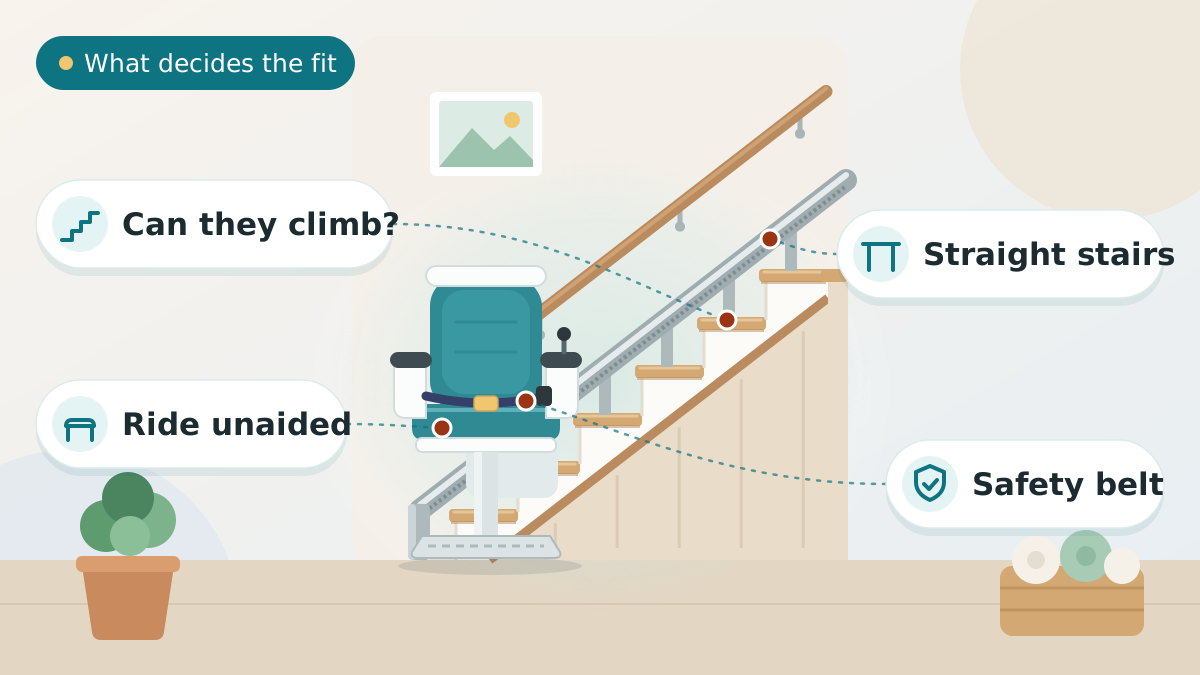
This is a category where the wrong purchase costs thousands or does nothing at all, and the search results actively work against you — a simple walking aid and an installed rail system sit side by side, both labelled stair lift. The first job of this page is to sort out which product solves which problem. The second is to be honest about the things the listings do not lead with: that a chair lift fits straight staircases only, that Medicare pays nothing toward any of this, that the return terms on a fitted lift are unusually harsh, and that for a good number of people the answer is a second handrail rather than a machine.
We may earn a commission when you buy through links on this page. Read our affiliate disclosure.

Our Top Pick
AmeriGlide Rave 2 Straight Stair Lift
The only genuine rail-mounted stair lift here, and the one product on this page that carries someone up a staircase they cannot climb.
- Battery powered, so it still works when the power is out
- Swivel seat means dismounting toward the landing, not the stairs
- Footrest safety sensor stops the carriage if something is in the way
- Wireless call stations at the top and bottom
- Flip-up seat and armrests so others can still pass on the stairs
Type
Rail-mounted chair lift
Staircase
Straight only
Capacity
350 lb
Track
15 ft included
Power
Battery
Safety
Swivel seat, footrest sensor
Top 3 Picks — Find Your Situation
Best forA straight staircase, and someone who can sit and ride unaided
- Battery powered, so it still works when the power is out
- Swivel seat means dismounting toward the landing, not the stairs
- Footrest safety sensor stops the carriage if something is in the way
Watch out: **Straight staircases only.** A turn, a landing or a winder rules it out entirely, and curved rails are custom-built at several times the cost
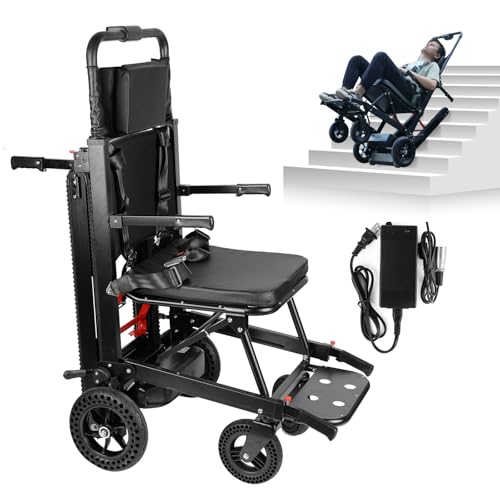 Electric Stair Climbing Wheelchair (NXN20-205)Best when they cannot ride a lift
Best forSomeone who cannot use a chair lift unaided, or a rented or shared building
- No installation, no rail, no permanent change to the house
- Highest capacity here at 450 lb
- Works on any staircase, including in rented or shared buildings
Watch out: **Someone else has to be there and has to operate it.** It gives the rider no independence at all
 NEAUDE Half-Step Stair Climbing CaneWhat many people actually need
Best forStairs that are hard rather than impossible, and anyone still steady on their feet
- Turns each full riser into two smaller steps
- A stated 400 lb capacity
- Ten handle heights, 29.5 to 38.5 inches
Watch out: **The listing does not state the half-step height** — check it against your own riser height before relying on it
AmeriGlide Rave 2 Straight Stair Lift
A straight staircase, and someone who can sit and ride unaided
It is the only product here that does the thing people picture when they search for a stair lift: a seat that carries someone up a staircase they can no longer climb, which they operate themselves. That independence is the point. Everything else on this page either needs another person or assumes the stairs are still manageable.
Two of its features are worth more than the spec sheet suggests. It runs on batteries, charging at the parking points, which means a power cut leaves someone able to get to their own bedroom rather than stranded downstairs. And the seat swivels at the top, so they step off facing the landing instead of turning around at the head of a staircase — which is exactly where a turn is most dangerous.
The honest limits are two. It fits straight staircases only, which excludes a great many houses. And the question of whether you can actually install it yourself is genuinely unresolved between the listing and the manufacturer’s own website, which is covered below and needs settling before you order.
What we love
- Battery powered, so it still works when the power is out
- Swivel seat means dismounting toward the landing, not the stairs
- Footrest safety sensor stops the carriage if something is in the way
- Wireless call stations at the top and bottom
- Flip-up seat and armrests so others can still pass on the stairs
Things to consider
- **Straight staircases only.** A turn, a landing or a winder rules it out entirely, and curved rails are custom-built at several times the cost
- **The listing says DIY self-install; the manufacturer’s own website says straight lifts are not self-installable.** Confirm which applies before ordering — see the section below
- 350 lb capacity, which is lower than some heavy-duty models
- Return terms on fitted lifts are unusually restrictive — read the section on that before you commit
Right for you if
- ✓The staircase is straight, with no turn, landing or winder
- ✓They can transfer onto a seat and sit safely while it moves
- ✓They want to get upstairs without asking anyone
- ✓You own the property, or have permission to fix a rail to the treads
Maybe skip it if
- !The staircase turns — you need a custom curved rail, at several times the cost
- !They cannot sit unsupported or would not stay seated
- !You are renting and cannot alter the stairs
- !Stairs are difficult rather than impossible — look at the assist cane first
Getting started
- →Measure the staircase before ordering: total run, tread width, and whether anything projects into it.
- →Check the rail leaves enough clear width for anyone else using the stairs, and that the seat folds out of the way.
- →Settle the installation question with the seller in writing before purchase, given the contradiction below.
- →Find the manual release and the battery charging points on day one, and show everyone in the house.
How it compares to our runner-up
The climbing wheelchair is the better choice in three situations the Rave 2 cannot serve: a staircase that turns, a rented or shared building where you cannot fit a rail, and a person who cannot ride a lift unaided. What it takes away is independence — someone has to be present and has to drive it. If the person can ride a lift and the staircase is straight, the stair lift is the better answer; if either of those is not true, the climbing chair probably is.
How we picked
We do not own or test these products, and this page makes no claim to original testing. Specifications are quoted from the manufacturers’ own listings. Where a listing contradicts the manufacturer’s website — and one here does, on whether the lift is self-installable — we set out both and tell you to confirm before ordering rather than picking the version we prefer.
Our picks, reviewed
AmeriGlide Rave 2 Straight Stair Lift
The only genuine rail-mounted stair lift here, and the one product on this page that carries someone up a staircase they cannot climb. It runs on batteries rather than mains power, so it keeps working in a power cut — which matters more than it sounds when the alternative is being stranded on the wrong floor. The safety details are the right ones: a swivel seat so you get off facing the landing rather than the drop, a footrest sensor that stops the lift if it meets an obstruction, and call stations at both ends so it can be summoned to whichever floor you are on.
What we like
- Battery powered, so it still works when the power is out
- Swivel seat means dismounting toward the landing, not the stairs
- Footrest safety sensor stops the carriage if something is in the way
- Wireless call stations at the top and bottom
- Flip-up seat and armrests so others can still pass on the stairs
Keep in mind
- **Straight staircases only.** A turn, a landing or a winder rules it out entirely, and curved rails are custom-built at several times the cost
- **The listing says DIY self-install; the manufacturer’s own website says straight lifts are not self-installable.** Confirm which applies before ordering — see the section below
- 350 lb capacity, which is lower than some heavy-duty models
- Return terms on fitted lifts are unusually restrictive — read the section on that before you commit
- Type
- Rail-mounted chair lift
- Staircase
- Straight only
- Capacity
- 350 lb
- Track
- 15 ft included
- Power
- Battery
- Safety
- Swivel seat, footrest sensor
Electric Stair Climbing Wheelchair (NXN20-205)
A different answer to a different problem. This is not something the person operates — it has **attendant controls**, so a caregiver drives it while they sit strapped in. That makes it the option when someone cannot transfer onto a lift seat, cannot hold themselves upright on one, or cannot be left to ride alone. It needs no rail, no fitting and no permission from a landlord, folds into a car boot, and works on any staircase in any building, which a fixed lift never will. At 450 lb it also carries more than our top pick.
What we like
- No installation, no rail, no permanent change to the house
- Highest capacity here at 450 lb
- Works on any staircase, including in rented or shared buildings
- Folds for the car, so it travels between homes and appointments
- Seat belt and lockable rear wheels
Keep in mind
- **Someone else has to be there and has to operate it.** It gives the rider no independence at all
- The caregiver needs to be steady and confident on stairs while controlling it
- A chair to transfer into and out of at both ends, which a stair lift avoids
- No stated stair width or riser limits on the listing — measure and ask before ordering
- Type
- Powered climbing chair
- Operated by
- Attendant, not the rider
- Capacity
- 450 lb
- Installation
- None
- Portability
- Folds for transport
- Safety
- Seat belt, lockable rear wheels
NEAUDE Half-Step Stair Climbing Cane
We have put this third because it is the smallest product on the page, not the least useful. It is a quad-base cane with a large **half-step platform** built into it: place it on the tread above, step onto the platform, then onto the full stair, so every riser becomes two smaller steps. For someone whose knees or hips make a full step painful but who is otherwise steady, that can solve the whole problem for a fraction of the price of anything else here. The listing states a 400 lb capacity and ten handle heights from 29.5 to 38.5 inches.
What we like
- Turns each full riser into two smaller steps
- A stated 400 lb capacity
- Ten handle heights, 29.5 to 38.5 inches
- Large platform with rubber feet and a removable anti-slip pad
- A fraction of the cost of anything powered
Keep in mind
- **The listing does not state the half-step height** — check it against your own riser height before relying on it
- **Make sure the 12 × 6 inch base sits fully on your tread.** Shallow treads in older houses may not take it safely
- Use it alongside a handrail — it is not a substitute for one
- No use whatever for someone who cannot climb stairs at all
- Type
- Quad-base cane with half step
- Platform
- 12 × 6 in
- Handle height
- 29.5–38.5 in, 10 settings
- Capacity
- 400 lb (stated)
- Material
- Iron and stainless steel, rubber feet
What to look for
Four products, one search term
Search for a stairlift — or a stair lift, written either way — and the results include at least four unrelated things at wildly different prices. Sorting them out is most of the decision.
The spelling itself causes some of the confusion: manufacturers, retailers and installers use stairlift and stair lift interchangeably, and there is no difference between them. Both mean the same rail-mounted chair. The specification that actually matters is straight versus curved, covered below.
- A rail-mounted chair lift. A seat on a rail bolted to the stair treads. The person rides it themselves. This is what most people mean, and it is the most expensive.
- A powered climbing chair. A wheelchair that walks itself up the steps, driven by a caregiver standing behind it. No rail, no fitting, no permanence — but no independence either.
- A stair-assist cane with a half step. A walking aid that halves the height of each riser. For people who can still climb stairs but find a full step painful.
- An evacuation chair. A carrying chair for emergencies and occasional moves, of the kind ambulance crews use. Not for daily life.
They are not competing products at different prices. They answer different questions, and the question is: can they climb stairs at all, and if not, can they ride a seat unaided?
Straight or curved decides almost everything
This is the first thing to establish, because it changes the budget by a factor of three or more.
A straight staircase — no turn, no landing, no winder — takes a standard rail cut to length. That is the affordable end of the market, and it is what our top pick fits.
A curved staircase needs a rail fabricated to the exact shape of your stairs. It has to be measured, made and fitted, which is why the industry price for a curved lift runs into five figures where a straight one is a few thousand. There is no off-the-shelf curved lift, and there is no way to make a straight rail go round a corner.
Two things worth knowing before you resign yourself to the expensive option. Some installers fit two straight lifts meeting at a landing, with a transfer between them — cheaper than a curved rail, though it means standing up and sitting down again halfway. And a climbing chair, our second pick, does not care what shape the staircase is.
Is it really self-install? The listing and the maker disagree
This needs settling before you order, and we cannot settle it for you.
The Amazon listing for our top pick describes it as a DIY self-install stair lift and states that it is self installable with 15 feet of track included. AmeriGlide’s own website says that its straight stair lifts are not self-installable and includes professional installation from a modest fee.
Both statements cannot be true of the same product, and the difference matters enormously. A self-installed stair lift is a weekend job with a drill. A professionally installed one is a fitter, a date, and a different total cost.
- Ask the seller directly, in writing, whether installation is included and whether self-installation voids anything.
- Assume it needs fitting when you budget, and treat DIY as a bonus if confirmed.
- Do not cut the track until you are certain — a cut rail is generally not returnable, as the next section explains.
- If you do install it yourself, this is a load-bearing fixture on a staircase. Getting it wrong creates a fall hazard in the one place you least want one.
Before any of it: do they actually need one?
A stair lift is a large purchase and a permanent change to a house. It is worth ten minutes on the alternatives first, because for a meaningful number of people one of these is the answer.
- A second handrail. Many staircases have one. Fitting a second, on the other side, so both hands have something to hold is cheap, quick, and transforms confidence for a lot of people. It is the first thing an occupational therapist will suggest.
- A half-step assist cane, our third pick, if the difficulty is the height of each riser rather than the stairs as a whole.
- Moving the bedroom downstairs. Unglamorous and often resisted, but if there is a room and a downstairs toilet, it removes the problem rather than engineering around it.
- Better lighting on the stairs, and marking the top and bottom step edges. Poor depth perception in low light causes more stair falls than weakness does.
- Strength and balance work. If the stairs became difficult recently, that may be reversible — see our balance exercises for seniors.
None of that helps someone who genuinely cannot climb stairs. But it helps a surprising number of people who think they need a lift, and it costs almost nothing to find out which group you are in.
Medicare pays nothing — but four other routes might
This surprises almost everyone, so it is worth saying plainly at the start: Medicare does not cover stair lifts. They are treated as a modification to the structure of a home rather than durable medical equipment, and home modifications fall outside what Part B pays for. It does not matter how medically necessary the lift is.
There are, however, four routes that sometimes work, and almost nobody is told about them.
- Medicare Advantage plans. Some Part C plans include supplemental home-safety benefits that traditional Medicare does not. Coverage varies enormously between plans and years, so ask your specific plan rather than assuming.
- Medicaid home and community-based services waivers. Many states run HCBS waiver programmes that fund home modifications for people who would otherwise need residential care. Eligibility and what is covered differ by state.
- Veterans’ grants. The VA runs several — HISA, and the SAH, SHA and TRA grant programmes — aimed at adapting a home for a service-connected or age-related disability. These are among the more generous options where they apply.
- A medical expense deduction. Home modifications made for a medical reason can sometimes be deducted, to the extent the cost exceeds any increase in the property’s value. IRS Publication 502 sets out the rules, and a tax preparer is worth asking.
None is quick, and none is guaranteed. But a few phone calls before spending several thousand dollars is a reasonable use of an afternoon.
The return terms are harsher than you expect
Stair lifts are not like other Amazon purchases, and the terms are worth reading before rather than after.
Typical terms on a straight lift give a return window measured in days rather than weeks, a restocking fee of around 15 percent, the original shipping cost deducted, and return shipping at your expense — on an item weighing over fifty pounds with fifteen feet of rail. A cut track usually attracts a further charge, because it cannot be resold.
Curved lifts are generally not returnable at all, since the rail was fabricated for one specific staircase and fits no other.
- Measure before you order, not after it arrives.
- Do not cut anything until you are certain the lift is staying.
- Read the specific seller’s terms rather than assuming Amazon’s standard return policy applies.
- Budget for it going wrong. If there is real doubt, a local dealer who measures first costs more and removes that risk.
What to measure on your staircase
Ten minutes with a tape measure saves an expensive mistake.
- Total run, from the bottom step to the top landing, to check the track length is enough.
- Tread width. Our assist cane needs at least 10 inches; a rail lift needs enough width left over for anyone else using the stairs.
- Riser height. A typical step is around 7 inches — useful for judging how much a half step would help.
- Obstructions. Radiators, skirting, a newel post at the bottom, or a door that opens onto the landing at the top.
- Clearance at both ends. A stair lift needs somewhere to park where it is not blocking a doorway.
- Whether the staircase is truly straight. One winder step at the bottom makes it a curved staircase for these purposes.
If you are unsure about any of it, an occupational therapist assessment is usually free through a local authority or health service and will tell you which product suits the house and the person. Our mobility aids guide covers where a stair lift sits among the alternatives.
Frequently asked questions
Yes — they are two spellings of the same thing, used interchangeably by manufacturers, retailers and installers. A stairlift (or stair lift) is a chair on a rail bolted to the stair treads that carries someone up and down themselves. The distinction that actually matters when buying is straight versus curved: a straight stairlift fits one unbroken flight and costs far less, while a curved one is built to measure for your staircase.
No. Medicare treats a stair lift as a modification to the structure of the home rather than durable medical equipment, so Part B does not pay for it however medically necessary it is. Four other routes sometimes work: a Medicare Advantage plan with supplemental home-safety benefits, a state Medicaid home and community-based services waiver, VA grants such as HISA, SAH, SHA or TRA, or a medical expense deduction under IRS Publication 502.
A straight stair lift typically runs a few thousand dollars installed. A curved one runs into five figures, because the rail has to be fabricated to the exact shape of your staircase rather than cut from stock. That gap is the single biggest cost factor in the category, which is why establishing whether your stairs are truly straight is the first thing to do.
It depends who you ask, and on our top pick the answer is genuinely contested. The Amazon listing describes it as DIY self-install; the manufacturer’s own website says its straight stair lifts are not self-installable and includes professional fitting. Confirm with the seller in writing before ordering, budget as though it needs a fitter, and remember this is a load-bearing fixture on a staircase.
Not a standard one. Curved staircases need a rail made to measure for that specific staircase, which is why they cost several times more and cannot generally be returned. Two alternatives are worth knowing about: some installers fit two straight lifts meeting at a landing with a transfer in between, and a powered climbing chair works on any staircase shape because it has no rail at all.
It is a walking cane with a small platform built into the base, forming a half step. You place it on the tread above, step onto the half step, then onto the full stair, which roughly halves the height of each riser. For someone whose knees or hips make a full step painful but who is otherwise steady, it can solve the problem entirely. Its base has to sit fully on the tread, and it should be used alongside a handrail.
A stair lift is a seat on a rail fixed to your staircase, and the person rides it themselves. A stair climbing wheelchair has no rail, needs no installation, folds for transport, works on any staircase — and is driven by a caregiver standing behind it. Choose the lift for independence on a straight staircase you own; choose the climbing chair for a turning staircase, a rented building, or someone who cannot ride a lift unaided.
Usually yes, on a reasonably wide staircase. The seat, footrest and armrests fold up when the lift is parked, leaving the rail along one side. On a narrow staircase it is worth measuring the clear width that remains, particularly if anyone else in the house uses a walking frame or carries things up and down.
A battery-powered lift like our top pick keeps working, because it charges at the parking points and runs off the battery rather than the mains. That is worth having: the alternative is being stranded on whichever floor you happen to be on. Whatever you buy, find the manual release on the day it is installed and make sure everyone in the house knows where it is.
The final verdict
If the staircase is straight and they can ride a seat unaided, the AmeriGlide Rave 2 is the right product — battery powered, swivel seat, and the independence that is the entire point. If the staircase turns, if you are renting, or if they cannot ride a lift alone, the climbing wheelchair does the job with no fitting at all, at the cost of needing someone there every time. And if stairs are hard rather than impossible, try the NEAUDE half-step cane first: it turns every riser into two smaller steps for a fraction of the price, and if it works you have saved thousands. Before any of it, fit a second handrail and check whether that alone is enough. Quite often it is.
Our overall winner is the AmeriGlide Rave 2 Straight Stair Lift — our our pick for most seniors. You can check the current price on Amazon to see today’s deal.
