
Sock Aid vs Sock Slider: Which One Suits Your Hands?

Written from manufacturer specifications, occupational therapy guidance and published owner reports. We do not own or test these products, and this page makes no claim to original testing.
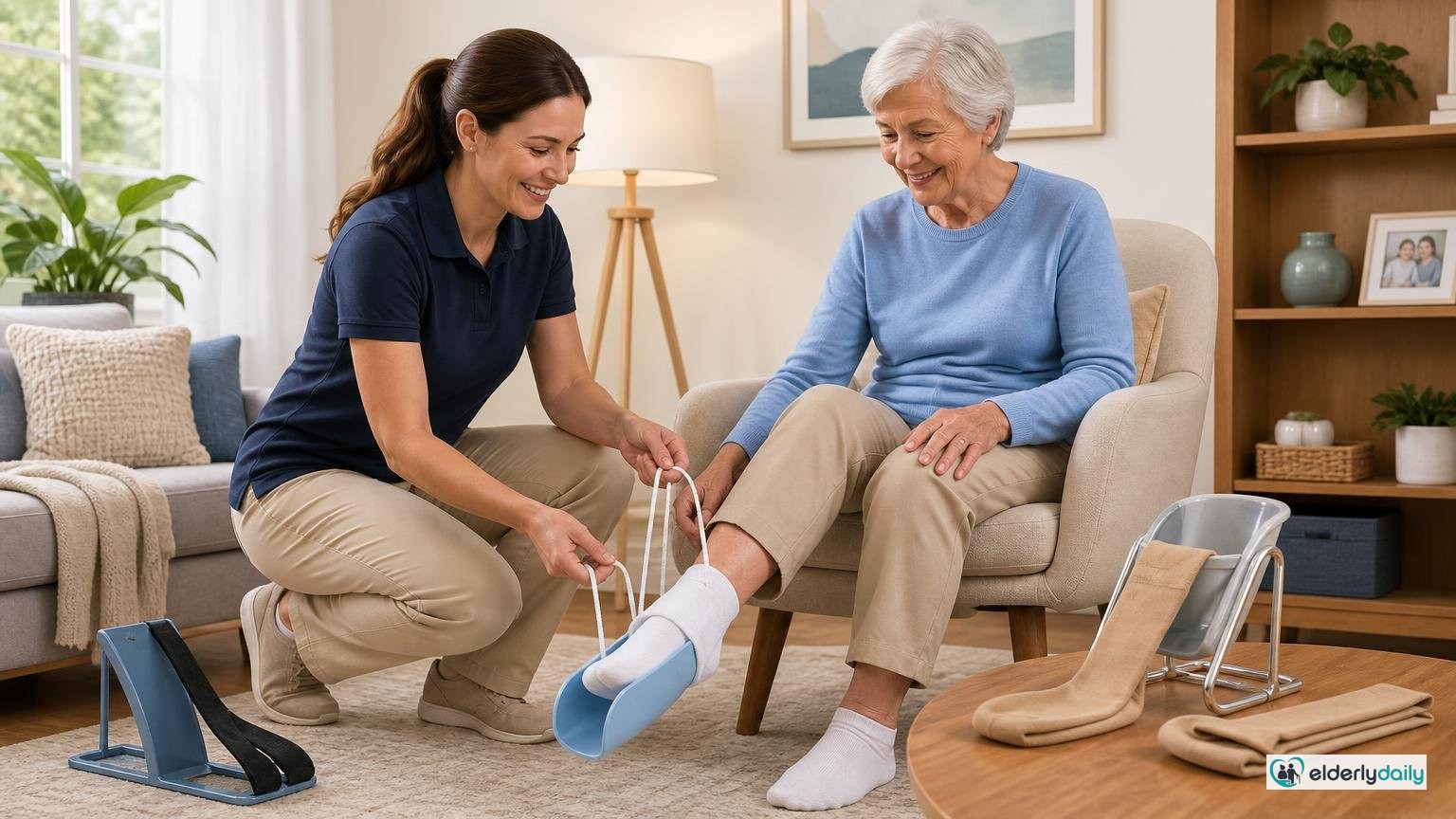
Both put a sock on a foot you cannot reach. They ask completely different things of your hands, which is the only question that matters — and if the socks in question are medical compression, neither may be the right answer.
Key takeaways
- A sock aid is a flexible cradle you pull up with cords — it needs a decent grip and a pull.
- A sock slider is a rigid frame you step into — far less demanding on the hands, which is why it suits severe arthritis.
- For medical-grade compression stockings, neither is really the tool. Those need a metal stocking donner, which is a third product category.
- Pulling a compression stocking on by hand shortens its life — overstretching causes runs and loses the therapeutic pressure you are paying for.
- Whichever you choose, the sizing and the technique matter more than the brand.
Quick answer
Is a sock aid or a sock slider better for seniors?
It depends on the hands, not the socks. A sock aid needs enough grip to hold two cords and enough strength to pull — fine for most people, hard with severe arthritis. A sock slider is a rigid frame you push your foot into, so it asks almost nothing of the hands. If the person is putting on medical compression stockings, look at a dedicated stocking donner instead: a standard sock aid is built for ordinary socks and light compression.
The question is what your hands can do
Both devices solve the same problem: getting a sock onto a foot you cannot comfortably reach. They differ in what they ask of you to do it, and that is the whole decision.
| Sock aid | Sock slider | |
|---|---|---|
| Shape | Flexible cradle with two cords | Rigid frame that sits on the floor |
| What you do | Pull the cords upward | Push your foot down through it |
| Demands on the hands | Grip and a sustained pull | Very little |
| Suits | Most people with reasonable grip | Severe arthritis, weak hands, poor grip |
| Portability | Light, packs flat | Bulkier, tends to stay at home |
| Regular socks | Yes | Yes |
| Medical compression | Light compression only | Varies by model |
How each one actually works
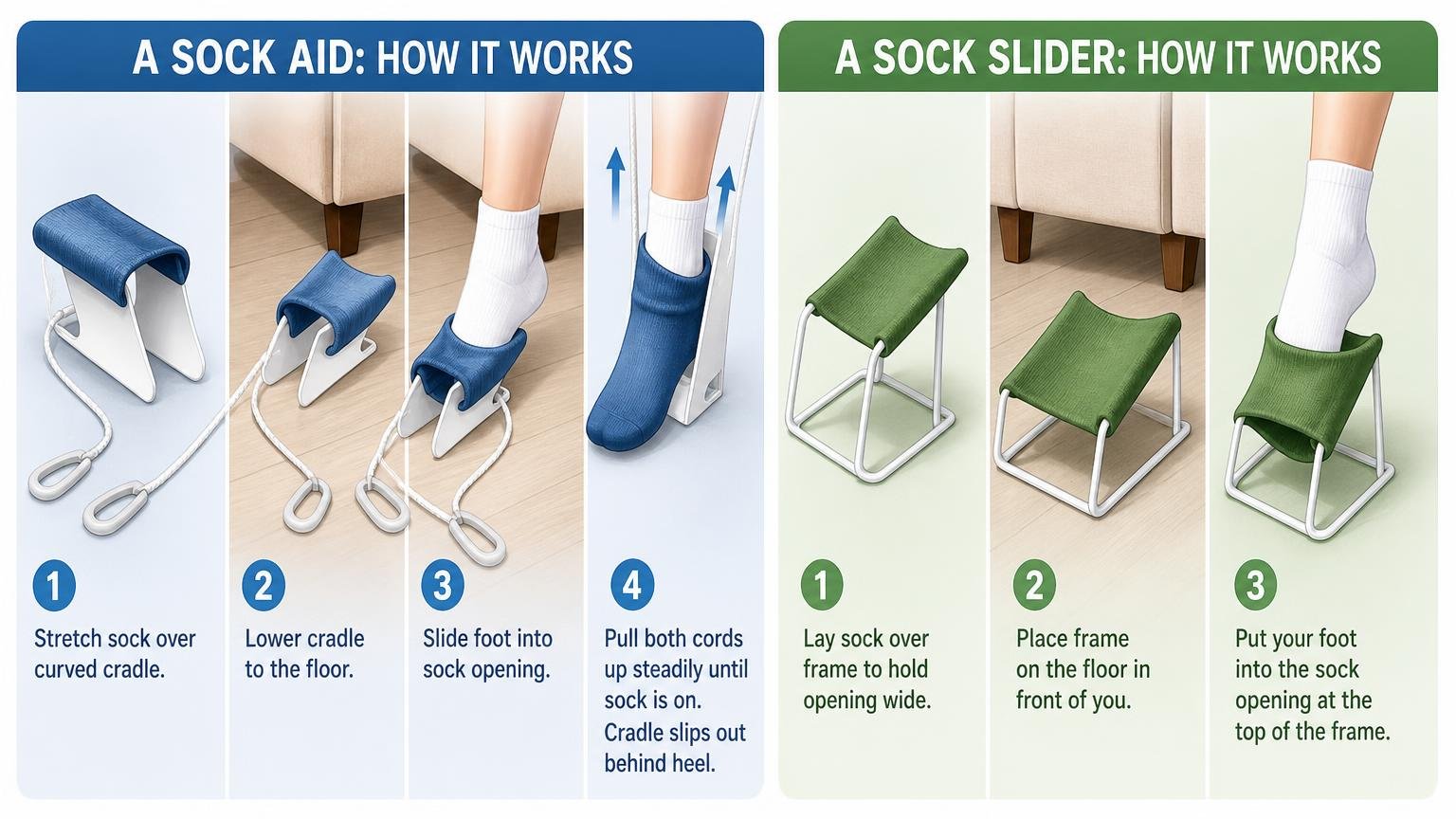
A sock aid, step by step: stretch the sock over the curved plastic or fabric cradle so the opening stays wide; lower the cradle to the floor using the attached cords; slide your foot into the sock opening; then pull both cords steadily upward until the sock is on and the cradle slips out behind your heel.
A sock slider, step by step: lay the sock over the frame so the opening is held wide; place the frame on the floor in front of you; put your foot into the sock opening at the top of the frame; then push your foot down through the frame, which slides the sock on and leaves the frame behind.
Read those two descriptions again and the difference is obvious: one ends with a pull, the other with a push. If pulling is the part that hurts, no amount of choosing between brands of sock aid will fix it.
Good to know
Try the movement before you buy. Sit down, hold two shoelaces and pull them steadily upward for a few seconds. If that is uncomfortable, a sock aid will be uncomfortable every morning — and a slider almost certainly suits you better.
Choose a sock aid if
- You have reasonable grip and coordination — enough to hold two cords and pull.
- You mostly wear ordinary socks, or light compression.
- You want something portable that packs flat for travel or a hospital bag.
- You want the cheaper of the two, in most cases.
- You would rather have something small that lives in a drawer than a frame on the bedroom floor.
If a sock aid is the right shape but the cords are the problem, look for wide foam grip handles rather than thin braided loops. That one feature makes a large difference to arthritic hands, and it costs very little more.
Choose a sock slider if
- Severe arthritis, or hands that will not grip reliably. This is the main reason sliders exist.
- You have very limited hand or wrist strength after a stroke or with a neurological condition.
- You want the simplest possible motion — one downward push, nothing to coordinate.
- The device will live in one place, so bulk does not matter.
A slider takes up more room and travels less well. In exchange it removes the pulling motion entirely, which for the right person is the difference between dressing independently and needing help every morning.
If the socks are medical compression, look at a third device
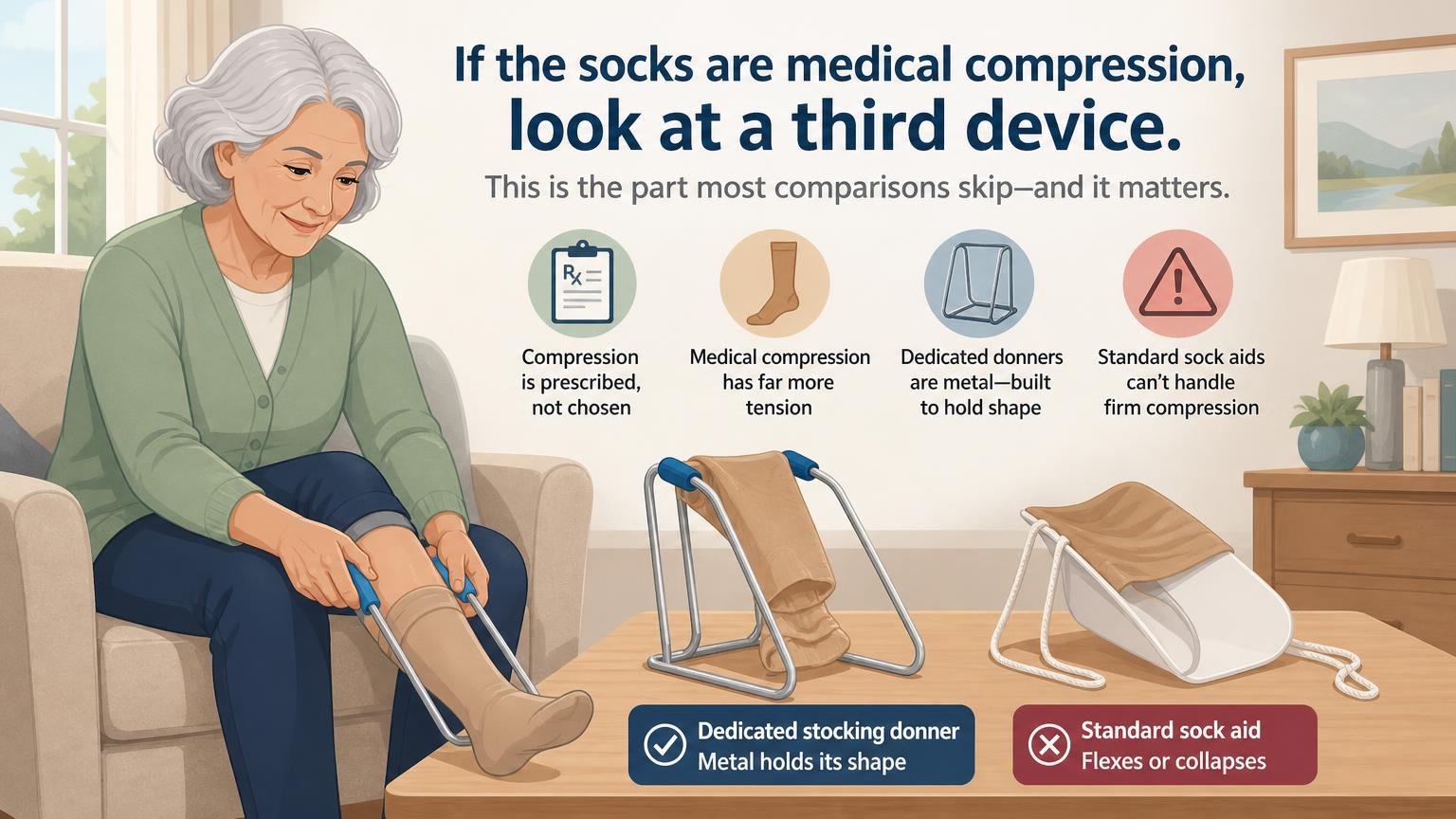
This is the part most comparisons skip, and it matters because compression stockings are prescribed rather than chosen.
Standard sock aids are thin, flexible plastic designed around ordinary socks and light compression. Medical-grade compression garments exert far more tension than that, which is why dedicated stocking donners are built from metal rather than plastic — they have to hold their shape against the garment. Try to put a firm compression stocking onto a standard sock aid and the usual result is the stocking sliding off the aid, or the aid flexing out of shape.
There is a second reason to use the right tool, and it is financial as much as clinical. Pulling a compression stocking on by hand concentrates all the force wherever your fingers happen to be gripping. Repeated overstretching causes runs and gradually reduces the pressure the garment delivers — which is the whole point of wearing it. Spreading that tension across a frame is gentler on the fabric and makes an expensive pair last longer.
If compression stockings are what you are dressing in each morning, start with our sock aids for compression stockings review rather than choosing between the two devices on this page.
Watch out
A bunched or twisted compression stocking creates pressure points instead of even compression, which is worse than not wearing it properly. Whatever device you use, check the heel is seated and the fabric is smooth before you stand up.
Sizing and technique matter more than brand
Most disappointment with these devices comes from fit and method rather than from the product.
- Match the aid to the sock. A cradle sized for thin dress socks will fight a thick winter one. If both are worn, that may mean two devices, or one sized for the thicker sock.
- Check the cord length against your height. Cords that are too short mean leaning forward, which is exactly what the aid was bought to avoid.
- Sit in a stable chair with arms. Doing this perched on a bed edge is how people end up on the floor.
- Do not rush the heel. Most failures happen there — the sock catches, the person tugs, and the aid comes away with the sock half on.
- Expect a learning curve. An occupational therapist will usually run through it once, and one demonstration saves a fortnight of frustration.
The bottom line
If your hands work reasonably well, buy a sock aid. It is cheaper, packs flat, and does the job for ordinary socks.
If gripping and pulling is the problem, buy a sock slider. That is precisely what it is for, and no sock aid will get around it.
If the socks are medical compression, buy neither of these first. Look at a proper stocking donner — a different product, built in metal for a reason.
And if reaching your feet is not actually the difficulty, none of these is your answer. Our dressing aids review covers the wider set of tools for getting dressed with limited strength or reach.
Frequently asked questions
What is the difference between a sock aid and a sock slider?
A sock aid is a flexible plastic or fabric cradle with two long cords. You stretch the sock over it, lower it to the floor, put your foot in and pull the cords to draw the sock on. A sock slider is a rigid frame that holds the sock open at floor level; you push your foot down through it and the frame stays behind. The sock aid asks for grip and a pull; the slider asks for a downward push.
Which is better for arthritis?
Usually the slider. Gripping two cords and pulling steadily is exactly the movement that hurts with arthritic hands and weak wrists. A slider replaces that pull with a downward push through the leg, which most people can manage even when their hands cannot. If a sock aid is still preferred, choose one with wide foam grips rather than thin cord loops.
Can I use a sock aid for compression stockings?
For light compression, often yes. For medical-grade compression, usually not well. Standard sock aids are thin flexible plastic built for ordinary socks; medical compression exerts far more tension and needs a sturdier frame, which is why dedicated stocking donners are made of metal. Using the wrong tool tends to end with the stocking sliding off the aid, or the aid bending.
Does using an aid make compression stockings last longer?
It generally helps. Pulling a compression garment on by hand concentrates the force in whatever your fingers are gripping, and repeated overstretching causes runs and gradually reduces the pressure the stocking delivers. Spreading the tension over a frame is gentler on the fabric. Given what a pair of medical stockings costs, that is not a trivial consideration.
Do I need donning gloves as well?
They are worth trying if you are handling compression garments. Textured rubber gloves give enough grip to position the heel and smooth out wrinkles without catching the fabric with a fingernail. Wrinkles matter: a bunched stocking creates pressure points instead of even compression.
Will either help with removing socks?
Not usually, and this is worth knowing before you buy. Most sock aids and sliders are for putting socks on. Taking them off is a separate problem with separate tools — look for a long-handled sock or stocking remover, sometimes sold as part of a dressing kit.
Are these worth it if someone can still reach their feet?
Probably not. These aids solve the problem of not being able to reach — after a hip replacement, with a back that will not bend, with significant hip or knee pain. If reach is fine and only the grip is failing, a different set of tools helps more. Our dressing aids review covers the wider set.
