
6 Best Air Purifiers for COPD and Asthma
 By SK Kutubuddin, Founder & Senior Care Researcher Updated October 2026
In this guide
 Best Overall for a BedroomLevoit Core 300-P True HEPA Air Purifier
 Best for the Living RoomCoway Airmega Mighty2 (AP-1512N)
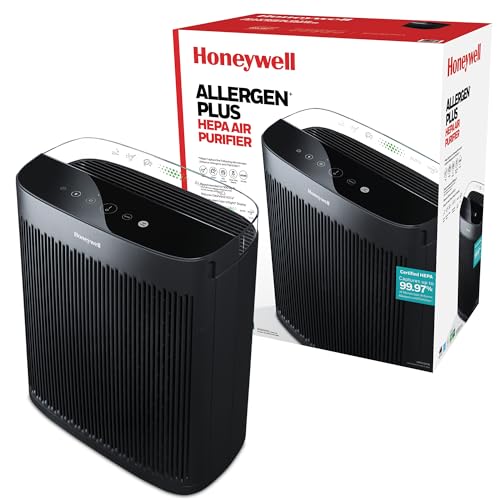 Best for Large RoomsHoneywell InSight HEPA Air Purifier (HPA5300B)
 Best Certified Zero-OzoneDaikin MCB50YSAU Room Air Purifier
 Best Small and SimpleBlueair Blue Pure Mini Max
 Best with Voice and App ControlLevoit Core 200S-P Smart Air Purifier
- What to look for
- Frequently asked questions
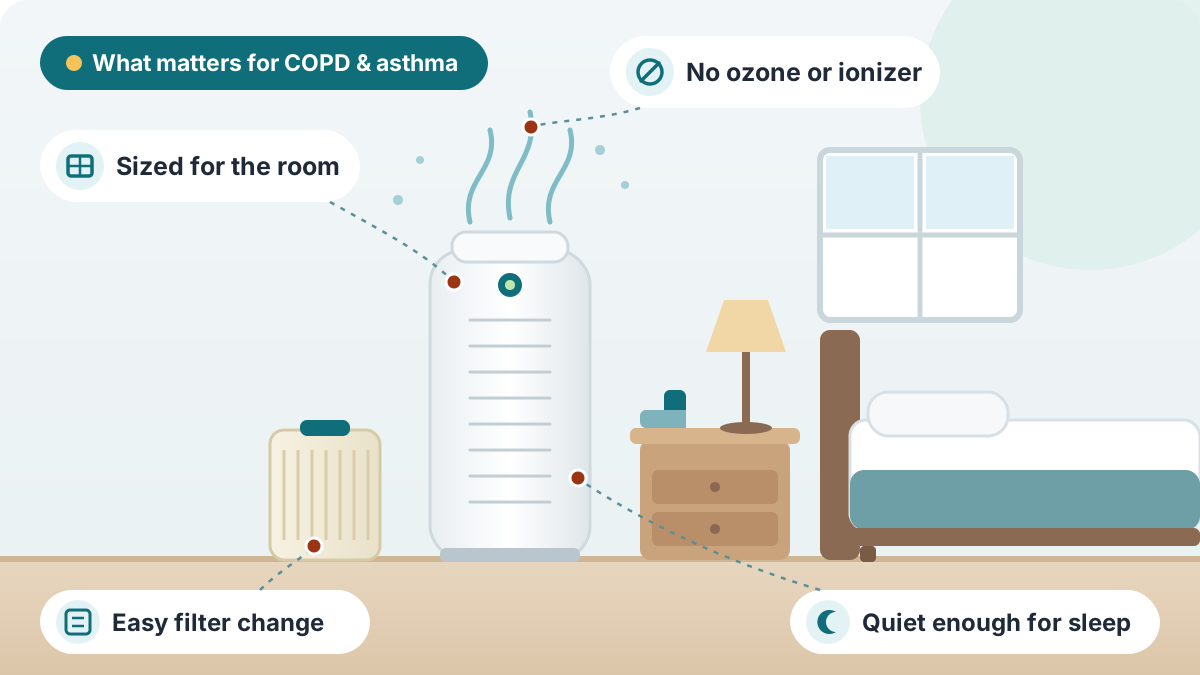
For an older adult with COPD or asthma, the right air purifier filters the air with a HEPA filter, adds nothing to it (no ozone, ionizer or scent), is sized for the room by its clean air delivery rate, and is quiet enough to run day and night.
We may earn a commission when you buy through links on this page. Read our affiliate disclosure.
On sale now

iHealth Rechargeable Bluetooth Fingertip Pulse Oximeter with…
$25.49-36%
Prices from Amazon as of Oct 26, 11:15 AM ET. They can change; the price on Amazon when you buy is the one that applies. Affiliate links — we may earn a commission.
Top 6 Picks — Find Your Situation
#1 · Best Overall for a Bedroom
Levoit Core 300-P True HEPA Air PurifierBest for: A bedroom of up to about 220 sq ft, run all night
#2 · Best for the Living Room
Coway Airmega Mighty2 (AP-1512N)Best for: A living room or open-plan area of up to about 360 sq ft
#3 · Best for Large Rooms
Honeywell InSight HEPA Air Purifier (HPA5300B)Best for: A large living room of up to 500 sq ft
#4 · Best Certified Zero-Ozone
Daikin MCB50YSAU Room Air PurifierBest for: Anyone who wants third-party proof of zero ozone
#5 · Best Small and Simple
Blueair Blue Pure Mini MaxBest for: A small bedroom or study, with the simplest controls
#6 · Best with Voice and App Control
Levoit Core 200S-P Smart Air PurifierBest for: A small bedroom, with family checking filter life remotely
Our overall pick, the Levoit Core 300-P, does exactly that for a bedroom. For a living room, the Coway Airmega Mighty2 adds an automatic laser sensor and, unlike the older model, no ionizer; for a large room, the Honeywell InSight HPA5300B. If you want third-party proof of zero ozone, the Daikin MCB50YSAU; for one-button simplicity in a small room, the Blueair Mini Max; and for voice and app control, the Levoit Core 200S-P. A purifier works alongside inhalers and the care plan, never instead of them.
A closer look at our top pick
Levoit Core 300-P True HEPA Air Purifier
Best for: A bedroom of up to about 220 sq ft, run all night
- Room size
- 222 sq ft at 4.8 air changes/hr (AHAM)
- Quietest
- 24 dB (sleep mode)
- Ozone/ionizer
- No ionizer, UV or scent listed; CARB compliant
- Controls
- Touch panel, 2-8 h timer, display off
Independently researched · Updated October 2026
The Levoit Core 300-P does the basics right for an older adult with COPD or asthma. Its CADR is AHAM-verified (143 smoke, 153 dust, 167 pollen), so the 222 sq ft room size at 4.8 air changes an hour is a tested figure, not a marketing one. It cleans with a HEPA-grade filter alone, with no ionizer, UV lamp or scent, and Levoit lists it as CARB compliant.
It is also easy to live with: 24 dB in sleep mode with the display fully off, a 2 to 8-hour timer, a filter-change light, and a weight of 7.9 lb that most people can carry from the bedroom to the living room. That matters, because the CLEAN AIR trial found the benefit went to people who kept their purifiers running.
What we love
- AHAM-verified CADR, so the room size claim is tested
- Filter-only cleaning: nothing added to the air
- 24 dB sleep mode with the lights fully off
- Light enough to carry between rooms
Things to consider
- Too small for an open-plan living room (see the Coway or Honeywell)
- No automatic air quality sensor: you choose the speed
- Use genuine Levoit filters; cheaper copies may not seal or filter as well
Right for you if
- ✓A bedroom of up to about 220 sq ft
- ✓You want a filter-only purifier with nothing added to the air
- ✓You will run it all night
Maybe skip it if
- !A large or open-plan living room: choose the Coway Mighty2 or Honeywell HPA5300B
- !You want it to adjust itself automatically: it has no air quality sensor
- !You want a product tested hands-on; we research listings and published evidence, and we say so
Getting started
- →Remove the plastic bag from the filter before first use
- →Place it a foot or more from walls and furniture, near the bed but not blowing on the face
- →Run it on high for 30 minutes when you get home, then on sleep mode overnight
- →Note the date of the first filter change on the base
How it compares
Our #2 pick, the Coway Airmega Mighty2, covers a bigger room (about 360 sq ft by the two-thirds rule) and has a laser air quality sensor that adjusts the fan by itself, but it weighs almost twice as much. Choose the Levoit for a bedroom, the Coway for a living room.
How we picked
We compared 13 options. We considered 48 air purifiers and filters from Amazon searches for HEPA purifiers for allergies, asthma, smoke and large rooms, and for the brands people search by name (Levoit, Coway, Honeywell, Blueair, Winix, Medify and others), and shortlisted 13. We judged them on what matters for lungs that are already struggling: true HEPA or HEPA-grade filtration, no ozone, ionizer or added scent, an AHAM-verified clean air delivery rate matched to real room sizes, quiet night-time running, and controls and filters an older adult can manage. Every product detail comes from the product's own Amazon listing, pulled through Amazon's product API on 26 October 2026, checked against the California Air Resources Board's certified list where relevant. Health guidance draws on the CLEAN AIR trial in COPD, the U.S. asthma guidelines, ENERGY STAR and EPA guidance, and CARB's ozone rules, cited where they appear. We did not test these purifiers hands-on.
Reviewed by SK Kutubuddin — who researches senior-care products and the real-world needs of caregivers and older adults.
Other picks, reviewed
Coway Airmega Mighty2 (AP-1512N)
The new version of a long-time favourite, and an important change for anyone with lung disease: the older Mighty (AP-1512HH) lists a "Bipolar Device" (an ionizer) among its filter stages, while the Mighty2 lists a washable pre-filter and a combined HEPA and carbon filter only, and the California Air Resources Board lists the AP-1512N as a mechanical (filter-only) air cleaner. Its CADR is 240 for smoke, 242 for dust and 249 for pollen, enough for a room of roughly 360 sq ft by the usual rule of thumb. A laser sensor reads PM1, PM2.5 and PM10 and shows the number and a colour, Smart Mode turns the fan up and down on its own, and a light sensor drops it to 19 dB when the room goes dark. Coway gives a 3-year limited warranty.
What we like
- Auto mode reacts to cooking smoke and dust without anyone pressing buttons
- Clear number and colour air quality display
- No ionizer, unlike the older Mighty
- 3-year warranty
Keep in mind
- Make sure you buy the Mighty2 (AP-1512N), not the older AP-1512HH
- At 15.2 lb it is better left in one room
- "Wirecutter's top pick" in the listing refers to the earlier model
- Room size
- About 360 sq ft (CADR 240 smoke)
- Quietest
- 19 dB (sleep mode)
- Ozone/ionizer
- Filter only (CARB: mechanical)
- Controls
- Smart Mode with laser PM2.5 sensor
- Weight
- 15.2 lb, hidden handles
Honeywell InSight HEPA Air Purifier (HPA5300B)
For a big family room, or a parent who spends the day in one large living space, the HPA5300B covers 500 sq ft at 4.8 air changes an hour, the rate AHAM room-size ratings are based on, and that figure is AHAM-verified. It uses HEPA filters with a carbon pre-filter for odours, and the listing names no ionizer. An air quality indicator and auto mode adjust the fan on their own, and Honeywell gives a 5-year limited warranty, the longest here.
What we like
- Covers the largest room of any pick
- Auto mode with an air quality indicator
- 5-year limited warranty
- Sold by Amazon
Keep in mind
- Heavy at 20.5 lb: put it in place once
- No published sleep-mode noise figure
- Uses separate HEPA filters and pre-filters, so two parts to keep in stock
- Room size
- 500 sq ft at 4.8 air changes/hr (AHAM)
- Quietest
- Not stated in the listing
- Ozone/ionizer
- HEPA + carbon pre-filter; no ionizer listed
- Controls
- Auto mode, air quality indicator
- Weight
- 20.5 lb
Daikin MCB50YSAU Room Air Purifier
For the most cautious households, Daikin states this purifier is AHAM Verified, CARB certified and Zero Ozone Product certified, three separate checks. It covers 245 sq ft at 4.8 air changes an hour with pre-filters, a HEPA filter and a carbon filter. Its UV-C LED shines inside the machine on the trapped particles, not into the room. Dust and odour sensors adjust it automatically, the quiet mode runs at 21 dB, and side handles make it easier to move.
What we like
- Three certifications stated: AHAM, CARB and Zero Ozone
- Automatic dust and odour sensors
- 21 dB quiet mode
- Side handles
Keep in mind
- Sold by Daikin Comfort, not Amazon, so check the returns policy
- The UV-C light adds a part, though not a needed one
- Formaldehyde claim (up to 50.3%) is the maker's own figure
- Room size
- 245 sq ft at 4.8 air changes/hr (AHAM)
- Quietest
- 21 dB (quiet mode)
- Ozone/ionizer
- Zero Ozone certified; CARB certified
- Controls
- Dust and odour sensors, digital display
- Weight
- 15 lb, side handles
Blueair Blue Pure Mini Max
The simplest purifier here to live with. At 2.7 lb it sits on a nightstand or desk and is easy to lift, and simple one-touch controls run three speeds and a night mode, with an auto sensor that adjusts the fan. It runs as quietly as 19 dB, and the washable fabric pre-filter slips off for a rinse. Blueair says all its purifiers are CARB certified. The trade-off is size: it is rated for a small room of 105 sq ft at 4.8 air changes an hour.
What we like
- Simple one-touch controls
- Light enough for anyone to lift
- Auto sensor and 19 dB quietest setting
- Washable fabric pre-filter
Keep in mind
- Only for small rooms
- Not enough for a living room or a large bedroom
- The "bacteria and viruses" claim refers to particles caught by the filter, not a medical effect
- Room size
- 105 sq ft at 4.8 air changes/hr
- Quietest
- 19 dB
- Ozone/ionizer
- CARB certified (per Blueair)
- Controls
- One-touch controls, auto sensor
- Weight
- 2.7 lb
Levoit Core 200S-P Smart Air Purifier
For a parent who already talks to a voice assistant, voice control means no bending to a control panel, and the Levoit app lets a family member check from anywhere that the purifier is on and how much filter life is left. It is AHAM Verifide for a 140 sq ft room at 4.8 air changes an hour, runs as low as 27 dB, has a button to turn off all the lights, and uses a pre-filter, carbon filter and HEPA-grade main filter, with no ionizer listed.
What we like
- Voice control: no buttons to reach
- Family can check filter life in the app
- Display-off button for sleep
- Sold by Amazon
Keep in mind
- Small-room capacity only
- App and voice need home Wi-Fi set up
- Louder at its quietest than the Core 300-P
- Room size
- 140 sq ft at 4.8 air changes/hr (AHAM)
- Quietest
- 27 dB
- Ozone/ionizer
- No ionizer, UV or scent listed
- Controls
- Panel, app and voice control
- Weight
- 6.6 lb
What to look for
Size it by CADR, not the box's biggest number
The clean air delivery rate (CADR) is how much filtered air a purifier delivers, measured in cubic feet per minute and verified by AHAM, the appliance makers' association. ENERGY STAR's rule of thumb is a CADR of at least two-thirds of the room's floor area: a 12 x 15 ft bedroom (180 sq ft) needs a smoke CADR of at least 120. Use the smoke figure, because smoke particles are the smallest and hardest to catch.
Ignore headline claims like "up to 1,800 sq ft": those usually mean one air change an hour, too slow for anyone with breathing problems. The useful figure is the room size at 4.8 air changes an hour (every 12.5 minutes), which most of our picks state. When in doubt, buy a size up and run it on a lower, quieter speed.
Avoid ozone, ionizers and scents
Ozone is a lung irritant. Even small amounts can cause chest pain, coughing and shortness of breath, as ENERGY STAR notes from EPA guidance, and people with asthma or COPD are among the most sensitive. Never use an "ozone generator" sold as an air cleaner.
- Ionizers, plasma, electrostatic precipitators, photocatalytic (PCO) and some UV devices can produce ozone or other by-products. California's Air Resources Board (CARB) classes them as "electronic" air cleaners and certifies them only if ozone stays at or below 0.050 ppm (50 ppb)
- Filter-only ("mechanical") purifiers like our Coway and Levoit picks clean by passing air through filters and do not produce ozone
- If a purifier has an ionizer switch, keep it off. Several popular models include one, including the older Coway Mighty AP-1512HH and the Medify MA-40, whose ionizer is optional
- Skip scent cartridges and aroma pads. Fragrances are a common asthma trigger; a purifier should take things out of the air, not add them
Quiet enough to keep running
In the CLEAN AIR trial (below), people who ran their purifiers more than 80% of the time benefited most. A purifier that is switched off because it is noisy does nothing, so look for 25 dB or lower on the quietest setting for the bedroom, and lights that switch off. Auto mode, as on our Coway, Honeywell, Daikin and Blueair picks, lets the purifier speed up when someone cooks or dusts and slow down when the air is clean, without anyone pressing a button.
Filters an older adult can manage
- A filter-change light or an app reminder, because a clogged filter quietly stops working
- Genuine replacement filters: cheaper copies may not seal or filter as well
- Filters that twist or slide out without tools; ask a family member to do the first change together
- A washable pre-filter to vacuum or rinse every few weeks, which keeps the main filter working longer
- Budget for filters: most need replacing every 6 to 12 months, sooner in smoky or dusty homes
Read more:Dementia Daily Routine for CaregiversPreventing Hospital Readmission in SeniorsSenior Living Alone Safety Checklist
Do air purifiers help COPD and asthma? What the research shows
COPD. The best evidence comes from the CLEAN AIR trial at Johns Hopkins (Hansel and colleagues, American Journal of Respiratory and Critical Care Medicine, 2022). 116 former smokers with moderate to severe COPD were given either two real HEPA and carbon air cleaners or two identical-looking sham machines for six months. The real purifiers did not improve overall quality-of-life scores, but they did reduce moderate flare-ups (exacerbations needing steroids, antibiotics or an urgent visit; relative risk 0.32) and rescue inhaler use. Benefits were greatest in those with the weakest lungs and in those who ran the purifiers more than 80% of the time.
Asthma. HEPA purifiers reliably lower airborne particles, but improvements in symptoms are modest and less consistent. The 2020 U.S. asthma guidelines (National Asthma Education and Prevention Program) advise that for people allergic to an indoor allergen such as dust mites, pets or mould, reduction works best as a multi-part plan (for example, mattress covers, cleaning and a HEPA purifier together) rather than one product on its own.
The bottom line: a HEPA purifier is a sensible, low-risk addition for an older adult with COPD or asthma, especially in a smoky, dusty or wildfire-affected home. It does not replace prescribed inhalers, a COPD or asthma action plan, pulmonary rehabilitation, vaccinations or removing the source of the problem.
Source control comes first
A purifier cleans the air in one room, but stopping pollution at the source does more:
- No smoking indoors, by anyone, and no wood stoves or candles in the room the purifier is in
- Use the kitchen extractor fan when cooking, especially on a gas hob
- Keep humidity between 30% and 50% to discourage dust mites and mould
- Wash bedding weekly in hot water and use allergen covers on mattresses and pillows if dust mites are a trigger
- Avoid sprays, air fresheners and strong cleaning products around anyone with lung disease
- On wildfire smoke days, keep windows closed, run the purifier on high and check the local air quality at airnow.gov
Can I use FSA or HSA money?
Often, yes, with paperwork. Air purifiers are "dual-purpose" items, so plans such as FSAFEDS reimburse them only with a letter of medical necessity from a doctor that names the medical condition (such as COPD or asthma), the recommended treatment and how long it is needed, plus an itemised receipt. Some listings, like Shark's, say a purifier "may be eligible", but the decision is your plan administrator's. Ask the doctor for the letter at the next visit and check with the plan before buying.
Frequently asked questions
They can. In the CLEAN AIR trial, former smokers with moderate to severe COPD who had real HEPA purifiers at home for six months had fewer moderate flare-ups and used their rescue inhalers less than those with sham machines, especially when the purifiers ran more than 80% of the time. Overall quality-of-life scores did not change.
A HEPA purifier with no ozone or ionizer, sized for the room by its CADR and quiet enough to run day and night. Our picks are the Levoit Core 300-P for a bedroom, the Coway Airmega Mighty2 for a living room and the Honeywell InSight HPA5300B for a large room.
They are best avoided. Ionizers and other electronic air cleaners can produce ozone, which irritates the lungs. California certifies them only if ozone stays at or below 0.050 ppm, but filter-only HEPA purifiers produce none. If a purifier has an ionizer switch, keep it off.
Choose a smoke CADR of at least two-thirds of the room's floor area: at least 120 for a 180 sq ft bedroom. Better still, use the room size the maker states at 4.8 air changes an hour.
Yes, for lung disease. The CLEAN AIR trial found the greatest benefit in people who ran their purifiers more than 80% of the time. Use auto or sleep mode to keep it quiet.
In the room where they spend the most hours, usually the bedroom, a foot or more from walls and furniture, with nothing blocking the intake. Add a second purifier for the living room rather than moving one around.
Usually only with a letter of medical necessity from a doctor naming the condition, because air purifiers are dual-purpose items. Check with your plan administrator before buying.
Yes. A HEPA purifier sized for the room lowers fine smoke particles indoors, which matters most for older adults with heart or lung disease. Keep windows closed and run it on high on smoky days.
Follow the filter light or the maker's guidance, typically every 6 to 12 months, and sooner in smoky, dusty or pet-filled homes. Wash or vacuum any pre-filter every few weeks.
No. A purifier reduces some triggers in one room. It does not treat COPD or asthma, so keep using prescribed medicines and the action plan from the doctor.
The final verdict
For most older adults with COPD or asthma, start with the Levoit Core 300-P in the bedroom: AHAM-verified HEPA filtration, no ionizer and a 24 dB sleep mode. For a living room, choose the Coway Airmega Mighty2, with automatic sensing and no ionizer; for a large room, the Honeywell InSight HPA5300B; for certified zero ozone, the Daikin MCB50YSAU; for one-button simplicity, the Blueair Mini Max; and for voice and app control, the Levoit Core 200S-P. Size it by CADR, keep any ionizer off, run it most of the day, change the filter on time, and keep using the treatment plan the doctor has set.
Our overall winner is the Levoit Core 300-P True HEPA Air Purifier. You can check the current price on Amazon.
Our Top 5 Picks at a Glance
Ready to choose? Here are the top 5 again.
Best Overall for a Bedroom
Levoit Core 300-P True HEPA Air Purifier
Best for the Living Room
Coway Airmega Mighty2 (AP-1512N)
Best for Large Rooms
Honeywell InSight HEPA Air Purifier (HPA5300B)
Best Certified Zero-Ozone
Daikin MCB50YSAU Room Air Purifier
Best Small and Simple
Blueair Blue Pure Mini Max
Affiliate links — we may earn a commission.
