
Printable Blood Sugar Log: Free Large Print Chart (PDF)

Educational only, not medical advice. Ranges and low blood sugar steps are taken from the CDC. Your own targets and plan come from your doctor.
A blood sugar log works best when it takes seconds to fill in. This free printable log has big boxes for readings before and after each meal and at bedtime, the CDC target ranges and low blood sugar steps on one page, and space for the plan your own doctor gives you. Type into it on screen, or print as many copies as you need.
Key takeaways
- Free printable blood sugar log in large print, 7 pages, with no sign-up.
- A weekly log with before and after columns for breakfast, lunch and dinner, plus bedtime, and a simple log with one reading per line.
- Fill it in on screen: click any box in the PDF and type, then save or print. Or print it blank and use a pen.
- Includes the CDC target ranges, the signs of low blood sugar and the 15-15 rule, with space for your own targets from your doctor.
- Comes in US Letter and A4, in color and black and white.
Quick answer
Where can I get a free printable blood sugar log?
Download it free here: the printable blood sugar log (PDF) has a weekly before-and-after-meals chart, a one-reading-per-line log, a page for your doctor, meter and medicines, and the CDC target ranges and low blood sugar steps, all in large print. You can type into the boxes on screen or print it. There are black-and-white and A4 editions too. No email or sign-up is needed.
Download the free blood sugar log
All four files have the same seven pages. Pick the paper size you use: US Letter in the US and Canada, A4 almost everywhere else.
- Blood Sugar Log, color, US Letter (PDF, 7 pages)
- Blood Sugar Log, black and white, US Letter (PDF, 7 pages)
- Blood Sugar Log, color, A4 (PDF, 7 pages)
- Blood Sugar Log, black and white, A4 (PDF, 7 pages)
You only need to print the pages you use. Most people print a weekly log page each week and keep the rest in a folder.
Filling it in on screen
Open the PDF in Chrome, Edge or Adobe Acrobat Reader, click any box and type. When you are done, download or save the file so your readings are kept, or print it. On a phone, Adobe Acrobat Reader works best.
An ElderlyDaily original
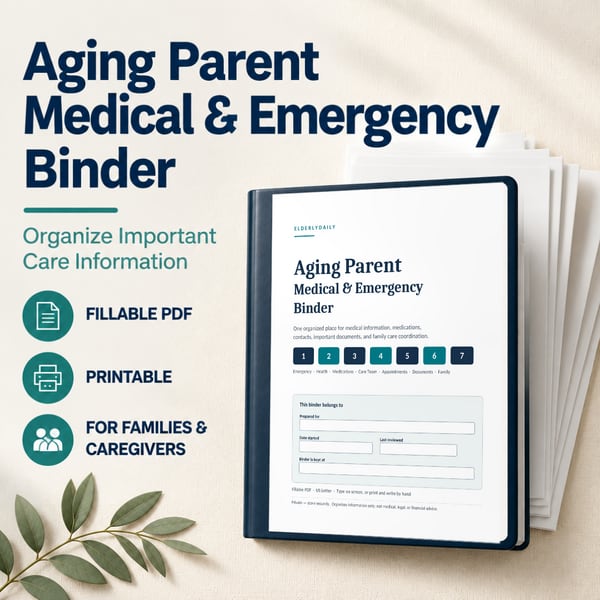
Want all of it in one organized binder?
Aging Parent Medical & Emergency Binder
- Medical history, medications and emergency contacts in one place
- Seven sections: emergency, health, medications, care team, appointments, documents and family
- Type into it on screen, or print it and fill it in by hand
One-off purchase. Instant download.
Fillable PDF · US Letter

Sponsored Pick
Greater Goods Bluetooth Blood Pressure Monitor
Budget-focused buyers who still want a clinically validated, easy-to-read monitor
Check PriceWhat is inside the log
- Page 1 — Cover.
- Page 2 — Understanding your numbers: the CDC target ranges with space for your own targets, the signs of low blood sugar, the 15-15 rule and what counts as 15 grams of carbs.
- Page 3 — How to check your blood sugar: the steps to follow every time.
- Page 4 — My details: your doctor, diabetes nurse, pharmacy, meter, when to check, your low blood sugar plan and your medicines.
- Pages 5 and 6 — Weekly log: Monday to Sunday, before and after breakfast, lunch and dinner, plus bedtime, with a small line for the time and a notes column.
- Page 7 — Simple log: one reading per line with the date, time, meal, medicine and notes.
Blood sugar target ranges
The CDC gives these ranges for most people with diabetes who are not pregnant. It adds that your own target range may be different, based on your age, health status and diabetes management plan, so write the targets your doctor gives you on page 2 and go by those.
| When | Target range |
|---|---|
| Before meals | 80 to 130 mg/dL |
| 1 to 2 hours after a meal | Below 180 mg/dL |
Low blood sugar: signs and the 15-15 rule
The CDC says blood sugar below 70 mg/dL is considered low. Common signs are a fast heartbeat, shaking, sweating, nervousness or anxiety, irritability or confusion, dizziness and hunger.
The CDC’s 15-15 rule for treating a low:
- 1
Have 15 grams of carbs
then wait 15 minutes.
- 2
Check your blood sugar again
and if it is still below 70 mg/dL, repeat.
- 3
Keep going until you are back in your target range
then eat a balanced snack or meal with protein and carbs.
Severe low blood sugar
Below 54 mg/dL is severe, and the person will often need someone to help. The CDC says injectable glucagon is the best treatment, and to contact a doctor for emergency treatment right after giving it. If someone passes out or cannot swallow safely, give nothing by mouth and call 911.
What counts as 15 grams of carbs
These examples are from the CDC. Keep one of them where you check your blood sugar.
- 4 ounces (1/2 cup) of juice or regular, non-diet soda
- 1 tablespoon of sugar, honey or syrup
- 3 to 4 glucose tablets (follow the label)
- 1 dose of glucose gel, usually 1 tube (follow the label)
- Hard candies, jellybeans or gumdrops (check the label for how many)
How to check your blood sugar with a meter
These steps follow the CDC’s guide to monitoring your blood sugar:
- 1
Make sure the meter is ready to use
charged, with strips that are in date.
- 2
Wash your hands with soap and warm water
and dry them well before every check.
- 3
Massage or shake out your hand
to get blood into your finger.
- 4
Prick your finger with the lancet
then gently squeeze from the base of the finger onto the strip.
- 5
Put the strip in the meter
and the reading appears after a few seconds.
- 6
Write the result in your log
with a note on anything that might have affected it.
- 7
Throw the lancet and strip away safely
and never share your equipment, even with family.
Making your log useful to your doctor
- Write exactly what the meter shows, rather than rounding.
- Use the notes column for anything that might explain a number: a late meal, a missed dose, illness, poor sleep or extra activity.
- Ask your doctor when and how often to check. The CDC says your doctor will tell you when and how often.
- Bring the log to every appointment, along with your meter if it stores readings.
- Never change or stop a medicine or insulin dose because of your readings without talking to your doctor first.
More free printables
See all 24 free printables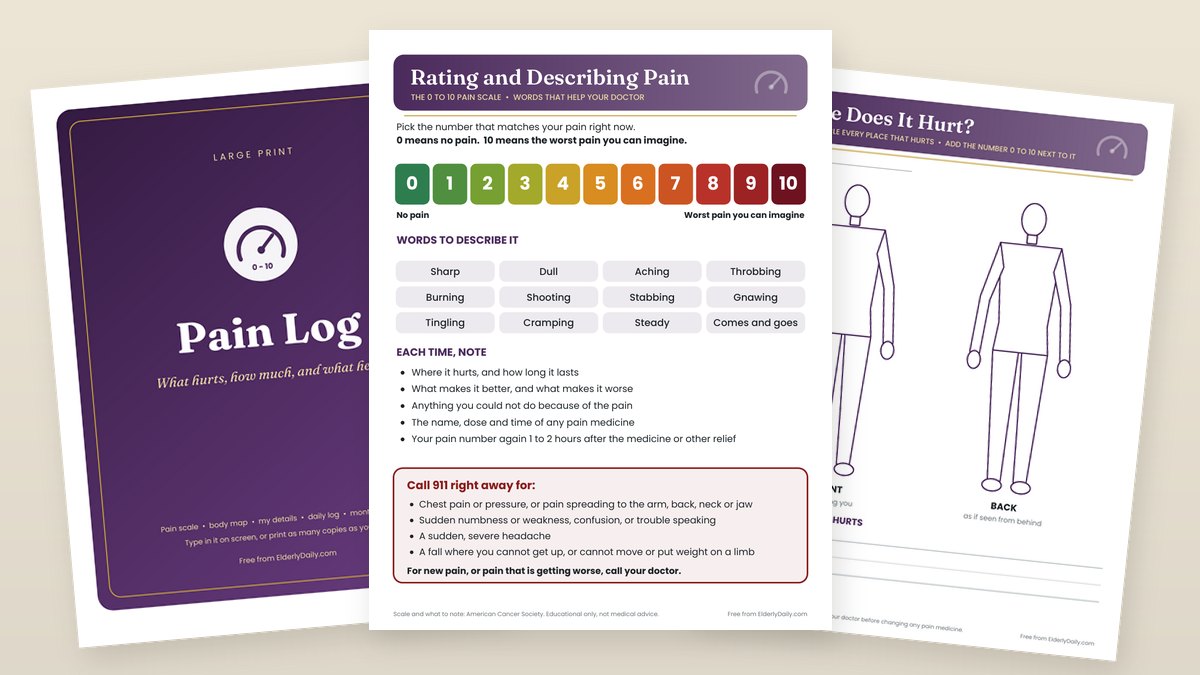 Pain LogA 0 to 10 pain scale, a body map, a daily pain diary and a monthly tracker to show your doctor.Free PDF, no sign-up
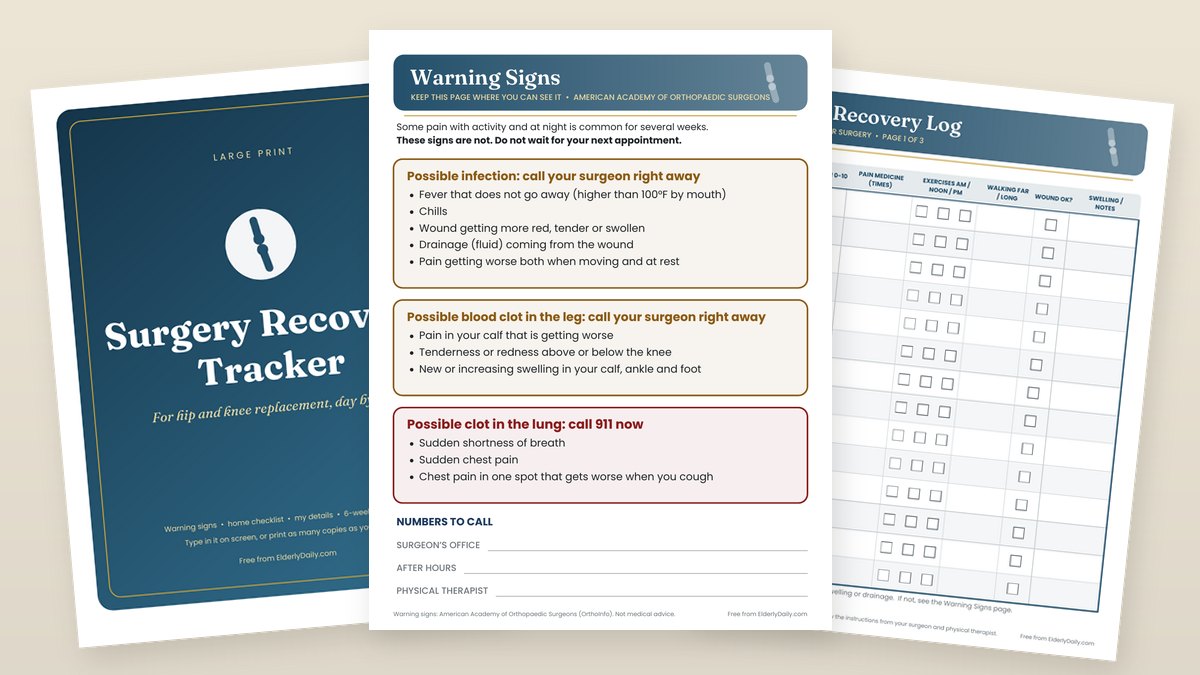 Surgery Recovery TrackerFor knee and hip replacement: warning signs, a home checklist and a 6-week daily log for pain, exercises and walking.Free PDF, no sign-up
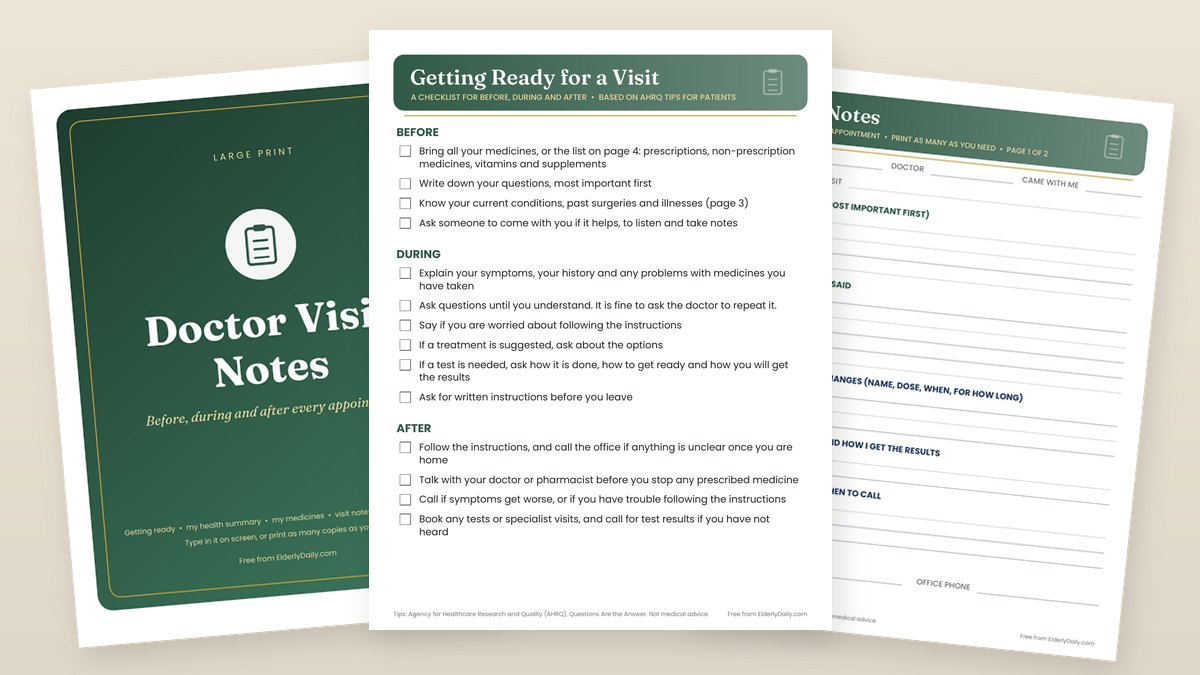 Doctor Visit NotesA before-and-after checklist, health summary, medicine list, visit notes pages and an appointment log.Free PDF, no sign-up
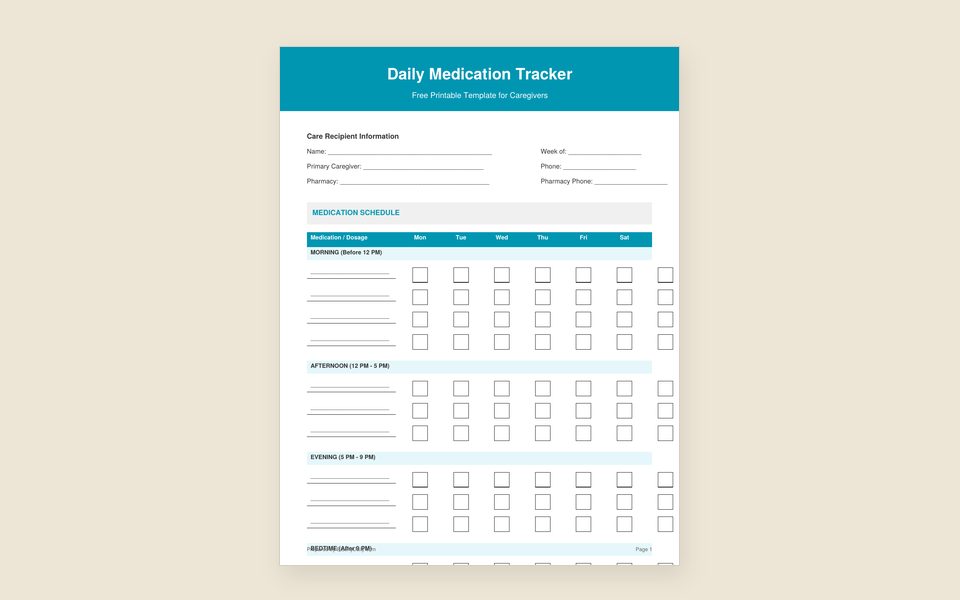 Daily Medication ChartMorning, afternoon and evening checkboxes that help prevent missed or double doses.Free PDF, no sign-up
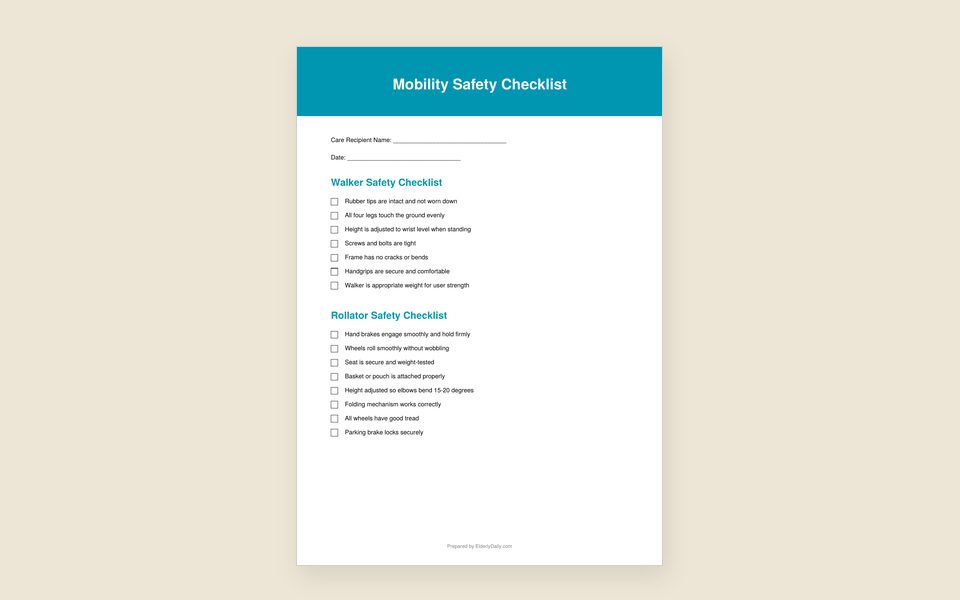 Mobility Safety ChecklistChecks for walkers, rollators, wheelchairs and safe walking around the home.Free PDF, no sign-up
 Emergency Binder TemplateMedications, doctors, allergies, insurance and safety plans, organized in one binder.Free PDF, no sign-up
Frequently asked questions
Is this blood sugar log really free?
Yes. All four PDFs download directly, with no email address, sign-up or payment. Print or fill in as many copies as you like for personal use.
Can I fill in the blood sugar log on my computer?
Yes. Open the PDF in Chrome, Edge or Adobe Acrobat Reader, click any box and type. Then download or save the file so your readings are kept. You can also print it blank and write by hand.
What is a normal blood sugar level for seniors?
The CDC gives 80 to 130 mg/dL before meals and below 180 mg/dL one to two hours after a meal for most people with diabetes who are not pregnant, but says your own target may be different based on your age, health and care plan. Older adults are often given their own targets, so write the ones your doctor gives you on page 2 and go by those.
When should I check my blood sugar?
Ask your doctor, because it depends on your diabetes, your medicines and whether you use insulin. The weekly log has a column for before and after each meal and at bedtime, so you can fill in whichever times your doctor asks for.
My meter shows mmol/L. Can I still use this log?
Yes. Write the numbers exactly as your meter shows them and note the unit at the top of the page. The CDC ranges printed on page 2 are in mg/dL, so use the targets your own doctor gives you instead.
